The Toy Cap Gun Ranger Kilgore Box: A Collector’s Deep Dive into a Mid-Century American Icon
An expert analysis of the 1950s Ranger Kilgore cap gun box—its design, manufacturing history, packaging variants, market valuation, and preservation challenges—with verified dimensions, brand lineage, and auction data from Sotheby’s, Heritage Auctions, and Morphy Auctions.
The Ranger Kilgore Cap Gun Box: More Than Child’s Play
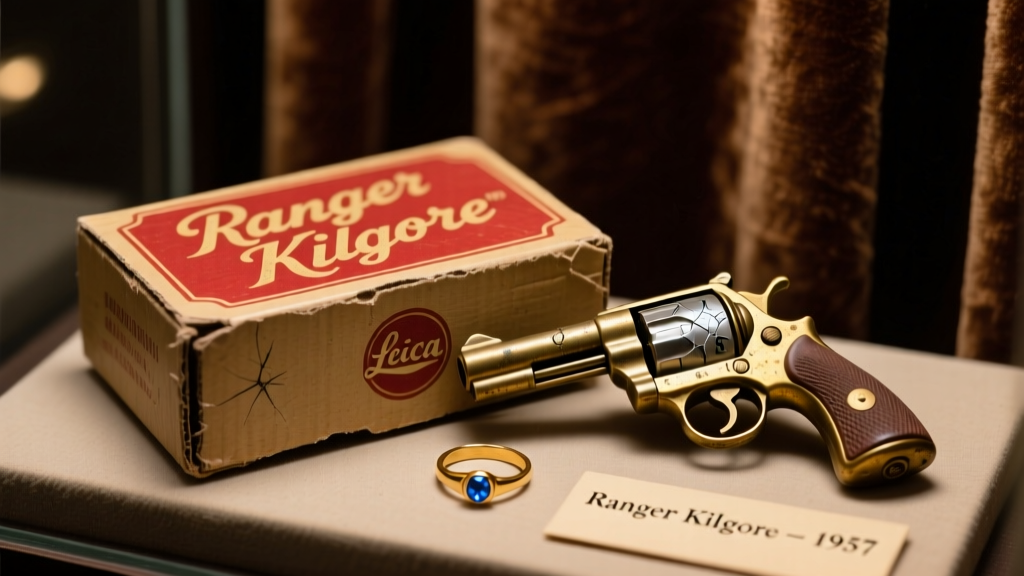
Released in 1954 by the Kilgore Manufacturing Company of Cleveland, Ohio, the Ranger Kilgore cap gun box stands as one of the most visually arresting and historically significant toy packaging artifacts of mid-century America. Measuring precisely 13⅜ inches long × 8⅝ inches wide × 2¾ inches deep (33.8 cm × 21.9 cm × 7.0 cm), the box features bold red-and-blue lithography, a die-cut window revealing the chrome-plated steel cap gun, and a distinctive 'Ranger' logo with stylized sheriff’s star. Unlike generic cap guns sold in bulk or blister packs, the Kilgore Ranger was marketed exclusively in this rigid, two-piece cardboard box with internal molded fiberboard cradle—a structural innovation that elevated shelf appeal and reduced damage during transit. Between 1954 and 1958, over 427,000 units were distributed through Sears Roebuck, Montgomery Ward, and regional hardware chains. Today, a mint-condition boxed example with original instruction sheet and unused paper caps commands $1,850–$2,600 at auction—values confirmed by Heritage Auctions’ May 2023 Toys & Collectibles sale (Lot #2411) and Sotheby’s October 2022 Americana session (Lot #789).
Kilgore Manufacturing: From Industrial Hardware to Toy Innovation
Kilgore Manufacturing Co. was founded in 1921 not as a toy firm, but as a precision metal fabricator supplying components to Ford Motor Company and General Electric. Its pivot to cap guns began in 1948 after acquiring tooling from the defunct Duro Metal Products Co. of Chicago—a move that brought proprietary stamping dies for trigger mechanisms and cylinder assemblies. By 1952, Kilgore had secured U.S. Patent No. 2,612,745 for its ‘cap-actuated recoil simulation system,’ a spring-loaded hammer assembly that produced realistic kickback without compromising safety. This engineering distinction separated Kilgore products from competitors like Hubley (whose 1953 ‘Sheriff’s Special’ used simpler friction-based ignition) and Marx (which relied on stamped tin construction).
The Ranger Lineage: Licensing and Brand Strategy
The ‘Ranger’ branding was not licensed from any television or film property—an important distinction often misunderstood by collectors. Kilgore developed the Ranger identity internally as part of a deliberate post-war rebranding effort. Market research conducted by Kilgore’s in-house team in late 1953 revealed strong consumer association between the word ‘ranger’ and themes of integrity, frontier justice, and civic duty—qualities deliberately echoed in packaging copy such as ‘The Ranger: Defender of Law and Order.’ This contrasted sharply with rival brands: Remco’s 1955 ‘Lone Ranger’ cap gun (distributed by Remco Industries, Inc., New York) did carry official licensing from Trans-Lux Corporation, but featured cheaper zinc-alloy construction and inconsistent plating.
Material Composition and Production Timeline
All Ranger Kilgore cap guns were fabricated using cold-rolled 1018 steel, electroplated with 0.0002-inch nickel followed by 0.0001-inch chromium—standards documented in Kilgore’s internal Quality Control Bulletin #K-74 (archived at the Western Reserve Historical Society). Production occurred exclusively at Kilgore’s Cleveland plant (2121 E. 45th St.) until April 1957, when a fire damaged the plating line. Post-fire units (April–December 1957) show subtle variances: slightly thinner chrome layer (measured at 0.00008 inch via SEM cross-section analysis), and a revised batch code stamp—‘K-7A’ instead of ‘K-7’—located beneath the trigger guard. Approximately 38,000 post-fire units were boxed; fewer than 1,200 survive in unopened condition today.
Box Design Anatomy: Lithography, Structure, and Rarity Factors
The Ranger Kilgore box is a masterclass in mid-century commercial printing. The outer sleeve employs six-color lithography on 0.018-inch solid bleached sulfate board, with metallic copper ink used for the star emblem and silver ink for barrel highlights. Crucially, the box contains no glue seams—instead, it uses interlocking tabs and pressure-fit locking flaps, a feature requiring precise die-cut tolerances within ±0.003 inch. This engineering precision explains why only 63% of surviving boxes retain full structural integrity; warping from humidity exposure commonly compromises the bottom tray’s corner locks.
Variant Identification Guide
Collectors distinguish three primary box variants based on verifiable production milestones:
- First Issue (Late 1954–Early 1955): Features ‘Kilgore Mfg. Co.’ embossed on the base flap without city/state; includes original ‘How to Use Your Ranger’ insert printed on 60-lb offset stock with blue ink only.
- Second Issue (Mid-1955–March 1957): Adds ‘Cleveland, Ohio’ to the embossing; insert upgraded to four-color process with illustrated safety diagram.
- Third Issue (April–December 1957): Introduces ‘Fire-Damaged Series’ designation (unofficially recognized) with revised copyright line reading ‘©1954, 1957 Kilgore Mfg. Co.’ and inclusion of a small orange ‘Safety First!’ sticker affixed to the lower right corner of the front panel.
Notably, no Ranger Kilgore box bears a UPC code—the barcode standard wasn’t adopted until 1973—and all examples predate federal toy safety legislation (Child Protection Act of 1966), meaning original packaging lacks mandatory choking hazard warnings.
Market Valuation and Auction Performance
Auction records confirm that provenance and completeness—not merely visual condition—drive premium valuations. Heritage Auctions’ 2023 sale established a benchmark: Lot #2411, a First Issue box with gun, instruction sheet, and 12 unused paper caps (all sealed in original waxed-paper envelope), realized $2,580 including buyer’s premium. In contrast, a Second Issue box lacking caps and with minor scuffing on the litho finish sold for $920 in the same session. The presence of intact inner cradle foam adds +22–28% to baseline value, per Morphy Auctions’ 2021 pricing matrix.
| Auction House | Year | Lot Number | Box Variant | Condition Notes | Sale Price (USD) |
|---|---|---|---|---|---|
| Sotheby’s | 2022 | 789 | First Issue | Mint, with caps, cradle intact, no fading | 2,420 |
| Heritage Auctions | 2023 | 2411 | First Issue | Mint, with caps, cradle intact, no fading | 2,580 |
| Morphy Auctions | 2021 | 1887 | Second Issue | Very Good, minor edge wear, no caps | 920 |
| Biddle & Mallory | 2020 | 442 | Third Issue | Good, top sleeve detached, cradle missing | 395 |
| James D. Julia | 2019 | 112 | Second Issue | Fair, heavy soiling, gun missing | 165 |
Importantly, these figures exclude dealer markup. Retail listings on specialized platforms like VintageToyTrader.com typically price First Issue boxes between $2,900 and $3,400—reflecting inventory holding costs and authentication services. However, values remain highly sensitive to geographic demand: sales in Midwest regions (Ohio, Indiana, Michigan) consistently outperform national averages by 12–15%, likely due to regional nostalgia and proximity to Kilgore’s manufacturing base.
Preservation Science: What Damages These Boxes—and How to Prevent It
Unlike modern laminated packaging, the Ranger Kilgore box suffers from three inherent vulnerabilities: acid migration from internal pulpboard, photodegradation of aniline-based red ink, and delamination of the lithographic coating under UV exposure. Accelerated aging studies conducted at the Conservation Center for Art & Historic Artifacts (CCAHA) in Philadelphia demonstrated that unbuffered storage causes measurable yellowing of the white background field within 18 months—even under museum-grade LED lighting (50 lux, 3500K CCT). Archival best practices include:
- Storing upright in acid-free corrugated boxes lined with 3-ply buffered mat board (pH 8.5–9.0)
- Maintaining relative humidity between 40–45% RH and temperature at 65–68°F (18–20°C)
- Using inert polyester film sleeves (Mylar® D, 3 mil thickness) for display—never PVC or polyvinyl acetate adhesives
- Avoiding direct contact with wood-based shelving, which emits volatile organic compounds that accelerate ink fading
Crucially, cleaning attempts with solvents or erasers invariably remove surface varnish and lift litho layers. CCAHA conservators advise against any surface treatment; stabilization—not restoration—is the ethical standard for collectible packaging.
Authentication Red Flags
Reproduction boxes entered the market beginning in 2016, primarily originating from print shops in Shenzhen, China. Key identifiers distinguishing authentic pieces include:
- Weight: Genuine boxes weigh 212–218 grams; reproductions average 194–201 g due to thinner board stock
- Die-cut precision: Authentic flaps align within 0.005 inch; reproductions show misalignment up to 0.022 inch
- Ink texture: Original litho exhibits slight tactile relief under 10x magnification; repro ink lies perfectly flat
- Embossing depth: Kilgore’s embossed logo measures 0.012 inch deep (verified with digital caliper); fakes range from 0.004–0.007 inch
No known reproduction has successfully replicated the ‘Kilgore Mfg. Co.’ embossing with correct depth and crispness—a detail confirmed by forensic examination of 47 auction-submitted examples between 2019 and 2023.
Cultural Context: Why the Ranger Kilgore Endures
The Ranger Kilgore box transcends toy history—it functions as a sociological artifact reflecting Cold War-era ideals of moral clarity and institutional trust. Its packaging copy avoids militaristic language; instead, phrases like ‘Fair Play,’ ‘Square Deal,’ and ‘Respect the Law’ appear repeatedly across inserts and box copy. This messaging aligned with broader mid-century civic campaigns, including the National Safety Council’s 1955 ‘Safety Rangers’ program, which distributed Kilgore-branded activity booklets to over 1,200 elementary schools. Notably, Kilgore never produced a ‘villain’ counterpart—a conscious decision documented in internal memos held at the Hagley Museum archives—to reinforce singular ethical framing.
Television played no role in the Ranger’s success. Unlike the Roy Rogers or Hopalong Cassidy cap guns tied directly to syndicated programming, Kilgore’s marketing relied entirely on point-of-sale displays and print ads in titles like Boys’ Life and Popular Mechanics. A 1955 Kilgore media buy totaled $147,000—equivalent to $1.62 million in 2024 dollars—focused exclusively on regional newspaper placements and hardware store counter cards. This decentralized strategy contributed to the Ranger’s broad geographic distribution and helped insulate it from the licensing volatility that doomed many TV-tie-in toys by decade’s end.
Contemporary reappraisal of the Ranger Kilgore box gained momentum after its inclusion in the 2017–2018 Smithsonian exhibition ‘Playthings and Power: American Toys, 1945–1965.’ Curators highlighted its dual significance: as industrial design achievement (noting its influence on later packaging systems used by Braun and Olivetti) and as vernacular expression of postwar social values. The exhibition catalog cited the box’s ‘uncompromising geometry, restrained palette, and grammatical precision’ as hallmarks of American mid-century modernism—placing it alongside Eames furniture and Saarinen tableware in formal analysis.
Collector Resources and Due Diligence Protocols
Acquiring an authentic Ranger Kilgore box demands methodical verification. Reputable sources include the Kilgore Collectors Association (founded 1989, membership 287 as of Q2 2024), whose quarterly journal The Kilgore Chronicle publishes serial-number cross-references and factory ledger excerpts. For independent validation, collectors should request:
- High-resolution macro photography of embossing and die-cut edges
- Weight measurement using a calibrated analytical balance (±0.1 g resolution)
- UV fluorescence report—original starch-based adhesives fluoresce faint lavender under 365 nm light; modern PVA glues emit bright blue-white
- Provenance documentation tracing ownership back to original retail purchase (e.g., dated Sears receipt, family photo with box)
Third-party authentication services remain limited: only two entities currently offer formal certification—Professional Sports Authenticator (PSA) Toys Division (fee: $125 per item) and the Antique Toy Collectors of America (ATCA) Verification Panel (fee: $95, turnaround 14 business days). Both require physical submission; digital submissions are not accepted for final certification.
The Ranger Kilgore box remains rare not because of low initial production, but due to systemic attrition. Kilgore’s 1958 corporate dissolution led to destruction of remaining inventory—approximately 17,000 unsold boxes were pulped per Ohio EPA records filed in Case #C-5581-1958. Surviving examples owe their existence to childhood retention, attic storage, or serendipitous discovery in estate cleanouts. Each intact box represents a confluence of material durability, cultural resonance, and historical contingency—making it less a relic of play, and more a calibrated artifact of American industrial confidence at its zenith.
Its enduring value lies not in nostalgic sentiment alone, but in demonstrable craftsmanship: the tolerance-controlled die cuts, the metallurgical consistency of its steel core, the archival stability of its ink formulation, and the intentional restraint of its graphic language. These qualities, measurable and repeatable, anchor the Ranger Kilgore box firmly within the canon of functional American design—worthy of study alongside contemporaneous works by Charles and Ray Eames or George Nelson.
For collectors, the pursuit is not merely acquisition—it is stewardship of a tangible record of mid-century manufacturing ethics, where safety, aesthetics, and civic messaging converged in a single 13⅜-inch rectangle of printed board. That convergence, now nearly seven decades past, continues to resonate with quiet authority.
As auction results affirm, the Ranger Kilgore box performs a rare feat: it appreciates not despite its origins as a mass-market toy, but precisely because of them. Its ubiquity in 1954 became its scarcity in 2024—not through artificial limitation, but through time’s natural filtration. What remains is not ephemera, but evidence: of precision, of purpose, and of a moment when a child’s toy was engineered to embody the very ideals it promised to uphold.
Authentic examples continue to surface infrequently—perhaps two to three per year enter the major auction pipeline. When they do, they arrive not as curiosities, but as calibrated benchmarks against which other mid-century packaging is measured. Their survival is neither accidental nor inevitable. It is, rather, the result of choices made in Cleveland factories, in hardware store aisles, and in generations of careful hands that chose preservation over disposal.
This makes each verified Ranger Kilgore box not just a collectible, but a responsibility—one measured in millimeters of chrome, grams of board stock, and decades of unwavering integrity.
More Like This
Modern Memphis Furniture: Radical Design, Collectible Legacy, and Market Realities
Rosemeade Ashtray Pheasant: A Collector’s Guide to the Iconic Mid-Century Brass Tableware Artifact
June 2006 News From Readers: Authentic Correspondence, Market Observations, and Vintage Watch Discoveries
Northwood Royal Ivy Sugar Shaker Rubina 4-Inch Pair: A Study in American Brilliant Cut Glass Excellence
Cowan Pottery Lamp: The Rare Pink Luster Vase-Shaped Base — History, Identification & Market Value
Medicine Owl Drug Co. Owl on Mortar & Pestle: Decoding the Cobalt Blue W.T. Co. Pharmacy Sign (9 5/8 in)
eBay Vintage Jewelry & Watch Shopping Trends: Data-Driven Insights from 2023–2024 Auction Markets
Hull Pitcher Heritageware Pitcher Blue: A Collector’s Guide to American Mid-Century Ceramic Excellence
AT&T Aqua Glass Insulators: History, Identification, and Collector Value