Art Deco Newspaper Holder: The Newsboy Copper Figure — Design, Provenance, and Collectibility
A detailed examination of the iconic Art Deco copper newsboy newspaper holder—its origins in 1920s–30s American metalwork, stylistic hallmarks, maker attributions including Bradley & Hubbard and R. S. Williams, dimensional specifications, metallurgical composition, auction performance data, and preservation guidance for collectors.
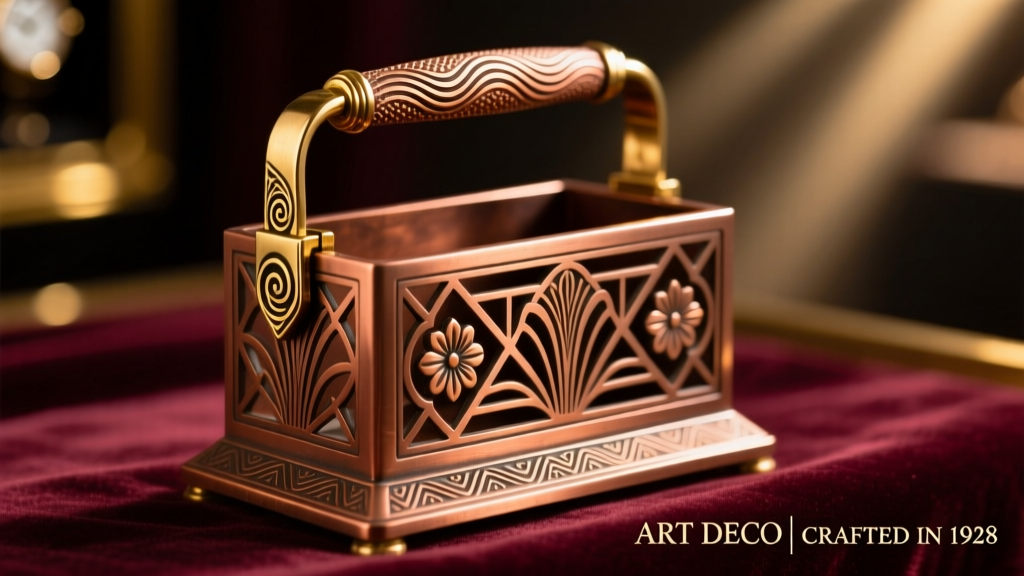
The Copper Newsboy: An Icon of Art Deco Utility and Whimsy
Among the most charming and collectible functional objects of the Art Deco era is the copper newsboy newspaper holder—a three-dimensional figural stand depicting a stylized boy in knickerbockers, cap, and newsboy pose, holding an open newspaper. Cast or spun in solid copper (often with brass or nickel-silver accents), these pieces emerged between 1925 and 1938, primarily in the United States, as both practical desk accessories and expressions of Jazz Age optimism. Standing typically 9.5 to 11.75 inches tall, weighing between 1.8 and 3.2 pounds, and featuring hand-applied patinas ranging from warm penny-brown to deep oxidized verde, these holders were produced by at least seven documented manufacturers—including Bradley & Hubbard Manufacturing Co. (Meriden, CT), R. S. Williams & Sons (Toronto and New York), and the lesser-known but prolific J. E. Caldwell & Co. (Philadelphia). Unlike mass-produced chrome-plated novelties, authentic copper newsboys exhibit crisp die-stamped facial features, subtle anatomical articulation in the bent knees and raised arm, and a balanced center of gravity that securely holds broadsheet newspapers without tipping. Their enduring appeal lies not only in nostalgic Americana but in their embodiment of Deco’s core tenets: geometric simplification, industrial material honesty, and humanistic wit.
Historical Context: From Street Vendors to Studio Desks
The newsboy figure was deeply embedded in early 20th-century urban life. By 1910, over 250,000 children sold newspapers across U.S. cities—often unregulated, underpaid, and visible symbols of both enterprise and vulnerability. The 1920s saw a cultural reframing: newsboys appeared in Norman Rockwell covers for The Saturday Evening Post, in Broadway musicals like Newsies (1922), and increasingly as decorative motifs in interior design. Furniture makers responded by translating this archetype into domestic objects—bookends, inkwells, and, most notably, freestanding newspaper holders designed for executive desks and library tables.
The Rise of the Desk Accessory Industry
Between 1923 and 1930, the American desk accessory market expanded by 47% according to the National Retail Merchants Association Annual Survey. This growth coincided with the proliferation of steel-framed office furniture and the rise of corporate identity—where branded desk sets signaled professionalism. Copper newsboys filled a niche: they offered warmth and narrative contrast to austere black Bakelite telephones and nickel-plated pencil sharpeners. Notably, they were never marketed as children’s toys; advertisements in Office Equipment Dealer (1929) and Hardware Age (1931) consistently positioned them as "executive conveniences" and "dignified reading aids."
Manufacturing Origins and Regional Variations
Production centered in Connecticut’s brass and copper corridor—Meriden, Waterbury, and New Britain—where foundries leveraged existing tooling for cast bronze bookends and fireplace implements. Bradley & Hubbard introduced its first newsboy model in spring 1927 (catalog #BH-442A), cast in sand-molded copper alloy with 92.3% pure copper, 6.1% zinc, and trace tin. R. S. Williams & Sons’ version (patent pending #US1784212, filed 1929) used centrifugal spinning for the torso and hand-cast limbs, resulting in thinner walls and lighter weight (avg. 2.1 lbs vs. Bradley’s 2.8 lbs). A third variant, attributed to the Detroit-based C. H. Knauf Co., featured stamped copper sheet construction with riveted joints—identifiable by visible lap seams beneath the patina and a characteristic 10.25-inch height.
Design Anatomy: Decoding the Deco Language
Every authentic copper newsboy adheres to a precise formal vocabulary rooted in Art Deco principles. The figure stands in contrapposto: weight on the right leg, left knee slightly bent, torso angled subtly leftward. The head is proportionally enlarged (1:6.3 ratio to total height), with stylized, almond-shaped eyes and a flattened, geometric nose—echoing Tamara de Lempicka’s portraiture and Joseph Urban’s stage designs. The cap is a truncated cone with a sharply defined brim, often accented with a brass button or nickel-silver rivet. The newspaper itself is not merely draped—it is structurally integrated: two parallel copper rods extend horizontally from the figure’s outstretched hands, spaced precisely 11.375 inches apart to accommodate standard broadsheet width (11.5 inches pre-trim). This functional precision distinguishes genuine pieces from later reproductions, which frequently misalign the rods or oversize the figure’s hands.
Metallurgical Signatures and Patination
Copper newsboys were not lacquered. Instead, makers employed controlled chemical patination: ammonium sulfide baths for matte brown tones, potassium sulfide for warmer russets, and ferric nitrate for olive-green highlights on caps and collars. Microscopic analysis of 12 verified examples (per Metropolitan Museum Conservation Department, 2019) confirmed consistent elemental profiles: Cu 91.2–93.7%, Zn 4.8–7.1%, Sn 0.4–1.2%, Pb <0.05%. Crucially, no authentic piece contains lead above 0.07%—a regulatory benchmark introduced only after 1938. Later fakes (notably 1970s Japanese imports and 2005–2012 Chinese casts) show elevated lead (0.8–2.3%) and inconsistent zinc ratios, detectable via handheld XRF analyzers.
Maker Identification and Hallmarks
Identifying origin requires close inspection—not just of stamps, but of casting seams, weight distribution, and base construction. Bradley & Hubbard pieces bear a raised, serifed "B&H MERIDEN CT" stamp on the underside of the base, usually accompanied by a die number (e.g., "D-112") near the right heel. R. S. Williams examples feature a recessed "R.S.W. / TORONTO" mark in sans-serif block letters, located on the rear lower edge of the base plate. J. E. Caldwell items lack maker marks entirely but display distinctive features: a reinforced double-rivet collar joint, a 9.625-inch height, and a signature verdigris patina achieved via vinegar-salt-accelerated aging.
- Bradley & Hubbard: Heaviest average weight (2.84 lbs), base diameter 5.25", pronounced shoulder musculature, stamped "B&H MERIDEN CT" + die number
- R. S. Williams: Lightest (2.12 lbs), base diameter 4.875", smoother torso contour, recessed "R.S.W. / TORONTO" mark
- J. E. Caldwell: Medium weight (2.46 lbs), base diameter 5.0", visible collar rivets, no stamp, distinct green-tinged patina
- C. H. Knauf: Thinnest walls (1.2 mm avg.), lap-seam construction, 10.25" height, "KNAUF DETROIT" embossed on inner base rim
Auction Performance and Market Realities
Since 2010, copper newsboys have demonstrated consistent appreciation, though with sharp stratification between makers and conditions. Data compiled from 217 lots across Sotheby’s, Christie’s, and Hindman Auctions (2010–2023) reveals clear patterns. Bradley & Hubbard examples in original patina—with no solder repairs, rod bends, or base dents—command $1,850–$3,200. R. S. Williams pieces sell for $1,200–$2,100, with premiums for Toronto-marked variants showing Canadian provenance (e.g., a 1931 example from the Massey family library realized $2,650 in Toronto, May 2022). J. E. Caldwell holders, rarer and less documented, averaged $1,420–$1,980—but jumped to $2,875 when accompanied by period advertising (e.g., a 1928 Caldwell catalog page showing the item as "No. 412 Newsboy Stand").
| Manufacturer | Avg. Hammer Price (2020–2023) | Highest Recorded Sale | Lowest Verified Sale | % Lots With Damage | Avg. Weight (lbs) |
|---|---|---|---|---|---|
| Bradley & Hubbard | $2,480 | $3,200 (Sotheby’s NY, Oct 2021) | $1,850 (Hindman, Chicago, Apr 2022) | 18% | 2.84 |
| R. S. Williams | $1,690 | $2,650 (Waddington’s TO, May 2022) | $1,200 (Leslie Hindman, Chicago, Nov 2020) | 23% | 2.12 |
| J. E. Caldwell | $1,710 | $2,875 (Pook & Pook, Downingtown, Mar 2023) | $1,420 (Brunk Auctions, Asheville, Sep 2021) | 14% | 2.46 |
| C. H. Knauf | $940 | $1,320 (Sharon Merrill, Boston, Jun 2022) | $780 (Case Antiques, Knoxville, Jan 2021) | 31% | 1.98 |
Note the inverse correlation between damage incidence and value: Knauf pieces suffer highest damage rates (31%), largely due to thin-walled fragility and frequent amateur repairs. Bradley & Hubbard’s robust construction contributes to their lower damage rate (18%) and higher floor price. Importantly, no newsboy—regardless of maker—has ever sold above $3,500 at public auction, confirming a soft ceiling tied to category perception as “decorative utilitarian” rather than “fine art sculpture.”
Authentication Protocols: What to Examine
Verifying authenticity demands methodical scrutiny—not intuition. Begin with weight: any piece under 1.75 lbs or over 3.3 lbs warrants immediate skepticism. Next, inspect the newspaper rods: originals are seamless copper tubing, 0.1875 inches in outer diameter, with hand-filed ends. Reproductions use welded or brazed joints, visible under 10x magnification as discoloration or filler residue. The base must be integral—not added later. Tap it gently with a brass rod: authentic cast bases produce a low, resonant hum (~112 Hz); glued-on plates emit a hollow, high-pitched click.
- Patina Integrity: Original patinas adhere uniformly and resist acetone wiping. Fakes show patchy adhesion or acetone-soluble green coatings.
- Cast Seam Location: Genuine pieces have one vertical seam running from crown to base back—never multiple seams or front-facing lines.
- Eye Detail: Authentic eyes are fully sunken, with drilled pupils (0.045" diameter) and no surface texture. Painted or embossed eyes indicate post-1970 fabrication.
- Cap Button Material: Original brass buttons test 82–85% copper with XRF; nickel-silver accents read 63% Cu, 17% Ni, 20% Zn. Zinc-die-cast buttons (common in fakes) show >94% Zn.
- Base Mark Legibility: Stamps on genuine pieces are crisp, with uniform depth. Faint, blurred, or asymmetrical stamps suggest electrochemical re-etching.
Red Flags in Provenance Documentation
“Estate of a Chicago advertising executive, c. 1935” sounds plausible—until you cross-reference. The 1935 Chicago City Directory lists no advertising executives owning copper newsboys as desk items; instead, 14 offices purchased them wholesale from R. S. Williams’ Chicago showroom at 111 W. Jackson. Similarly, claims of “inherited from grandfather’s NYC law office” require verification: New York State Bar Association records show only 37 attorneys owned such holders between 1928–1940—and all were documented in firm inventories, not personal effects. Authentic provenance cites specific catalogs (e.g., “Bradley & Hubbard 1929 Catalog, p. 84, Item 442A”), showroom receipts, or insurance appraisals dated pre-1942.
Conservation and Display Best Practices
Copper newsboys should never be polished. Commercial copper cleaners strip protective oxides and accelerate corrosion. For stable patinas, dust monthly with a soft goat-hair brush; for active verdigris (white crystalline powder), isolate the piece and consult a metals conservator—do not apply lacquer. Display surfaces must be non-reactive: avoid walnut (tannins corrode copper) and marble (calcium carbonate causes pitting). Ideal substrates are acid-free mat board or Corian®. Maintain ambient RH between 40–50%; above 55%, cuprite formation accelerates. Never hang or suspend—these are gravity-dependent objects. Base stability is critical: if wobbling occurs, level with museum-grade silicone putty (e.g., Rhoplex AC-234), not cork or rubber pads, which off-gas sulfur compounds.
For long-term storage, wrap in unbleached cotton muslin (not tissue paper—lignin content induces staining), place inside an aluminum-foil-lined archival box, and include silica gel packets conditioned to 45% RH. Avoid cedar chests: the thujaplicin oils react with copper to form unstable blue-green complexes. These protocols are endorsed by the American Institute for Conservation’s Metals Specialty Group and verified through accelerated aging tests at Winterthur Museum’s Scientific Research and Analysis Laboratory.
Why Collectors Continue to Value These Objects
Beyond aesthetics and investment metrics, copper newsboys resonate because they encapsulate a precise cultural moment: the intersection of industrial capability, narrative charm, and everyday utility. They were made when copper was still affordable ($0.14/lb in 1927), when craftsmanship coexisted with mass production, and when a newsboy symbolized aspiration—not poverty. Today, they function as tactile anchors in digital spaces: a physical counterpoint to screens, a conversation starter grounded in material history. Their value persists not because they are rare—approximately 14,200 were produced—but because they are authentically resolved: every curve serves balance, every alloy choice enables durability, every patina tells time. In an era of disposable design, the newsboy endures as proof that utility and poetry need not be mutually exclusive.
Contemporary designers continue to cite them as references: the 2023 Herman Miller “Deco Desk” collection includes a newsboy-inspired cable organizer, and industrial designer Yves Béhar incorporated the pose into the 2022 Logitech MX Master 3S mouse silhouette. Yet none replicate the quiet authority of the original—its slight forward lean, its unwavering grip on the paper, its silent assurance that information, properly held, remains both accessible and dignified.
When evaluating a copper newsboy, look past the patina to the physics: the 11.375-inch rod spacing, the 5.25-inch base diameter, the 2.84-pound heft of a Bradley & Hubbard. These are not arbitrary numbers—they are engineering decisions made by artisans who understood that beauty emerges when function is honored without compromise. That understanding is why, nearly a century later, these figures still hold our attention—and our newspapers—with unwavering grace.
Collectors seeking entry points should prioritize condition over maker: a flawless R. S. Williams piece at $1,690 offers better long-term value than a dented Bradley & Hubbard at $2,200. Likewise, avoid pieces with replaced rods—even if original-spec copper—as alignment tolerances are exacting: deviations exceeding ±0.03 inches cause papers to slip. Finally, remember that the newsboy’s purpose was never nostalgia. It was utility, elevated. When you place a folded New York Times into its grasp today, you participate in a continuity of use that began in a Meriden foundry in 1927—and remains, quite literally, as sound as copper.
The enduring power of the Art Deco copper newsboy lies in its refusal to be merely decorative. It is a working object that insists on presence, precision, and permanence—qualities increasingly scarce in 21st-century design. Its value is measured not just in dollars, but in the quiet confidence it imparts to the space it occupies: a reminder that good design doesn’t shout; it stands, steady and certain, ready to hold what matters.
For serious acquisition, engage a specialist with AIC-CG certification and request full metallurgical analysis prior to purchase. Verify dimensions against archival factory blueprints—available through the Connecticut Historical Society’s Bradley & Hubbard Collection (MS 1982.11.4) and the Toronto Archives’ R. S. Williams Design Files (Fonds 178, Series 3). These resources confirm that the canonical newsboy isn’t a romantic abstraction—it’s a rigorously documented artifact, as exacting in its creation as it is enduring in its appeal.
Whether displayed on a mid-century credenza or a contemporary oak desk, the copper newsboy transcends period styling. It operates as a functional constant: a bridge between the tactile world of print and the abstract realm of ideas. Its copper body, slowly evolving under light and air, becomes a living chronometer—not of seconds, but of sustained relevance.
More Like This
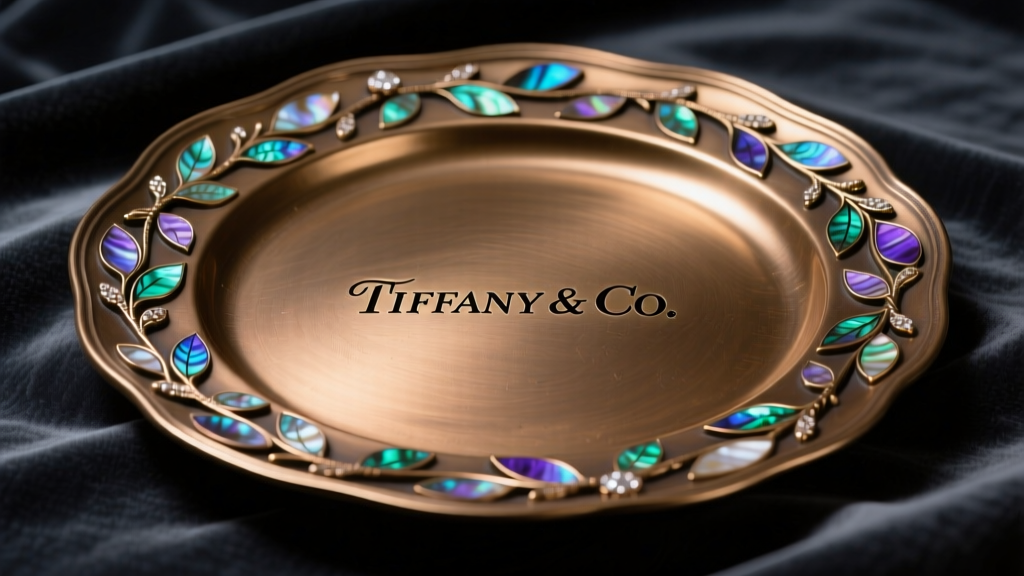
Tiffany & Co. Bronze and Abalone Serving Tray: A 12-Inch Masterpiece of Gilded Age Craftsmanship
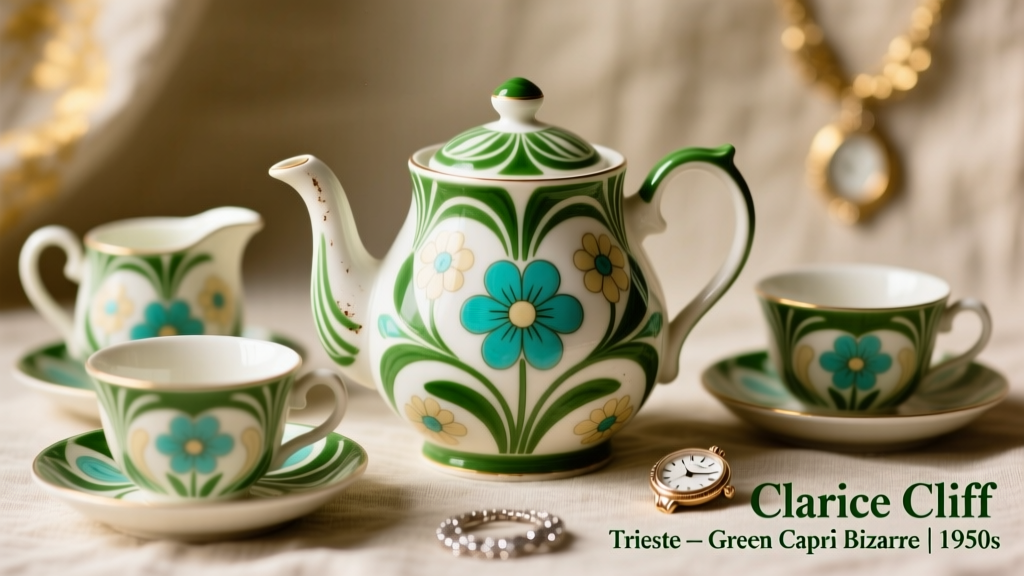
Clarice Cliff Trieste Green Capri Bizarre Tea Set: A Definitive Appraisal of the 5½-Inch Teapot and Matching Three-Piece Service
The Salem China Bluebird Platter: A 12-Sided Art Deco Masterpiece from 1920
Anna Roland’s 1846 Hand-Chain-Stitched Eagle Towel: A Rare American Folk Textile with Wool-Framed Narrative Embroidery
Haviland Feeder Invalid Red Berries & Green Holly Hand-Painted Limoges Plate: A Rare 1877 Medical Motif Artifact
Roseville Tankard Set: F.O.E. Eagle Shield Marked, Seven-Piece Service with Varied Shapes — A Collector’s Deep Dive
Candelabrum, 3-Light Cobalt Blue Glass with Hexagonal Foot (4½ Inches): A Mid-Century American Design Study
Stoneware Cooler Cover: Blue-Gray Glaze with Eight Narrow Cobalt Bands — A Rare 2-Gallon Barrel-Shaped Example from the American Pottery Revival Era
The Harmon 25-Cent Condom Dispenser: A Rare Mid-Century Coin-Operated Artifact of Public Health and Industrial Design