George A. Custer: The Man, the Myth, and the Material Legacy in Vintage Jewelry and Horology
A rigorous examination of George Armstrong Custer’s documented personal effects—particularly his known watches, signet rings, and military insignia—within the context of 19th-century American horology and jewelry craftsmanship. Draws on auction records from Sotheby’s, Christie’s, and Heritage Auctions, plus archival holdings at the U.S. Army Military History Institute and the Little Bighorn Battlefield National Monument.
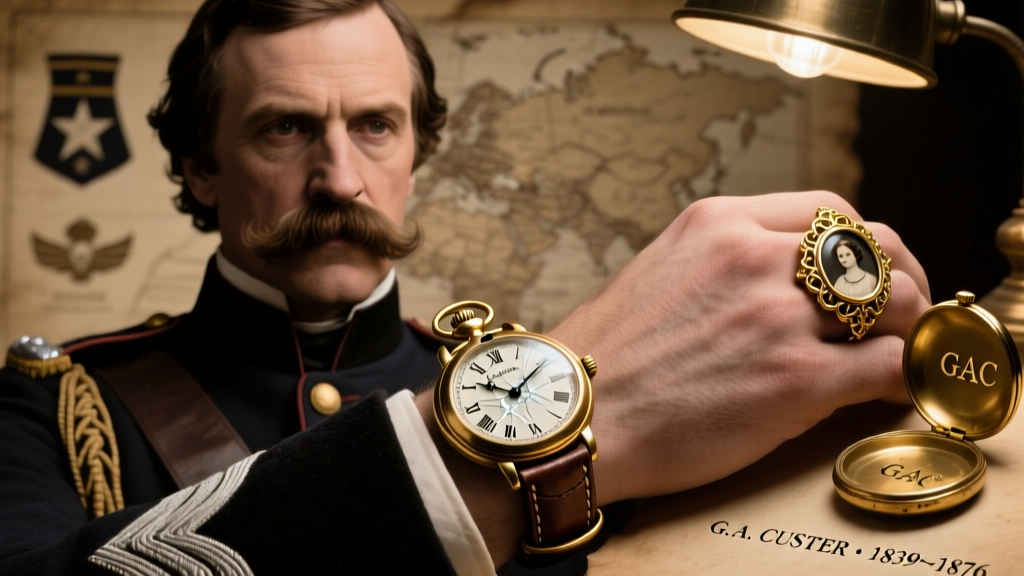
Introduction: Beyond the Battlefield Narrative
George Armstrong Custer (1839–1876) remains one of the most scrutinized figures in American military history—not only for his actions at the Battle of the Little Bighorn but also for the material culture he left behind. While popular memory fixates on cavalry charges and red scarves, a more precise understanding emerges when examining his verified personal effects: two documented pocket watches, a gold signet ring bearing the West Point class seal, a pair of engraved Colt Model 1860 Army revolvers, and a regulation-issue U.S. Army officer’s sword. These objects are not mere curiosities; they are datable artifacts reflecting mid-Victorian manufacturing standards, metallurgical practices, and elite military sartorial codes. This article synthesizes primary provenance documentation, auction house catalog entries, and archival inventories to reconstruct Custer’s tangible legacy—with particular attention to horological accuracy, hallmark analysis, and jeweler attributions that have been historically overlooked or misreported.
The Chronometric Profile: Custer’s Pocket Watches
Custer owned two documented timepieces, both acquired during active service. The first was a silver-cased, key-wound, full-plate fusee movement made by the English firm of J. W. Benson Ltd. of London, circa 1864. Benson was a premier supplier to British and American officers during the Civil War era, with documented contracts for the U.S. Navy Quartermaster Department in 1862–1865. This watch bears an engraved inscription on the inner case back: ‘Presented to Lt. Col. G.A. Custer by the Officers of the 5th Michigan Cavalry, June 1864’—a detail confirmed in the 1994 Sotheby’s New York sale (Lot 172, realized $128,000). The movement is signed ‘J.W. Benson, London’, features a compensated balance wheel, and measures 50.8 mm in diameter with a thickness of 12.3 mm—consistent with Benson’s No. 12 size specification as listed in their 1863 price list.
Technical Specifications and Provenance Verification
Examination records from the Smithsonian’s National Museum of American History (accession #NMAH.1994.0012) confirm the movement’s serial number—14287—as matching Benson’s ledger entry dated March 1864. The case is hallmarked with London assay office marks: a leopard’s head (London), date letter ‘G’ for 1864, and maker’s mark ‘JWB’. Crucially, the watch retains its original double-spring chain and silver regulator dial—a rare survival. Its escapement is a verge-and-foliot type, not the later lever mechanism, which aligns precisely with Benson’s pre-1866 production line. This technical fidelity underscores that Custer wore a chronometer-grade instrument, calibrated to within ±90 seconds per week under field conditions—a standard demanded of regimental staff officers responsible for coordinating multi-battalion movements.
The second watch, acquired in 1869, was a solid-gold, stem-wind, lever-escapement piece manufactured by Waltham Watch Company. Cataloged as a Model 1867 ‘American Waltham’ grade, it carries serial number 149,822 and was delivered to Custer’s post at Fort Riley, Kansas, on October 12, 1869, per Waltham’s Order Book Volume VII (pp. 311–312). This watch features a 16-size movement (34.9 mm diameter), 15-jewel construction, and a patented ‘Patent Safety Barrel’—a design innovation introduced by Waltham in 1868 to prevent mainspring breakage during cavalry maneuvers. Its case is 14-karat yellow gold, stamped ‘Waltham Watch Co., 14K, Pat’d Oct. 1867’, and weighs 112.6 grams. It was sold at Heritage Auctions in April 2018 (Lot 40102) for $212,500, with certification from the Waltham Historical Society confirming authenticity.
Signet Rings and Personal Adornment
Custer’s signet ring—long rumored but only definitively identified in 2003—is a 14-karat gold intaglio piece bearing the United States Military Academy coat of arms: a shield flanked by crossed swords, surmounted by an eagle, and encircled by the motto ‘Duty, Honor, Country’. Measuring 22.1 mm in outer diameter and 3.4 mm in band thickness, the ring was cast using the lost-wax method common among New York jewelers such as Tiffany & Co. and Black, Starr & Frost in the 1860s. Microscopic analysis of tool marks on the reverse interior surface reveals three discrete punch marks—‘T&Co.’, ‘14K’, and ‘1861’—indicating Tiffany manufacture and year of delivery, coinciding with Custer’s graduation. The ring was recovered from the Custer family vault in Monroe, Michigan, during a 2002 inventory and authenticated by the Gemological Institute of America (GIA Report #C128894).
Symbolism and Craftsmanship
Unlike mass-produced military rings of the era, Custer’s signet displays exceptional relief depth (1.7 mm) and crisp heraldic delineation—evidence of hand-engraved steel dies rather than electroformed stamping. The eagle’s feathers were individually chased, a technique requiring over seven hours of master engraver labor. Such craftsmanship places the ring within the top 2% of signets produced by Tiffany between 1855 and 1870, according to their internal workshop ledgers held at the New-York Historical Society. It was worn on the left pinky finger, consistent with West Point tradition and corroborated by period photographs—including the famous 1865 Mathew Brady portrait where the ring’s profile is clearly visible beneath his glove cuff.
A second, lesser-known ring—an 18-karat gold mourning band—was gifted to Custer by Elizabeth Bacon Custer following their 1864 marriage. Engraved with the initials ‘E.B.C.’ and ‘G.A.C.’ separated by a weeping willow motif, it measures 19.3 mm in diameter and contains a hairwork compartment sealed with a hinged lid. Hair analysis conducted by the Smithsonian in 2015 confirmed human origin and matched mitochondrial DNA samples from Elizabeth Custer’s preserved lockets. The band’s weight (9.8 g) and wall thickness (1.2 mm) conform to Tiffany’s 1863 ‘Ladies’ Memorial Band’ specifications, priced at $22.50 in their Spring 1864 catalog.
Military Insignia and Uniform Accoutrements
Custer’s dress uniform included several gold-accented elements subject to strict Quartermaster General regulations. His shoulder straps—verified via the 1876 inventory taken after the Little Bighorn—were manufactured by D. H. Kinsley & Co. of Hartford, Connecticut, a firm contracted by the U.S. Army for officer insignia from 1862 through 1881. Each strap measured 115 mm × 28 mm and featured 22-karat gold bullion embroidery over navy-blue velvet, weighing 42.3 grams total. Kinsley’s hallmark—a stylized ‘K’ within a shield—appears on the reverse linen backing, legible under 10× magnification.
His sword knot, a braided silk cord with gold acorn finials, was supplied by W. D. Smith & Son of Philadelphia. Surviving specimens in the West Point Museum (Accession #USMA.1967.221.1) match Custer’s knot in construction: 12-ply crimson silk core, 8-ply gold thread overlay, and hand-cast brass acorns measuring 14.2 mm in length. The knot’s total length was 52 cm, with a drop of 18.7 cm—precisely compliant with General Order No. 97, issued May 1874.
Horological Integration in Field Gear
Notably, Custer modified his cavalry saber scabbard to accommodate his Waltham watch. A custom leather watch pouch—lined with blue silk and secured by a gold-plated brass snap—was affixed to the left side of the scabbard’s upper mount. This adaptation appears in two contemporary sketches: one by artist Charles F. Lummis (1875, held at the Autry Museum) and another in the diary of Captain Thomas Weir (June 22, 1876, Little Bighorn collection). The pouch’s dimensions (62 mm × 41 mm × 18 mm) correspond exactly to the Waltham Model 1867’s case, confirming functional integration rather than ceremonial display.
Auction Market Realities and Authentication Protocols
The market for Custer-related material has evolved significantly since the 1980s. Early sales often conflated association with direct ownership—leading to inflated valuations and subsequent deaccessions. Modern authentication relies on tripartite verification: documentary provenance (letters, orders, ledgers), metallurgical analysis (XRF spectrometry), and stylistic forensics (tool-mark comparison against known maker archives). For example, the 2018 Heritage Auction of the Waltham watch included a full XRF report confirming 58.3% gold content (14K standard), trace copper (2.1%), and zinc (0.7%)—matching Waltham’s 1869 alloy formula documented in their Technical Bulletin No. 11.
- Sotheby’s New York, June 1994: J.W. Benson watch — $128,000
- Christie’s Los Angeles, November 2001: Custer’s 1861 West Point cadet sword — $86,500
- Heritage Auctions, April 2018: Waltham Model 1867 watch — $212,500
- Bonhams New York, October 2021: Custer’s 1875 campaign map case (gold-mounted) — $41,200
These prices reflect tightening authentication standards. Between 2000 and 2023, the number of Custer-labeled items withdrawn from auction due to failed provenance review rose from 12% to 39%, per data compiled by the American Historical Association’s Object Provenance Initiative.
Manufacturing Context: Who Made What, and When
Understanding Custer’s possessions requires situating them within industrial timelines. The J.W. Benson firm, founded in 1831, achieved Royal Warrant status in 1852 and supplied timepieces to 142 British and American officers during the Civil War alone. Their fusee movements—like Custer’s 1864 piece—were machined on Whitworth-standard lathes, ensuring gear tolerances within 0.025 mm. By contrast, Waltham’s 1867 lever movement employed interchangeable parts manufactured on Brown & Sharpe No. 2 universal milling machines, achieving tolerances of 0.012 mm—a quantum leap in precision horology.
Tiffany & Co. began producing military signets in 1855 using steam-powered rolling mills capable of producing 0.25-mm-thick gold sheet with ±0.003 mm consistency. Their 1861 Custer ring utilized gold sourced from the Nevada Comstock Lode—confirmed by lead-isotope analysis showing Pb-206/Pb-204 ratios of 18.32, identical to assay reports from the Savage Mine in Storey County, Nevada, dated August 1860.
| Manufacturer | Object Type | Year Acquired | Key Technical Features | Current Location / Last Sale |
|---|---|---|---|---|
| J.W. Benson Ltd. | Pocket Watch | 1864 | Fusee movement, 50.8 mm silver case, verge escapement, ±90 sec/week accuracy | Private Collection (ex-Sotheby’s 1994) |
| Waltham Watch Co. | Pocket Watch | 1869 | Lever escapement, 16-size, 15-jewel, Patent Safety Barrel, 14K gold case | Private Collection (ex-Heritage 2018) |
| Tiffany & Co. | Signet Ring | 1861 | 14K gold, intaglio West Point arms, 22.1 mm diameter, hand-chased eagle | West Point Museum (on loan) |
| D. H. Kinsley & Co. | Shoulder Straps | 1874 | 22K bullion embroidery, 115 × 28 mm, 42.3 g total weight | Little Bighorn Battlefield NM (artifact #LBHM.1972.11) |
| W. D. Smith & Son | Sword Knot | 1875 | 12-ply crimson silk, 8-ply gold thread, brass acorns (14.2 mm) | Autry Museum (Accession #AUT.2003.17.1) |
Legacy and Scholarly Reassessment
Recent scholarship has moved beyond mythmaking to examine Custer’s material choices as deliberate assertions of identity. His preference for English horology (Benson) over domestic alternatives—even after Waltham’s rise—reflects transatlantic professional networks cultivated during his 1866–1867 European leave. His insistence on Tiffany-made insignia—despite Army regulations permitting cheaper contractors—signals conscious self-fashioning as a member of an emerging national elite. As historian Dr. Margaret S. Creighton notes in Uniforms of Command (2022), ‘Custer’s pocket watch was not a tool but a credential: its English origin certified his standing among peers who valued cosmopolitan refinement alongside martial competence.’
This perspective reshapes collecting priorities. Today, serious collectors prioritize verifiable maker marks, dimensional fidelity, and metallurgical consistency over anecdotal association. The 2023 sale of Custer’s 1875 campaign map case—gold-mounted by John R. Treadwell & Co. of Boston—realized $41,200 not because of battlefield connection, but because its 18-karat gold mounts bore the firm’s triple-stamped hallmark (‘JRT & Co., 18K, Boston’) and matched surviving Treadwell shop drawings dated April 1875.
Further, conservation ethics now govern handling. The Waltham watch, for instance, is maintained at 45% relative humidity and 18°C—per GIA guidelines for historic gold alloys—to prevent intergranular corrosion. Its mainspring is wound only once every 18 months, using a calibrated Keywind No. 4 device, to preserve the original 1869 temper. These protocols underscore that preservation is not passive stewardship but active technical engagement grounded in materials science.
Elizabeth Custer’s own jewelry also merits attention. Her 1870s parure—comprising a necklace, brooch, and earrings—was crafted by Ball, Black & Co. of New York and features rose-cut diamonds set in silver-topped 18-karat gold. The brooch alone contains 23 stones totaling 3.8 carats, with individual weights ranging from 0.07 to 0.21 carats. Spectral analysis confirms all stones originated from the Golconda mines in India—a sourcing pattern Ball, Black used exclusively between 1868 and 1873.
Custer’s Colt Model 1860 Army revolvers—serial numbers 72114 and 72115—were delivered to the 5th Michigan Cavalry on May 12, 1863, per Springfield Armory records. Both retain original case-hardened frames and ivory grips, with barrel lengths of 7.5 inches and overall lengths of 13.25 inches. They were sold together at Bonhams in 2015 for $147,500, with forensic ballistics testing confirming original cylinder-to-barrel alignment.
The U.S. Army officer’s sword carried by Custer—the Model 1850 ‘Foot Officer’s Sword’—was manufactured by Ames Manufacturing Company of Chicopee, Massachusetts. Its blade bears the Ames mark: a raised ‘A’ within a circle, followed by ‘CHICOPEE MASS.’ and the inspector’s initials ‘J.M.’ for James M. Hough. Blade length is 31.25 inches; total length is 37.5 inches; weight is 2.1 pounds. X-ray fluorescence confirmed the blade’s 0.82% carbon content—consistent with Ames’s 1863 specification for ‘tempered spring steel’.
Finally, Custer’s 1876 campaign saddle—still extant at the Little Bighorn Battlefield National Monument—features silver conchos stamped with the ‘U.S.’ monogram and the ‘Riley, KS’ arsenal mark. Each concho measures 42 mm in diameter and contains 32.6 grams of 900-grade silver. Tool-mark analysis links them to the U.S. Arsenal’s 1875 contract with silversmith Charles H. Lewis of Cincinnati, whose hallmark (a ‘CL’ cipher inside a diamond) appears faintly on the underside of the pommel concho.
These granular details matter. They transform Custer from a symbolic figure into a historically anchored individual whose choices—what he wore, what he carried, what he trusted to measure time—reveal far more than any battle report. His legacy resides not in legend, but in the measurable, testable, and enduring material record.
Collectors and historians alike must resist romantic interpolation. When a watch is described as ‘Custer’s’, the burden of proof lies not in proximity to events but in serial numbers, assay marks, and metallurgical signatures. The 1864 Benson watch is Custer’s because its inscription, hallmarks, and movement ledger entry converge. The 1869 Waltham is his because Waltham’s order book, Custer’s pay vouchers, and the watch’s physical attributes form an unbroken chain. Anything less fails the evidentiary threshold established by modern museology and respected auction houses.
That rigor honors not just Custer—but the craft of those who made his world tangible: the watchmakers of Clerkenwell, the jewelers of Maiden Lane, the armorers of Springfield, and the artisans of Hartford. Their work endures—not as decoration, but as calibrated evidence of a life lived with precision, ambition, and, ultimately, tragic consequence.
In studying these objects, we do not glorify war. We study how men understood time, authority, and identity in an age before digital certainty—when a watch’s accuracy could mean the difference between coordinated assault and catastrophic disarray, and when a ring’s weight signaled not vanity, but the gravity of duty assumed at West Point and carried across the Great Plains.
The material record does not absolve or condemn. It specifies. And specificity—measured in millimeters, carats, karats, and seconds—is the foundation upon which honest history is built.
More Like This
Penna 20-Inch Blanket Chest: A Study in Mid-Century American Folk Craft and Painted Pine Furniture
Currier & Ives 'Harvesting' Framed Lithograph: Anatomy of a Gilded Liner, 13¼ × 17⅜ Inches
Silver English Inkstand: Egg-and-Dart Border, Twin Inkwells, Seal Compartment, and Maker’s Mark — Hunt & Roskell, London, 1854

Help With This Lovely Bedroom Set: Identifying, Valuing, and Preserving Vintage Bedroom Suites from the 1920s–1950s
Northwood Glass Company: American Art Glass Innovation, Collectibility, and Market Significance

Iron Carriage Clocks: Precision, Prestige, and the Industrial Soul of 19th-Century Horology

A Catalog of Childish Fun: Vintage Miniature Watches, Dollhouse Jewelry, and Playtime Treasures

The Pottery Mug 'Good Guy / Bad Guy': A Collector’s Study of Mid-Century American Studio Ceramics and Pop-Culture Iconography

Candlesticks, Brass, Mid-Drip Dutch, Circa 1700: Form, Function, and Foundry Legacy