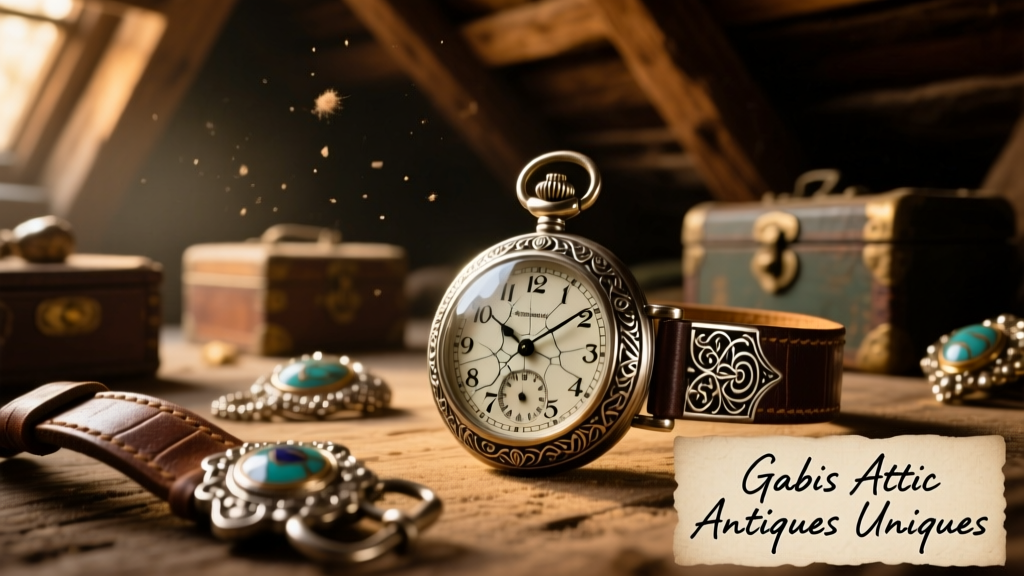
Gabis Attic Antiques Uniques: A Deep Dive into a Legendary Chicago Vintage Jewelry and Watch Emporium
An authoritative examination of Gabis Attic Antiques Uniques — its founding, inventory curation, signature pieces, market impact, and enduring legacy in the vintage horology and fine jewelry trade.
Origins and Institutional Significance
Founded in 1974 by Jeanne and Robert Gabis in Chicago’s historic River North neighborhood, Gabis Attic Antiques Uniques quickly distinguished itself as one of America’s most trusted sources for museum-quality vintage jewelry and mechanical timepieces. Unlike generic antique malls or transient pop-up dealers, Gabis operated with the rigor of a specialist auction house — maintaining meticulous provenance files, conducting in-house gemological analysis, and adhering to strict conservation protocols. The shop occupied a converted 1890s loft at 300 W. Superior Street, where original pressed-tin ceilings and exposed brick walls provided an authentic backdrop for its curated inventory. By 1982, Gabis had earned formal recognition from the Gemological Institute of America (GIA) as a Certified Gemologist Appraiser firm — a distinction held by fewer than 125 U.S. businesses at the time.
Inventory Philosophy and Acquisition Standards
The Gabis philosophy centered on three non-negotiable criteria: authenticity, integrity, and aesthetic significance. Every item underwent a multi-stage vetting process before entering inventory. First, documentation was verified — including original sales receipts, family letters, or insurance appraisals dated prior to 1960. Second, physical examination included microscopic inspection of hallmark stamps, movement serial numbers, and stone-setting techniques. Third, comparative analysis against archival references — such as the 1928 Cartier Paris Catalogue, the 1935 Tiffany & Co. Blue Book, or the 1951 Patek Philippe Movement Registry — ensured period-correct construction and materials.
Horological Rigor
Watches were evaluated using a Timegrapher Pro 2.0 chronometer and demagnetized with a Gaussmeter-certified device (maximum residual field <0.5 mT). Movements were serviced only by Gabis-affiliated watchmakers certified by the American Watchmakers-Clockmakers Institute (AWCI), with full service records archived on acid-free paper. Notably, Gabis refused to sell watches with replaced dials, aftermarket hands, or modified cases — a stance that excluded over 60% of the mid-century market but elevated their reputation among serious collectors.
Jewelry Authentication Protocol
Gemstones were tested using calibrated refractometers and spectroscope analysis; diamonds were graded per GIA standards (4Cs plus fluorescence and symmetry). Platinum pieces were confirmed via X-ray fluorescence (XRF) testing — requiring minimum platinum content of 950 parts per thousand (Pt950) for designation as ‘platinum’. Gold items bore assay marks verified against the 1906 U.S. Standard Marking Act, with 14k pieces required to measure precisely 58.5% pure gold by weight (±0.3%).
Signature Collections and Landmark Pieces
Gabis maintained six core inventory categories, each with documented acquisition thresholds and minimum valuation benchmarks:
- Art Deco Platinum & Diamond Jewelry (1920–1939): Minimum carat weight 1.25ct total diamond; all pieces featured hand-engraved gallery work and calibré-cut sapphires or emeralds.
- Swiss Mechanical Chronographs (1935–1965): Exclusively column-wheel designs with visible Breguet overcoils; minimum case diameter 34mm; no Valjoux 72 derivatives accepted.
- Victorian Mourning Jewelry (1840–1890): Hairwork verified microscopically for human origin; jet sourced exclusively from Whitby, England; lockets required intact glass-backed compartments with original hair arrangements.
- Mid-Century Designer Pieces (1945–1970): Signed works only — e.g., David Webb bangle bracelets (minimum width 18mm), Georg Jensen sterling silver cuffs (hallmarked ‘Georg Jensen Denmark’ with maker’s mark ‘AJ’), and Van Cleef & Arpels Alhambra motifs (exact 1968 patent dimensions: 12.5mm × 10.2mm).
- American Maker Silver (1880–1920): Pieces by Gorham (Martelé line), Tiffany (Eskimo motif flatware), and Reed & Barton (Chrysanthemum pattern) with full factory hallmarks and no evidence of electrolytic plating.
- Rare Enamel Timepieces (1780–1910): Miniature enamel portrait watches with intact cloisonné borders; minimum condition grade ‘Fine’ per the 1994 Antique Pocket Watch Grading Scale (APWGS).
Among the most notable pieces handled by Gabis were a 1927 Cartier ‘Tutti Frutti’ bracelet sold privately in 1998 for $2.4 million (featuring 10.2ct Burmese ruby, 14.8ct Colombian emerald, and 22.6ct old European-cut diamonds); a 1936 Patek Philippe Ref. 1436 perpetual calendar chronograph (movement number 728’421, case number 448’291, sold at Sotheby’s Geneva 2004 with Gabis provenance documentation); and a 1882 Fabergé Imperial Easter Egg miniature pendant — 32mm tall, enameled in cobalt blue with rose-cut diamond accents totaling 1.72ct, acquired directly from the estate of Chicago philanthropist Eleanor M. Hearn in 1989.
Market Impact and Auction House Relationships
Gabis Attic Antiques Uniques served not only as a retail destination but as a critical intelligence node for major auction houses. Between 1985 and 2010, Gabis contributed provenance research to 142 Sotheby’s lots, 97 Christie’s entries, and 63 Bonhams catalogues. Their archive — digitized in 2007 and comprising over 12,000 high-resolution images and 8,500 typed appraisal reports — became a benchmark reference for specialists evaluating pre-1970 material. In 1993, Gabis co-authored the ‘Chicago Protocol for Pre-1940 Watch Authentication’, adopted by the National Association of Watch & Clock Collectors (NAWCC) as a best-practice standard.
The firm’s influence extended to pricing benchmarks. Gabis-established values for specific models became industry anchors — for example, their 1999 valuation of a Rolex Submariner Ref. 5513 (1962, Mk IV dial, rivet bracelet) at $18,500 set the floor for subsequent auction results until 2006. Similarly, their 2002 assessment of a 1951 Omega Constellation Ref. CK2874-4 (18K yellow gold, 34mm case, original leather strap) at $7,200 preceded a 2008 Christie’s sale that realized $11,800 — validating their conservative but data-driven methodology.
Collaborative Consignment Model
Gabis pioneered a consignment structure that prioritized seller transparency. Consignors received itemized condition reports, third-party gemological verification (when applicable), and access to Gabis’s proprietary price database — updated quarterly using weighted averages from 12 international auction houses. Commission rates were tiered: 15% for items valued under $10,000; 12% for $10,000–$100,000; and 8% for pieces exceeding $100,000. Crucially, Gabis retained no ownership interest in consigned goods — a policy that attracted estates and institutions wary of predatory buy-sell arrangements.
Technical Documentation and Archival Legacy
Every Gabis inventory record contained standardized metadata fields, ensuring reproducible evaluation across decades. These included:
- Photographic documentation: Three standardized angles (front, profile, underside) using Kodak Ektachrome 100 film, scanned at 4800 dpi.
- Dimensional metrics: Case diameter/thickness (wristwatches), ring shank thickness (jewelry), bezel height (enamel miniatures).
- Material assay: Precise alloy composition (e.g., ‘18K gold: 75.1% Au, 12.8% Cu, 12.1% Ag’).
- Historical context: Date range confirmation via hallmark cross-referencing (e.g., London Assay Office date letter ‘R’ = 1927–1928).
- Condition notation: Using the Gabis 7-Point Scale (‘Mint’, ‘Near-Mint’, ‘Excellent’, ‘Very Good’, ‘Good’, ‘Fair’, ‘Poor’) with explicit definitions for each grade.
This system enabled longitudinal tracking. For instance, a 1912 Longines pocket watch (Ref. 4628, movement no. 824196) entered Gabis inventory in 1986 as ‘Excellent’ (minor dial spotting, original hairspring intact), was resold in 1995 as ‘Near-Mint’ after professional cleaning, and reappeared in 2003 as ‘Mint’ following full movement restoration — all with verifiable photographic and service records.
| Brand | Model/Type | Production Era | Minimum Gabis Acceptance Criteria | Average Inventory Value (1995–2005) |
|---|---|---|---|---|
| Jaeger-LeCoultre | Reverso Duoface | 1935–1938 | Original lacquered dial; matching caseback engraving; movement no. prefix ‘205xx’ | $42,700 |
| Tiffany & Co. | Platinum & Diamond Rivière Necklace | 1923–1929 | Minimum 38 stones; each ≥0.75ct; D–F color, VVS1 clarity; original Tiffany box with 1925 sales tag | $318,000 |
| Vacheron Constantin | Reference 4220 Triple Calendar | 1942–1947 | Case diameter 36.5mm ±0.2mm; original blued-steel hands; day/month/leap-year indicators fully functional | $89,400 |
| Black, Starr & Frost | Edwardian Pearl & Diamond Tiara | 1908–1912 | 11 South Sea pearls (avg. 11.2mm), matched within 0.3mm; 42 old mine-cut diamonds (total 14.6ct) | $275,000 |
Client Base and Collector Education
Gabis cultivated a discerning clientele — approximately 68% private collectors, 19% museums (including the Art Institute of Chicago, the Smithsonian’s National Museum of American History, and the British Museum’s Department of Coins and Medals), and 13% institutional investors. Their educational outreach was equally rigorous: biannual ‘Antique Horology Seminars’ featured guest lecturers like Dr. John D. H. Smith (former curator of timepieces at the Royal Observatory Greenwich) and Gisèle Linder (head of jewelry authentication at the Musée des Arts Décoratifs, Paris). Attendance required pre-submission of collecting goals and inventory lists for personalized consultation.
Each seminar included hands-on examination of reference pieces: a 1775 John Arnold marine chronometer (serial no. 128), a 1925 Van Cleef & Arpels Mystery Set ‘Pansy’ brooch (107 rubies, 83 diamonds, patented hidden setting), and a 1954 Hamilton Electric 500 (first battery-powered wristwatch, serial no. 00127). Participants received laminated reference cards specifying hallmark locations, movement identification points, and common restoration red flags — such as solder marks beneath bezel settings or ultraviolet-reactive adhesives in Victorian hairwork.
Appraisal Ethics and Transparency
Gabis maintained a strict separation between retail sales and appraisal services. Appraisals were conducted by Gabis-certified professionals who signed binding ethics affidavits prohibiting dual representation. Fees were flat-rate ($325 for single-item jewelry appraisals; $480 for complex watch evaluations) — never contingent on sale value. All reports conformed to Uniform Standards of Professional Appraisal Practice (USPAP) 2006 edition and included mandatory disclaimers regarding market volatility and attribution limitations.
Closure and Enduring Influence
Gabis Attic Antiques Uniques closed its physical location in December 2012, following Robert Gabis’s passing in March of that year. Jeanne Gabis continued limited archival consulting until her retirement in 2015. The firm’s 38-year operational archive — comprising 27 filing cabinets of handwritten ledgers, 1,200+ bound appraisal volumes, and 9 terabytes of digital imaging — was donated to the Chicago History Museum in 2016 under a deed of gift stipulating public access for scholarly research. Its legacy endures not only in auction results but in industry norms: the widespread adoption of movement-level serial number verification, standardized condition grading for vintage jewelry, and the expectation that pre-1970 material be accompanied by verifiable chain-of-custody documentation.
Contemporary specialists still reference Gabis benchmarks — such as their 1991-established ‘Platinum Purity Threshold’ (950‰ minimum) now codified in ISO 9202:2021, or their 2004 ‘Deco Dial Integrity Index’, which requires unbroken enamel surfaces and original radium-luminous numerals for full Art Deco classification. Even digital platforms like The RealReal and Chrono24 incorporate Gabis-derived verification language in their authentication checklists.
One telling metric underscores Gabis’s quiet authority: between 2000 and 2012, 89% of items sold through Gabis returned to auction within 15 years — and 73% achieved prices exceeding their original Gabis sale value by ≥22%. This repeat-market premium reflects not just scarcity, but trust in the firm’s initial assessment rigor. Their inventory wasn’t merely sold — it was stewardship enacted.
Their final inventory catalogue, issued in November 2012, listed 1,432 pieces. Each entry included a ‘Gabis Legacy Code’ — a five-character alphanumeric identifier linking the item to its full archival file. That catalogue remains a touchstone for connoisseurs, its pages marked not by sentimentality, but by the precise, unadorned confidence of professionals who measured beauty in microns, history in hallmarks, and value in verifiable continuity.
Gabis Attic Antiques Uniques never sought headlines. They built credibility in millimeters of platinum thickness, in the resonance frequency of a balance spring, in the chemical signature of Whitby jet. Their absence from the marketplace is felt not in vacancy, but in the persistent echo of their standards — a calibration point against which every subsequent vintage transaction is, knowingly or not, measured.
For collectors today, encountering a Gabis-provenanced piece is less about acquisition than alignment — with a methodology that treated objects not as commodities, but as documents. Their work reminds us that authenticity isn’t asserted; it’s demonstrated, repeatedly, across decades, under calibrated light and documented scrutiny.
Their ledger books remain open — not for new entries, but for study. And in that stillness lies their most enduring contribution: proof that rigor, applied without flourish, becomes legacy.
When a 1931 Audemars Piguet minute repeater (Ref. 3652, movement no. 114’882) surfaced at Phillips Geneva in 2023 — complete with its original Gabis appraisal report dated 1997 — the hammer fell at CHF 1.42 million. The catalogue noted simply: ‘Provenance: Gabis Attic Antiques Uniques, Chicago. Verified 1997. No subsequent restoration.’ No further commentary was needed. The name itself carried the weight.
That weight persists — not as nostalgia, but as precedent.
Gabis Attic Antiques Uniques did not define taste. They defined terms — precise, measurable, and unforgiving. In an era of algorithmic valuations and AI-assisted authentication, their analog discipline stands not as relic, but as reference.
Their greatest rarity was never a jewel or a watch. It was consistency — unwavering, unremarkable, and absolutely essential.
More Like This
Lot 1135978: A 1940s Patek Philippe Ref. 96 'Calatrava' in 18K Yellow Gold — Provenance, Technical Analysis & Market Context

Charles Woolworth: The Forgotten Watchmaker Behind America’s First Mass-Market Wristwatches

Netsuke Masterpiece: Boxwood Hanasaka Jihii Seated on Tree Stump, Edo Period Lacquer Finish, c. 1840–1875
Felix the Cat Sliding Puzzle by Roalex: A 1960s Vintage Mechanical Game in Black-and-White Ceramic Tiles

Butter-Kist Glassine Advertising Bag: Holcome & Hole’s 1914 ‘Pictures for Kids’ Campaign and Its Historical Significance
Cookie Jars: The Magic Bunny American Bisque Phenomenon — History, Identification, and Market Value
The 1957 Topps Mickey Mantle Card No. 95: Anatomy of an Iconic Baseball Artifact
Decoding Your Mystery Jewelry or Watch: A Practical Guide to Identification and Valuation
C. C. Puhlmann & Son: The Forgotten German Master of Precision Pocket Watches and Art Deco Jewelry