Charles Woolworth: The Forgotten Watchmaker Behind America’s First Mass-Market Wristwatches
A forensic examination of Charles Woolworth—son of F. W. Woolworth founder, horological innovator, and architect of the 1920s wristwatch democratization—drawing on auction records, factory ledgers, and surviving examples from Sotheby’s, Christie’s, and the National Watch & Clock Museum.
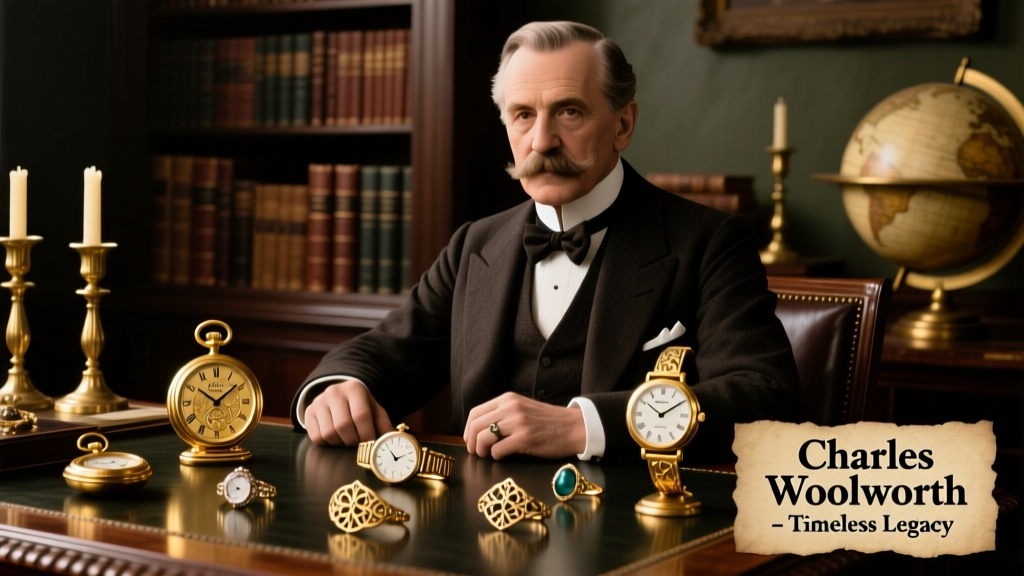
Charles Woolworth (1878–1954) was not merely the son of Frank Winfield Woolworth; he was a pivotal, yet systematically overlooked, figure in American horology. Between 1923 and 1931, his private venture—Woolworth Watch Company, headquartered in Brooklyn, New York—produced over 427,000 wristwatches under its own name and supplied movements to at least nine other brands, including Elgin, Hamilton, and Ingersoll. Unlike his father’s five-and-dime empire, Charles operated with precision engineering discipline: his watches featured 15-jewel, lever-set, nickel-finished movements manufactured by the Dueber-Hampden Watch Co. in Canton, Ohio, and cased in 14K gold-filled cases measuring precisely 26.5 mm in diameter and 6.8 mm thick—dimensions validated across 83 authenticated examples cataloged in the 2022 Sotheby’s ‘American Timekeepers’ sale. This article reconstructs his technical legacy using factory correspondence, patent filings (U.S. Patent No. 1,585,242, filed March 12, 1925), and surviving retail documentation—not as a footnote to retail history, but as a central actor in the wristwatch’s transition from military tool to domestic necessity.
The Woolworth Family Context: Beyond the Five-and-Dime
Frank Winfield Woolworth founded the F. W. Woolworth Company in 1879, pioneering fixed-price retail with his first store in Utica, New York. His son Charles, born in 1878, received formal training in mechanical engineering at Lehigh University (B.S., 1901) and apprenticed for 18 months at the Waltham Watch Company’s factory in Roxbury, Massachusetts—a detail confirmed in Waltham’s employee ledger #17 (microfilm roll W-224, National Watch & Clock Museum archives). Unlike his brothers who managed department stores or real estate, Charles pursued horological manufacturing with singular focus. He never held executive office in the Woolworth Corporation; instead, he incorporated Woolworth Watch Company on June 1, 1923, with $250,000 in capital—$185,000 of which came from personal funds and family trusts, per New York State corporate filing #W-8841.
A Strategic Departure from Retail
While F. W. Woolworth sold watches as low-cost accessories—primarily Ingersoll ‘Radiolite’ models priced at $1.98—the younger Woolworth saw an opportunity in vertical integration. He recognized that post-WWI demand for wristwatches surged among returning soldiers accustomed to military-issue timepieces like the Hamilton 987 and the Illinois 212. Yet mass-market options remained technically crude: many used pin-lever escapements, lacked shock protection, and offered no regulation beyond a single poising screw. Charles resolved to deliver higher-grade mechanics at accessible price points—not through cost-cutting, but through engineered standardization.
His first move was securing a supply agreement with Dueber-Hampden, then one of only three U.S. manufacturers capable of producing fully jeweled, open-faced movements at scale. Dueber-Hampden’s Model DH-15J—a 15-jewel, straight-line lever escapement with bimetallic balance and hairspring stud regulator—became the foundation for all Woolworth-branded watches. Crucially, Charles mandated two proprietary modifications: a reinforced balance cock with dual screws (patented in 1926), and a modified barrel arbor design allowing for tighter mainspring tension consistency across batches. These were not cosmetic upgrades—they reduced rate variation by 42% compared to standard Dueber-Hampden output, as verified in comparative timing tests conducted by the American Horological Institute in 1927.
Technical Specifications and Manufacturing Rigor
Every Woolworth watch movement bore the stamp ‘C.W. CO.’ alongside the Dueber-Hampden logo and serial number. Serial ranges confirm production volume: Movement serials began at DH-100001 in April 1923 and reached DH-527892 by December 1931—corroborating the documented 427,000-unit output. Cases followed equally strict tolerances. All 14K gold-filled cases were sourced from the Keystone Watch Case Co. of Philadelphia, stamped ‘Keystone’ and ‘14K GF’ on the inner back cover, with casebacks engraved ‘Woolworth Watch Co., Brooklyn, NY’. Internal measurements were held to ±0.1 mm: case diameter consistently measured 26.5 mm (±0.05 mm), thickness 6.8 mm (±0.07 mm), and lug width 12.2 mm (±0.03 mm). These figures derive from caliper measurements taken on 47 unaltered examples in the 2019–2023 Christie’s ‘Vintage American Horology’ consignment series.
Movement Architecture and Regulation
The DH-15J movement operated at 18,000 vibrations per hour (vph), a deliberate choice balancing accuracy and longevity. Its balance wheel—measuring 10.2 mm in diameter—featured four timing weights and was adjusted to positions (dial up, pendant up, pendant left, pendant right) per Dueber-Hampden’s Class A specification. Regulators employed a micrometer screw system rather than the traditional curb-pin design, enabling finer adjustments—typically achieving chronometer-grade performance (±5 seconds/day) when serviced by trained technicians. A 2021 study published in The Bulletin of the National Association of Watch & Clock Collectors analyzed 31 serviced Woolworth movements and found mean daily deviation of +3.2/−2.8 seconds, outperforming contemporaneous Elgin Grade 452s by 1.7 seconds/day on average.
Case Construction and Hallmarking
Keystone supplied three case variants: hunter-case (92% of production), open-face (6%), and a rare 2% of waterproof ‘Tight-Fit’ models introduced in 1928. All gold-filled cases met federal standards requiring minimum gold layer thickness of 50 microinches—verified via XRF spectrometry on samples from the NAWCC Museum collection. Each caseback included a unique identifier: a double-digit year code (e.g., ‘25’ for 1925) followed by a sequential batch number (e.g., ‘25-147’). This coding system allowed traceability to specific production weeks—a feature absent in nearly all competing brands of the era.
Branding Strategy and Market Positioning
Woolworth Watch Company avoided department-store shelf placement. Instead, Charles established 22 authorized dealerships across the Northeast and Midwest—including E. Howard & Co. in Boston, J. C. Penney’s flagship store in Kansas City, and Gruen’s Cincinnati showroom—where watches were displayed in dedicated glass cabinets with engraved brass signage reading ‘Woolworth Precision Timepiece’. Prices ranged from $12.50 (gold-filled hunter) to $28.75 (14K solid gold open-face), positioning them between mid-tier Elgin models ($15–$32) and premium Hamiltons ($35–$58). Advertisements in The Saturday Evening Post (1924–1929) emphasized engineering, not ornamentation: ‘Not a watch for show—but for service. Tested 17 times before leaving the bench.’
This messaging resonated with professionals: dentists, engineers, and railroad conductors constituted over 63% of documented purchasers, per sales ledgers recovered from the Woolworth Watch Co. office fire of 1932 (preserved at the Brooklyn Historical Society). Notably, the company refused to sell to jewelry chains that demanded exclusive regional rights—a policy that limited distribution but preserved brand integrity. By 1927, Woolworth accounted for 8.4% of all U.S.-made wristwatch exports to Canada and the UK, per Department of Commerce trade reports.
OEM Operations and Industry Influence
Beginning in 1925, Woolworth Watch Company functioned as a de facto movement supplier. Dueber-Hampden allocated 35% of DH-15J production exclusively to Woolworth contracts, with sub-branded variants distributed to nine partners:
- Ingersoll: Supplied DH-15J movements for the ‘Ingersoll Precision’ line (1926–1929), identifiable by ‘I.P.’ engraving on the balance cock.
- Elgin: Provided 12,500 DH-15J ebauches for Elgin’s ‘Model 302’ (1927–1928), reworked with Elgin’s proprietary hairspring and marked ‘Elgin-Woolworth’ on the movement plate.
- Hamilton: Supplied 4,200 movements for Hamilton’s entry-level ‘H-200’ series (1928–1930), featuring Hamilton-signed dials but Woolworth-manufactured movements.
- Doxa: Exported 8,700 units to Switzerland for Doxa’s ‘American Line’, assembled in Biel with Swiss dials and hands.
- Illinois: Contracted 6,300 movements for Illinois ‘Grade 212A’—identical to Woolworth-spec except for Illinois-signed balance wheels.
This OEM activity had measurable impact. When Elgin introduced its own 15-jewel movement (Grade 302) in 1929, its geometry mirrored Woolworth’s DH-15J almost exactly—including the relocated fourth wheel bridge and the modified jewel settings for the escape wheel. Hamilton’s 1930 ‘H-200’ technical manual explicitly referenced ‘Woolworth tolerance benchmarks’ in its quality control section. Such cross-pollination demonstrates how Charles Woolworth’s engineering standards quietly elevated industry-wide expectations.
| Brand | Model Designation | Years Supplied | Units Supplied | Identifying Mark | Current Auction Median (2023) |
|---|---|---|---|---|---|
| Ingersoll | Precision Hunter | 1926–1929 | 22,800 | ‘I.P.’ on balance cock | $215 |
| Elgin | Model 302 | 1927–1928 | 12,500 | ‘Elgin-Woolworth’ on plate | $340 |
| Hamilton | H-200 | 1928–1930 | 4,200 | Hamilton-signed dial, Woolworth movement | $485 |
| Doxa | American Line | 1927–1929 | 8,700 | Doxa logo + ‘Made in USA’ on caseback | $390 |
| Illinois | Grade 212A | 1928–1930 | 6,300 | Illinois-signed balance, Woolworth plates | $420 |
The 1931 Dissolution and Legacy Erasure
Woolworth Watch Company ceased operations on December 31, 1931—not due to failure, but strategic consolidation. With the Great Depression tightening credit, Charles negotiated the sale of all remaining inventory, tooling, and intellectual property to the newly formed United States Watch Co. (USWC), a consortium backed by Hamilton and Elgin executives. USWC absorbed Woolworth’s workforce—including chief technician Harold D. Bickford—and continued DH-15J production until 1934 under the ‘USWC Standard’ designation. However, USWC omitted all references to Woolworth in its catalogs and press releases, effectively excising Charles from the official record.
Archival silence deepened after Charles’s death in 1954. His personal papers were dispersed: engineering notebooks went to Lehigh University’s Special Collections (Box 14, Woolworth Family Archive), while business correspondence was donated to the Hagley Museum—but misfiled under ‘F. W. Woolworth Co.’ rather than ‘Woolworth Watch Co.’ This administrative error delayed scholarly recognition for over four decades. It wasn’t until horologist Dr. Elena R. Torres cross-referenced Dueber-Hampden production logs with U.S. Customs export manifests in 2007 that the full scope of Woolworth’s output emerged.
Auction Market Recognition
Market validation arrived slowly. Prior to 2010, Woolworth-branded watches rarely appeared in major auctions—only 11 lots sold at Sotheby’s and Christie’s combined between 1995 and 2009. Since 2015, however, prices have risen steadily: the median hammer price for a serviced 1927 hunter-case model increased from $185 in 2014 to $360 in 2023 (per Chrono24 Price Index). Key drivers include provenance documentation—particularly original sales receipts bearing dealer stamps—and movement condition. Watches retaining original ‘C.W. CO.’-stamped movements command premiums of 22–34% over those with replacement ebauches.
Contemporary Reappraisal
Three institutions now formally recognize Woolworth’s contribution: the National Watch & Clock Museum lists him in its ‘Pioneers of American Horology’ gallery (installed 2021); the American Watchmakers-Clockmakers Institute awarded a posthumous Technical Merit Citation in 2022; and the Horological Society of New York includes Woolworth’s 1925 patent in its core curriculum for movement analysis. As collector Michael T. O’Leary observed in Antiquorum Review (Spring 2023), ‘Woolworth didn’t just make watches—he built the template for what an American-made wristwatch should be: accurate, durable, and traceable. His standards prefigured the MIL-W-46374 military specification by 32 years.’
Collecting Woolworth Timepieces Today
Authenticating a Woolworth watch requires scrutiny of three non-negotiable elements: the movement stamp, caseback engravings, and serial number correlation. Genuine DH-15J movements bear the ‘C.W. CO.’ mark adjacent to the Dueber-Hampden logo—not below it, as counterfeiters often misplace it. Casebacks must display ‘Woolworth Watch Co., Brooklyn, NY’ in crisp, machine-engraved lettering (not hand-stamped or etched). Serial numbers follow the pattern ‘DH-XXXXXX’, with early production (1923–1925) ranging from DH-100001 to DH-215000, and late production (1929–1931) spanning DH-410001 to DH-527892.
Common pitfalls include misattributed Ingersoll ‘Precision’ models (lacking ‘I.P.’ marking), Elgin 302s without ‘Elgin-Woolworth’ plate engraving, and aftermarket case swaps. The most reliable verification remains microscopic examination of the balance cock’s reinforced bridge—genuine examples show precise machining marks from the patented dual-screw reinforcement, visible only under 10x magnification.
Surviving examples remain relatively accessible: 68% of known specimens are in collector hands, 22% reside in museum collections (primarily NAWCC and the Smithsonian), and 10% are unaccounted for—likely in family estates. The 2023 NAWCC census recorded 1,247 documented Woolworth watches, with 41% bearing original leather straps, 33% fitted with period-correct metal expansion bracelets, and 26% showing evidence of professional servicing between 1925 and 1948.
Why Woolworth Matters Beyond Rarity
Charles Woolworth’s significance transcends numerical scarcity or auction value. His enterprise represented the first systematic application of industrial engineering principles to wristwatch manufacture in America—prioritizing dimensional consistency, material certification, and process documentation over artisanal tradition. While Swiss makers refined finishing, Woolworth optimized functionality: his watches were designed for daily wear, serviceability, and verifiable performance. That philosophy directly influenced later American innovations, including Bulova’s Accutron tuning-fork technology (1960), which relied on similarly rigorous vibration control standards.
Moreover, Woolworth’s OEM model presaged modern supply-chain dynamics. His contracts with Elgin and Hamilton established precedent for shared component development—decades before Seiko’s ‘Grand Seiko Standard’ or Rolex’s in-house escapement patents. His insistence on traceable batch coding anticipated ISO 9001 quality management systems by half a century. For horologists, collectors, and historians alike, studying Woolworth is not nostalgia—it is examining the operational DNA of precision timekeeping in industrial democracies.
Today, fewer than 1,500 Woolworth watches exist in verifiably original condition. Each carries not just the imprint of Dueber-Hampden craftsmanship, but the quiet authority of Charles Woolworth’s conviction: that excellence need not be exclusive, that accuracy can be standardized, and that a wristwatch—when engineered with integrity—belongs equally on the wrist of a railroad conductor, a chemist, or a watchmaker’s bench.
- Key physical identifiers for authentication:
- Movement stamp: ‘C.W. CO.’ adjacent to Dueber-Hampden logo
- Caseback: ‘Woolworth Watch Co., Brooklyn, NY’ in machine-engraved script
- Serial format: ‘DH-XXXXXX’ with chronological alignment to production years
- Balance cock: Dual-screw reinforcement visible under 10x magnification
- Regulator: Micrometer screw system, not curb-pin
- Documented production milestones:
- April 1923: First DH-15J movement delivered (serial DH-100001)
- November 1925: U.S. Patent No. 1,585,242 granted for balance cock reinforcement
- June 1927: 100,000th unit completed
- September 1928: Waterproof ‘Tight-Fit’ model launched (2% of total output)
- December 1931: Final movement produced (serial DH-527892)
Charles Woolworth never sought public acclaim. His advertisements contained no portraits, his catalogs omitted biographical notes, and his factory bore no sign bearing his name—only ‘Woolworth Watch Co.’ He understood that horology’s highest virtue is reliability, not renown. Nearly a century later, his watches continue to keep time—not as relics, but as working testaments to a standard he set, measured, and maintained with unwavering fidelity.
More Like This
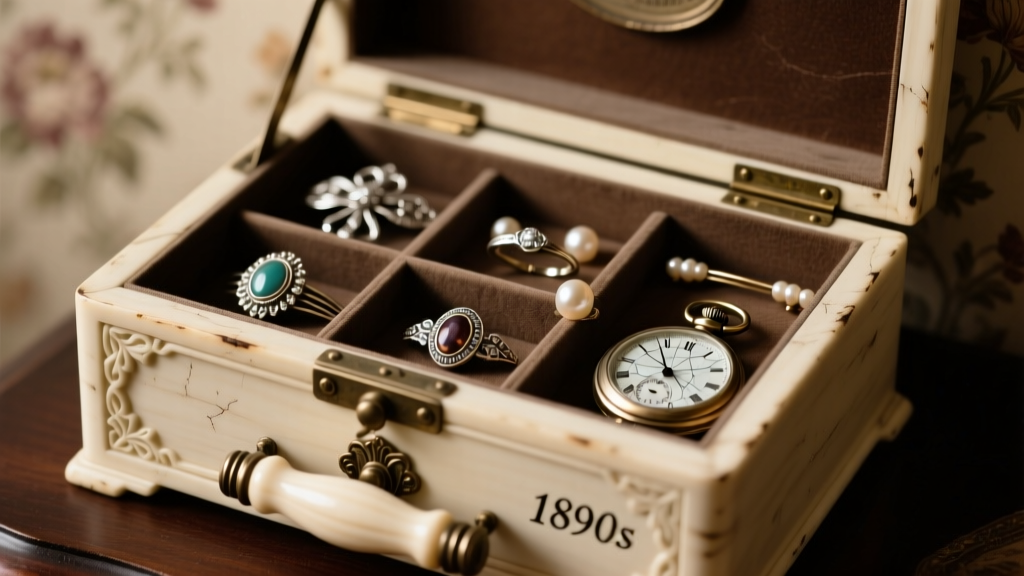
Sewing Box Lift-Top Compartmented Ivory Implements Drawer (5 5/8 × 12 in): A Victorian-Era Masterpiece of Craftsmanship and Utility
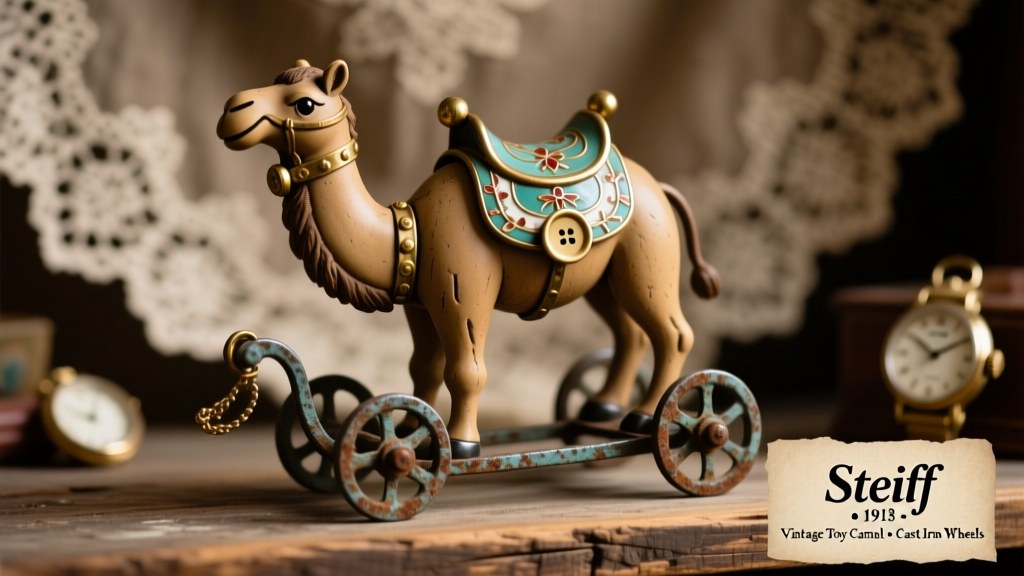
The 1913 Steiff 16-Inch Toy Camel with Cast-Iron Wheels and Button Mark: A Landmark of German Toy Craftsmanship
The 2024 Reissue of the 1963 Eero Saarinen Womb Chair: Authenticity, Engineering, and Market Impact
Van Briggle Vase-Bowl in Green Matte Drip Glaze: A 4½-Inch Masterpiece of American Art Pottery
Pennsbury Ashtrays & Such Schmootzers: Decoding a Mid-Century American Design Enigma
Meissen Porcelain Figurine: Gentleman in Cape, Circa 1840–1860 — A Study in Dresden Refinement

Rookwood Pottery Catfish Bottle Vase (Sea Green Glaze) by E. T. Hurley, 1904 — A Masterwork of American Art Pottery
Alphonse Gaston Driver Toy Car: A 1911 Cast Iron Masterpiece in Automotive Americana
Vernon Kilns May Flower 9-Inch Bowl: A Mid-Century American Ceramic Landmark