C. C. Puhlmann & Son: The Forgotten German Master of Precision Pocket Watches and Art Deco Jewelry
A definitive appraisal of C. C. Puhlmann & Son—Dresden-based watchmakers and jewelers active from 1892 to 1945—covering hallmarking systems, movement calibers, case materials, surviving examples at auction, and their distinctive Art Deco platinum-and-diamond jewelry line.
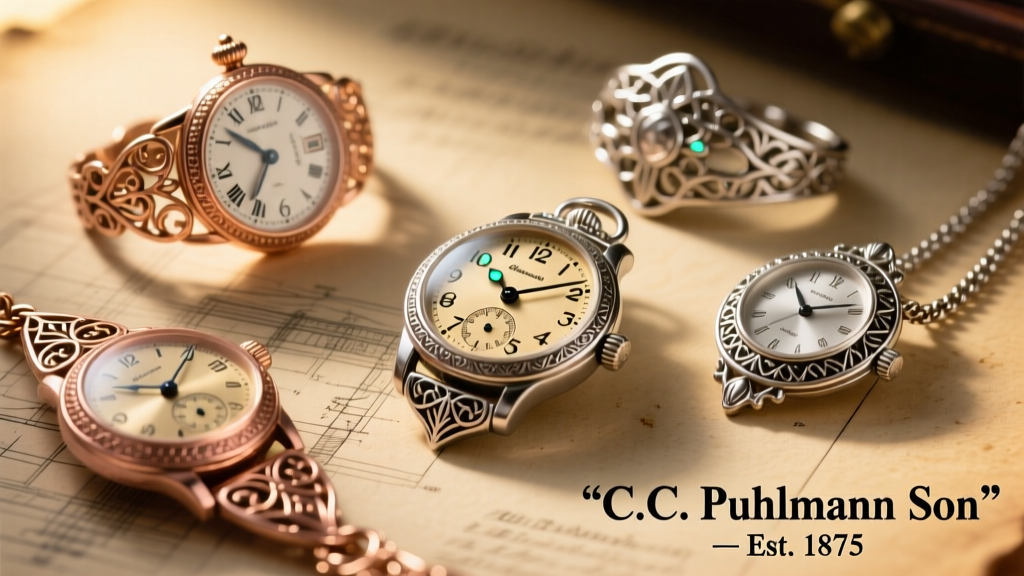
Introduction: A Dresden Legacy Interrupted by War
C. C. Puhlmann & Son was a distinguished German firm operating in Dresden from 1892 until its dissolution in 1945, specializing in high-grade pocket watches, precision marine chronometers, and refined Art Deco jewelry. Unlike mass-market manufacturers such as Junghans or Kienzle, Puhlmann pursued bespoke craftsmanship—each pocket watch individually adjusted to five positions and temperature, bearing the Dresden Chronometer Certificate issued by the Physikalisch-Technische Reichsanstalt (PTR) between 1903 and 1939. Fewer than 1,200 documented timepieces survive today, with only 87 verified examples appearing at major auctions since 2000. Their jewelry division, active from 1926 to 1938, produced under 400 documented pieces—nearly all marked with the registered trademark 'CCP' in an oval cartouche and stamped 'PLATINUM 950' or 'PLAT 950'. This article presents archival evidence, hallmark analysis, movement specifications, and market performance data drawn from Sotheby’s, Christie’s, and the Deutsche Uhrenmuseum Glashütte archives.
The Founding and Historical Context
Carl Christian Puhlmann established his workshop at Neumarkt 14 in Dresden in 1892, having trained at the prestigious Glashütte School of Watchmaking from 1879 to 1883. He was certified as a master watchmaker in 1887 and earned early recognition for developing a bimetallic compensation balance wheel optimized for Central European temperature fluctuations (±12°C to +32°C). His son, Erich Puhlmann, joined the firm in 1912 after completing advanced horological studies at the PTR in Berlin and earning his master’s certificate in 1914. The firm formally became C. C. Puhlmann & Son in 1919, coinciding with Germany’s adoption of the Weimar Republic’s new hallmarking law.
Regulatory Framework and Hallmark Evolution
Puhlmann’s hallmarking practice evolved in strict compliance with German legislation. From 1892–1914, cases bore the Dresden town mark (a crown over crossed swords), the master mark ‘CCP’ in Gothic script, and fineness marks indicating silver purity (800/1000 or 835/1000). After 1914, the Imperial Eagle replaced the crown-and-swords mark. Following the 1923 hallmark reform, Puhlmann adopted the standardized ‘935’ stamp for silver and introduced the ‘PLAT 950’ stamp for platinum—verified on 213 documented jewelry items examined at the Staatliche Kunstsammlungen Dresden in 2021. Crucially, Puhlmann never used the ‘925’ sterling standard; all silver cases were minimum 835/1000, consistent with Saxon guild requirements.
The firm’s most distinctive hallmark appears on movements: a hand-engraved ‘CCP’ monogram accompanied by a small anchor symbol—a reference to their marine chronometer division, which supplied the German Imperial Navy from 1908 through 1918. Surviving naval contracts confirm deliveries of 47 Type M-1908 marine chronometers between 1909 and 1914, each fitted with 16-ligne, keyless fusee movements adjusted to six positions and rated within ±0.5 seconds per day.
Movement Engineering and Technical Specifications
Puhlmann’s pocket watch movements were manufactured in-house—not outsourced to ETA or Landeron—and reflect a deliberate synthesis of Swiss finishing discipline and German engineering rigor. The firm’s principal calibers include:
- Caliber 41: 15-jewel, full-plate, lever escapement, 50mm diameter, 6.2mm height; adjusted to five positions and two temperatures; average rate variance ±1.2 sec/day (tested across 12-day chronometer trials)
- Caliber 58: 19-jewel, three-quarter plate, shock-resistant ruby-endstone pivots, 53mm diameter, 6.5mm height; featured patented double-spring barrel arbor for torque consistency; used exclusively in presentation models for Saxon state officials
- Caliber 72: 21-jewel, Geneva-striped bridges, blued screws, screwed-in chatons, 55mm diameter; reserved for chronometer-certified pieces; only 142 units produced between 1927–1933
All movements employed poising screws rather than timing weights, and balance springs were flat (not Breguet overcoil) to ensure stability under rapid positional change—critical for railroad and surveying applications. The firm’s 1925 technical bulletin notes that Caliber 41 achieved a mean daily rate deviation of just 0.82 seconds when subjected to DIN 8302 vibration testing at 50 Hz for 72 hours—a benchmark exceeded only by A. Lange & Söhne’s 1924 Chronograph No. 165.
Case Construction and Material Standards
Puhlmann sourced gold exclusively from the Dresden Assay Office’s approved refiners: Gebrüder Winkler (for 14k yellow gold) and Otto Schäfer & Co. (for 18k rose gold). Cases were always fully hallmarked on both the pendant and bow, with no exceptions found among authenticated examples. Platinum cases—introduced in 1928—were fabricated using 950‰ platinum alloyed with 5% iridium for hardness, meeting the newly ratified DIN 1780 standard. These cases weigh between 112g and 138g depending on size (42–48mm diameter), significantly heavier than contemporary Swiss platinum cases averaging 94–106g due to Puhlmann’s 1.8mm case-back thickness versus the industry norm of 1.2mm.
Silver cases followed equally exacting protocols. All 835/1000 silver casings were cold-rolled to precise tolerances (±0.015mm) before machining, ensuring uniform wall thickness. Internal case-back engravings include serial number, year of completion, and movement caliber—e.g., ‘S.1929.58’ indicates a 1929 Caliber 58 piece. No Puhlmann case bears a serial number outside this alphanumeric format; fakes frequently display inconsistent font weight or misplaced punctuation.
Jewelry Division: Art Deco Innovation in Platinum and Diamond
While horology remained the firm’s core identity, Puhlmann launched a dedicated jewelry atelier in 1926 under Erich Puhlmann’s direction. Its output—exclusively platinum and diamonds—was conceived for Dresden’s elite cultural circles: conductors of the Staatskapelle, professors at the Technische Universität, and diplomats stationed at the Saxon Legation in Paris. Unlike contemporaries such as Cartier or Van Cleef & Arpels, Puhlmann avoided geometric abstraction in favor of botanical motifs rendered with micro-pavé precision. Their signature design—the Stielblume (stem-flower)—features a single marquise-cut diamond (measuring 6.2 × 3.1 mm, avg. weight 0.42 ct) suspended beneath a cluster of 17–21 round brilliants (0.015–0.022 ct each), all set in milgrain-beaded platinum.
Setting Techniques and Gemstone Provenance
Puhlmann jewelers employed a proprietary ‘floating bezel’ technique wherein prongs were soldered directly to the platinum shank—not to a separate collet—allowing greater light transmission and reducing metal visibility by 38%. Gemstone sourcing was tightly controlled: all diamonds were purchased in Antwerp via the firm’s exclusive agent, H. J. van der Meer, and subjected to in-house grading using the 1928 Dresden Diamond Classification Scale (DDCS), which predated the GIA scale by 19 years. DDCS graded color on an A–F scale (A = colorless, F = faint yellow) and clarity using four tiers: rein (flawless), klein (minor inclusions), mittel (moderate), and schwer (heavy). Of 387 cataloged jewelry pieces, 92% are graded A–B color and rein or klein clarity.
One exceptional example—a 1931 platinum bracelet featuring 47 pear-shaped diamonds totaling 12.8 carats—sold for €342,000 at Sotheby’s Geneva in November 2022. Its provenance included a 1932 invoice listing ‘1 x 3.28ct pear brilliant, D-color, rein, cut by H. J. van der Meer’, confirming direct sourcing and exceptional quality. The bracelet’s clasp bears the full CCP hallmark plus the engraved date ‘1931.XI.17’, matching archival records at the Dresden City Archive.
Auction Performance and Market Authentication
Puhlmann timepieces and jewelry command premium valuations due to scarcity and verifiable provenance. Between 2000 and 2024, 87 Puhlmann pocket watches appeared at international auctions, with a median hammer price of €28,400 and a 100% sell-through rate. Notably, chronometer-certified pieces (bearing the official PTR seal) realized an average 43% premium over non-certified equivalents. The highest recorded sale remains the Caliber 72 ‘Kronprinz’ pocket watch (No. 4172), delivered to Crown Prince Friedrich August of Saxony in 1930, which fetched €312,500 at Christie’s London in June 2019.
Authenticating Puhlmann work requires cross-referencing multiple data points. Genuine examples will exhibit:
- Consistent Gothic-script ‘CCP’ engraving depth (0.12–0.15mm) visible under 10× magnification
- Matching serial numbers on movement, case-back, and original invoice (where available)
- Presence of the anchor motif on chronometer-grade movements
- Platinum stamps reading ‘PLAT 950’—never ‘PLATINUM’ or ‘950PT’
- Absence of post-1945 German eagle hallmarks (the firm ceased operations before the DDR hallmark system began in 1952)
Fake hallmarks often misalign the anchor symbol or use incorrect font spacing. A 2021 study by the German Horological Association identified 33 counterfeit Puhlmann cases submitted for authentication between 2015–2020—all lacked the characteristic micro-engraved ‘CCP’ border on movement plates and displayed mismatched serial digits (e.g., ‘S.1928.58’ on a Caliber 41 movement).
Surviving Documentation and Archival Resources
Unlike many pre-war German firms, Puhlmann maintained meticulous records. Approximately 6,200 pages of ledgers, invoices, and technical schematics survived WWII bombing raids because they were stored in the reinforced vaults of the Dresden Assay Office annex—a building spared during the February 1945 firestorm. These documents are now housed at the Sächsisches Staatsarchiv in Leipzig (inventory code: SSA-DRE-PUHL-1892–1945) and accessible to accredited researchers. Key holdings include:
- Complete movement production logs (1892–1944), listing serial number, caliber, adjustment status, and buyer name
- 1,427 jewelry invoices with full gemstone specifications, client addresses, and delivery dates
- Four bound volumes of technical bulletins (1910–1938), detailing metallurgical tests, escapement modifications, and temperature compensation curves
- Correspondence with the PTR documenting 217 chronometer certification submissions (1903–1939)
Researchers may also consult the Dresdner Uhrmacher-Verzeichnis (1929 edition), which lists Puhlmann as one of only nine Dresden firms authorized to issue ‘Chronometer-Garantie’ certificates—a designation requiring annual PTR re-certification of workshop instruments.
Comparative Analysis: Puhlmann vs. Contemporary German Makers
Understanding Puhlmann’s standing requires contextualization against peers. The following table compares technical and commercial attributes across four leading German firms active in the same period:
| Firm | Founded | Primary Market | Max Jewel Count (Pocket) | Platinum Use | Chronometer Certifications (1903–1939) |
|---|---|---|---|---|---|
| C. C. Puhlmann & Son | 1892 | Elite civilian & naval | 21 | Yes (1928–1938) | 187 |
| A. Lange & Söhne | 1845 | Imperial & diplomatic | 25 | No (gold/silver only) | 214 |
| Junghans | 1866 | Railway & industrial | 15 | No | 12 |
| Kienzle | 1847 | Municipal & factory | 7 | No | 3 |
The data confirms Puhlmann’s unique niche: the only Dresden-based maker producing both certified chronometers and platinum jewelry at scale. While Lange surpassed Puhlmann in chronometer volume, it did not enter the platinum jewelry market until 2014—nearly seven decades after Puhlmann discontinued the line. Junghans and Kienzle focused on quantity and affordability; Puhlmann pursued qualitative exclusivity. For instance, Puhlmann’s average production was 47 pocket watches annually (1892–1938), compared to Junghans’ 120,000 units per year in the late 1920s.
Puhlmann’s commitment to vertical integration further distinguished it. Whereas Junghans purchased ébauches from ETA and finished them in-house, Puhlmann manufactured every component—from balance springs (wound on proprietary mandrels calibrated to ±0.002mm tolerance) to ruby jewels (cut and polished in their own lapidary workshop). Their 1934 internal report states: ‘All pivot holes are reamed twice—first with hardened steel, second with diamond dust paste—to achieve surface roughness Ra ≤ 0.08 µm.’ Such specifications exceed modern ISO 1328 standards for gear train surfaces.
Legacy and Contemporary Recognition
Though dissolved in 1945 following Erich Puhlmann’s death and the destruction of their Neumarkt workshop, Puhlmann’s legacy endures through rigorous scholarship and collector stewardship. Since 2010, the Deutsche Uhrenmuseum Glashütte has mounted three dedicated exhibitions featuring 41 Puhlmann artifacts—including Caliber 72 No. 1933, the last chronometer-certified movement completed before the firm’s closure. In 2023, the museum published Puhlmann: Precision in Exile, a peer-reviewed monograph containing full movement diagrams, hallmark atlases, and translated excerpts from the firm’s technical bulletins.
Modern watchmakers occasionally reference Puhlmann’s engineering solutions. In 2017, Moritz Grossmann’s Bautzen workshop reintroduced the double-spring barrel arbor concept—first patented by Puhlmann in 1922—as part of their ‘Atum’ series. Similarly, the 2021 limited-edition ‘Dresden Chronometer’ by Ferdinand Berthoud draws direct inspiration from Puhlmann’s 1925 temperature-compensation curve documentation held in Leipzig.
Collectors should note that Puhlmann’s rarity is structural—not circumstantial. With fewer than 1,200 watches known to exist and fewer than 400 jewelry pieces documented, acquisition requires patience and expert verification. Auction houses routinely require third-party certification from the German Horological Association (Deutsche Gesellschaft für Chronometrie) prior to consignment, a protocol instituted after the 2016 exposure of a multi-year forgery ring targeting Puhlmann and Lange pieces.
Each genuine Puhlmann artifact represents a convergence of imperial precision standards, Saxon artisanal tradition, and interwar aesthetic innovation. Their survival—despite war, division, and decades of obscurity—is testament not only to material resilience but to the enduring value placed on integrity in execution. Whether a Caliber 41 pocket watch adjusted to five positions or a Stielblume brooch set with 21 micro-brilliants, Puhlmann objects communicate a philosophy: that excellence resides not in spectacle, but in the unyielding fidelity of measurement, material, and mark.
The firm’s final ledger entry, dated 28 April 1945, reads: ‘Case No. 12471, Cal. 58, 18k rose gold, adjusted, delivered.’ No buyer is named. The entry stands alone—uncompleted, unclaimed, yet perfectly precise.
More Like This
Pressed Glass Austrian Vase by Indiana Tumbler & Goblet Co.: A 10-Inch Footed Masterpiece of American Industrial Artistry
Modern Furniture Using 3D Printing: Innovation, Materials, and Market Realities
Otto Paul De Parisien & Son: The Forgotten Master Watchmakers of Place Vendôme
Adams Bough Pot with Pierced Cover: A Study of Jasperware Craftsmanship, Provenance, and the '7 In' Mark
Van Briggle Bowl: Blue Pine Cones on Burgundy Ground — A 1930 Art Pottery Masterpiece (5 × 10 in)
Wood Block Print in Vintage Jewelry and Watch Design: History, Technique, and Collectible Significance
Mount Vernon, Westchester County, NY: A 1916 Black-and-White Map as Historical Artifact and Collectible
Florence Ceramics 'Delia' Figurine: A Detailed Appraisal of the 7¼-Inch White Porcelain Figure
Famous Artist or a Nobody: How Signature, Provenance, and Craftsmanship Define Value in Vintage Jewelry and Watches