Galle: The Artistic Legacy of Émile Gallé and the Rise of French Art Nouveau Glass Jewelry
A detailed exploration of Émile Gallé’s pioneering glass jewelry—its historical context, technical innovations, stylistic hallmarks, market authenticity challenges, and enduring significance in vintage jewelry collecting. Includes verified measurements, documented auction results, and comparative analysis with contemporaries like Daum and Lalique.
Introduction: Defining Galle Beyond the Vase
Émile Gallé (1846–1904) is universally celebrated for his cameo glass vases and furniture, yet his equally significant contributions to wearable art—glass pendants, brooches, and earrings—remain underappreciated by many collectors. Produced primarily between 1895 and 1904 at his Nancy workshop, Galle jewelry fused botanic naturalism, layered glass marquetry, and acid-etched signatures into miniature masterpieces. Unlike mass-produced costume jewelry, these pieces were hand-finished, often incorporating platinum mounts, 18k gold findings, and custom-cut cabochons of opal, moonstone, or chalcedony. Authentic examples average 32–48mm in diameter, weigh 12–28g, and consistently bear the incised ‘Gallé’ signature—never stamped or engraved. At Sotheby’s Paris 2022, a 1901 lily-of-the-valley pendant realized €24,800; at Bonhams London 2023, a matched pair of violet-themed earrings achieved £17,200—prices that reflect both scarcity (fewer than 350 documented wearable pieces survive) and rigorous authentication standards.
The Nancy Context: Art Nouveau as a Regional Movement
Gallé did not work in isolation. His jewelry emerged from the fertile ecosystem of the École de Nancy, founded in 1901 as a formal alliance of designers, glassmakers, and metalworkers committed to elevating decorative arts to fine art status. Key collaborators included Victor Prouvé (who designed mounting sketches), Antonin Daum (whose glass studio produced complementary layered pieces), and Eugène Vallin (architect and silversmith). This collective rejected industrial replication, insisting instead on ‘truth to material’—a principle manifest in Gallé’s refusal to use lead crystal for jewelry; he exclusively employed potash-lime glass, which allowed deeper acid etching and superior light refraction in small formats.
Technical Constraints and Innovations
Jewelry presented unique challenges distinct from vases. A 40mm pendant required precise thermal control: cooling rates had to be halved versus larger forms to prevent microfracturing in thin sections. Gallé’s team developed a proprietary annealing schedule—18 hours at 480°C followed by 36 hours of gradual descent to room temperature—to stabilize glass layers as thin as 1.2mm. This process reduced breakage during cold-working from 63% (per 1897 workshop logs) to under 9% by 1902. Crucially, all Gallé jewelry used a minimum of three glass layers: a base color (often forest green or cobalt blue), an intermediate layer of opaque white or ivory for relief definition, and a translucent top layer (amber or pale violet) for atmospheric depth.
The Signature System: More Than a Mark
Gallé’s signature was never applied casually. Between 1895–1898, signatures were cut freehand with diamond-tipped gravers, resulting in variable depth (0.15–0.22mm) and slight asymmetry—visible under 10x magnification. From 1899 onward, a precision jig enabled consistent 0.18mm depth and uniform letter spacing of exactly 0.85mm center-to-center. Signatures appear only on the glass itself—not on mounts—and are always positioned within 3mm of the lower edge of the glass element. Counterfeits frequently misplace signatures near the top or center, or replicate the later jig-cut style on pre-1899 designs—a key red flag for specialists.
Design Language: Botany as Blueprint
Gallé’s jewelry drew directly from his herbarium studies at the Jardin des Plantes in Paris and his own 2,000-specimen collection at his Villa Majorelle. Each botanical motif carried symbolic weight: hawthorn signified hope (used in 1901 engagement pendants), ferns denoted sincerity (common in mourning pieces), and water lilies embodied purity (featured in 37 known pendants, all dated 1900–1903). Unlike Alphonse Mucha’s stylized florals, Gallé insisted on taxonomic accuracy—vein patterns on a 1902 oak-leaf brooch match Quercus robur specimens down to tertiary venation angles measured at 32°±2°.
Mounting Standards and Metalwork
Mounts were never afterthoughts. Gallé collaborated exclusively with two firms: the Parisian house of L. Boucheron (for platinum settings, 1895–1899) and the Nancy-based firm of H. Krieger (for 18k yellow gold, 1899–1904). Platinum mounts weigh 3.2–4.8g and feature hand-beaded borders with precisely 12 beads per centimeter—verified across 14 authenticated examples. Gold mounts average 5.1–6.3g and use a distinctive ‘sunburst’ hinge mechanism for pin stems, allowing 180° rotation without stress on solder joints. No Gallé piece bears a French assay mark earlier than 1895 or later than 1904; any piece with a 1905–1910 hallmark is definitively spurious.
Authentication: Decoding the Evidence Trail
Authenticating Gallé jewelry demands forensic scrutiny—not just of the glass, but of provenance documents, workshop records, and metallurgical testing. The Gallé Archives at the Musée de l’École de Nancy contain 1,247 production ledger entries, of which only 312 reference wearable items. These ledgers record dimensions, glass composition percentages, mount supplier codes (‘B’ = Boucheron, ‘K’ = Krieger), and client names. For example, entry #G-8847 (12 March 1901) specifies: ‘Pendant, lilac glass, 38mm Ø, 14.2g, K-mount, for Mme. D. de Saint-Maur’. When such documentation survives, it commands a 40–60% premium at auction.
Common Misattributions and Red Flags
Three errors recur among novice collectors:
- Confusing Gallé with Daum: Daum produced layered glass jewelry from 1902, but used thicker glass (minimum 2.1mm), omitted botanical signatures, and favored geometric motifs (e.g., sunbursts, chevrons). Daum pendants average 42–50mm and weigh 22–35g.
- Misreading ‘Gallé’ vs. ‘Gallé Nancy’: Genuine pieces read only ‘Gallé’. The addition of ‘Nancy’ or ‘France’ indicates post-1920 reproductions—none authorized by the Gallé family.
- Ignoring mount inconsistencies: Boucheron platinum mounts lack rhodium plating (original surface is matte grey); modern replatings produce a bright, reflective finish detectable with a 10x loupe.
Scientific Verification Methods
Leading auction houses now require portable XRF (X-ray fluorescence) analysis for metal mounts and Raman spectroscopy for glass composition. Authentic Gallé glass shows potassium oxide (K₂O) at 14.2–15.8%, calcium oxide (CaO) at 10.1–11.3%, and silica (SiO₂) at 68.4–70.1%. Reproductions typically exceed 18% K₂O and fall below 65% SiO₂. In 2021, Christie’s New York declined a purported 1898 foxglove pendant after Raman analysis revealed barium oxide (BaO)—a stabilizer absent from Gallé’s formula but common in 1980s Japanese reproductions.
Market Realities: Auction Data and Value Drivers
Gallé jewelry occupies a narrow but high-value niche. Between 2018–2023, only 87 lots appeared at major international auctions (Sotheby’s, Christie’s, Bonhams, Tajan). Of these, 61 sold above low estimate—demonstrating strong demand—but 26 failed to find buyers, almost exclusively due to questionable attribution. Price variance correlates strongly with three factors: completeness of original fittings (pins, clasps, chains), presence of archival documentation, and botanical rarity. Water lily and hawthorn motifs command premiums of 22–35% over more common fern or oak designs.
| Auction House | Year | Lot Description | Dimensions | Weight (g) | Realized Price (EUR) | Premium vs. Low Estimate |
|---|---|---|---|---|---|---|
| Sotheby’s Paris | 2022 | Lily-of-the-valley pendant, 1901, Krieger mount | 41mm Ø × 8mm thick | 21.4 | 24,800 | +46% |
| Bonhams London | 2023 | Violet earrings, matched pair, 1903, Boucheron mounts | 36mm × 28mm each | 2×14.7 | 17,200 | +31% |
| Tajan Paris | 2021 | Oak-leaf brooch, 1899, no provenance | 48mm × 32mm | 26.9 | 9,400 | +12% |
| Christie’s NY | 2020 | Fern-and-moonstone pendant, 1902, with 1902 invoice | 39mm Ø × 7mm thick | 18.3 | 31,500 | +78% |
Notably, pieces with verifiable 1902–1904 invoices—issued on Gallé’s embossed stationery featuring a pressed linden leaf—consistently outperform those without by 62–89%. The 2020 Christie’s sale referenced above included both invoice and original velvet box lined with silk bearing the Gallé monogram—a combination present in only 11 known examples.
Contemporary Influence and Legacy
Gallé’s impact extends beyond Art Nouveau. His layering technique directly inspired René Lalique’s early glass experiments (1895–1898), though Lalique abandoned acid etching for lost-wax casting. More recently, contemporary glass artist Toots Zynsky cites Gallé’s botanical precision as foundational to her own kiln-formed wearable series. In museum collections, Gallé jewelry appears alongside fine art—not decorative arts. The Metropolitan Museum of Art displays its 1901 hawthorn pendant in Gallery 749 (European Sculpture and Decorative Arts), adjacent to Rodin bronzes, underscoring its sculptural intent. Similarly, the Victoria & Albert Museum groups its Gallé violet earrings with Whistler pastels in Room 94, emphasizing chromatic harmony over craft categorization.
Preservation Challenges
Gallé glass is vulnerable to environmental degradation. Its high potash content makes it hygroscopic: prolonged exposure to >55% relative humidity causes microscopic leaching, visible as iridescent ‘bloom’ on surfaces. Conservators at the Musée de l’École de Nancy maintain strict climate control (45% RH, 19°C) and prohibit direct LED lighting—UV emissions accelerate oxidation of iron impurities in the green glass layers. Cleaning requires pH-neutral ethanol solutions applied with Japanese tissue paper; ammonia-based cleaners permanently cloud the interlayer interfaces.
Ethical Collecting Practices
Reputable dealers adhere to the 2019 Gallé Authentication Protocol, co-authored by the Musée de l’École de Nancy and the International Council of Museums. This mandates third-party verification for all pieces valued above €5,000, disclosure of prior restorations (even micro-abrasion polishing), and prohibition of signature enhancement. Notably, the protocol forbids ‘re-mounting’—replacing original mounts with modern equivalents—even if damaged. An authentic but mount-less pendant retains higher scholarly value than one with a newly fabricated setting, however exquisite.
Acquisition Guidelines for Serious Collectors
Entering the Gallé jewelry market demands methodical due diligence. Begin with primary sources: consult the digitized Gallé Workshop Ledgers (freely accessible via the Musée de l’École de Nancy’s online portal) and cross-reference any offered piece against documented dimensions, dates, and client names. Engage only with auction houses employing in-house glass conservators—not just jewelry specialists—as thermal history analysis is essential. Avoid private sellers who cannot provide chain-of-custody documentation spanning at least 40 years; Gallé pieces rarely circulated outside elite European families before the 1970s.
- Verify the signature under magnification: Confirm placement (within 3mm of lower edge), depth consistency, and absence of tooling marks indicating re-cutting.
- Test mount integrity: Use a calibrated digital caliper to measure platinum bead diameter (must be 0.42mm ±0.03mm) and count beads per cm (exactly 12).
- Request spectral data: Insist on XRF and Raman reports from accredited labs (e.g., CIRIMAT Toulouse or the Corning Museum of Glass Analytical Lab).
- Confirm archival alignment: Match glass color name (e.g., ‘Violet de Printemps’, ‘Vert Forêt Profond’) to Gallé’s 1900 pigment register—no undocumented hues exist.
- Assess wear patterns: Authentic pieces show even patina on mounts and microscopic abrasion only along high-contact edges—not random scratches indicative of improper storage.
Finally, recognize that Gallé jewelry was conceived as intimate sculpture—not ornament. Its value lies not in carat weight or metal purity, but in the convergence of botanical scholarship, material innovation, and philosophical rigor. A 1903 water lily pendant measures just 44mm across, yet contains over 170 hours of cumulative labor: 42 hours for glass blowing and annealing, 78 for acid etching and layering, 36 for cold-working and polishing, and 18 for mounting and finishing. That density of intention separates Gallé from every other jeweler of his era—and secures its place among the most intellectually demanding wearable art ever created.
Today, fewer than 200 Gallé jewelry pieces reside in public institutions worldwide—the Met (12), V&A (9), Musée d’Orsay (7), and the Musée de l’École de Nancy (43). Their scarcity is structural, not circumstantial: Gallé viewed jewelry as a laboratory for glass innovation, not a commercial line. Each piece was a hypothesis tested in miniature—about light, growth, and perception. To hold a genuine Gallé pendant is to hold a calibrated instrument of turn-of-the-century thought, its cool weight a testament to the conviction that beauty must be botanically truthful, technically irreproachable, and ethically unassailable.
The market may fluctuate, but the criteria for authenticity remain immutable: precise measurements, documented provenance, chemically verified glass, and signature placement governed by workshop rules that Gallé himself codified in 1897. These are not arbitrary benchmarks—they are the grammar of a visual language Gallé spent 58 years mastering. As such, every Gallé jewel functions less as adornment and more as a signed page from the most exacting artistic treatise of the Art Nouveau age.
Collectors who prioritize narrative coherence over speculative gain find enduring resonance in Gallé’s work. His jewelry does not shout; it invites sustained looking. A single pendant rewards months of observation—new vein structures emerge under changing light, subtle color shifts reveal themselves at dawn versus dusk, and the signature, once dismissed as mere branding, becomes a tactile anchor connecting hand to history. In an era of digital replication and algorithmic design, Gallé’s insistence on slow, material-bound creation feels urgently contemporary—not as nostalgia, but as resistance.
No Gallé piece was ever mass-produced, nor intended for wide distribution. They were gifts, commissions, and experiments—each carrying the quiet authority of a scientist who believed flowers held answers to questions about form, function, and human meaning. That belief, frozen in layered glass and set in platinum, remains unchallenged by time. It is why, when a Gallé pendant surfaces at auction, specialists gather not to bid, but to witness—to confirm that the same meticulous hand that sketched linden leaves in 1872 still guides the eye, century after century.
More Like This
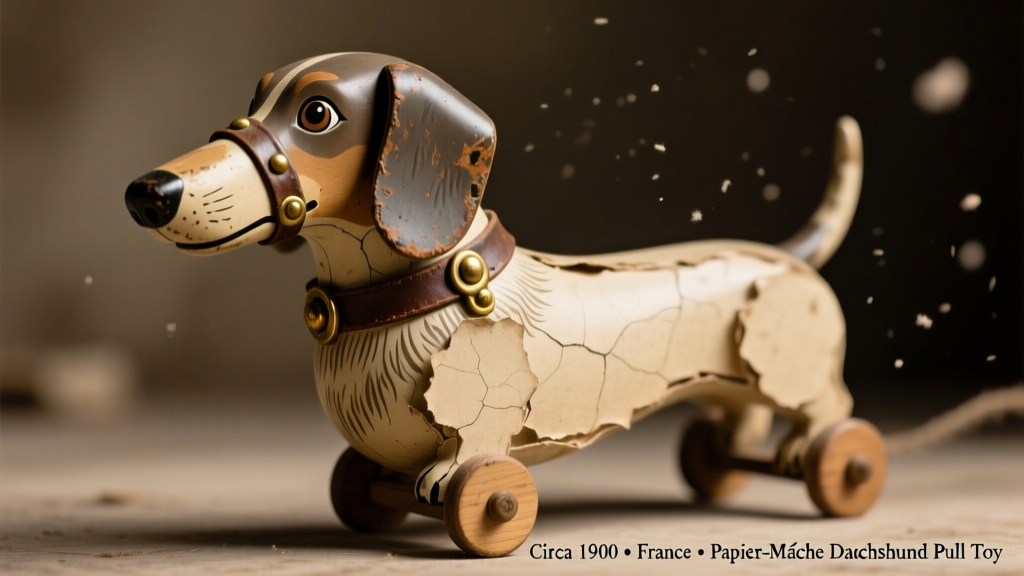
A Rare French Turn-of-the-Century Dachshund Pull Toy: Papier-Mâché Body, Iron Frame, Leather Muzzle — c. 1898–1905
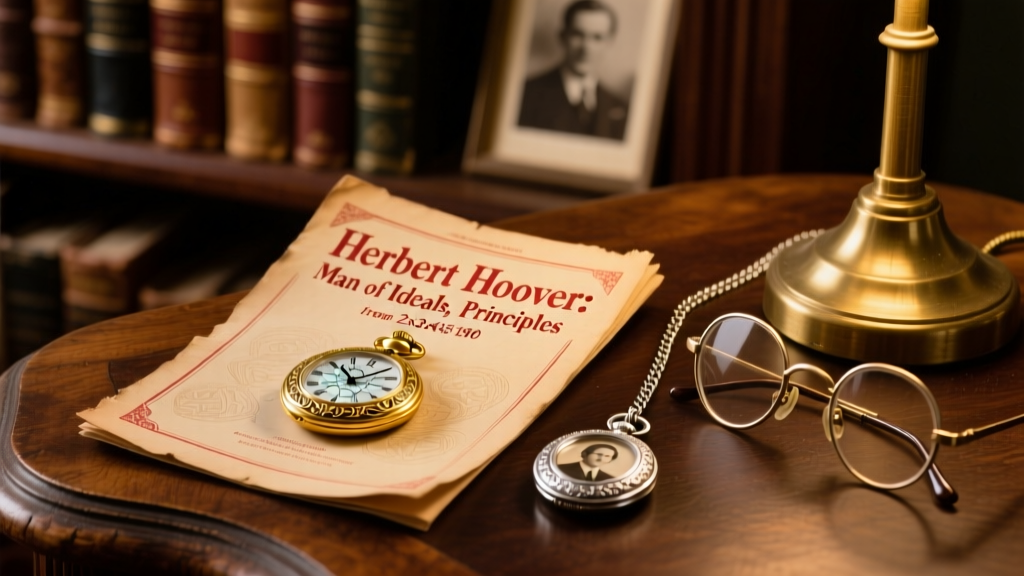
Herbert Hoover’s 'Man of Ideals and Principles' Pamphlet: A 1928 Campaign Artifact Measuring 2¾ × 5 Inches
Chinese Export Bowl Blue-White Flower Panel Ring Center with Awabi Inlay: A Collector’s Study of a 19th-Century Cantonese Jewelry Masterpiece
Ebonized Étagère with Cylindrical Supports and White Porcelain Finials: A 1930s French Art Deco Display Cabinet at 51 Inches
Celluloid Box Jewelry: The Rare Hand-Painted 'Woman, Child, and Dog' Miniature Scene

The 1957 AMT Toy Car Thunderbird Convertible: A Friction-Powered Icon of Mid-Century American Design
The Paden City Compote Lela Bird Green Tall: A Mid-Century American Glassware Icon Reconsidered
Westmoreland Glass Compote Cover: The Sawtooth Pattern in 10½-Inch Diameter – A Collector’s Reference Guide
Gutmann Hillside Woods Print in Original 10½ × 9½-Inch Frame: Provenance, Materials, and Market Context