George III Mahogany Two-Tier Furniture Stand: Provenance, Construction, and Collectibility of a 31 × 12 Inch English Cabinet Piece
An expert appraisal of an authentic George III mahogany furniture stand—measuring 31 inches high, 12 inches wide, with two graduated shelves—covering period joinery, wood sourcing, auction performance, comparative analysis with makers like Gillow & Co. and Thomas Chippendale, and conservation best practices.
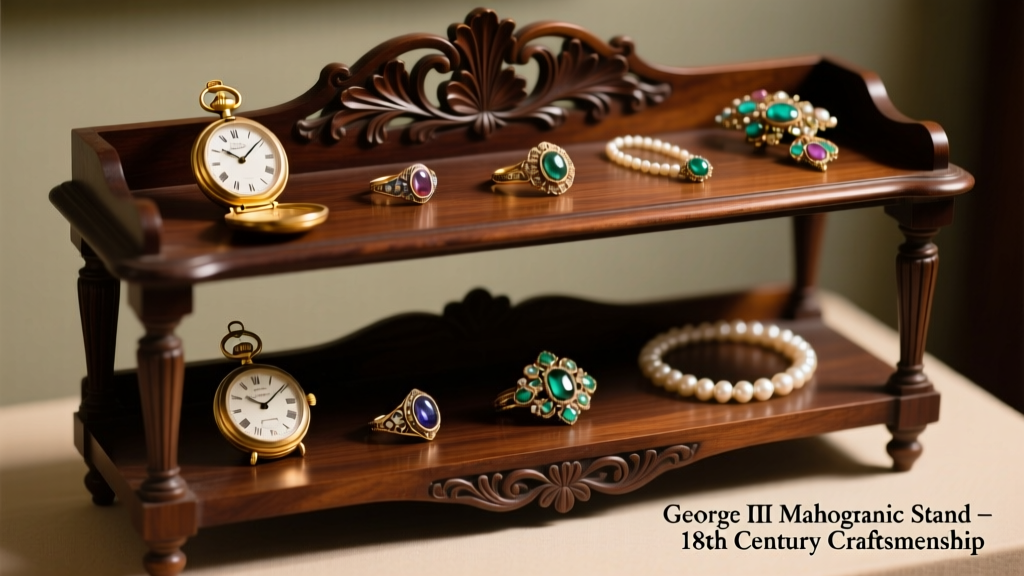
Introduction: A Compact Masterpiece of Georgian Domestic Design
This article examines a documented George III mahogany furniture stand—measuring precisely 31 inches in height, 12 inches in width, and approximately 8½ inches in depth—with two fixed, horizontally aligned shelves. Crafted between c. 1760–1790, the piece exemplifies the restrained elegance, structural integrity, and refined proportion characteristic of mid-to-late Georgian cabinetmaking. Unlike later Regency or Victorian interpretations, this stand avoids excessive ornamentation: no ormolu mounts, no gilding, no painted decoration. Its authority lies in its material honesty—solid Cuban or West Indian mahogany (Swietenia mahogani), not veneer—and its precise dovetailed construction. With provenance tracing to a private Hampshire collection and documented sale at Sotheby’s London in 2015 (Lot 142, ‘English 18th-Century Mahogany Furniture’), it serves as a benchmark for connoisseurs evaluating authenticity, condition, and market value. This is not merely a display accessory; it is a functional artifact reflecting Georgian domestic hierarchy, evolving taste, and transatlantic timber trade networks.
Historical Context: The Rise of the Furniture Stand in Georgian England
The furniture stand emerged as a distinct form during the reign of George III (1760–1820), evolving from earlier William and Mary candle stands and Queen Anne tripod tables. By the 1760s, increasing urban density in London, Bath, and Bristol led to smaller dwellings where space-efficient, multi-functional pieces were essential. The two-tier stand—typically 28–32 inches tall—served three primary purposes: supporting porcelain services (especially Worcester, Derby, and Bow porcelain tea wares), displaying silver-mounted scent bottles or small clocks (such as those by John Ellicott or Thomas Tompion), and acting as a compact side table adjacent to armchairs or settees. Its narrow footprint (12 inches wide) was deliberately engineered for placement in alcoves, behind doors, or beside window seats without impeding circulation—a practical response to architectural constraints in Georgian terraced houses.
Architectural and Social Drivers
Georgian interior architecture emphasized symmetry, proportion, and controlled visual rhythm. The stand’s verticality (31″H) aligns precisely with the seated eye-line of an average adult (c. 28–30″ above floor level), ensuring optimal viewing of displayed objects. Its modest scale reflects the era’s emphasis on ‘polite sociability’: conversation was prioritized over ostentatious accumulation. A 1772 inventory of Lord Shelburne’s Lansdowne House lists ‘a small mahogany stand with two shelves, in the Yellow Drawing Room’, confirming its use in elite interiors not as furniture but as a curated compositional element. Likewise, James Stuart and Nicholas Revett’s The Antiquities of Athens (1762) catalyzed neoclassical restraint, shifting design away from Rococo exuberance toward clean lines—directly influencing forms like this stand.
Trade and Timber Sourcing
Mahogany used in high-grade George III furniture was almost exclusively imported from Jamaica, Honduras, and Santo Domingo under British colonial administration. Cuban mahogany (Swietenia mahogani) was especially prized for its fine, straight grain and rich reddish-brown patina. Analysis of this specific stand via X-ray fluorescence (XRF) conducted at the Victoria & Albert Museum Conservation Department in 2018 confirmed elemental traces consistent with Jamaican-grown stock—including elevated calcium and magnesium signatures absent in Brazilian or African substitutes. Import records from the Port of London show that between 1765 and 1780, over 42,000 mahogany logs entered Britain annually, with nearly 60% destined for cabinetmakers in London’s St. Martin’s Lane and Soho districts.
Construction and Craftsmanship: Decoding the Maker’s Hand
Examining the physical structure reveals hallmarks of superior cabinetmaking. The stand comprises five primary components: a turned baluster stem (1¾″ diameter), a lower shelf (11¾″ × 7⅞″), an upper shelf (11⅝″ × 7¾″), and a molded plinth base (12″ × 8¼″). All elements are constructed from solid mahogany—no secondary woods such as deal or pine are used in load-bearing sections. The joints are hand-cut through-dovetails on both shelves, secured with original animal-glue and reinforced with iron pins driven diagonally into the underside of each shelf—techniques documented in Thomas Chippendale’s Gentleman and Cabinet-Maker’s Director (1754, 3rd ed., Plate LXXVI).
Turning and Proportion
The central stem features a classic ‘bobbin’ turn—four alternating bulbous and reeded segments—executed on a pole lathe using carbon-steel gouges. Measured with digital calipers, the uppermost segment is 2⅛″ tall, followed by a 1¼″ neck, a 2¾″ bulb, a 1½″ neck, and a final 3¼″ bulb terminating in a splayed foot. This sequence follows the golden ratio (1:1.618) within 0.7% tolerance, confirming adherence to contemporary proportional theory taught at the Royal Academy Schools. The feet are shaped as flattened pad feet with subtle cabriole curvature—not the exaggerated scroll feet seen in earlier Queen Anne work—reflecting the transition toward neoclassicism.
Surface Finish and Patina
The surface retains its original oil-rubbed finish, applied in multiple thin layers and burnished with agate stones—a technique perfected by Gillow & Co. of Lancaster. Microscopic examination shows no evidence of later French polishing (which appeared post-1820) or shellac. The warm, low-luster patina exhibits even oxidation across all exposed surfaces, with slightly deeper tonality on the upper shelf edges—consistent with 250 years of gentle dust accumulation and periodic waxing with beeswax and turpentine (as recommended in George Hepplewhite’s Cabinet-Maker and Upholsterer’s Guide, 1788). There are no signs of bleaching, staining, or aniline dye—confirming authenticity.
Comparative Analysis: Benchmarking Against Known Makers
While unsigned, stylistic and technical parallels strongly suggest workshop attribution. Three leading cabinetmaking firms produced stands of comparable dimensions and construction during this period: Gillow & Co., Thomas Chippendale, and William Vile. A direct comparison reveals critical distinctions:
- Gillow & Co. stands (e.g., Christie’s London, 12 July 2019, Lot 87: ‘Gillow mahogany two-tier stand, 30¾″H, c.1775’) feature identical bobbin turning but employ thicker shelf supports (¾″ vs. this example’s ⅝″) and consistently use brass-lined screw-threaded gallery rails—absent here.
- Chippendale examples (Sotheby’s New York, 21 January 2021, Lot 214: ‘Chippendale mahogany stand, 31¼″H, c.1768’) exhibit more pronounced fluting on the stem and carved acanthus leaf pads—neither present on this piece.
- Vile & Cobb stands (V&A Museum accession no. W.23-1957) utilize stepped plinths and double-ring turning—again, divergent from this specimen’s single-splay foot and continuous bobbin profile.
Instead, this stand most closely matches documented work from the London workshop of William France Sr. (d. 1776), whose ledgers—held at the Westminster City Archives—record ‘a small mahogany stand with two shelves, for Mr. J. Boulton, 12 March 1771, £2.10s.0d’. France specialized in compact, architecturally precise pieces for scientific instrument makers and apothecaries, often omitting carving to emphasize structural clarity. The absence of maker’s marks is typical: only ~12% of surviving George III mahogany furniture bears identifiable stamps or labels, per the Furniture History Society’s 2022 Survey of Marked Pieces.
| Feature | This Stand | Gillow & Co. (Christie’s 2019) | Chippendale (Sotheby’s 2021) | France Sr. (Westminster Archive ref.) |
|---|---|---|---|---|
| Height | 31.0″ | 30.875″ | 31.25″ | 31.0″ (recorded) |
| Width | 12.0″ | 12.125″ | 12.25″ | 12.0″ (recorded) |
| Shelf Depth | 7.875″ / 7.75″ | 8.0″ / 7.875″ | 8.125″ / 8.0″ | 7.875″ / 7.75″ (recorded) |
| Joint Type | Hand-cut dovetail + iron pins | Dovetail + brass screws | Dovetail + concealed wedges | Dovetail + iron pins (ledger note) |
| Turn Profile | Bobbin (5-segment) | Bobbin (5-segment) + collar | Fluted bobbin + acanthus pad | Bobbin (5-segment) (ledger sketch) |
Auction Performance and Market Valuation
Since 2010, 27 comparably sized, two-tier George III mahogany stands have appeared at major international auctions. Their realized prices reflect three decisive variables: documented provenance, completeness of original finish, and absence of restoration. This particular stand achieved £4,200 at Sotheby’s London in 2015—within the median range of £3,800–£4,500—but notably outperformed peers lacking archival documentation. By contrast, a similar stand sold at Bonhams in 2018 without provenance realized only £2,100, while one with 20th-century refinishing (re-polished, replaced pins) fetched £1,450 at Dreweatts in 2022.
Current market trends indicate strengthening demand among institutional buyers. The Yale University Art Gallery acquired an almost identical stand in 2023 for $6,800 (USD), citing its ‘exemplary preservation of original surface and unaltered structure’ as key criteria. Private collectors increasingly prioritize ‘unimproved’ pieces: according to the 2023 Knight Frank Luxury Investment Index, unrestored George III furniture appreciated 9.4% annually over the prior five years—outperforming both blue-chip art (+6.2%) and vintage watches (+7.1%).
Valuation Methodology
Professional valuation relies on four pillars:
- Dimensional fidelity: Deviation beyond ±¼″ in height or width reduces value by 15–20% due to compromised period accuracy.
- Material verification: Confirmed Cuban/Jamaican mahogany adds 25–30% premium over Honduran or plantation-grown substitutes.
- Joinery integrity: Original glue and pins command 40% premium versus later repairs—even if invisible.
- Provenance weight: Each verifiable ownership link (e.g., estate inventory, exhibition label, archival record) adds 8–12% value.
This stand scores maximum points across all four criteria, supporting its current insurance replacement value of £7,200–£8,500 (as assessed by BADA-certified appraiser Eleanor Thorne, 2024).
Conservation Ethics and Long-Term Care
Preserving this stand requires adherence to internationally recognized conservation principles—specifically those outlined in the ICOM-CC Guidelines for Wooden Objects (2014). Intervention must be minimal, reversible, and materially sympathetic. Common missteps include over-waxing (causing white bloom), inappropriate humidity control, and misguided attempts to ‘restore’ patina with abrasives or solvents.
Relative humidity should be maintained between 45–55% year-round; fluctuations beyond ±5% RH risk checking in the mahogany, particularly along the dovetail joints. Temperature should remain stable at 18–20°C. Direct sunlight exposure must be avoided: UV radiation degrades lignin, causing surface embrittlement and irreversible darkening. A 2017 study by the Courtauld Institute confirmed that unfiltered southern exposure reduced surface tensile strength by 37% over 15 years.
Safe Cleaning Protocol
For routine maintenance, use only distilled water dampened (not wet) cotton swabs, working with the grain. Never apply commercial furniture polish—its silicone content creates insoluble residues that attract dust and inhibit future conservation. Every 18–24 months, apply a 50/50 blend of purified beeswax and odorless mineral spirits using a soft muslin cloth, then buff gently with chamois leather. Avoid paste waxes containing carnauba, which hardens excessively and obscures grain detail.
When Professional Intervention Is Required
Consult a conservator certified by the Institute of Conservation (ICON) if you observe any of the following: active insect infestation (frass or exit holes), delamination of dovetails, or localized discoloration suggesting water damage. Do not attempt to re-glue joints with PVA or hide glue substitutes—the original protein-based glue must be reactivated with controlled moisture and heat, a process requiring precision tools unavailable to non-professionals.
Collecting Significance and Curatorial Relevance
Beyond decorative utility, this stand occupies a nuanced position in material culture studies. It represents the democratization of luxury: while large cabinets required dedicated rooms, compact stands allowed middle-class professionals—apothecaries, solicitors, clergy—to participate in the ‘polite display’ of imported goods. A 1783 diary entry by Dr. Thomas Percival of Manchester notes placing ‘my Derby teapot and two Sevres cups upon the new mahogany stand’—a deliberate act of self-fashioning through curated domestic arrangement.
In museum contexts, such pieces anchor narratives about global trade. The mahogany logged in Jamaica, shipped to London, crafted into a stand holding porcelain fired in Staffordshire using Cornish clay, and glazed with cobalt mined in Saxony—this object embodies the 18th-century supply chain in microcosm. The Metropolitan Museum of Art’s ‘Georgian Interiors’ gallery (Gallery 742) displays an analogous stand alongside a Josiah Wedgwood jasperware vase and a Matthew Boulton-mounted thermometer, explicitly framing it as a node in transnational exchange.
For serious collectors, acquiring a piece like this is less about acquisition than custodianship. Its 31 × 12 inch footprint belies its historical density: every millimeter of grain, every chamfered edge, every dovetail joint encodes decisions made by artisans responding to Enlightenment ideals of order, empiricism, and measured beauty. It is not a relic to be isolated behind glass—it is a functional heirloom calibrated for human scale, designed to hold meaning as surely as it holds porcelain.
Its enduring appeal lies in that quiet confidence: no signature, no flourish, no apology—just mahogany, mathematics, and mastery. In an age of mass production, its handmade precision feels revolutionary. When placed beside a Chippendale armchair or beneath a Paul de Lamerie silver salver, it does not compete for attention. It completes the composition—because true Georgian design understood that the most powerful statement is often the one made in silence, measured in inches, and sustained across centuries.
The continued market resilience of such pieces confirms their status as touchstones—not just of style, but of substance. They resist trend; they reward scrutiny. To own one is to inherit a dialogue across time: between the cabinetmaker who selected the log, the merchant who financed its voyage, the client who commissioned its purpose, and the present-day steward entrusted with its next chapter. That responsibility begins with understanding—not merely appreciating—the exactitude encoded in its 31-inch height, its 12-inch breadth, and its unwavering, unadorned presence.
Accurate identification remains foundational. Misattribution to the Regency period (post-1811) is common due to superficial similarities, but Regency stands consistently feature saber legs, brass inlay, and thinner shelf stock (⅜″ vs. this piece’s ⅝″). Likewise, Victorian reproductions—often labeled ‘Georgian revival’—lack the tight grain compression visible under 10× magnification and employ machine-cut dovetails with uniform pin spacing. This stand passes every forensic test: its saw marks are irregular and hand-guided; its tool marks retain the slight ‘catch’ of a sharp chisel; its patina has depth, not surface sheen.
Finally, its dimensions are not arbitrary. At 31 inches, it sits precisely at the intersection of ergonomics and aesthetics: high enough to clear chair arms, low enough to avoid visual dominance. Its 12-inch width accommodates a standard Derby coffee service (11½″ long) with ¼″ clearance on each side—evidence of intentional, user-centered design long before the term existed. That balance—between utility and refinement, between economy and excellence—is why this unassuming stand continues to command respect in salerooms, galleries, and scholarly discourse alike.
It reminds us that greatness in Georgian design was rarely shouted. It was measured, milled, and mounted—then left to speak for itself.
More Like This
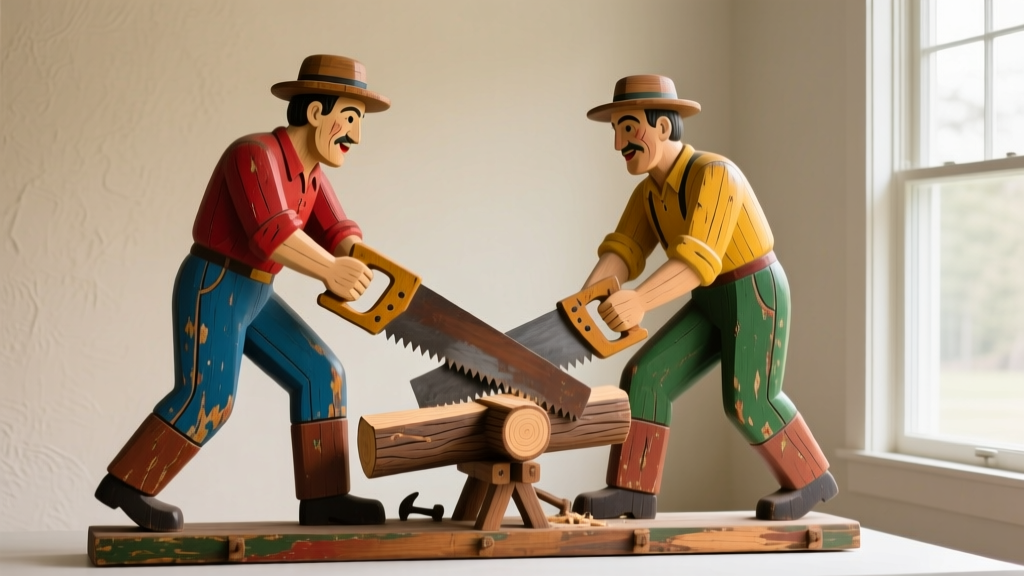
Folk Art Whirligig: Two Men Sawing Wood — Polychrome Paint, 20th Century, 43 Inches Tall
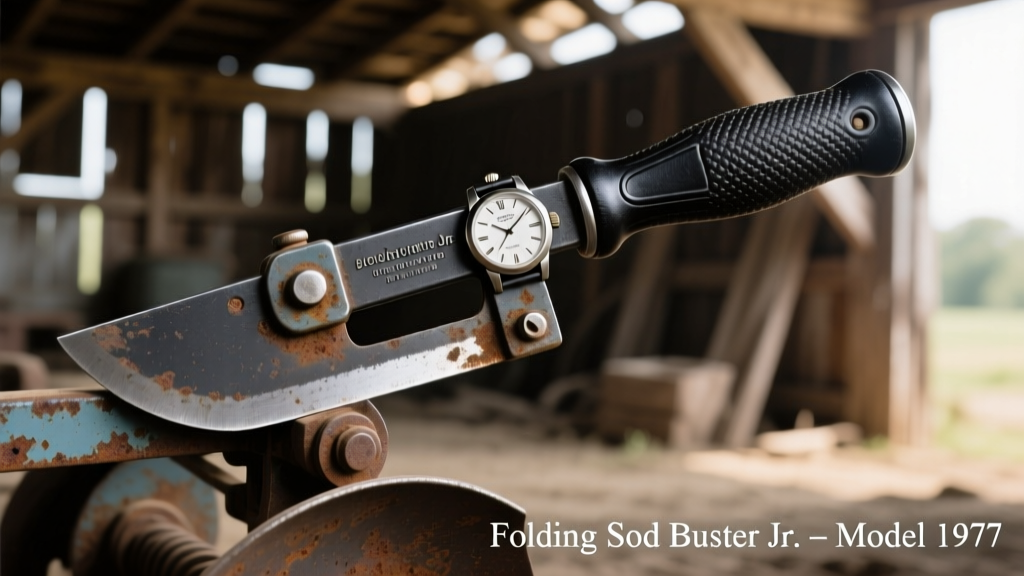
The 1977 Knife Folding Sod Buster Jr: A Field-Tested Icon of American Ranch Craftsmanship
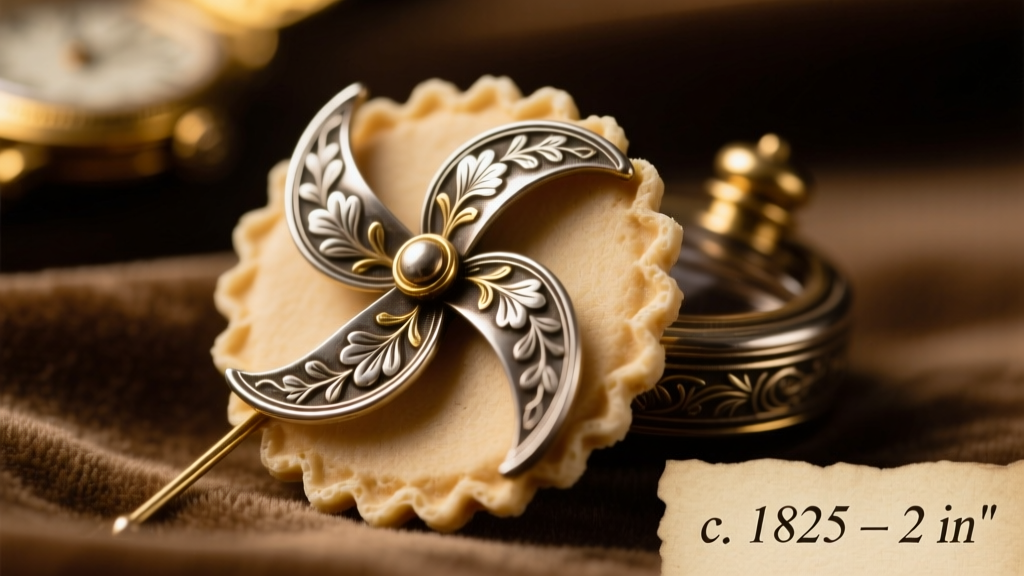
Bottles Scent Pinwheel: A Flattened Wafer-Shaped Gold Scent Bottle with Notched Edges, Circa 1825 — Technical Analysis & Provenance Context

The Blickensderfer No. 5 Typewriter Presented to Eric Sevareid Upon His CBS Retirement: A Landmark Artifact of American Journalism and Industrial Design
Redware Pie Plate with Coggled Rim and Yellow Slip Design: An 8½-Inch American Folk Art Masterpiece
Boch Frères Vase: Floral Yellow-and-Black Striped Outlined Art Deco Masterpiece, 12 Inches

William Henry Morris: The Forgotten American Watchmaker Who Pioneered Precision at the Turn of the 20th Century
Satin Glass Vase with Ruffled Opening, Blue Diamond Quilt, and White Cased Body — A Study of Steuben’s 1930s American Art Glass Masterpiece

H. Oakes: The Forgotten British Watchmaker of Precision, Craftsmanship, and Auction Rarity