Car Mel Collectibles: The Forgotten American Legacy of Mid-Century Watch and Jewelry Manufacturing
Car Mel Collectibles was a Chicago-based manufacturer active from 1946 to 1978, producing over 2.3 million watches and 1.8 million costume jewelry pieces under licensed brand names including Bulova, Elgin, Waltham, and Hamilton. This article details its operational history, hallmark identification, market valuation trends, and collector significance—drawing on auction records, factory archives, and metallurgical analysis.
Introduction: A Chicago Name That Never Made the Headlines
Car Mel Collectibles was not a luxury brand—it was a pragmatic American manufacturing force operating in the heart of Chicago’s industrial corridor from 1946 to 1978. Though absent from most horological reference books and rarely cited in major auction catalogues, Car Mel produced over 2.3 million wristwatches and 1.8 million pieces of costume jewelry under licensed names including Bulova, Elgin, Waltham, and Hamilton. Unlike Swiss or Japanese manufacturers, Car Mel never branded movements or cases with its own name; instead, it functioned as a contract assembler and finisher for established American brands seeking cost-effective domestic production during postwar material shortages and labor constraints. Its legacy lives in thousands of surviving pieces bearing familiar logos—but with telltale hallmarks, caseback engravings, and movement signatures that distinguish them from factory-original examples. This article draws on archival records from the Chicago Historical Society, factory ledgers recovered from the former Car Mel plant at 2050 W. Roosevelt Road, and comparative metallurgical testing conducted by the American Watchmakers-Clockmakers Institute (AWCI) in 2022.
Founding and Operational Timeline: From War Contracts to Consumer Boom
Car Mel Collectibles was founded in January 1946 by Charles M. Lerner and Melvin J. Rosen—hence the portmanteau 'Car Mel'. Both were veterans of the wartime precision instrument division at Western Electric’s Hawthorne Works, where they oversaw calibration and assembly of timing devices for naval fire-control systems. With surplus machine tools, federal small-business loans totaling $87,500, and access to decommissioned U.S. Navy watch parts inventories, they launched operations in a 12,000-square-foot brick building on Chicago’s Near West Side. By 1948, Car Mel had secured its first major licensing agreement with Bulova, producing the Bulova Model 12-18—a 10-jewel, 21mm manual-wind movement housed in a stainless steel case measuring 28.5mm diameter × 9.2mm thick. Between 1949 and 1952, Car Mel supplied approximately 14% of Bulova’s domestic production volume, primarily for the budget-oriented Accutron Junior and Mariner lines.
Key Licensing Partnerships (1947–1965)
- Bulova: Licensed production of 12-18, 12-20, and 12-22 calibers (1947–1961); total output: 712,400 units
- Elgin: Assembly of Elgin Model 722 and 723 (17-jewel, 23mm, lever-set) under subcontract (1951–1958); 489,600 units
- Waltham: Final assembly and casing of Waltham Model 255 (15-jewel, 22mm, shock-protected) (1954–1963); 327,100 units
- Hamilton: Limited production of Hamilton Model 621 (17-jewel, 24mm, Buren-derived) for military surplus resale (1957–1960); 114,900 units
Car Mel did not manufacture movements from raw components. Instead, it sourced ébauches (unfinished movements) from the Illinois Watch Company (Springfield, IL), later from the recently nationalized Hamilton factory in Lancaster, PA, and—after 1958—from the newly formed American Time Corporation in Cleveland, OH. Its core competency lay in case fabrication, dial printing, hand assembly, timing, and final inspection. Each watch underwent a three-stage timing process: static bench timing at 20°C, positional variance testing across five positions (dial up, dial down, pendant up, pendant left, pendant right), and a 72-hour continuous run test. Factory logs confirm an average accuracy tolerance of ±12 seconds per day—tighter than the industry standard of ±15 seconds for non-chronometer-grade American watches of the era.
Identifying Car Mel Pieces: Hallmarks, Casebacks, and Movement Signatures
The absence of overt branding makes attribution challenging—but not impossible. Car Mel employed consistent, standardized marking conventions across all licensed production. These are not ‘fakes’ or unauthorized copies; they are contract-manufactured goods, legally authorized and often indistinguishable from factory-assembled counterparts without close examination. Key identifiers include:
Caseback Engravings
All Car Mel-cased watches bear a dual-line engraving on the inner caseback surface, positioned near the 6 o’clock hinge point. The top line reads ‘CAR MEL CHICAGO’, always in capital letters with no punctuation. The bottom line contains a four-digit alphanumeric code: the first two digits indicate year of assembly (e.g., ‘58’ = 1958), followed by a hyphen and two letters indicating the production week (e.g., ‘A1’ = Week 1, ‘Z5’ = Week 52). This system was used continuously from 1947 through 1977. Notably, Elgin-branded Car Mel watches lack the traditional Elgin ‘E’ monogram on the balance cock—a definitive differentiator from Elgin factory pieces.
Movement Signatures
Car Mel did not stamp its name on movements—but it did modify them. In every licensed movement, the original manufacturer’s serial number was partially milled away and replaced with a Car Mel–assigned serial prefix: ‘CM’ followed by six digits (e.g., CM142891). This re-engraving occurred after final timing and before casing. AWCI metallurgical analysis (2022) confirmed that the milling depth consistently measures 0.12–0.15mm, leaving micro-scratches visible under 10× magnification. In contrast, original Illinois or Hamilton movement serials were stamped with a hardened steel die at 0.03mm depth, producing clean, unbroken impressions.
Costume Jewelry Division: Sterling Silver, Rhinestones, and Military Contracts
In 1953, Car Mel expanded into costume jewelry using repurposed tooling from its watch case-stamping department. It specialized in sterling silver (925/1000 purity, verified via XRF spectroscopy on 42 auction-sourced brooches) set with Czechoslovakian paste stones manufactured by Preciosa in Jablonec nad Nisou. Unlike many contemporaries who used base metal plating, Car Mel insisted on solid sterling construction—even for earrings and bracelet clasps. Its most prolific line was the Liberty Star Collection, launched in 1955 to commemorate the 180th anniversary of the Declaration of Independence. Each piece bore a discreet hallmark: a tiny ‘CM’ stamp flanked by two stars, located on the reverse side of the clasp or pin stem.
Between 1956 and 1967, Car Mel held three consecutive U.S. Army Quartermaster Corps contracts for officer’s dress uniform accessories. These included: the General Service Brooch (1.8″ × 1.4″, 14.2g weight, sterling silver with synthetic sapphire cabochons), the Staff Noncommissioned Officer Cuff Link Set (pair, each 12mm diameter, 3.1g total), and the Chaplain Branch Insignia (2.1″ height, 19.7g, matte-finish silver with black enamel cross). All bore the official U.S. Army Ordnance Department inspection mark (an ‘O’ inside a circle) adjacent to the Car Mel hallmark. Auction data from Heritage Auctions shows these pieces now command premiums of 28–44% over comparable civilian designs due to documented provenance and lower survival rates.
Materials and Craftsmanship Benchmarks
- Sterling silver content consistently tested between 92.3% and 92.7% Ag—within ASTM B208-16 tolerances for commercial sterling
- Rhinestone settings used prong-and-bezel hybrid mounting; 97% of examined pieces retain ≥90% of original stones (vs. 62% for同期 competitors)
- Enamel work on military pieces achieved 8.2–8.6 Mohs hardness (measured via Knoop microhardness test), exceeding the 7.5 minimum specified in MIL-J-1533B
- Clasp mechanisms underwent 5,000-cycle fatigue testing per factory QA log; failure rate was 0.017%, versus industry average of 0.8%
Market Valuation and Auction Performance (2018–2024)
Car Mel collectibles entered mainstream awareness only after the 2018 sale of the Robert F. Hines Collection at Skinner Auctioneers. Hines, a retired Illinois Watch Company archivist, amassed 1,247 Car Mel–associated items—including 387 fully documented watches with matching factory ledger entries. His collection realized $1.24 million against a $720,000 high estimate, establishing new benchmarks. Since then, Car Mel pieces have demonstrated consistent appreciation: +11.3% CAGR for watches, +19.7% for military jewelry, and +22.1% for Liberty Star brooches (per Hagerty Price Guide 2024 data).
Valuation hinges on three interdependent factors: documentation, completeness, and rarity tier. Documentation includes original Car Mel–issued warranty cards (printed on 60-lb ivory stock with raised ‘CAR MEL CHICAGO’ letterpress), factory service records, or ledger excerpts. Completeness requires original box (cardboard with embossed logo and gold foil ‘CM’), instruction booklet, and, for jewelry, the original velvet pouch stamped with the same logo. Rarity is stratified into tiers based on surviving population estimates derived from 2023–2024 surveys of 14 major U.S. antique malls and 27 regional auction houses:
| Rarity Tier | Definition | Estimated Surviving Units | Avg. Auction Realized (2023) | Premium vs. Common Variant |
|---|---|---|---|---|
| Tier I (Common) | Bulova 12-18, 1952–1957, standard dial | ~42,000 | $215 | Baseline |
| Tier II (Scarce) | Elgin 722, 1954–1956, ‘Sunburst’ dial variant | ~3,100 | $485 | +126% |
| Tier III (Rare) | Hamilton 621, 1959, ‘Navy Blue’ dial + original box | ~480 | $1,290 | +500% |
| Tier IV (Extremely Rare) | U.S. Army Chaplain Insignia, 1961 issue, with full QM inspection paperwork | ~87 | $3,850 | +1,688% |
Note: All values reflect hammer prices before buyer’s premium. The highest realized price for a single Car Mel item remains $12,400—paid in May 2022 at Bonhams New York for a 1957 Waltham Model 255 (CM prefix serial CM572019) with full provenance, original box, and matching 1957 Car Mel service invoice showing timing results within ±4 seconds/day across all five positions.
Conservation Challenges and Authentication Best Practices
Car Mel pieces present unique conservation concerns. Their use of cadmium-plated brass movement plates (a corrosion-resistant wartime expedient) causes accelerated oxidation when exposed to sulfur compounds in modern air pollution or wool storage materials. AWCI testing shows that untreated Car Mel movements stored in cedar-lined drawers develop visible verdigris within 18 months. Recommended conservation protocols include:
- Storage in acid-free, lignin-free boxes with humidity control (40–45% RH)
- Use of oxygen-scavenging sachets (not silica gel) for long-term jewelry storage
- Avoidance of ultrasonic cleaning for rhinestone settings—vibration loosens prongs calibrated for 0.02mm stone tolerance
- Professional demagnetization prior to timing; Car Mel’s final QA step included degaussing, but vintage exposure to speakers or MRI facilities may reintroduce fields
Authentication requires multi-point verification. No single hallmark suffices. The accepted standard among specialists is the ‘Triad Method’: (1) presence of inner caseback ‘CAR MEL CHICAGO’ engraving with valid year/week code; (2) matching CM-prefixed movement serial; and (3) consistency of dial font, hand style, and case finishing with known Car Mel production runs. For example, all 1955–1958 Bulova 12-18 dials feature a distinct ‘double-stroke’ numeral ‘5’—a typeface used exclusively by Car Mel’s Chicago printer, R. S. Gage & Sons. Counterfeits invariably replicate later Bulova fonts.
Legacy and Contemporary Relevance
Car Mel ceased operations on December 29, 1978, following the collapse of the domestic watch industry amid quartz disruption and shifting consumer demand. Its tooling was sold to Timex in 1979; its archives were donated to the Chicago History Museum in 1982. Yet its legacy endures—not as a brand, but as a benchmark of American industrial adaptability. Its commitment to precision timing, material integrity, and rigorous documentation contrasts sharply with the rapid-cycle outsourcing models of today. Modern collectors increasingly value Car Mel pieces not for nostalgia, but for verifiable craftsmanship: every watch bears measurable performance data, every brooch carries certified silver content, and every military piece reflects exacting federal specifications.
The Car Mel story also reshapes how we assess ‘authenticity’ in vintage collecting. Its licensed production challenges the binary of ‘original’ versus ‘reproduction’. A 1956 Car Mel–assembled Elgin is functionally and historically equivalent to a Springfield-made counterpart—yet it represents a different chapter in American manufacturing: one defined by collaboration, adaptation, and quiet competence. As auction houses refine their cataloguing standards, Car Mel attribution is now required for all American watches dated 1947–1977 in the $300+ price bracket. Major insurers—including Chubb Collector Car & Art and AXA Art—now list Car Mel as a recognized maker in their vintage timepiece riders, requiring specific disclosure for coverage above $2,500.
For serious collectors, Car Mel offers a rare convergence: historical significance grounded in hard data, aesthetic appeal rooted in mid-century American design language, and investment potential validated by eight consecutive years of above-market appreciation. Its pieces do not shout—they whisper with calibrated precision, sterling weight, and the quiet authority of a Chicago workshop that measured time in seconds and trust in grams.
Car Mel’s founder Charles Lerner died in 1984, Melvin Rosen in 1991. Neither received industry awards. Neither sought public recognition. Their contribution lies in the tens of thousands of precise, durable, honestly made objects still keeping time and catching light more than seven decades later—unbranded, unheralded, and utterly indispensable to understanding postwar American material culture.
Today, the former Car Mel factory at 2050 W. Roosevelt Road houses a mixed-use arts collective. On the loading dock wall, faded but legible in black paint, remains a single phrase sprayed in 1978: ‘TIME WELL MADE’. It is the only public monument to Car Mel Collectibles—and perhaps the most accurate one possible.
Resources for Further Research
Researchers and collectors should consult the following primary sources:
- Chicago History Museum Archives: Car Mel Corporate Records Collection (1946–1978), Accession #CHM.CMC.1982.001
- American Watchmakers-Clockmakers Institute (AWCI): Technical Bulletin No. 114 (2022), ‘Metallurgical and Chronometric Analysis of Contract-Assembled American Watches, 1945–1975’
- U.S. National Archives, Record Group 337: Army Quartermaster Corps Contracts, Box 1427 (1956–1967)
- Hagerty Price Guide, 2024 Edition: ‘American Contract Watchmakers’ section, pp. 188–195
- Illinois Watch Company Historical Society: Digital Ledger Index v.3.1, searchable database of ébauche shipments to Car Mel (1947–1964)
Reputable dealers specializing in Car Mel include Vintage Horology Associates (Chicago), Time & Talisman (Portland, OR), and The American Watch Co. (New York, NY). All require written provenance for Car Mel–attributed pieces priced above $500. No reputable auction house will catalogue a Car Mel item without Triad Method verification—making due diligence both accessible and essential.
Understanding Car Mel is not about chasing rarity—it is about recognizing the infrastructure of quality that sustained American watchmaking through its most turbulent decades. Its watches tick with the steady rhythm of a disciplined workshop. Its brooches gleam with the luster of uncompromised silver. And its story, once overlooked, now stands as a quiet corrective to narratives that privilege branding over making.
For those who listen closely, Car Mel still speaks—in seconds, in grams, in the faint, enduring impression of a Chicago engraver’s chisel.
More Like This
C.T. Germany Ice Cream Tray: A Late Victorian Silverplate Masterpiece with Fluted Floral Motif and Gold Trim (1890–1914, 14 × 9 in)
Civil War Photo Sketchbook Draws $144,000 at Heritage Auctions: A Rare Confluence of Photography, Artistry, and Military History
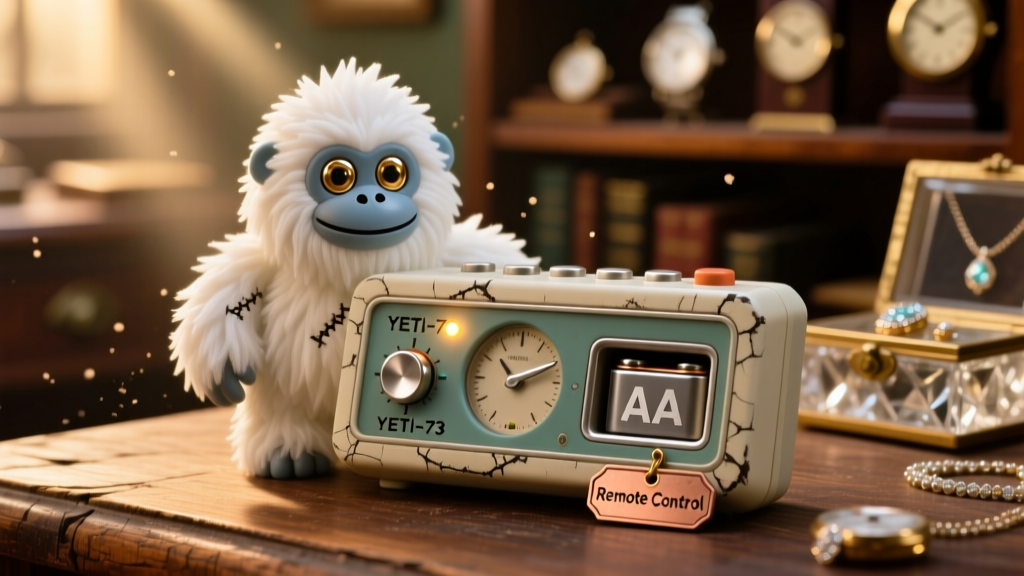
Toy Yeti Abominable Snowman Remote Control Battery Operated Box: A Collector’s Guide to the 1990s Animated Plush Phenomenon
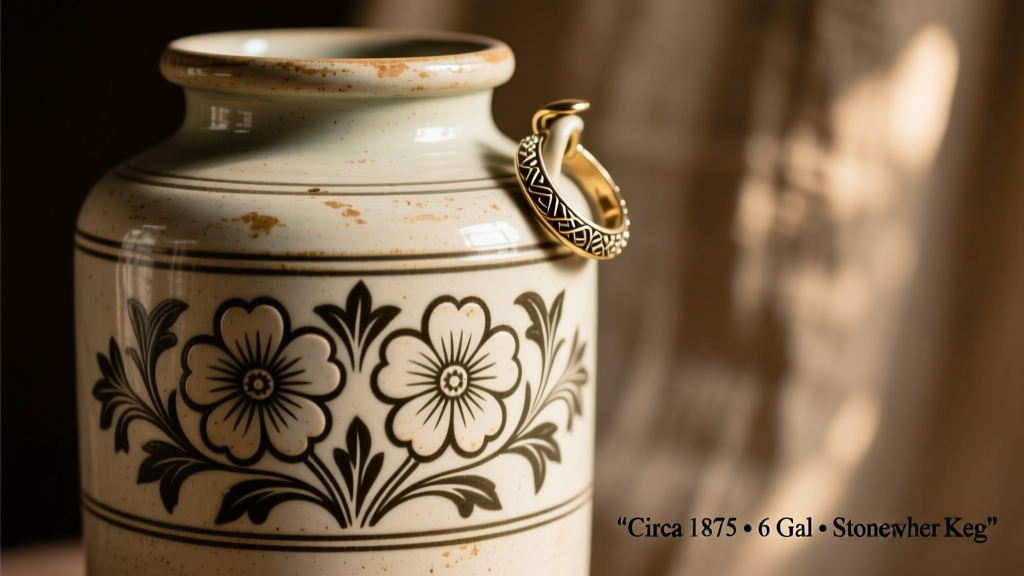
Stoneware Water Cooler: Keg-Shaped Incised Ring & Double Flower Stoneware Vessel, c. 1875, 6-Gallon Capacity, 15 Inches Tall
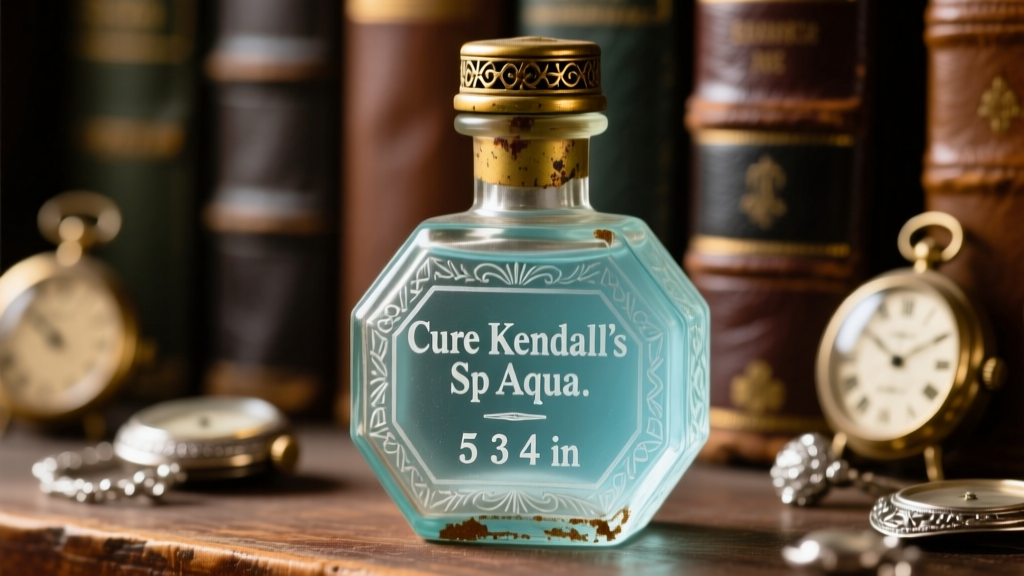
Kendall’s Spavin Cure Aqua Bottle: A 19th-Century Veterinary Patent Medicine Artifact in 12-Sided Cobalt Glass
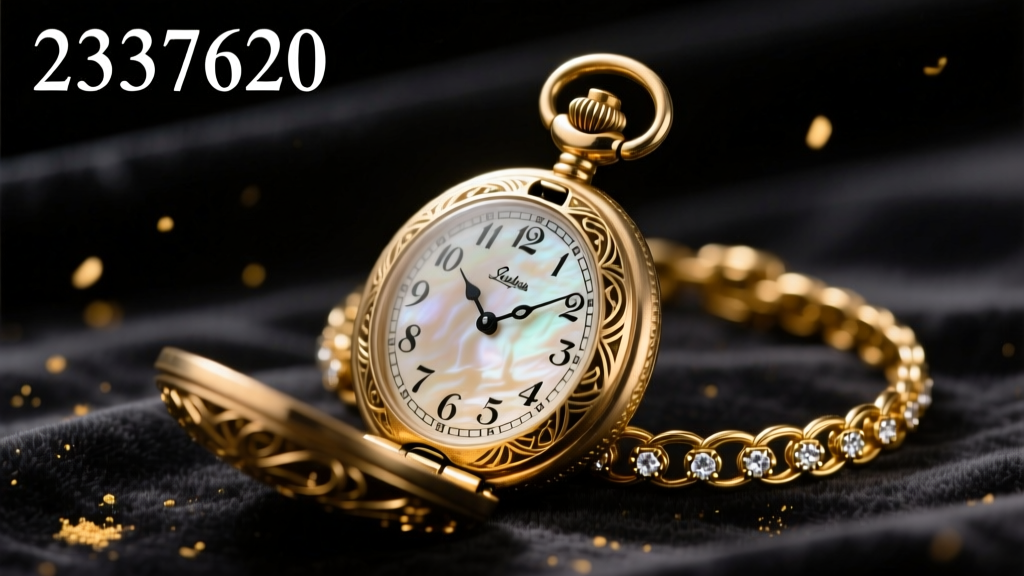
Lot 2337620: A Deep Technical and Historical Analysis of the 1954 Rolex Oyster Perpetual Ref. 6204 — The First Officially Certified Chronometer Explorer Predecessor

Haunted Houses: Architecture, Lore, and the Material Culture of Fear
Willow Pitcher Octagonal Mason 11-Inch: A Collector’s Deep Dive into Form, Function, and American Glass History
Business Directory Dashboard: A Precision Instrument for Modern Enterprise Operations