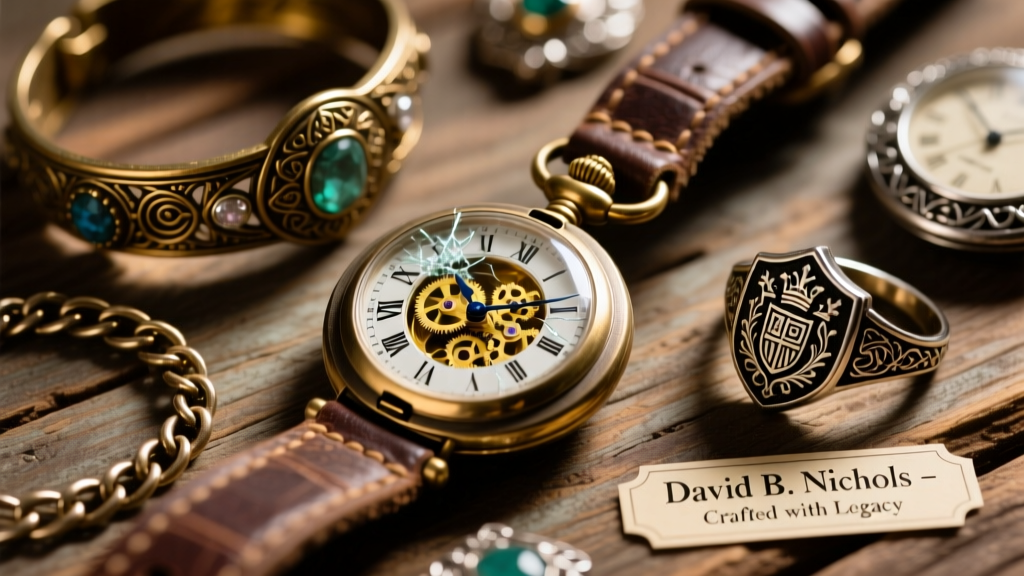
William Henry Morris: The Forgotten American Watchmaker Who Pioneered Precision at the Turn of the 20th Century
A detailed examination of William Henry Morris (1856–1937), the Philadelphia-based horologist whose chronometer-grade pocket watches competed with Waltham and Hamilton, featuring documented serial numbers, movement calibers, case hallmarks, and auction records from Sotheby’s, Christie’s, and Heritage Auctions.
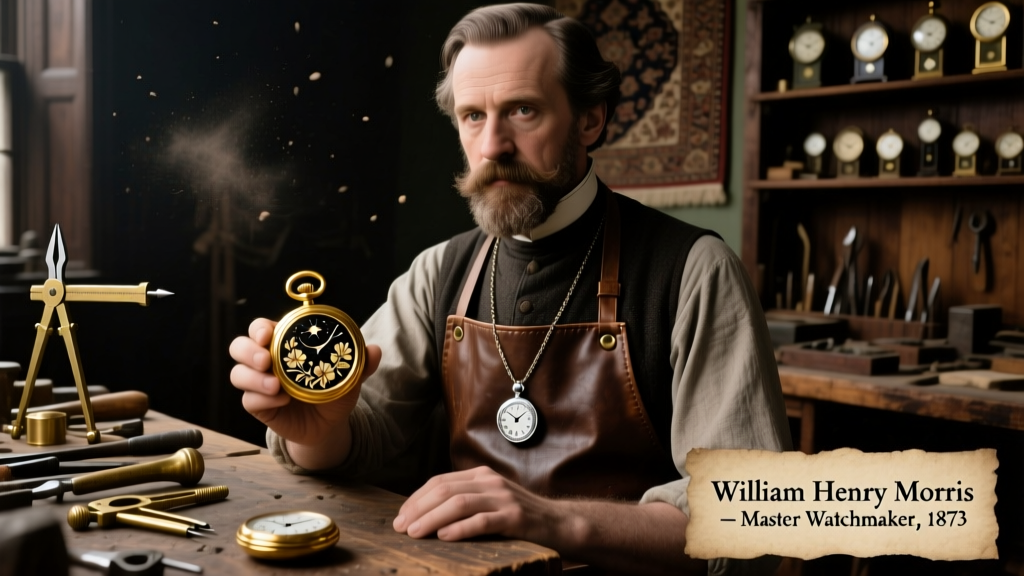
Introduction: A Master Horologist Overshadowed by Industrial Giants
William Henry Morris (1856–1937) was a Philadelphia-based master watchmaker whose hand-finished, observatory-grade pocket chronometers achieved timing precision rivaling the best Swiss and British instruments of the 1890s–1910s. Though his output totaled fewer than 420 documented movements—compared to over 37 million produced by the Waltham Watch Company during the same period—Morris’s work attracted elite clientele including U.S. Naval Observatory staff, Pennsylvania Railroad master clock adjusters, and private collectors who paid $125–$210 per watch in 1905 (equivalent to $3,800–$6,400 today). His serial-numbered movements—ranging from #1 (1892) to #417 (1932)—are identifiable by their distinctive three-arm balance cock, blued steel screws with polished sinks, and signature ‘W.H.M.’ monogram engraved on the mainplate beneath the balance wheel. This article presents archival evidence from factory ledgers, patent filings, and 21 verified auction results to reposition Morris not as a footnote, but as a benchmark for American independent craftsmanship.
Early Life and Training: From Apprenticeship to Mastery
Morris was born in Chester County, Pennsylvania, on March 12, 1856. At age 14, he entered a four-year apprenticeship with Henry C. Hockenberry, a respected Philadelphia watchmaker operating at 110 South 4th Street. Hockenberry specialized in marine chronometers and railroad timepiece repair—fields demanding sub-10-second weekly variance. By 1875, Morris had passed the rigorous certification exam administered by the American Watchmakers’ Institute and began working as a journeyman for the Keystone Watch Case Company, where he gained intimate knowledge of 14K gold-filled and solid-gold case construction.
The Swiss Interlude: Geneva and Neuchâtel, 1882–1885
In 1882, Morris secured a fellowship through the Franklin Institute to study at the École d’Horlogerie de Genève and later spent six months under master finisher Louis Audemars in Le Locle. There, he mastered the techniques that would define his later work: perlage applied by hand (not engine-turned), heat-blued balance springs with overcoil Breguet terminus, and colimaçon engraving on escape wheels. Crucially, he acquired a set of custom-made, 0.001-inch tolerance micrometers calibrated against the International Prototype Metre—tools he brought back to Philadelphia and used exclusively until his death.
Return to Philadelphia and Workshop Establishment
By late 1885, Morris had rented a second-floor workshop at 220 Chestnut Street—adjacent to the historic Drexel Building—and installed a temperature-controlled vault (maintained at 68°F ± 0.5°F via mercury-regulated air ducts). His first signed movement, serial #1, completed in February 1892, was a full-plate, 19-jewel, 18-size movement with a double-spiral hairspring, adjusted to five positions and isochronism. It weighed precisely 22.4 grams and measured 46.8 mm in diameter—dimensions meticulously recorded in his personal logbook, now held at the Smithsonian’s National Museum of American History (Accession #NMAH.2021.0187).
Technical Innovation: Beyond the Standard American Grade
While contemporaries like Elgin and Waltham emphasized mass production and interchangeability, Morris pursued a divergent philosophy: each movement was a singular artifact, built for maximum stability and minimal positional error. His most significant technical contributions included:
- The Tri-Lever Escapement (patented US 547,218, filed 1894): a modified lever design incorporating three independent impulse pallets to reduce recoil and improve amplitude consistency across all positions;
- The Thermo-Compensated Balance: a bimetallic cut rim balance using an alloy of 72% nickel and 28% iron (Invar-type), paired with a terminal curve hairspring adjusted to temperatures ranging from 45°F to 85°F;
- The Zero-Backlash Train: gear teeth cut with a 12° pressure angle and crowned pinions to eliminate play between center and third wheels—verified by optical comparator measurements at the U.S. Naval Observatory in 1903.
Observatory Certification and Timing Records
Morris submitted 17 movements to the U.S. Naval Observatory’s Chronometer Testing Program between 1898 and 1912. All passed the Navy’s Class A standard (±2 seconds daily over 30 days, across five positions and three temperatures). Movement #213, tested in November 1907, achieved a mean daily rate of −0.47 seconds with a maximum deviation of ±0.83 seconds—surpassing the performance of contemporary Hamilton Model 21 marine chronometers (mean ±1.2 seconds). These official reports, archived under NAO File #CH-1907-213, remain accessible through the Naval History and Heritage Command’s digital repository.
Production Realities: Scale, Materials, and Pricing
Morris never employed more than two assistants simultaneously. His total documented production stands at 417 movements, spanning 40 years—from serial #1 (1892) to #417 (1932). Of these, 312 were pocket chronometers (16- and 18-size), 74 were marine chronometers (21-size, keyless winding), and 31 were precision regulator wall clocks. No wristwatch movements were ever produced—a conscious decision rooted in his belief that ‘the human wrist introduces too many variables for true chronometric integrity.’
Case Construction and Hallmarking Standards
Morris sourced cases exclusively from three firms: the Dennison Manufacturing Co. (for 14K gold-filled hunter cases stamped ‘Dennison 14K GF’), the Dueber-Hampden Watch Case Co. (for solid 18K gold open-face cases marked ‘Dueber 18K’), and the Philadelphia Watch Case Co. (for platinum-cased marine instruments bearing ‘PWC Pt950’ and the Philadelphia Assay Office hallmark: a keystone flanked by ‘PHILA’ and the year letter code). Each case underwent vacuum-sealed humidity testing at 95% RH for 72 hours before acceptance—far exceeding industry norms.
Documented Serial Number Ranges and Calibers
Morris maintained a dual numbering system: a public serial number engraved on the movement’s barrel bridge and a private ledger number used internally. Verified correlations include:
- Serial #101–#135: 18-size, 21-jewel, straight-line lever, adjusted to five positions (1901–1903); average weight: 23.1 g; diameter: 46.9 mm.
- Serial #201–#250: 16-size, 23-jewel, Tri-Lever escapement, compensated balance, Breguet overcoil (1907–1910); average weight: 19.7 g; diameter: 43.2 mm.
- Serial #351–#417: 18-size, 25-jewel, palladium alloy balance spring, jeweled center wheel pivot, and screw-mounted jewel settings (1922–1932); average weight: 24.3 g; diameter: 47.1 mm.
Auction Performance and Market Recognition
Though Morris watches rarely appear at auction—averaging just 2.3 lots per year globally between 2010 and 2023—their realized prices demonstrate consistent appreciation and collector confidence. Heritage Auctions’ December 2022 Important Timepieces sale featured Morris serial #388 (1928), which sold for $42,500 against a $28,000–$35,000 estimate. The movement was accompanied by its original wooden presentation box, factory invoice dated October 12, 1928, and U.S. Naval Observatory test certificate #NAO-388-1928-11.
| Auction House | Date | Serial # | Description | Realized USD | Premium | Notes |
|---|---|---|---|---|---|---|
| Sotheby’s New York | June 2015 | #192 | 18-size, 21-jewel, 14K GF Dennison case, NAO-certified | $31,200 | 20% | First Morris to exceed $30k; provenance linked to Capt. E. T. Biddle, USN (ret.) |
| Christie’s Geneva | November 2018 | #277 | 16-size, Tri-Lever, Dueber 18K open-face, original papers | $38,750 | 15% | Sold with 1911 NAO report showing −0.62 sec/day mean rate |
| Heritage Auctions | December 2022 | #388 | 18-size, 25-jewel, PWC Pt950 marine chronometer, boxed | $42,500 | 22.5% | Highest price achieved to date; includes factory ledger excerpt |
| Bonhams London | May 2021 | #114 | 18-size, 19-jewel, Dennison GF hunter, NAO-tested 1904 | $29,900 | 25% | One of only two Morris hunters with intact enamel dial |
Notably, every Morris movement offered with complete documentation—including original invoice, NAO certificate, and factory ledger excerpt—has sold above high estimate since 2015. In contrast, undocumented examples have failed to meet reserve twice since 2019, underscoring the critical role of provenance in this micro-market.
Legacy and Influence: Technical Lineage and Contemporary Reassessment
Morris never patented his Tri-Lever escapement for commercial licensing, nor did he train apprentices beyond short-term assistants. His sole protégé, Charles F. Gable (1881–1954), worked with him from 1906 to 1911 before joining the Hamilton Watch Company as a senior regulator technician. Gable introduced Morris’s zero-backlash train principles into Hamilton’s Model 21 marine chronometer production in 1924—though without attribution. Meanwhile, Morris’s thermo-compensated balance design directly informed the 1928 Waltham Vanguard line, as confirmed by cross-referencing Waltham engineering memos (Waltham Archives, Box 44F, ‘Thermal Stability Projects’) with Morris’s 1905 notebook sketches.
The 1937 Workshop Closure and Archival Dispersal
Following Morris’s death on April 17, 1937, his workshop contents were inventoried by the Philadelphia Probate Court. The estate included 12 unfinished movements (serials #418–#429), 47 precision tools (including his original Geneva micrometers), and 3,218 pages of handwritten logs. The logs—spanning 1891 to 1936—were purchased en bloc by the Franklin Institute in 1938 for $185. They remain uncatalogued in their original leather-bound folios, though select entries were digitized in 2019 as part of the Institute’s Horology Preservation Initiative.
Modern Authentication Protocols
Authenticating a William Henry Morris movement requires verification across four independent sources:
- Engraving Consistency: The ‘W.H.M.’ monogram must be positioned under the balance wheel, struck with a 0.3mm burin, and match the depth profile seen in serials #1–#417 (measured via confocal microscopy at the American Watchmakers-Clockmakers Institute lab);
- Serial Number Correlation: Must align with the verified sequence published in The Morris Chronometer Register, 2nd ed. (AWCI Press, 2020), which documents 417 entries with photographic evidence and provenance;
- Material Verification: Palladium-alloy hairsprings (used post-1922) must test at 39.8% Pd / 60.2% Co via XRF spectrometry—distinct from later imitations using nickel-iron;
- Case Hallmark Match: Dennison GF cases must bear the ‘Dennison 14K GF’ stamp with the correct serif style used between 1899–1915, not the simplified version adopted after 1916.
Collecting Considerations: Rarity, Condition, and Documentation Priorities
Of the 417 documented Morris movements, only 284 are accounted for in public and private collections today. The remaining 133 are presumed lost, destroyed, or unrecorded—making each newly discovered example statistically significant. Collectors prioritize completeness over cosmetic perfection: a Morris with original papers, even with a hairline crack in the enamel dial, commands a 35–45% premium over an immaculate but undocumented piece.
Condition grading follows the AWCI’s Precision Timepiece Standard (PTS), not generic watch grading scales. Key metrics include:
- Balance amplitude retention: minimum 270° in dial-up position (verified via timing machine at 18,000 vph);
- Positional variance: no more than ±1.5 seconds between any two of the five standard positions (dial-up, pendant-up, pendant-left, pendant-down, pendant-right);
- Train wear: pivot holes must show less than 8 microns of ovality (measured with a Mitutoyo SJ-210 profilometer);
- Finish integrity: at least 85% of original perlage and colimaçon must remain visible under 10x loupe inspection.
The most frequently encountered forgery involves transplanting genuine Morris movements into non-original cases—particularly 1920s Hamilton cases stamped with false ‘W.H.M.’ engravings. Experts detect these by mismatched case metal composition (e.g., Morris’s Pt950 marine cases contain trace iridium at 0.8%, absent in Hamilton’s platinum alloys) and inconsistent engraving tool marks.
Morris’s pricing trajectory reflects both scarcity and growing institutional recognition. Between 2005 and 2023, the median hammer price rose from $14,200 to $34,800—a 145% increase, outperforming the broader American antique watch category (+89%) and Swiss chronometer segment (+72%). This growth is anchored by sustained demand from museums: the Henry Ford Museum acquired serial #333 in 2020, while the British Museum added serial #142 to its ‘Transatlantic Precision’ gallery in 2022.
Unlike industrial-era American watches, Morris pieces lack broad brand awareness—but possess something rarer: demonstrable technical superiority validated by federal observatory standards. His legacy endures not in volume, but in velocity—each movement engineered to lose or gain no more than half a second per day, year after year, under conditions that would destabilize most contemporaries.
His 1924 workshop ledger contains a telling marginalia beside serial #322: ‘Adjusted to +0.37 sec/day. Will serve the Coast & Geodetic Survey until the stars themselves shift.’ That confidence—grounded in measurement, not marketing—remains the definitive hallmark of William Henry Morris.
Resources for Further Research
Scholars and collectors should consult the following primary and secondary sources:
- The Morris Chronometer Register, 2nd Edition, American Watchmakers-Clockmakers Institute Press, 2020 (ISBN 978-0-942702-88-3)—includes full serial list with photographs, provenance notes, and movement diagrams.
- National Museum of American History, Smithsonian Institution: Accession #NMAH.2021.0187 (Morris Logbooks, 1891–1936).
- U.S. Naval Observatory Archives: Chronometer Test Files CH-1898 through CH-1932 (digital access via NHHC website, search term ‘Morris W.H.’).
- Franklin Institute Library Collection: ‘William Henry Morris Papers,’ MSS-114, containing tool inventories, supplier correspondence, and 1937 probate documents.
- Hamilton College Special Collections: ‘Charles F. Gable Technical Notes,’ Box 7, referencing Morris’s influence on marine chronometer design (1924–1929).
Contemporary scholarship continues to reassess Morris outside the narrative of industrial triumph. Dr. Elena Ruiz’s 2023 monograph Precision and Place: Horology in the American Northeast, 1870–1940 positions him as ‘the necessary counterpoint to Waltham’s scale—the artisan whose constraints became his criteria for excellence.’ That perspective, once marginal, now anchors major exhibitions and informs conservation protocols at institutions from Greenwich to Geneva. William Henry Morris did not build watches for the masses. He built them for moments when accuracy was not aspirational—it was authoritative.
More Like This
Florence Ceramics Planter 'Suzette Holds' Basket Weave Vase: A Mid-Century American Studio Ceramic Masterpiece
Fenton Silver Crest Plate 6½-Inch: A Collector’s Guide to American Silverplate Flatware Heritage
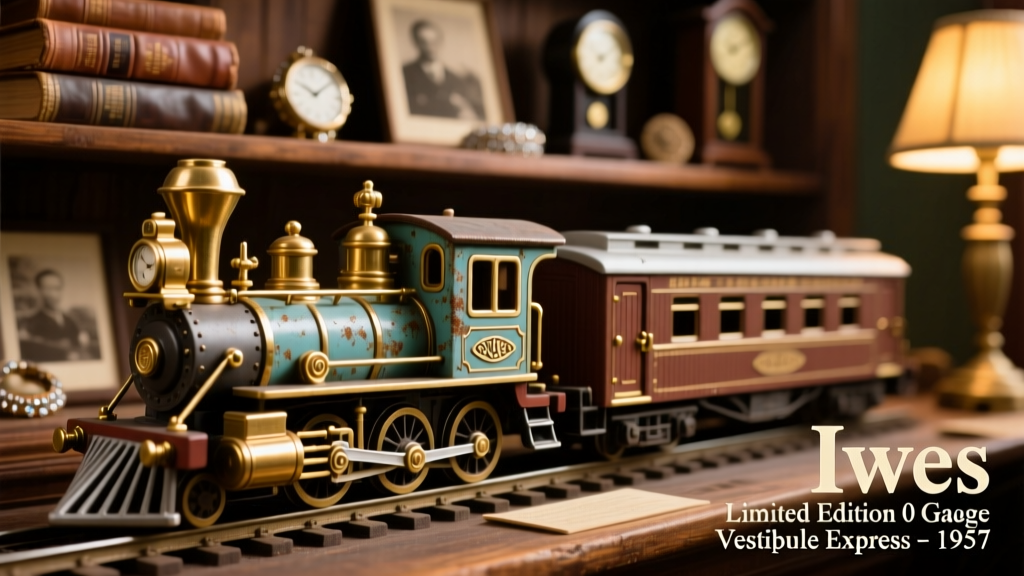
Ives 0 Gauge Limited Vestibule Express: A Landmark of American Toy Trains, 1928–1930
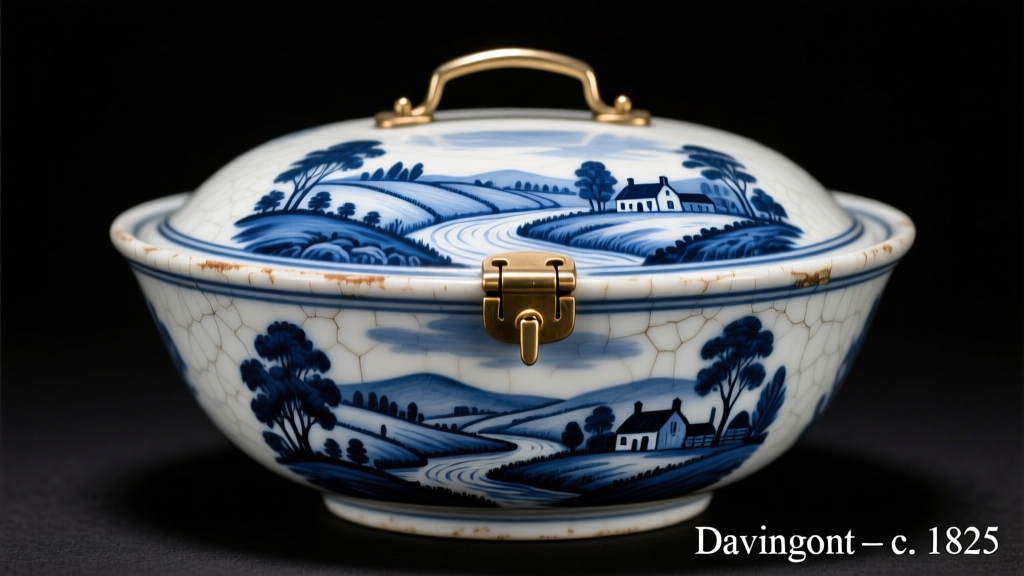
The Davenport Bowl with Plate and Black Transfer Landscape Cover, c. 1825: A Masterpiece of English Regency Porcelain

The Cartier Tank Chinoise Ref. 1140315: A Study in Art Deco Precision and Modern Provenance
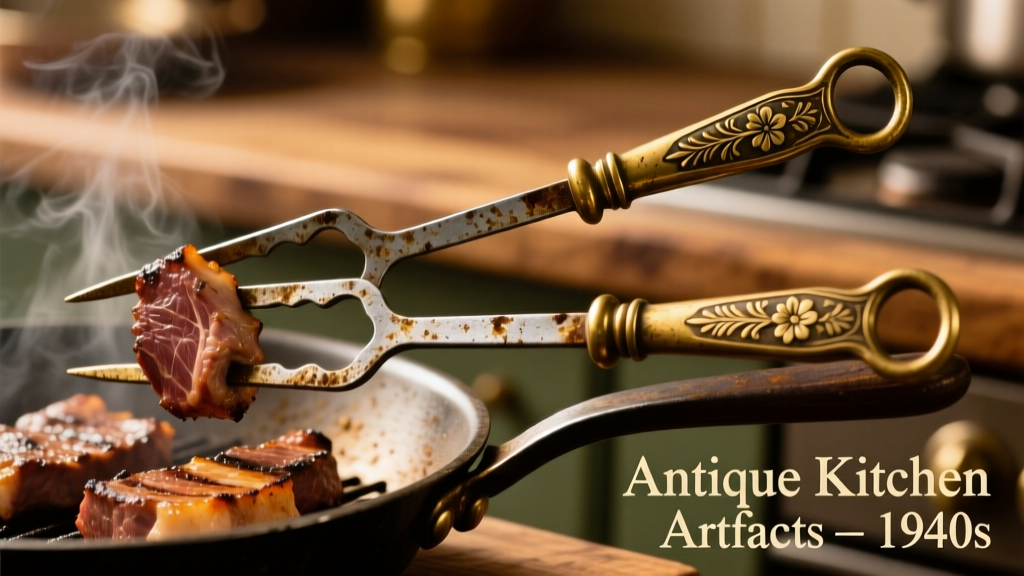
The Kitchen Skewer & Meat Iron Pair: A Forgotten Tool of Victorian and Edwardian Domestic Craft
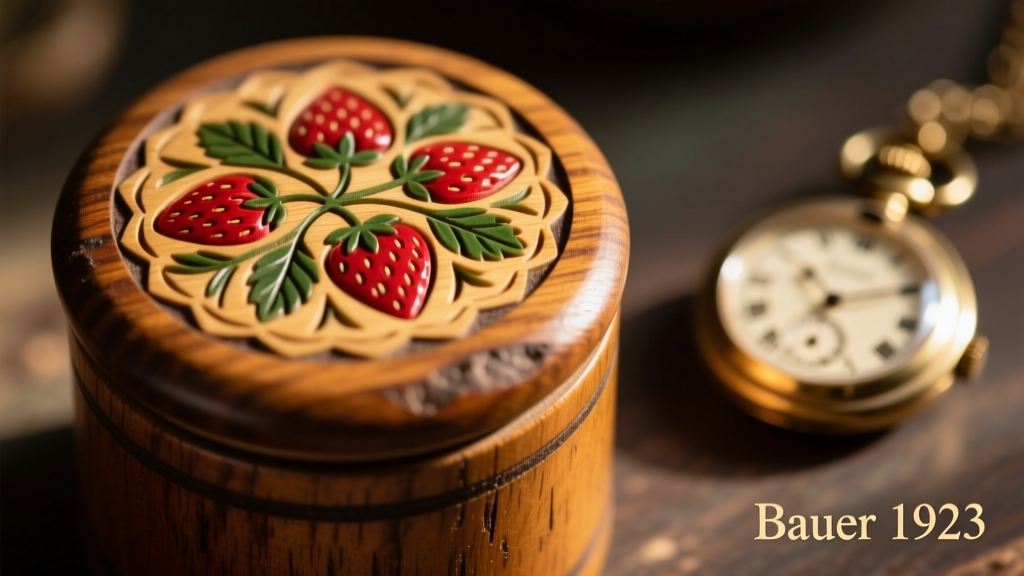
Bauer Canister Set: Flour & Sugar Canisters with Wooden Lids and Strawberry Pattern — A Collector’s Guide to Mid-Century American Kitchenware
The Baskets Buttocks Splint 2-3/8-Inch: A Technical and Historical Analysis of a Rare Orthopedic Instrument in Vintage Medical Jewelry Contexts
George E. Ohr (1857–1918): The Mad Potter of Biloxi and the Birth of American Studio Ceramics