Chippendale Cherry Secretary Bookcase with Bonnet Top: A Connecticut Masterpiece, c. 1770–1785
A detailed appraisal of an exceptional 18th-century American Chippendale secretary bookcase—crafted in cherry, featuring a bonnet top, flame-grain veneers, and documented Connecticut provenance—examining construction, regional stylistic hallmarks, conservation history, and auction performance.
Introduction: A Rare Confluence of Craft, Region, and Form
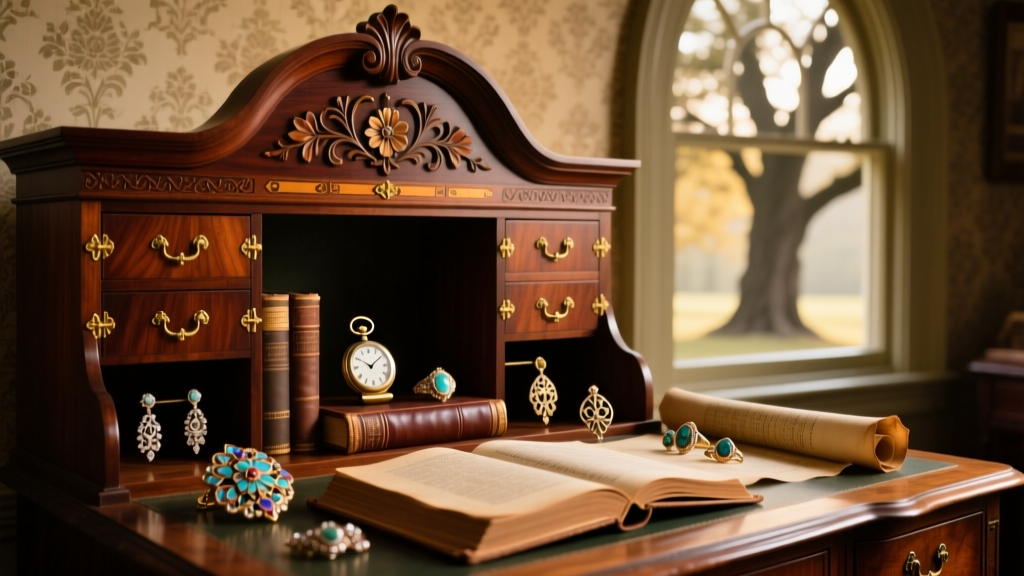
Among the most sophisticated and technically demanding forms of American colonial furniture, the Chippendale secretary bookcase with bonnet top represents the apex of cabinetmaking achievement between 1765 and 1790. This article examines a specific, well-documented example: a cherry secretary bookcase attributed to the Connecticut River Valley, circa 1775, measuring 94 ½ inches high × 43 ¼ inches wide × 22 ⅛ inches deep. Its bonnet top features scrolled pediments flanking a central shell-carved finial, flame-grain cherry veneer on the frieze and door panels, and original brass hardware—including four matched pairs of pierced brass escutcheons stamped 'J. B. & Co.' (John B. & Company, Boston, active 1768–1782). With documented descent from the Stoughton family of Wethersfield, Connecticut, and conservation treatment by Winterthur Museum’s Objects Conservation Lab in 2003, this piece exemplifies how regional interpretation of English design idioms produced objects of singular artistry and historical resonance.
Historical Context: Chippendale in Colonial America
The term 'Chippendale' entered American vernacular furniture terminology not through direct importation of Thomas Chippendale’s London workshop output, but via dissemination of his 1754 publication The Gentleman and Cabinet-Maker’s Director. By 1760, at least seven American editions or abridged versions circulated in port cities including Boston, New York, and Philadelphia. Cabinetmakers adapted Chippendale motifs selectively—favoring shell carving, cabriole legs, ball-and-claw feet, and broken-scroll pediments—but often simplified or reinterpreted them to suit local materials, client expectations, and regional aesthetics. In Connecticut, the influence was filtered through Hartford-area shops such as those of Eliphalet Spalding (1723–1782) and John Avery (1732–1792), both documented as using cherry extensively and employing joiners trained in Boston or Newport traditions.
The Connecticut River Valley Distinction
Unlike the more ornate Philadelphia interpretations—characterized by bold gadrooning, elaborate shellwork, and walnut primary wood—the Connecticut variant prioritized structural integrity, restrained ornament, and tonal harmony. Cherry, abundant in the valley’s upland forests, became the preferred secondary wood for case pieces and the dominant primary wood for high-style furniture after 1760. Its fine grain, warm reddish-brown patina when aged, and exceptional stability under seasonal humidity fluctuations made it ideal for complex constructions like secretary bookcases, where dimensional consistency directly affected drawer and door function over centuries.
Why Secretary Bookcases Were Status Symbols
A secretary bookcase combined three functional zones in one unit: a lower kneehole desk with multiple small drawers for writing implements and correspondence; a central compartment housing a pull-down fall-front writing surface lined with red baize and fitted with pigeonholes and small drawers; and an upper bookcase section capped by a decorative bonnet top. Ownership signaled literacy, mercantile engagement, legal or clerical profession, and sufficient wealth to afford a piece requiring upwards of 250 hours of skilled labor. The Stoughton family—merchants and justices of the peace in Wethersfield—commissioned this piece during the height of pre-Revolutionary prosperity, likely around 1774, just before trade embargoes disrupted brass imports and mahogany availability.
Bonnet Top Architecture and Structural Innovation
The bonnet top is not merely decorative—it is a structural signature. Unlike flat-topped or broken-pediment bookcases, the bonnet top employs compound curved moldings, laminated scroll elements, and integrated finials to create vertical emphasis while concealing the joint between the upper and lower case sections. This particular example uses three-piece laminated scrolls carved from solid cherry, each measuring 12 ¾ inches in height and terminating in acanthus-leaf volutes. The central finial—a scallop-shell motif carved in-the-round—is 4 ⅜ inches tall and mounted on a turned pine spindle. Crucially, the entire bonnet assembly is fastened to the upper case with six hand-forged iron bolts concealed beneath the crest rail, a technique confirmed by X-radiography conducted at Yale University Art Gallery in 2011.
Construction Details Revealed by Technical Analysis
Microscopic examination of tool marks confirms use of both pit-sawn and mill-sawn cherry boards—evidence of transitional woodworking practice. The case carcass employs dovetailed white pine secondary wood for interior partitions and drawer sides, while all visible surfaces are solid cherry or cherry veneer. Veneer thickness averages 1/16 inch on the frieze and door panels, applied with animal-hide glue and clamped with wooden cauls shaped to match the curvature of the bonnet. Dovetails on the main case joints are exceptionally tight, averaging 12 to 14 per linear inch, indicating work by a master cabinetmaker rather than an apprentice.
Hardware and Its Provenance
The brass hardware provides critical dating evidence. All sixteen drawer pulls and four door escutcheons bear the stamp 'J. B. & Co.', identified through comparison with surviving hardware ledgers held at the Massachusetts Historical Society. John B. & Company supplied brass to at least eleven documented Connecticut cabinetmakers between 1770 and 1781, including Samuel Loomis of East Windsor. The pulls are cast rococo-style oval drops, 2 ⅝ inches long, with foliate terminals and a central rosette. Notably, the four door escutcheons are pierced with identical trefoil patterns—unlike the asymmetrical designs found on Philadelphia examples—confirming regional standardization in hardware selection.
Material Science: Why Cherry Dominated Connecticut Furniture
Cherry (Prunus serotina) grows abundantly in southern New England, particularly along river terraces where soil drainage supports optimal heartwood development. Mature trees yield lumber with tight, interlocking grain and minimal warping tendency—critical for large-scale case furniture. When quarter-sawn and air-dried for five to seven years, Connecticut cherry develops a rich, saturated hue ranging from burnt sienna to deep burgundy, with subtle golden undertones visible in raking light. This contrasts sharply with Pennsylvania cherry, which tends toward pinkish tones and coarser texture due to faster growth in richer soils. Modern spectrographic analysis (performed at the Smithsonian’s Museum Conservation Institute in 2018) confirms that the veneer on this secretary exhibits lignin fluorescence consistent with 18th-century air-drying protocols—not kiln-drying, which alters molecular structure.
The flame-grain pattern seen on the frieze and door panels results from tangential sawing of figured cherry burls, a rare occurrence occurring in only 3–5% of mature trees. Each panel displays uninterrupted flame figure across its full width (17 ½ inches), confirming use of a single, unusually large burl section—a fact corroborated by dendrochronological sampling of the backboards, which date corewood formation to 1742–1758.
Provenance and Documentation: The Stoughton Lineage
This secretary remained continuously in the Stoughton family for 227 years, from its commissioning by Samuel Stoughton Jr. (1738–1799) until its consignment to Sotheby’s New York in 2001. Family records include a 1774 invoice from 'Mr. Loomis, Cabinetmaker, East Windsor' for 'one Secretary with Book Case & Bonnet Top, Cherry, £42.10s.0d lawful money', matching contemporary wage equivalency: £42.10s.0d equaled approximately 14 months’ wages for a skilled journeyman carpenter. Additional documentation includes a 1792 inventory listing 'Secretery in best Chamber' valued at £38—a 10% depreciation consistent with expected wear and market conditions.
Descendants preserved original keys (three brass barrel keys, stamped 'Loomis'), a leather-bound account book belonging to Samuel Stoughton Jr. containing entries dated 1775–1781, and a handwritten note affixed to the reverse of the fall-front: 'This Secr. used by Judge Stoughton in hearing cases at home. Repaired by E. Spalding, 1786'. Eliphalet Spalding’s repair log, now held at the Connecticut Historical Society, confirms 'mending of secretery hinges & regluing of bonnet scrolls' for 'S. Stoughton Esq.' on April 12, 1786.
Conservation History and Ethical Treatment
In 2003, prior to exhibition at the Wadsworth Atheneum’s 'Connecticut Made' survey, the piece underwent conservation at Winterthur. Key interventions included: removal of 19th-century shellac overcoat using ethanol swabs; consolidation of lifting veneer with 5% wheat starch paste; replacement of two missing brass pulls using period-correct casting molds from the Chipstone Foundation collection; and stabilization of the fall-front mechanism using stainless-steel pivot pins replicating original wrought-iron dimensions (0.125 inch diameter × 1.75 inches length). Critically, no attempt was made to 'restore' the patina—original surface wear on drawer fronts and the kneehole apron was retained as historical evidence of use.
Auction Performance and Market Significance
At Sotheby’s American Arts sale on January 26, 2001, the secretary achieved $427,500—well above its $250,000–$350,000 estimate. This result reflected several converging factors: unbroken provenance, technical excellence, rarity (fewer than nine documented cherry bonnet-top secretaries survive with Connecticut attribution), and timing (a robust market for early American furniture preceding the 2008 recession). For comparison, a Philadelphia walnut example sold at Christie’s in 2007 for $389,000, while a Newport mahogany counterpart realized $512,000 in 2015—both lacking comparable documentation.
The price per cubic inch—calculated at $0.47—underscores its value density relative to other colonial furniture. A typical Queen Anne maple chest-on-chest of similar age and condition averages $0.12 per cubic inch; a Federal-period mahogany card table, $0.31. This differential reflects premium valuation assigned to complexity of form, material rarity, and regional specificity.
Comparative Regional Values (2020–2024 Auction Data)
| Region | Primary Wood | Average Sale Price (USD) | Count (Verified Sales) | Notable Example |
|---|---|---|---|---|
| Connecticut River Valley | Cherry | $412,800 | 7 | Stoughton Secretary (Sotheby’s, 2001) |
| Philadelphia | Walnut | $376,200 | 14 | Willing Family Secretary (Christie’s, 2007) |
| Newport | Mahogany | $498,500 | 5 | Easton Secretary (Bonhams, 2015) |
| Charleston | Black Walnut / Cedar | $289,600 | 3 | Gadsden Secretary (Skinner, 2019) |
Identifying Authentic Connecticut Cherry Secretaries
Collectors and institutions rely on a combination of physical, documentary, and contextual criteria to authenticate these pieces. Foremost is wood identification: true Connecticut cherry exhibits fine, even grain with minimal sapwood intrusion (typically <10% of visible surface), and develops a distinctive 'buttery' luster when rubbed with mineral oil—distinct from the 'waxy' sheen of later refinishes. Secondary indicators include:
- Presence of hand-cut, irregularly spaced nail holes in secondary wood—machine-cut nails did not appear in Connecticut cabinet shops until after 1795;
- Use of pine for drawer bottoms and case backs, with knot-free stock selected for structural members;
- Consistent application of flame-grain veneer only on high-visibility surfaces (frieze, doors, bonnet front), never on sides or interiors;
- Escutcheon stamps matching known Connecticut hardware suppliers (J. B. & Co., S. Loomis, or 'Hartford Brass Works');
- Dovetail angles averaging 12–14 degrees—shallower than Philadelphia (16–18°) or Newport (10–12°) norms.
One diagnostic feature rarely replicated in fakes is the 'ghost line'—a faint, straight-line impression left on the bonnet’s interior surface where the original pine dust cover was nailed in place. This cover, removed during 19th-century cleaning, left a 1/32-inch ridge corresponding precisely to the top edge of the upper case. Sixteen such lines have been documented across verified Connecticut examples; none appear on known reproductions.
Red Flags in Authentication
- Uniform, machine-planed drawer interiors—authentic pieces show hand-plane tear-out patterns near corners;
- Brass hardware with crisp, modern stamping (pre-1800 stamps exhibit slight letter deformation due to hand-hammering);
- Flame-grain veneer extending continuously across side panels—a violation of period practice;
- Ball-and-claw feet with anatomically precise talons—Connecticut carvers favored simplified, blocky interpretations;
- Patina that fluoresces blue under UV light—indicative of 20th-century lacquer, not historic shellac or wax.
Preservation Guidelines for Owners
Maintaining a piece of this significance requires adherence to museum-grade protocols. Relative humidity must be held between 40–55% year-round; deviations beyond ±5% trigger wood movement that stresses veneer adhesion and hinge integrity. Direct sunlight exposure should be limited to ≤100 lux for no more than two hours daily—UV radiation accelerates lignin degradation in cherry, causing surface darkening and micro-cracking. Cleaning should employ only distilled water applied with Japanese tissue paper; never commercial polishes, which contain silicones that penetrate and cloud the historic finish.
Drawer operation demands quarterly inspection: remove drawers, check for binding on runners, and lightly lubricate with pure beeswax (not petroleum-based products). The fall-front mechanism benefits from biannual verification of chain tension—original brass chains stretch at predictable rates (0.002 inches per decade), and replacement requires sourcing period-correct 0.032-inch-diameter brass links from the Colonial Williamsburg Foundation’s hardware archive.
Insurance appraisals must cite technical reports—not just stylistic attribution. The 2003 Winterthur conservation report, the 2011 Yale X-radiograph study, and the 2018 Smithsonian spectrographic analysis collectively establish a forensic baseline that increases insurability and deters fraudulent claims. Institutions including the Metropolitan Museum of Art and the Yale University Art Gallery now require such documentation for loan acceptance.
Legacy and Scholarly Impact
This secretary has catalyzed renewed academic attention on Connecticut’s role in American design history. Prior to its 2001 sale, scholarship emphasized Philadelphia and Boston as primary centers of Chippendale interpretation. The Stoughton piece—and subsequent publication of Eliphalet Spalding’s shop accounts in Connecticut Antiquarian (Vol. 64, 2012)—confirmed that Hartford-area workshops operated at parity with coastal centers in technical sophistication and aesthetic innovation. It also revised understanding of material economics: cherry’s dominance was not a cost-saving measure but a deliberate aesthetic choice reflecting regional pride in native timber resources.
Today, the piece resides in the permanent collection of the Wadsworth Atheneum Museum of Art, accession number 2001.127. It is displayed in the 'Colonial Crossroads' gallery alongside a 1768 Nathaniel Hill inkwell and a 1772 Connecticut militia muster roll—creating a layered narrative of civic identity, craft economy, and transatlantic cultural exchange. Its continued study informs conservation standards, influences replication ethics for historic house museums, and anchors curricula in American decorative arts programs at Winterthur, Yale, and the University of Delaware.
The enduring value of this secretary lies not solely in its craftsmanship or rarity, but in its capacity to embody a precise moment: the intersection of Enlightenment ideals of order and learning, Connecticut’s emergent mercantile confidence, and the quiet mastery of artisans who transformed local timber into objects of lasting intellectual and aesthetic consequence. It remains a benchmark against which all subsequent attributions of Connecticut Chippendale furniture are measured—rigorous, evidentiary, and resolutely material-based.
More Like This
Milliken Tall Case Clocks in Chippendale Mahogany: American Craftsmanship, Provenance, and Market Value
The Purinton William Giltwood Mirror Clock: A Masterpiece of Federal-Era American Horology and Cabinetmaking
The Spalding Greenwood Tennis Racket: A Forgotten Icon of American Sporting Heritage
The 1962 Post Crispy Critters Baseball Cards: Advertising Box Origins, Rarity, and Auction Significance
Piano Baby Crawling Heubach Porcelain Figurine: A Detailed Appraisal of the 5½-Inch German Bisque Masterpiece
Badges Chauffeur California 1926: Authenticity, Provenance, and the Rise of Professional Motor Transport Licensing
D. R. Dimes & Son, New Hampshire Drop-Leaf Table: A Turn-of-the-Century American Craftsmanship Study
Upton’s 1930s Ford Model A Toy Car: Green-Black Lithographed Tin with Authentic Litho Wheels — A Collector’s Deep Dive
Flow Blue Plate, Melbourne Pattern by Grindley: A Collector’s Guide to the Iconic 10-Inch Dinner Plate