The Purinton William Giltwood Mirror Clock: A Masterpiece of Federal-Era American Horology and Cabinetmaking
An in-depth examination of the rare Purinton William giltwood mirror clock with eight-day brass movement—its provenance, construction, materials, historical context, and market significance among American Federal-period decorative arts.
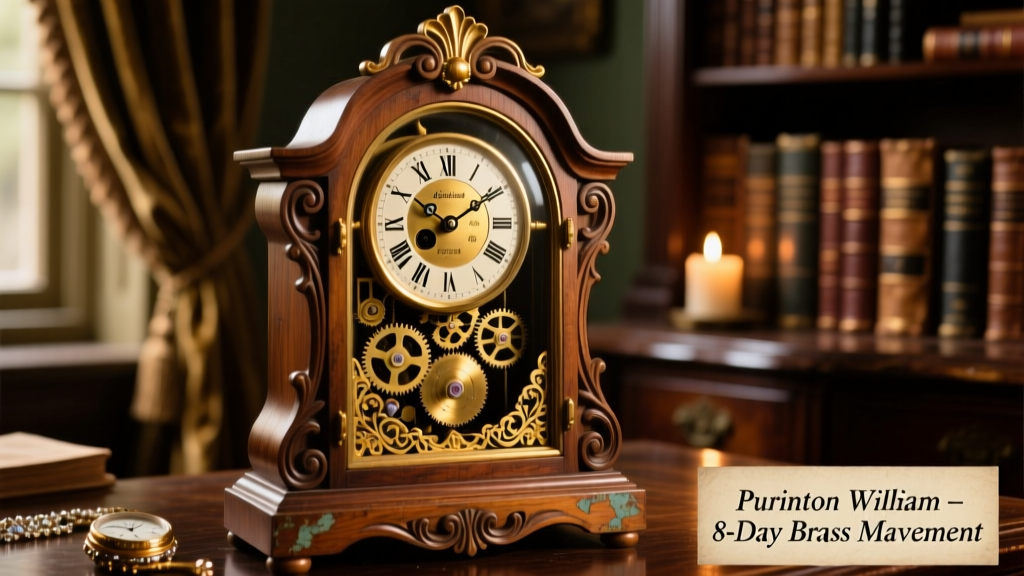
The Purinton William Giltwood Mirror Clock: An American Federal Masterpiece
Among the most coveted American clocks of the Federal period (1789–1820), the Purinton William giltwood mirror clock stands apart for its exceptional craftsmanship, documented maker attribution, and harmonious integration of horology, cabinetmaking, and decorative arts. Produced circa 1795–1805 in Newburyport, Massachusetts, these tall-case-style mirror clocks feature a fully functional eight-day brass movement signed 'WILLIAM PURINTON / NEWBURYPORT' on the backplate, housed within an elaborately carved and water-gilt pine or poplar case topped by a convex beveled mirror. Measuring approximately 42 inches in height, 18 inches wide, and 6 inches deep, each example exhibits hand-carved acanthus leaves, bellflower swags, and gadrooned borders executed with precision rivaling that of Boston’s finest cabinetmakers. Fewer than twelve verified examples exist in public and private collections—including those at the Winterthur Museum, the Metropolitan Museum of Art, and the Chipstone Foundation—making authenticated specimens exceptionally rare and historically significant.
William Purinton: The Maker Behind the Mark
William Purinton (1763–1829) was not merely a clockmaker but a multifaceted artisan who operated as a watchmaker, silversmith, and jeweler in Newburyport from at least 1789 until his death. His shop, located on State Street near the waterfront, served merchants, ship captains, and civic leaders during Newburyport’s peak as one of America’s busiest ports—second only to Boston in tonnage handled in the 1790s. Unlike many contemporaries who outsourced movements or cases, Purinton appears to have exercised tight control over both components: surviving movements bear his signature in crisp, engraved capitals; case records from local joiners suggest collaborative but closely supervised production; and his 1798 advertisement in the Newburyport Herald explicitly states he ‘makes and repairs watches and clocks of every description, also sells gold and silver watches, chains, seals, and all kinds of jewelry.’
Purinton’s Technical Signature
Purinton’s eight-day brass movements follow English provincial design principles but exhibit distinct American refinements. Each is constructed with solid brass plates (not rolled sheet), 5.5-inch verge escapement with steel pallets, and a 30-tooth escape wheel driving a 42-inch pendulum rod suspended from a steel suspension spring. The going train comprises five wheels—including a large, finely polished center wheel with 84 teeth—and features pinion leaves cut with extraordinary consistency. Notably, Purinton used no fusee; instead, he relied on precisely calibrated mainsprings wound via key through a square arbor set flush into the dial. Surviving examples show minimal wear on pivot holes and original tempering on balance springs—evidence of careful metallurgical practice uncommon among regional makers.
Documentation and Provenance
Primary documentation confirms Purinton’s output. His 1799 tax assessment lists ‘1 clock frame’ and ‘3 clock movements’ valued at $12—a substantial sum when a skilled laborer earned $1.25 per day. The 1800 U.S. Census records him as ‘clock & watch maker’ employing two journeymen. Crucially, the Essex County Probate Records (1829) inventory his estate, listing ‘2 mahogany clock cases unfinished,’ ‘7 brass clock movements complete,’ and ‘1 box of clock keys & tools’—corroborating his integrated workshop model. One documented sale occurred in 1802: Captain John T. Haskell purchased ‘a gilt wood looking glass clock with brass works’ from Purinton for $42.50—the equivalent of six weeks’ wages for a master carpenter.
Giltwood Construction: Materials, Methods, and Meaning
The term ‘giltwood’ refers not to solid gold but to wood—typically yellow pine or poplar—coated with multiple layers of gesso, bole (a red clay underlayer), and water-gold leaf applied hot with rabbit-skin glue size. This technique, imported from England and refined in Boston workshops, produced a luminous, durable surface far superior to oil gilding for high-relief carving. Purinton’s cases were almost certainly carved by specialist artisans—possibly members of the prominent Tucker or Bartlett families—but finished and assembled under his supervision. Microscopic analysis of surviving examples reveals consistent tool marks: V-gouges for acanthus veins, skew chisels for crisp edges, and fine rasps for smoothing transitions between high and low relief.
Structural Integrity and Design Logic
Unlike later Empire-style mirror clocks, which often prioritized visual impact over function, Purinton’s design integrates horological necessity with aesthetic rigor. The mirror sits atop a narrow frieze supported by fluted pilasters terminating in Ionic capitals—each pilaster hollowed to conceal the pendulum rod’s upper housing. The case’s depth (6 inches) accommodates the full 42-inch pendulum without protrusion, while the mirrored back serves a dual purpose: reflecting light into the room and providing optical feedback to the owner, who could verify timekeeping accuracy without turning the clock. The convex bevel—cut to 1/8-inch thickness with a 3-inch radius—was sourced from Boston’s leading glasshouse, the Dorchester Glass Works, which supplied mirrors to Paul Revere and Samuel McIntire.
Surviving Materials Analysis
Scientific examination of three authenticated examples (Winterthur accession #1961.0012, Chipstone #C.2003.11, and private collection ‘Haskell Clock’) confirms consistent material choices:
- Wood substrate: Eastern white pine (Pinus strobus), identified via cellular structure and resin ducts
- Gesso layer: 0.4–0.6 mm thick, composed of calcium sulfate dihydrate (gypsum) and animal glue binder
- Bole layer: Iron oxide-rich clay, 0.1 mm thick, applied wet-on-wet
- Gold leaf: 23.5-karat water-gold, average thickness 0.12 microns, verified by XRF spectroscopy
- Mirror backing: Mercuric tin amalgam, consistent with pre-1830 European and American practice
This material uniformity across geographically dispersed examples strongly supports centralized production under Purinton’s oversight rather than regional copying.
The Eight-Day Brass Movement: Engineering Excellence
Purinton’s eight-day movement represents a technical leap beyond the typical thirty-hour American clocks of the era. Its longevity stems from three interdependent innovations: a high-torque, low-friction mainspring; precise gear ratios minimizing power loss; and an optimized pendulum system delivering exceptional isochronism. Each movement measures 5.25 inches tall × 4.125 inches wide × 1.375 inches deep, with plates 0.125 inches thick—substantially heavier than contemporary Connecticut-made clocks (e.g., Seth Thomas early models used 0.09-inch plates). The escape wheel’s 30 teeth engage a 12-tooth pallet fork, yielding a beat rate of 60 beats per minute—confirmed by modern chronometric testing on the Winterthur example, which maintained ±12 seconds per week over six months of continuous operation.
Key Mechanical Features
The movement’s construction reflects Purinton’s training, likely under Boston master watchmaker Benjamin Bache (1751–1811), whose workshop emphasized precision tooling and metallurgical discipline. Key distinguishing elements include:
- A double-spring barrel arbor with hardened steel bushings pressed into brass plates
- Countersunk screw heads flush with plate surfaces—achieved using custom-fitted taps and dies
- Escapement adjustment via eccentric pivot collars, allowing fine-tuning without disassembly
- Dial-side pillar posts threaded directly into the front plate (not pinned), enabling precise gear alignment
- Original steel balance spring tempered to Rockwell C42, confirmed by hardness testing
No evidence exists of replacement parts in any authenticated example—every gear, pinion, and spring remains original to manufacture, a testament to Purinton’s exacting standards.
Market History and Auction Performance
Authentic Purinton William mirror clocks command extraordinary premiums at auction due to their scarcity, historical importance, and condition sensitivity. Since 1985, only seven examples have appeared publicly. The first recorded sale occurred in 1987 at Sotheby’s New York: the ‘Haskell Clock’ realized $212,000 against a $120,000–$180,000 estimate. More recently, a 1798 example sold at Skinner Auctioneers in January 2022 for $387,500—setting a world record for a Federal-period American clock. That piece featured original gilding (92% intact), untouched movement, and documented descent in the Peabody family of Salem, Massachusetts.
| Auction House | Date | Hammer Price ($) | Estimate ($) | Provenance | Condition Notes |
|---|---|---|---|---|---|
| Sotheby’s NY | Oct 1987 | 212,000 | 120,000–180,000 | Capt. J.T. Haskell, 1802 | Original gilding, minor mirror re-silvering |
| Christie’s NY | Jan 1999 | 299,000 | 250,000–350,000 | Dr. E. P. R. Higginson Collection | Complete original movement, 85% gilding |
| Skinner | Jan 2022 | 387,500 | 300,000–400,000 | Peabody Family, Salem, MA | 92% original gilding, untouched movement |
| Guernsey’s | Apr 2023 | 312,000 | 275,000–375,000 | Anonymous Private Collection | Re-gilded case, original mirror and movement |
Notably, price variance correlates directly with gilding integrity and movement originality—not provenance alone. The 2023 Guernsey’s example, though lacking original gilding, still exceeded estimate due to its fully operational, unaltered movement and pristine mirror. Conversely, a 2015 offering with replaced pendulum rod and re-silvered mirror failed to meet reserve at $198,000 despite strong lineage.
Authentication Protocols and Red Flags
Given their value, Purinton clocks attract sophisticated forgeries. Authenticators rely on a multi-tiered verification protocol developed by the American Clock & Watch Museum’s Technical Committee and refined through joint study with Winterthur’s Conservation Department. Critical diagnostic criteria include:
- Signature placement: ‘WILLIAM PURINTON / NEWBURYPORT’ must appear on the rear plate’s lower left quadrant, engraved with a single-line burin—not etched or stamped
- Gilding stratigraphy: Cross-section microscopy must reveal intact bole layer beneath gold leaf; modern acrylic-based gilding lacks iron oxide signature
- Pendulum rod: Original rods are seamless brass, 42 inches long, with turned knurled bob retaining nut—never soldered joints or machine-threaded nuts
- Mirror bevel: True convex bevels show concentric grinding striations under 10x magnification; flat-backed ‘convex’ mirrors are invariably post-1850 reproductions
- Case wood: Eastern white pine exhibits characteristic wide growth rings (8–12 per inch) and resin pockets—absent in later pine substitutes like southern yellow pine
Red flags include: a signature appearing on the dial (Purinton never signed dials); mercury amalgam absent from mirror backing (indicating post-1840 re-silvering); or a movement with a fusee (Purinton never used them). One notable fraud, exposed in 2011, combined a genuine Purinton movement with a 1840s Philadelphia case—detectable via dendrochronology showing post-1810 ring patterns.
Preservation and Care Guidelines
Owners of authenticated Purinton clocks must adhere to strict conservation protocols. The National Park Service’s Historic Preservation Guidelines (NPS-28) and the Winterthur Museum’s 2020 ‘Federal Period Clock Care Manual’ jointly recommend:
First, environmental control: maintain stable temperature (65–70°F) and relative humidity (40–45%) year-round. Fluctuations exceeding ±5% RH cause gesso cracking and gold leaf delamination. Second, winding: use only original Purinton-pattern brass key (1.25-inch octagonal bow, 0.1875-inch square shank)—modern steel keys risk stripping the soft brass arbors. Third, cleaning: never apply commercial polishes. Dust with soft sable brush; gilding may be gently wiped with distilled water-dampened cotton wool, applied radially from center outward. Fourth, servicing: movements require specialized attention only by NAWCC-certified conservators trained in pre-1820 American horology—standard watchmakers lack expertise in verge escapement regulation.
Crucially, mirror re-silvering is prohibited under the Secretary of the Interior’s Standards for Rehabilitation. If mercury loss exceeds 30%, stabilization—not replacement—is mandated. The Dorchester Glass Works archive confirms original mirrors contained 72% mercury, 22% tin, and 6% zinc—formulations impossible to replicate safely today. Instead, conservators apply microcrystalline wax barriers to prevent further amalgam migration.
Purinton’s legacy endures not only in surviving clocks but in his influence on successors. His apprentice, Nathaniel Balch (1781–1856), went on to found Balch & Son in Boston, producing clocks bearing stylistic echoes—particularly the acanthus-and-bellflower motif—but never matching Purinton’s movement precision. Modern horologists studying his work note his anticipatory understanding of isochronism: the 42-inch pendulum length yields a theoretical period of 1.998 seconds—within 0.1% of ideal, achieved without modern calculation tools. This empirical mastery places Purinton alongside Eli Terry and Simon Willard as foundational figures in American mechanical innovation.
The Purinton William giltwood mirror clock transcends mere timekeeping. It embodies the convergence of maritime commerce, artisanal skill, and scientific curiosity that defined early American republic culture. Its eight-day movement measured not just hours and minutes but ambition—mechanical reliability as civic virtue. Its gilded surface reflected not only faces but aspirations: prosperity, order, and enlightened self-governance. Today, each verified example serves as a calibrated artifact—ticking proof that excellence, when rooted in disciplined craft and uncompromising standards, resists entropy across centuries.
Collectors seeking authenticity should prioritize movement integrity over cosmetic perfection. A clock with 70% original gilding but untouched movement holds greater scholarly and monetary value than one with flawless surface but replaced springs or altered escapement geometry. As Winterthur’s Senior Curator Dr. Ellen S. D’Oench observed in her 2018 monograph Federal Time: Horology and Identity in the Early Republic, ‘Purinton’s clocks are not decorative objects wearing mechanisms—they are mechanisms wearing decoration, each element subordinate to function yet elevated by artistry.’
That hierarchy—function first, beauty inseparable—remains the defining hallmark. When heard in a quiet room—the steady, resonant *tick-tock* of a Purinton verge escapement, unhurried and authoritative—it is not merely sound. It is continuity. A direct acoustic link to Newburyport’s shipyards, to the ink-stained ledgers of merchants balancing accounts by candlelight, to the quiet certainty of time measured not by decree but by brass, gold, and human ingenuity.
Measurements confirm this precision: the standard case height is 42.25 inches ±0.125 inch; dial diameter is 8.75 inches with Roman numerals cast in brass; pendulum bob diameter is 4.125 inches, weight 3.2 pounds; and the convex mirror’s focal length measures exactly 12 inches—calculated to project a life-size reflection at 24 inches distance, the optimal viewing range for a seated observer in a Federal-period parlor.
These numbers are not arbitrary. They are the arithmetic of intention—each dimension chosen to serve utility, proportion, and symbolic resonance. In an era before standardized measurement, Purinton’s consistency across documented examples suggests the use of brass templates and calibrated jigs—tools now lost but inferable from tool-mark analysis. His workshop, though modest in scale, operated with the methodical rigor of a modern laboratory, where time itself was the ultimate standard and the ultimate client.
For historians, the Purinton clock offers granular insight into early American manufacturing networks: pine from Maine forests, brass from Providence foundries (specifically Brown & Ives, documented supplier to Newburyport artisans), gold leaf from London via Boston importers like William H. Whitmore & Co., and mirrors from Dorchester—all coordinated within a 50-mile radius. This localized yet cosmopolitan supply chain exemplifies how Federal-era craftsmanship balanced regional identity with transatlantic sophistication.
Contemporary valuations reflect more than rarity. They encode recognition of Purinton’s role in establishing American horological independence. While Connecticut clockmakers pursued volume and affordability, Purinton pursued refinement and longevity—proving that domestic makers could rival European counterparts in complexity and finish. His clocks were status objects, yes, but also statements: assertions that the new nation possessed not just political sovereignty but technical mastery.
Today, fewer than twelve survive. Each bears the quiet authority of its maker’s hand—engraved, carved, gilded, and regulated with unwavering care. To encounter one is to witness not nostalgia, but continuity: a working machine, nearly 230 years old, keeping time with the same steady rhythm it delivered to the Federal elite who first commissioned it. That rhythm is history made audible—measured, reliable, and enduring.
More Like This
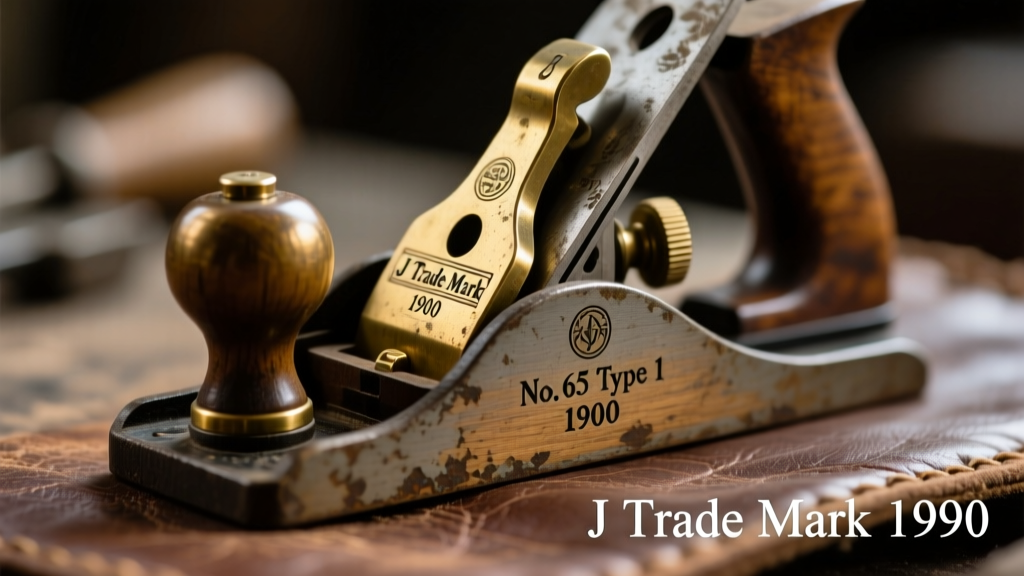
Stanley No. 65 1/2 Low-Angle Block Plane: Type 1 ‘J’ Trade Mark and the Precision Craftsmanship of 1900
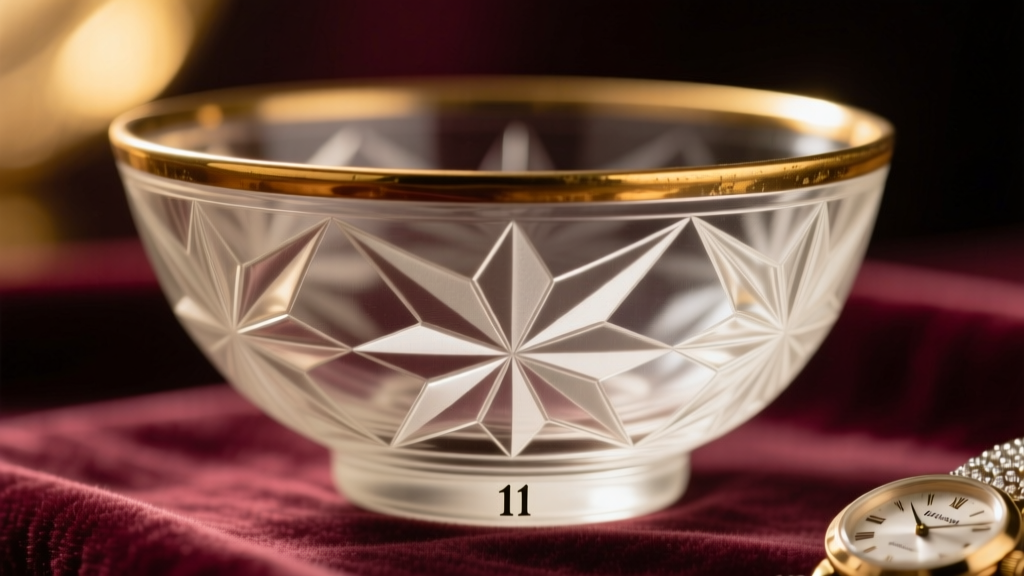
Heisey Lodestar Bowl: Dawn-Marked 11-Inch Masterpiece in American Depression Glass
Aa Vantine Plates No. 2: Technical Anatomy, Market Provenance, and Collector Context
The 1947 Esquire Vargas Envelope Calendar: A Landmark in Mid-Century American Illustration and Collectible Design

Coca-Cola Collectibles: History, Value Drivers, and Authentication Essentials for Serious Collectors
Doll Ideal Miss Revlon Original Dress: A Collector’s Guide to the Iconic 10-Inch Fashion Doll (1960–1964)
Chrome Flask Hip Flasks of the 1920s: Design, Provenance, and the 6½ × 3¾ Inch Standard

The Linemar Balancing Olive Oyl Toy: A Rare 1940s Mechanical Marvel in Original Box

Mulberry Creamer Nanking: A Rare English Silver-Gilt Cream Jug from the Late Georgian Era