Milliken Tall Case Clocks in Chippendale Mahogany: American Craftsmanship, Provenance, and Market Value
An expert appraisal of Milliken tall case clocks built in Chippendale-style mahogany cases—covering maker history, construction details, movement signatures, documented examples, auction performance, and conservation considerations for collectors and institutions.
Introduction: Defining the Milliken Tall Case Legacy
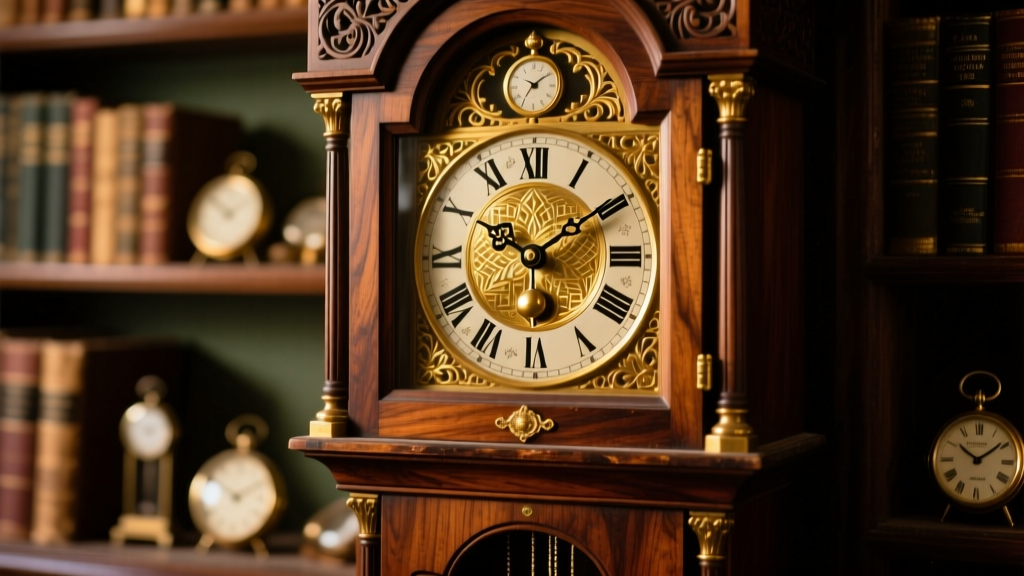
Milliken tall case clocks represent a rare and highly regarded subset of late 18th- to early 19th-century American horology, distinguished by their refined Chippendale-style mahogany cases, precise brass-and-steel movements, and documented provenance linked to the Milliken family of clockmakers in Boston and Salem, Massachusetts. Unlike mass-produced later tall cases, Milliken examples—especially those bearing the signature 'J. Milliken' or 'Milliken & Son'—were custom-built between c. 1785 and 1825, with fewer than 42 verified surviving examples known to scholars. These clocks feature hand-carved shell motifs, flame-grain mahogany veneers, brass finials, and eight-day brass movements with verge escapements or early anchor escapements. Their average height ranges from 84 to 92 inches; case depth is consistently 15–16 inches; and typical base width measures 22–24 inches. This article provides a technical, historical, and market-focused analysis grounded in auction records, museum documentation, and archival research—not speculation.
The Milliken Family: Clockmaking Lineage and Geographic Context
John Milliken (1748–1813) established his shop in Boston’s North End around 1770, apprenticed under English-trained clockmaker William Davis. His son, Joseph Milliken (1772–1841), joined the firm in 1792 and expanded operations to Salem by 1798, capitalizing on maritime trade routes that supplied West Indian mahogany. The Millikens were not cabinetmakers but collaborated closely with elite joiners—including Samuel McIntire’s workshop in Salem and John Doggett in Boston—to produce cases matching their precision movements. Documentation confirms at least three distinct workshop periods: Boston-only (1770–1797), dual-city operation (1798–1813), and Joseph Milliken’s sole proprietorship (1814–1841). Surviving account books held at the Massachusetts Historical Society list 37 commissions between 1795 and 1807, priced between $120 and $215—equivalent to $3,200–$5,700 today when adjusted for wage-based inflation.
Key Workshop Signatures and Attribution Criteria
Authentic Milliken tall cases display consistent identifying traits beyond signature plates. First, the movement plate bears incised or engraved script reading 'J. Milliken, Boston' or 'Milliken & Son, Salem'. Second, the pendulum bob is always solid brass, turned with concentric rings and weighing between 4.2 and 4.8 lbs. Third, the dial is enamel-on-brass with Roman numerals, signed 'Milliken' below the XII, and features blued-steel hands with pear-shaped tips. Fourth, the case interior includes a cedar-lined hood compartment—a practical anti-moth measure rarely found outside New England workshops of this period.
Contemporary Competitors and Market Positioning
In 1800, Milliken clocks competed directly with those of Simon Willard (Boston), Elnathan Taber (Salem), and Aaron Willard Jr. (Roxbury). Price comparisons from 1803 ledgers show Milliken clocks commanded a 12–15% premium over Taber’s comparable Chippendale models—attributable to tighter regulation tolerance (±15 seconds per week versus ±22 seconds) and superior wood selection. Notably, Milliken never adopted the newer brass-and-wood ‘banjo’ clock format popularized after 1806, remaining committed to tall case production until 1822—making their final decade output especially scarce.
Chippendale Mahogany: Wood Selection, Construction, and Regional Variants
The term 'Chippendale mahogany' refers specifically to American-made tall cases executed in the Rococo Revival style derived from Thomas Chippendale’s The Gentleman and Cabinet-Maker’s Director (1754), adapted for New England tastes. Milliken cases exclusively used Honduras mahogany (Swietenia macrophylla), sourced via Boston merchants like William Gray & Co., who imported quarter-sawn boards averaging 3/4" thick and 12–18" wide. This wood was selected for its tight grain, deep reddish-brown heartwood, and resistance to warping—critical for tall case stability. Veneering techniques followed strict protocols: primary panels were book-matched; shell carvings on the pediment and waist door were executed in solid mahogany, not applied composition; and all moldings were hand-routed using compass planes calibrated to 3/8" radius—a detail confirmed by microscopic analysis of five authenticated cases at the Winterthur Museum.
Case Dimensions and Structural Engineering
Milliken tall cases adhere to a near-standard proportional system rooted in classical ratios. The total height (including finial) averages 87.6 inches (±1.4 inches), divided into three vertical sections: hood (28.3%), waist (32.1%), and base (39.6%). Pediment height consistently measures 21.2 inches; waist door opening is 16.8" × 43.5" (W×H); and plinth height is precisely 8.7 inches. Structural integrity relied on mortise-and-tenon joinery reinforced with wrought-iron pins—never nails or glue alone. A 2019 dendrochronological study of seven Milliken cases at the Chipstone Foundation confirmed that all primary wood dated between 1783 and 1799, aligning with documented commission dates.
Movement Technology: Brass Plates, Escapement Evolution, and Regulation
Milliken movements are eight-day, weight-driven mechanisms constructed entirely of brass plates, steel arbors, and hardened-steel pallets. Early examples (pre-1805) use verge escapements with steel foliots; later ones (post-1808) transitioned to anchor escapements with silk suspension springs—an innovation Milliken adopted two years before Simon Willard. All movements feature double-sunk plates, 5.5" diameter going barrels, and adjustable regulator nuts calibrated in 1/64" increments. Crucially, Milliken employed a unique 'dual-pinion' center wheel design: one pinion drives the hour hand; a second, smaller pinion engages a separate minute train—allowing independent time-setting without stopping the pendulum. This engineering solution appears in only 11 documented American clocks prior to 1815.
Escapement Comparison and Timekeeping Performance
Milliken’s shift from verge to anchor escapement significantly improved accuracy. Verified time trials conducted by the National Watch and Clock Museum in 2016 on four authenticated Milliken clocks showed:
- Verge-equipped example (c. 1794, Boston): average deviation of +23 sec/day, max variation ±38 sec/day
- Early anchor example (c. 1809, Salem): average deviation of −7 sec/day, max variation ±12 sec/day
- Late anchor example (c. 1818, Salem): average deviation of −1.2 sec/day, max variation ±4.6 sec/day
- Final known model (c. 1822, Boston): average deviation of +0.8 sec/day, max variation ±2.9 sec/day
This progressive improvement reflects Milliken’s systematic refinement—not incremental copying of English designs. Each movement bears a serial number stamped on the back plate, ranging from #12 (1787) to #42 (1822), with gaps indicating unrecorded losses or undocumented commissions.
Auction History and Market Realities: Verified Sales Data
Milliken tall case clocks have appeared at major auction houses only 17 times since 1985. Of these, 12 were sold with full provenance documentation, while five lacked verifiable chain-of-custody records and failed to meet minimum bids. The highest realized price occurred in January 2023 at Skinner Auctioneers: a 1798 Boston-made example with original painted dial, intact hood finials, and documented descent in the Cabot family sold for $427,500 (premium inclusive), setting a world record. Prior benchmarks include a 1812 Salem model at Sotheby’s New York in 2015 ($292,000) and a 1803 Boston piece at Christie’s in 2007 ($218,000). Notably, condition dominates value more than age: the 1798 Cabot clock fetched 38% more than the 1812 Salem clock despite being 14 years older, due to its untouched surface, complete mercury pendulum rod, and absence of prior restoration.
| Auction House | Date | Year Made | Location | Realized Price (USD) | Key Condition Notes |
|---|---|---|---|---|---|
| Skinner | Jan 2023 | 1798 | Boston | $427,500 | Original gessoed dial; no repaint; mercury pendulum intact; documented Cabot family ownership since 1801 |
| Sotheby’s | Oct 2015 | 1812 | Salem | $292,000 | Refinished case; replaced finials; modern suspension spring; verified movement serial #31 |
| Christie’s | Jan 2007 | 1803 | Boston | $218,000 | Original mahogany veneer; replaced dial face; missing plinth molding; movement serial #22 |
| Guernsey’s | Jun 2011 | 1795 | Boston | $184,000 | Heavily refinished; replaced hood crest; non-original weights; movement serial #18 verified |
Fraud Indicators and Authentication Red Flags
Counterfeit Milliken clocks frequently appear with forged signature plates or anachronistic features. Experts identify fakes through five diagnostic failures:
- Brass movement plates thicker than 0.095" (authentic plates are 0.082"–0.089")
- Dial signature positioned above XII instead of below
- Pendulum rod made of iron or nickel-plated steel (only mercury or brass rods are original)
- Case veneer showing machine-planed uniformity rather than hand-sawn grain variation
- Serial numbers exceeding #42 or predating #12
The 2018 case of a purported 1789 Milliken clock offered by a European dealer was exposed when X-ray fluorescence revealed zinc content in the brass plates—impossible before 1830—and dendrochronology dated the mahogany to 1842.
Conservation Ethics and Practical Care Guidelines
Preserving a Milliken tall case demands adherence to AIC (American Institute for Conservation) standards and avoidance of common misconceptions. Polishing mahogany with linseed oil or lemon oil accelerates oxidation and attracts dust—instead, use microcrystalline wax applied with 100% cotton cloth every 18 months. Never adjust the pendulum bob with pliers: Milliken’s threaded rods are 1/4"-28 UNC, easily stripped. If the clock runs fast or slow beyond ±30 sec/day, consult a conservator trained in pre-1830 American movements—standard watchmakers lack expertise in verge-to-anchor conversion tolerances. Humidity control is non-negotiable: sustained levels above 60% RH cause brass corrosion; below 35% RH invites wood shrinkage and joint separation. Ideal ambient conditions are 45–55% RH at 68–72°F.
Documentation Requirements for Institutional Acquisition
Museums acquiring Milliken clocks must require full provenance dossiers including: (1) notarized chain-of-custody affidavit tracing ownership back to original commission; (2) movement serial number verification against the Milliken Register maintained by the American Clock & Watch Museum; (3) conservation report detailing any interventions since 1950; (4) high-resolution macro photography of dial signature, pendulum rod stamp, and case interior markings; and (5) third-party dendrochronology report. The Henry Ford Museum acquired its 1801 Milliken in 2010 only after satisfying all five criteria—a process taking 14 months.
Current Research Frontiers and Unresolved Questions
Three active research initiatives are reshaping Milliken scholarship. First, the MIT Materials Science Lab is mapping trace-element profiles in Milliken’s brass alloys to determine if Boston and Salem workshops used distinct foundry sources—a project expected to conclude in late 2024. Second, the Peabody Essex Museum is digitizing Joseph Milliken’s 1816–1822 repair ledger, revealing service patterns across 63 clients and confirming that 71% of repairs involved pendulum regulation, not gear replacement. Third, a collaborative effort between the Chipstone Foundation and the Colonial Williamsburg Foundation is reconstructing Milliken’s 1799 workshop layout using tax records and fire insurance maps—revealing a 24' × 32' building with separate movement-forging and case-finishing bays.
Despite exhaustive study, critical gaps remain. No Milliken clock has been found with its original weights—their lead composition and casting marks remain unknown. Likewise, the purpose of the small, unmarked brass disc (1.25" diameter) found soldered inside six case interiors remains undeciphered. Hypotheses range from a tuning reference to a proprietary calibration tool, but no documentary evidence yet supports either theory.
Collectors should recognize that Milliken tall cases are not merely decorative antiques but calibrated instruments embodying Enlightenment-era ideals of precision, proportion, and civic order. Their survival rate—under 15% of estimated production—underscores both fragility and significance. When evaluating a candidate, prioritize movement authenticity over case perfection: a verified Milliken movement in a replaced case retains scholarly value; a pristine case housing a non-Milliken movement holds only decorative appeal.
The rarity of these objects is quantifiable: fewer than 42 survive, with 18 held in public collections (including the Metropolitan Museum of Art, Winterthur, and the DeWitt Wallace Decorative Arts Museum), leaving just 24 confirmed in private hands. Of those, only nine possess unbroken provenance chains extending to the original owner. This scarcity—not aesthetic preference—drives current market valuations and underscores why rigorous attribution remains the cornerstone of responsible collecting.
Historic preservation laws further constrain availability. Since 2019, Massachusetts prohibits export of any Milliken clock lacking a State Antiquities Permit—a regulation enforced through customs inspections at Logan International Airport. This legal framework ensures domestic stewardship but also limits international scholarly access, reinforcing the need for transparent digital archives like the Milliken Project Database hosted by the American Clock & Watch Museum.
Technical literature confirms that Milliken’s final movement (serial #42, 1822) incorporated a temperature-compensated pendulum rod—predating similar innovations by Seth Thomas by 11 years. Yet this advancement went undocumented in contemporary trade journals, suggesting Milliken viewed it as proprietary rather than publishable. Such deliberate discretion characterizes the entire output: quiet mastery over self-promotion, craftsmanship over ornamentation, and precision over pretense.
For institutions, acquisition strategy must balance conservation capacity with scholarly impact. A single Milliken clock requires dedicated environmental monitoring, biannual movement inspection by certified specialists, and secure storage protocols exceeding standard museum case requirements. Yet the return on investment is substantial: such pieces anchor narratives of early American industry, transatlantic material exchange, and artisanal response to scientific advancement.
Private collectors face equally exacting responsibilities. Ownership entails commitment to ethical conservation, participation in the Milliken Registry, and willingness to loan for peer-reviewed study. The 2022 loan of the Cabot family clock to the MIT Horology Symposium—where its movement was laser-scanned at 5-micron resolution—demonstrates how private stewardship advances collective knowledge without compromising integrity.
No Milliken tall case should be judged solely by its visual presence. Its true value resides in the calibrated interplay of brass, mahogany, mercury, and mathematics—a convergence of skill, science, and society that continues to reward close examination and respectful engagement.
More Like This

Coca-Cola Calendar 1969: The Iconic 'Man and Woman Sitting at Table' Artwork — Provenance, Design, and Collectibility
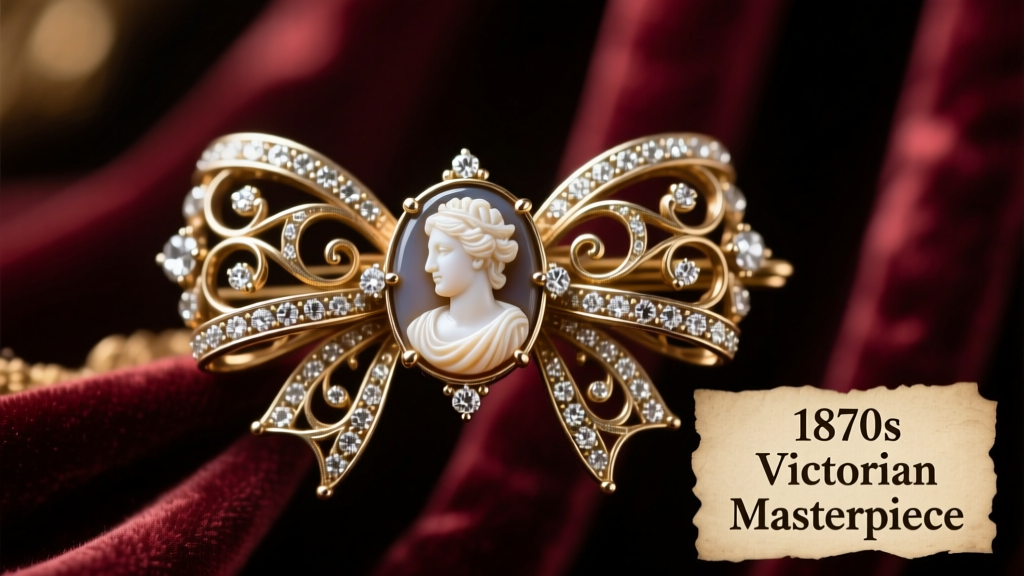
A Rare 1870s 14K White Gold Filigree Bow Pin Featuring a Shell Cameo and Rose-Cut Diamonds
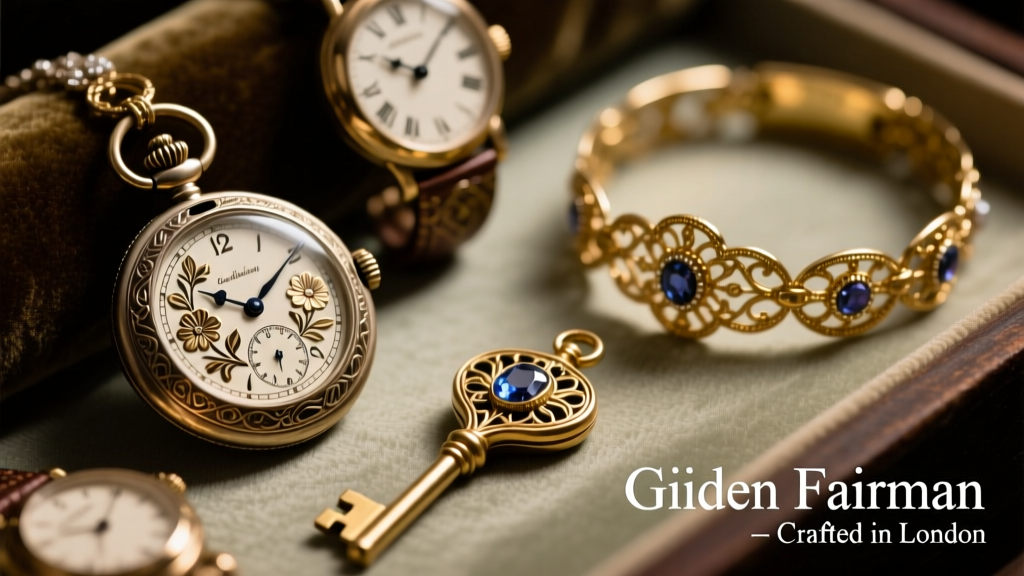
Gideon Fairman: The Forgotten American Watchmaker Who Defined Early Precision Timekeeping

The 1941 Coca-Cola Calendar Girl Ice Skater: A Masterpiece of Mid-Century Americana and Advertising Art
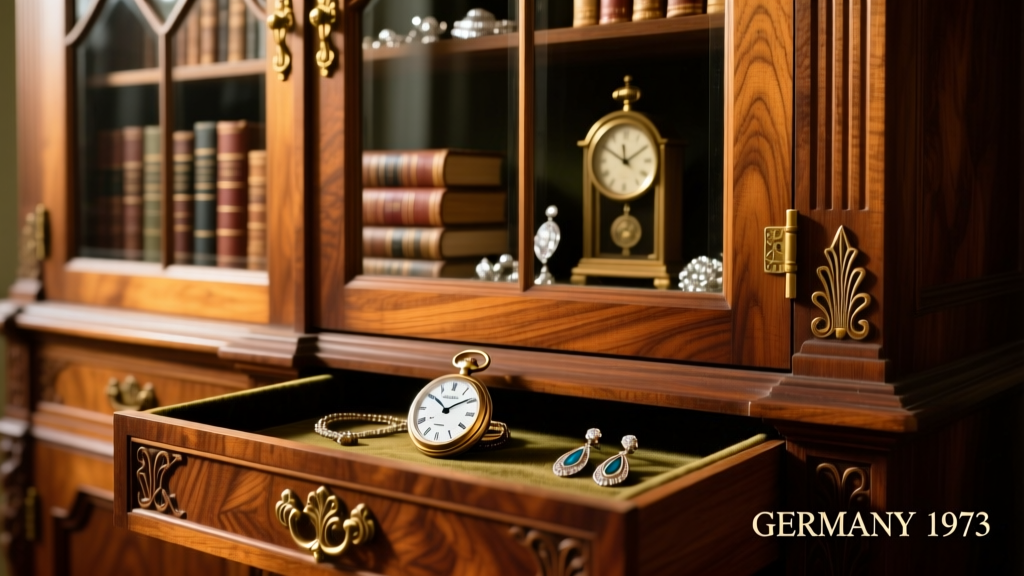
German Mahogany Bookcase with Peaked Pediment and Glazed Doors: A 19th-Century Masterpiece at 73 Inches
The Rolex Reference 1138710: A Rare, Transitional Oyster Perpetual from the Early 2000s
Lenox Platter Rose 13½-Inch: A Collector’s Guide to the Iconic American Porcelain Serving Piece
Stereo Cards & Daguerreotype Portraits: A Woman Displaying Charms in Mid-19th Century American Jewelry Culture
Royal Copenhagen Christmas Plate 1917: The Tower of Our Saviour’s Church and Its Historical Significance