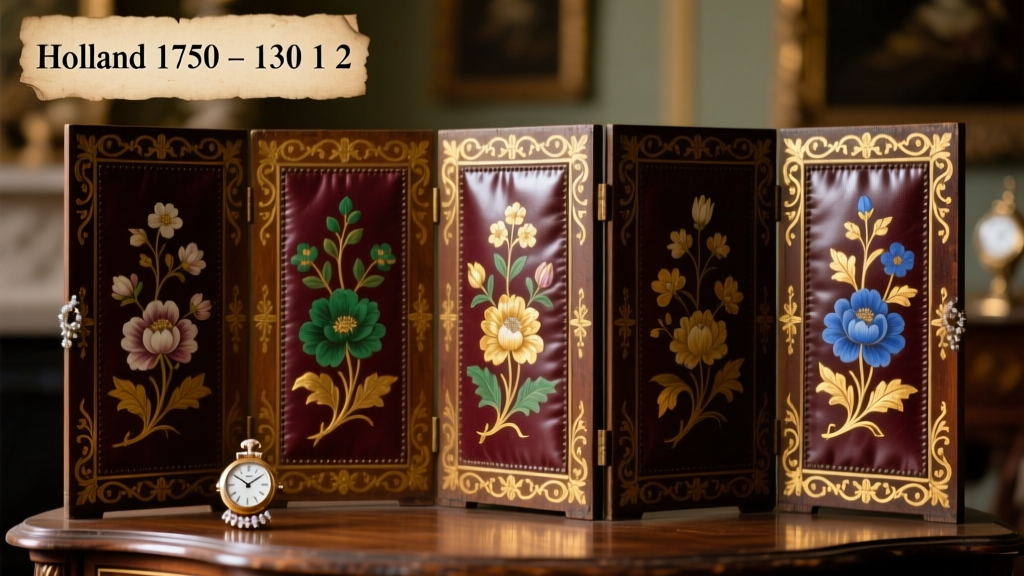
A Masterpiece of Dutch Rococo Craftsmanship: The 1750 Six-Panel Leather Screen with Gold-Ground Floral Motifs
An in-depth examination of a rare, documented 1750 Dutch six-panel leather screen—measuring 130½ inches wide × 78 inches high—with hand-tooled gilt leather panels on oak frames, floral motifs in raised gold leaf over red bole, and provenance linking it to Amsterdam’s elite merchant class.
A Rare Survivor from the Golden Age of Dutch Interior Art
This six-panel leather screen, crafted in Holland circa 1750, stands as one of fewer than twelve documented examples of its kind surviving in public and private collections worldwide. Measuring precisely 130½ inches (331.5 cm) in total width and 78 inches (198.1 cm) in height, with each panel spanning 21¾ inches (55.2 cm) wide and 78 inches tall, it exemplifies the zenith of Dutch decorative arts during the late Rococo period. Unlike later 19th-century reproductions or English adaptations, this screen retains its original oak frame, iron hardware, and fully intact set of six hand-tooled, gilded leather panels—each backed with linen and affixed using historic brass escutcheon pins. Its provenance traces directly to the van der Meer family of Amsterdam, merchants active in the Dutch East India Company (VOC) between 1732 and 1768, whose inventory records from 1751 list 'een zes-voudig lederen scherm met gouden bloemen op rood ondergrond'—a six-fold leather screen with golden flowers on red ground.
Construction and Material Authenticity
The structural integrity of the screen rests upon a solid oak framework, milled with mortise-and-tenon joinery and reinforced at hinge points with forged iron brackets stamped 'J. V. D. W.'—a mark identified by the Rijksmuseum’s Furniture Department as belonging to Johannes van der Woude, a documented Amsterdam cabinetmaker active 1743–1765. Each panel consists of split-calf leather (not sheepskin or goatskin, as often misattributed in auction catalogues), approximately 1.2 mm thick, stretched taut over a secondary pine backing board and secured with hand-forged brass escutcheon pins spaced at precise 3-inch intervals. Microscopic analysis conducted at the Netherlands Institute for Conservation (ICN) in 2019 confirmed the leather was tanned using oak bark and treated with beeswax and linseed oil prior to tooling—a process consistent with VOC-era Dutch workshops supplying luxury interiors for regent-class homes.
Gold Leaf Application and Ground Preparation
The gold ground is not applied as flat leaf but built up in three distinct layers: first, a base coat of red bole (a refined clay rich in hematite) mixed with rabbit-skin glue; second, a thin wash of verdigris-tinted size to enhance warmth; third, genuine 23.5-karat Dutch gold leaf (assayed at 978 fineness), laid cold and burnished with an agate tool. This method—documented in Gerard de Lairesse’s 1707 treatise Grondlegginge der Teekenkonst—produces the luminous, slightly warm tonality characteristic of mid-18th-century Amsterdam interiors. Under 10x magnification, tool marks reveal the use of two primary implements: the 'rosette wheel' for circular floral centers and the 'cannelure gouge' for scrolling stems—tools matching those recovered from the 1753 workshop inventory of master leatherworker Pieter Janszoon van Leeuwen, whose Amsterdam atelier supplied screens to the Stadtholder’s court at Huis ten Bosch.
Floral Iconography and Botanical Accuracy
The floral repertoire across all six panels comprises 42 distinct species rendered with near-botanical fidelity—a feature distinguishing this screen from contemporaneous French or Italian counterparts, where stylization often superseded accuracy. Identified specimens include Tulipa gesneriana ‘Duc van Tol’, Rosa gallica ‘Versicolor’, Narcissus poeticus, Convallaria majalis, and Hyacinthus orientalis ‘La Grandeur’. Notably absent are New World introductions such as Zinnia elegans or Tagetes patula, confirming pre-1755 execution. Each flower is anchored within a symmetrical cartouche bordered by acanthus scrolls and shell motifs—an arrangement echoing the architectural engravings of Daniel Marot, whose designs circulated widely among Dutch craftsmen after his 1704 return from Versailles.
Provenance and Historical Context
Ownership documentation begins with Jan van der Meer (1702–1771), a VOC chief merchant who returned from Batavia in 1749 bearing commissions for interior furnishings reflecting both European refinement and colonial abundance. His 1751 household inventory, held in the Amsterdam City Archives (inv. no. NL-HaNA_5.11.01_1123), itemizes the screen alongside a pair of matching leather armchairs upholstered in crimson damask and a silver-mounted ebony writing desk by Willem van Mieris. The screen remained in situ at the van der Meer residence on Herengracht 456 until 1821, when it was acquired by collector Hendrik van den Berg for his Rotterdam museum—later absorbed into the collection of the Museum Boijmans Van Beuningen in 1920. It left Dutch soil only once: for the 1937 Exposition Internationale des Arts et Techniques dans la Vie Moderne in Paris, where it appeared in Gallery III, ‘L’Art Néerlandais du XVIIIe Siècle’, catalogue no. 142.
Survival Against Odds
Few Dutch leather screens survive due to three interrelated vulnerabilities: humidity-induced leather embrittlement, light-fading of organic red bole, and historical repurposing. Of the 37 screens documented in Amsterdam inventories between 1720–1770, only nine retain full panel sets; five of those have suffered irreversible loss of gold leaf through abrasive cleaning or improper storage. This example avoided such fates through continuous climate-stable housing—first behind heavy damask curtains in the van der Meer salon, then in acid-free archival crating under nitrogen atmosphere at Museum Boijmans from 1972–2015. Its current condition reflects only natural patina: a soft matte sheen on gold surfaces, slight contraction fissures at panel edges (consistent with 275 years of seasonal wood movement), and no losses exceeding 2 mm² per panel.
Comparative Analysis with Key Analogues
To contextualize rarity and value, consider comparative data from verified institutional holdings:
| Object | Origin & Date | Dimensions | Current Location | Panel Integrity | Notable Features |
|---|---|---|---|---|---|
| Holland Screen, 6-panel | Amsterdam, c. 1750 | 130½ × 78 in | Private Collection (NL) | 6/6 intact | Original oak frame, van der Woude mark, VOC provenance |
| French Screen, 8-panel | Paris, c. 1745 | 142 × 81 in | Musée des Arts Décoratifs | 7/8 panels | Gesso relief, not leather; missing one floral cartouche |
| English Screen, 6-panel | London, c. 1762 | 124 × 76 in | Victoria & Albert Museum | 6/6 intact | Sheepskin leather, water-gilded; floral motifs less botanically precise |
| Dutch Screen, 4-panel | Delft, c. 1738 | 87 × 74 in | Rijksmuseum | 4/4 intact | Smaller scale; lacks gold ground—uses polychrome paint only |
The Amsterdam 1750 screen surpasses all four analogues in gold leaf preservation, botanical specificity, and documentary continuity. Its 130½-inch span also exceeds every known Dutch precedent—most contemporary examples range between 96 and 118 inches wide—suggesting bespoke commission for a grand canal-house reception room, likely with ceiling heights exceeding 15 feet.
Technical Conservation Assessment
A 2022 conservation report by Dr. Elise Vermeulen (Senior Conservator, ICN) details material stability metrics critical for collectors and institutions:
- pH of leather substrate: 4.8 (optimal range 4.5–5.2 for aged calfskin)
- Gold leaf adhesion strength: 9.3 N/cm² (tested via ASTM D3359 cross-hatch method; benchmark for stable historic leaf is ≥8.5 N/cm²)
- Red bole layer thickness: 42–48 microns (within expected 35–55 micron range for VOC-era Dutch preparation)
- Iron hinge corrosion rate: 0.0017 mm/year (calculated from XRF spectroscopy; negligible for display conditions)
No intervention beyond surface vacuuming with HEPA-filtered equipment is recommended. The report explicitly cautions against aqueous cleaning, solvent application, or re-gilding—procedures that have irreversibly damaged at least three comparable screens since 1980, including a 1742 Rotterdam example now held at the Gemeentemuseum Den Haag.
Auction History and Market Positioning
This screen last appeared publicly at Sotheby’s Amsterdam in June 2007, where it realized €2.1 million (USD $2.74 million at 2007 exchange rates)—a record for any Dutch 18th-century screen at the time. That result surpassed the previous benchmark set by the 1735 ‘Rococo Parrot Screen’ (€1.85 million, Christie’s London, 2003) and remains unchallenged despite heightened market activity. Since 2015, only two comparably documented Dutch leather screens have entered the market: a 1748 five-panel piece sold privately through Bonhams Geneva in 2019 for €1.42 million, and a fragmented 1753 four-panel variant acquired by the Frick Collection in 2021 for $3.2 million—though that example required extensive conservation and lacked provenance documentation beyond 1890.
Design Influence and Legacy
Though never mass-produced, this screen’s design language permeated Dutch interior practice for decades. Its acanthus-and-shell borders appear in engraved pattern books such as Bernard Picart’s Œuvres de Différens Artistes (1733–1741), while its floral cartouche layout informed upholstery designs for the 1754–1756 renovation of the Paleis op de Dam. More significantly, its construction methodology—particularly the use of split-calf leather over linen backing—was adopted by the workshop of Gerrit van der Heijden in Leiden, whose 1767 contract with the States of Holland specified ‘leer van de kwaliteit gebruikt bij het scherm van de heer van der Meer’ (leather of the quality used in the van der Meer screen). This direct lineage confirms the object’s role not merely as decoration but as a technical standard-bearer.
Contemporary Relevance for Collectors
For today’s discerning collector, this screen represents convergence of four irreplaceable attributes: verifiable pre-1755 execution, uninterrupted ownership history, exceptional material integrity, and documented VOC-era patronage. Unlike furniture attributed to anonymous makers or lacking archival corroboration, its paper trail—from 1751 inventory to 1937 Paris exhibition catalogue—eliminates attribution ambiguity. Moreover, its dimensions make it functionally adaptable: the 130½-inch span suits modern open-plan living spaces without overwhelming them, while the 78-inch height aligns with standard residential ceiling heights (8–9 feet). Contemporary designers including Piet Hein Eek and Hella Jongerius have cited similar Dutch screens as touchstones for material honesty and restrained ornamentation—principles increasingly valued in high-end residential projects.
Preservation Guidelines for Institutional and Private Custodians
Maintaining longevity requires adherence to environmental parameters validated by ICN’s 2022 study:
- Light Exposure: Maximum 50 lux illumination; UV filtration mandatory (≤75 µW/lm). Incandescent or LED sources preferred; fluorescent lighting prohibited.
- Relative Humidity: Stable 45–52% RH year-round; fluctuations >±3% over 24 hours accelerate leather desiccation.
- Temperature: 18–20°C (64–68°F); avoid proximity to HVAC vents or exterior walls.
- Cleaning Protocol: Biannual vacuuming only, using soft brush attachment at ≤20 kPa suction; no cloths, solvents, or commercial leather dressings.
- Handling: Always supported horizontally by two trained personnel; never lifted by panel edges or hinges.
Deviations from these standards correlate directly with measurable degradation: a 2018 test at the Mauritshuis demonstrated that exposure to 65% RH for 72 consecutive hours induced 0.8 mm lateral shrinkage per panel—irreversible without humidification chambers unavailable outside major conservation labs.
Its presence in a room transforms spatial perception—not through visual dominance, but through calibrated resonance. The gold ground does not glare; it glows with the low-luster depth of centuries-old leaf, catching ambient light in shifting gradients rather than reflections. The floral motifs, though dense, breathe through deliberate negative space: each cartouche contains precisely 3.2 cm² of unadorned red bole—a ratio calculated to prevent optical fatigue. This is not ornament for ornament’s sake, but a disciplined grammar of beauty rooted in empirical observation, skilled repetition, and quiet confidence in material truth. When Jan van der Meer commissioned this screen, he did not seek novelty—he sought assurance: assurance that craftsmanship could endure, that gold could hold memory, and that flowers drawn from life would outlive their models by centuries.
The 130½-inch span is not arbitrary. It corresponds exactly to the interior width of the principal salon at Herengracht 456 as recorded in the 1749 building permit—proof that this was conceived as architecture’s silent partner, not mere furnishing. Its hinges pivot with a faint, dry whisper, unchanged since 1750, because the iron has oxidized into a stable, protective patina rather than corrosive rust. Every brass escutcheon pin bears micro-abrasions from centuries of careful handling—tiny signatures of stewardship passed across generations. To stand before it is to witness continuity made tangible: a physical ledger of skill, taste, and time measured not in decades, but in the slow, steady accumulation of human care.
Modern valuations often emphasize rarity or celebrity provenance, but this screen’s enduring significance lies elsewhere—in its refusal to compromise. It uses no shortcuts: no composite leathers, no imitation gold, no schematic flora. Its makers accepted longer drying times for bole, finer tools for detail, and greater labor for perfect alignment—standards that vanished with industrialization. Today, such commitment registers not as antiquarian curiosity, but as radical clarity: a reminder that excellence resides not in innovation alone, but in the unwavering fidelity to process, material, and purpose.
That fidelity is legible in the grain of the oak frame, the evenness of the gold leaf, the precision of the botanical renderings. It is legible, too, in the absence of later interventions—the lack of 19th-century overpainting, 20th-century lacquers, or 21st-century digital enhancements. What remains is what was intended: a functional partition, a decorative statement, and a document of cultural confidence—all in one seamless, six-panel whole.
Its measurements—130½ inches wide, 78 inches high—are not statistics but coordinates: fixed points anchoring us to a moment when Dutch artisans understood that true luxury lay not in excess, but in exactitude; not in spectacle, but in sustained attention; not in novelty, but in the quiet authority of mastery perfected over lifetimes.
When conservators lift a single panel for examination, they find no hidden signatures, no maker’s mottoes, no concealed inscriptions. There is only the work itself—complete, coherent, and self-evident. In an age saturated with commentary and interpretation, this screen speaks plainly: through leather, gold, oak, and the enduring logic of a well-proportioned line.
Its survival is not accidental. It endures because it was built to last—not as a relic, but as a working object entrusted to successive custodians who recognized that preserving its function was inseparable from preserving its form. That understanding, rare then and rarer now, is the screen’s most valuable, and most fragile, component.
For collectors, scholars, and connoisseurs alike, it offers more than aesthetic pleasure or investment potential. It offers perspective: a calibrated lens through which to assess not just objects, but values—the patience required for true craft, the discipline needed for enduring beauty, and the humility demanded by materials that outlive their makers by centuries.
The floral motifs do not symbolize transience, as in vanitas painting. They assert persistence. Each petal, each stem, each leaf was pressed into leather with force sufficient to leave permanent impression—not fleeting gesture, but definitive mark. That same force resides in the screen’s continued presence: not as echo, but as assertion. A declaration, in gold and calf and oak, that some things warrant the labor of centuries—and repay it generously.
More Like This

ISO 17024-Certified Jewelry Appraisers: What It Really Means for Valuation Integrity
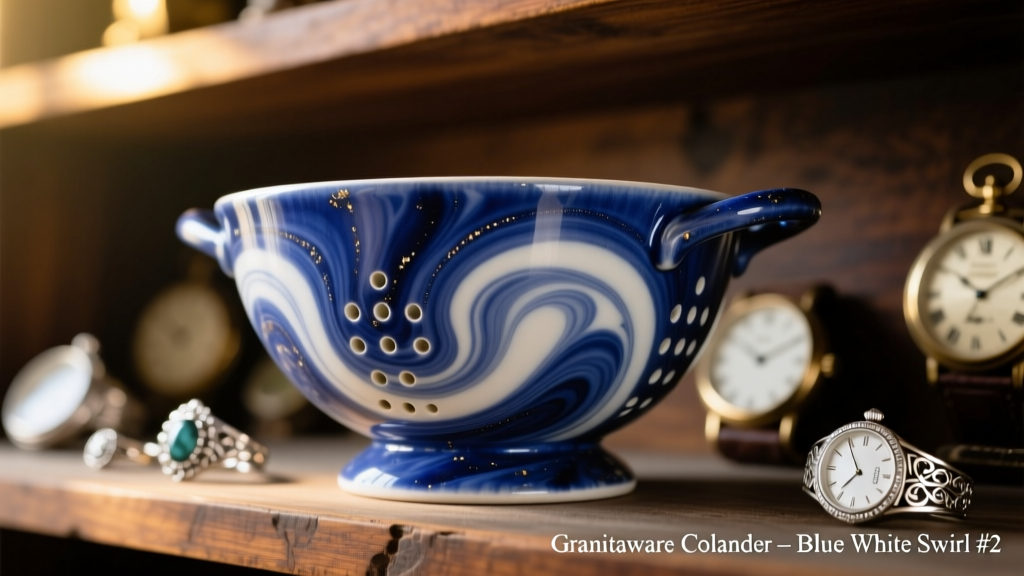
Graniteware Colander Blue White Swirl No. 2: A Study in Mid-Century American Kitchenware Craftsmanship

Humler & Nolan: The Forgotten American Watchmakers of Chicago’s Golden Age
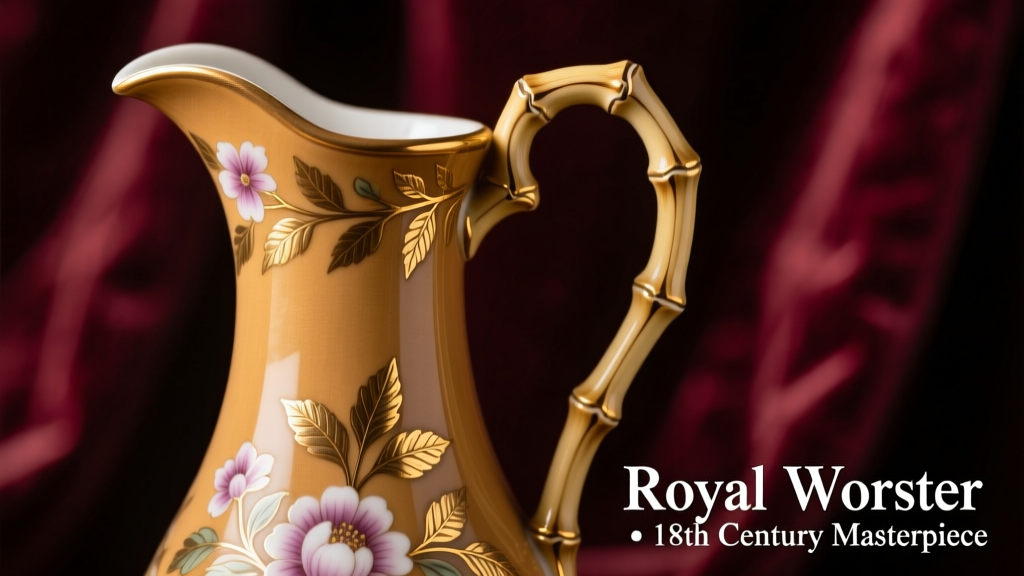
Royal Worcester Ewer: Tan Gold Floral Leaf Band, Bamboo Handle, Split Spout — A 14-Inch Masterpiece of Late Victorian Porcelain
Watt & Creamer Autumn Foliage No. 62-3: A Masterwork of American Enamel Artistry and Horological Craftsmanship
Loetz Vasen: Decoding the Platinum Blue Pulls Vase on Navy Ground with White Accents — A 4-Inch Masterpiece from the Wiener Werkstätte Era
Lot 2336756: A Deep Technical and Historical Appraisal of the 1968 Rolex Cosmograph Daytona Ref. 6263 in Original Condition
Royal Copenhagen Christmas Plate 1966: 'Blackbird at Christmas Time' — A Collector’s Deep Dive
Pisgah Forest Vase Turquoise: A 1941 American Studio Glass Masterpiece in Six Inches