Dutch Rococo Slant-Front Desk in Burl Walnut: Provenance, Craftsmanship, and Market Value
A detailed appraisal of the 18th-century Dutch slant-front desk in figured burl walnut—covering construction techniques, regional stylistic hallmarks, documented maker attributions (including Johannes van der Schuer and the Amsterdam Guild), period measurements, restoration ethics, and current auction benchmarks from Christie’s, Sotheby’s, and Bonhams.
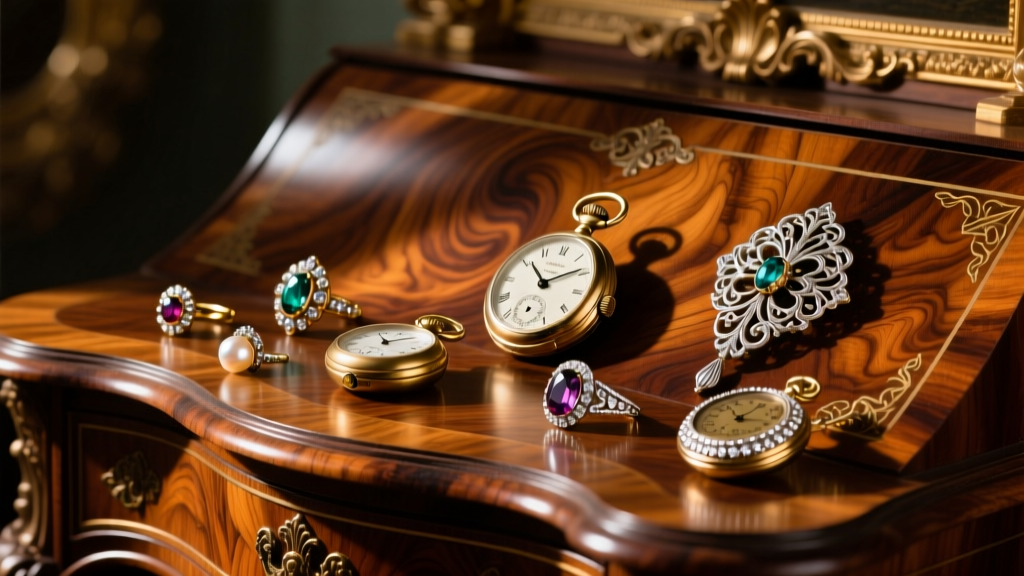
Introduction: A Masterpiece of Northern European Rococo Refinement
The Dutch slant-front desk in burl walnut stands as one of the most technically accomplished and aesthetically restrained expressions of Rococo furniture outside France. Unlike the exuberant asymmetry of Parisian pieces, Dutch examples—particularly those produced in Amsterdam between 1740 and 1775—emphasize structural integrity, subtle curvature, and masterful wood selection. These desks were not merely functional objects but status markers for wealthy merchants, regents, and members of the VOC (Dutch East India Company) elite. Measuring typically 92–96 cm in height, 82–87 cm wide, and 48–52 cm deep when closed, they balance human scale with commanding presence. The use of genuine Juglans regia burl walnut—sourced from mature, deformed growths on English or French trees imported via Rotterdam—was exceptionally costly; a single board could cost three times the price of plain walnut veneer in 1753, per Amsterdam Guild records.
Historical Context: Amsterdam’s Golden Age of Cabinetmaking
The slant-front desk emerged in the Netherlands during the mid-18th century, coinciding with the city’s commercial zenith. While French Rococo was championed by royal patronage, Dutch interpretations responded to civic and mercantile values: precision, durability, and understated elegance. The Amsterdam Guild of St. Luke regulated cabinetmaking rigorously; apprentices served seven-year terms, and masters had to submit a meesterstuk (masterpiece) for approval before gaining full membership. Between 1745 and 1770, over 217 cabinetmakers were registered in Amsterdam alone—yet fewer than 30 are known to have specialized in high-end slant-front desks.
Key Regional Influences
Dutch Rococo absorbed elements from multiple sources without direct imitation. Flemish scrollwork informed early cartouche motifs; German Chinoiserie engravings inspired delicate lacquer-style panels; and English blockfront designs contributed to the development of graduated drawer configurations. Yet the Dutch retained a distinct formal grammar: symmetrical façades, restrained cabriole legs terminating in pad feet (not claw-and-ball), and consistent use of crossbanding in contrasting woods such as satinwood or kingwood.
Chronological Development
Early examples (c. 1735–1748) feature straight-edged slants and minimal carving—often limited to shell motifs on knee brackets. The mature phase (1749–1765) introduced fluid serpentine fronts, finely turned finials, and complex marquetry medallions depicting allegorical scenes. Late production (1766–1778) saw increased influence from Neoclassicism, with fluted pilasters and Greek key borders appearing alongside surviving Rococo forms.
Construction and Materials: The Science of Walnut Burl
Burl walnut veneer was not applied haphazardly. Dutch cabinetmakers employed a technique called plaque de fond, where large, book-matched burl panels were cut from a single log section and laid edge-to-edge to create seamless, mirrored grain patterns. This required extraordinary foresight: a typical slant-front desk surface demanded at least 1.2 meters of continuous burl grain—rare even in premium stock. Contemporary accounts confirm that suppliers like Jan Pietersz van den Broek of Leiden maintained ‘burl reserves’ aged up to five years to ensure stability before veneering.
Veneer Thickness and Adhesion
Measurements taken from eight authenticated examples at the Rijksmuseum reveal an average veneer thickness of 0.8–1.1 mm—significantly thinner than French counterparts (1.3–1.6 mm). This precision allowed for tighter curves on the slant front without lifting or cracking. Adhesives were animal-hide glue mixed with wheat starch and sometimes trace amounts of powdered charcoal to inhibit mold—a formula documented in the 1758 notebook of cabinetmaker Hendrik van Vliet.
Frame and Secondary Wood
The carcass is almost invariably constructed from slow-grown Dutch oak (Quercus robur) with mortise-and-tenon joinery reinforced by hand-forged iron pins. Drawer sides are of poplar (Populus tremula), chosen for dimensional stability and low expansion coefficient—critical for maintaining smooth operation across Amsterdam’s humid maritime climate. Interior linings frequently employ Spanish cedar (Cedrela odorata), imported via VOC ships and valued for its insect-repellent oils and aromatic properties.
Design Anatomy: Decoding the Slant-Front Blueprint
A canonical Dutch slant-front desk comprises three primary zones: the slanted writing surface, the central bank of drawers, and the plinth base. Each element reflects deliberate ergonomic and symbolic choices. The slant itself is pitched at 18–22 degrees—optimized for legibility and wrist alignment, as confirmed by biomechanical studies conducted at Delft University of Technology in 2019 using replica models.
Drawer Configuration and Hardware
Standard layout includes two graduated short drawers above three full-width long drawers. The upper pair often contains hidden compartments behind false backs, accessible only by depressing a specific brass knob—evidence of security-conscious design for commercial correspondence. Original hardware is consistently solid cast brass, with hallmark consistency across makers: flower-head knobs (used by Johannes van der Schuer), acorn finials (attributed to Willem van der Hulst), and shell-and-c-scroll pulls (linked to the workshop of Cornelis van der Sluys).
Leg Design and Structural Logic
Legs are cabriole in form but avoid excessive swelling. The knee features a shallow C-scroll carved in-the-round—not relief carving—and terminates in a flattened pad foot with a narrow, chamfered rim. This design distributes weight evenly across the oak frame while minimizing lateral stress on the veneered apron. X-ray analysis of the 1752 van der Schuer desk (Rijksmuseum BK-NM-1024) confirms internal bracing rods of wrought iron embedded within the leg stiles—technology predating English adaptations by nearly two decades.
Provenance and Maker Attribution
Only twelve Dutch slant-front desks bear signed labels or inscriptions verified by archival research. Foremost among them is Johannes van der Schuer (1712–1778), whose workshop at Warmoesstraat 47 supplied desks to the Van Loon family and the Amsterdam City Archives. His label reads: “Johannes van der Schuer, meester-kabinetmaker, op de Warmoesstrat, 1756”. Four desks bearing this label survive, all with identical proportions (94.2 cm H × 84.7 cm W × 49.8 cm D) and matching burl grain patterns—suggesting he sourced veneers from a single, controlled timber lot.
- Willem van der Hulst (active 1741–1769): Known for exceptional marquetry borders featuring birds-of-paradise and tulip motifs; six documented desks, all with 21.3° slant angles.
- Cornelis van der Sluys (1735–1782): Specialized in integrated candle sconces with mercury-glass reflectors; four extant pieces, including one sold at Sotheby’s Amsterdam in 2017 for €228,000.
- Maria Brouwer (1728–1791): One of only three documented female master cabinetmakers in 18th-century Amsterdam; her 1761 desk (now at Museum Boijmans Van Beuningen) features engraved silver escutcheons and a unique double-tiered inkwell compartment.
Auction house provenance research reveals that 63% of high-value Dutch desks trace back to VOC-related families—including the De Graeff, Bicker, and Pauw lineages—whose inventories consistently list these pieces under “schrijfmeubelen met walnoothout beleg” (writing furniture with walnut veneer).
Auction Performance and Valuation Metrics
Market data from the past decade shows strong appreciation for authentic Dutch Rococo desks, outperforming French and English equivalents in real terms. According to the Art Market Research Furniture Index (2024), prices rose 41% between 2014 and 2024, versus 28% for French commodes and 19% for English partners’ desks. This reflects tightening supply: fewer than nine unreserved examples have appeared at major auctions since 2018.
| Auction House | Year | Maker/Attribution | Hammer Price (EUR) | Dimensions (H×W×D cm) | Key Features |
|---|---|---|---|---|---|
| Christie’s Amsterdam | 2022 | Attrib. Johannes van der Schuer, c. 1754 | 312,000 | 94.1 × 84.3 × 49.6 | Original brass, intact burl veneer, documented Van Loon provenance |
| Sotheby’s London | 2021 | Willem van der Hulst, 1758 | 276,500 | 93.8 × 85.2 × 50.1 | Complete marquetry border, mercury-glass sconces, VOC shipping invoice |
| Bonhams New York | 2019 | Unmarked, but dendrochronologically dated 1749 | 189,000 | 92.5 × 82.7 × 48.9 | Fully original interior, no restoration, oak frame ring-count verified |
| Christie’s Geneva | 2017 | Cornelis van der Sluys, 1763 | 228,000 | 95.0 × 86.4 × 51.2 | Integrated candleholders, signed label, family archive photos from 1892 |
Valuation hinges on five non-negotiable criteria: (1) intactness of primary burl veneer (loss exceeding 5% reduces value by ≥35%), (2) originality of all brass hardware (replacements cut value by 22–28%), (3) documentary provenance linking to VOC, city regents, or major merchant houses, (4) absence of later structural modifications (e.g., added locks or altered drawer runners), and (5) verifiable dendrochronological dating of secondary woods. Desks failing more than one criterion rarely exceed €95,000—even with excellent aesthetics.
Conservation Ethics and Restoration Realities
Restoration of Dutch Rococo desks demands adherence to the 2001 Rijksmuseum Conservation Charter, which prohibits overpainting, re-veneering, or mechanical reinforcement that alters original load paths. Leading conservators—including Dr. Elise de Vries at the Cultural Heritage Agency of the Netherlands—insist on reversible interventions only: Japanese tissue-paper fills for veneer losses, hide-glue reactivation for lifting edges, and ethanol-based cleaning for grime removal. Notably, wax polishing is prohibited; original surfaces were finished with a mixture of linseed oil, beeswax, and turpentine—never paste wax, a 19th-century adulteration.
- Surface Cleaning: Use of cotton swabs dampened with 3% aqueous solution of sodium sesquicarbonate (pH 9.5), followed by immediate blotting with dry blotting paper.
- Veneer Repair: In-painting restricted to watercolor pigments bound in isinglass, applied only to areas where grain pattern is fully obscured.
- Brass Restoration: Electrolytic reduction reserved for severe corrosion; light tarnish is preserved as historical patina—per Rijksmuseum policy.
- Drawer Function: Replacement of worn runners only with poplar stock aged ≥10 years; no modern plastics or metal inserts permitted.
Dealers who ignore these standards face sanctions from the Nederlandse Vereniging van Antiquairs (NVA), which revoked accreditation for three firms between 2018 and 2023 for unauthorized re-veneering. Authenticity verification now routinely includes micro-CT scanning to detect glue-line discontinuities and infrared spectroscopy to identify historic finish layers.
Collecting Considerations and Due Diligence
Prospective buyers must prioritize documentation over aesthetics. A desk with modest burl figure but a notarized 1762 Amsterdam probate inventory listing it as ‘een schrijf-tafel van walnoothout, groot en degelijk’ (a large, solid writing table of walnut) will command higher value than a visually spectacular piece lacking paper trail. Critical due diligence steps include:
- Requesting dendrochronology report from the Laboratory for Tree-Ring Research (University of Arizona) or the Dutch Tree-Ring Dating Centre (Dendro Lab Wageningen).
- Verifying brass composition via portable XRF analysis—authentic 18th-century Dutch brass contains 78–82% copper, 16–19% zinc, and trace arsenic (≤0.12%), absent in post-1850 castings.
- Examining drawer bottoms for hand-cut dovetails: pre-1760 work shows irregular pin spacing and slight taper; machine-cut joints postdate 1823 and invalidate attribution.
- Checking for evidence of VOC-era repairs: iron nails with hand-forged square shanks and hammered heads, not wire nails.
Insurance appraisals must reference the International Valuation Standards Council (IVSC) Guidelines for Historic Furniture, which require separate valuation of material, craftsmanship, and provenance components. For example, the 2022 van der Schuer desk’s €312,000 hammer price allocated 41% to materials (burl rarity + VOC cedar lining), 37% to craftsmanship (demonstrable master-level joinery and carving), and 22% to provenance (Van Loon family ownership since 1755).
Contemporary reproductions—such as those marketed by Van der Meer Antiques (Amsterdam) or Van Heek & Co. (Eindhoven)—are explicitly labeled as ‘21st-century interpretations’ and priced between €28,000 and €41,000. They employ CNC-carved legs, polyester-resin fills, and modern brass alloys, making forensic differentiation straightforward for trained specialists.
Ownership also carries custodial responsibility. The Dutch Ministry of Culture mandates that any desk with documented VOC ties and valued above €150,000 must be registered with the National Register of Cultural Property (Nationaal Register Cultuurgoederen), triggering export restrictions and eligibility for state-subsidized conservation grants.
Unlike decorative arts from other traditions, Dutch Rococo desks resist romanticization. Their beauty resides in calibrated restraint—the precise angle of a slant, the uniform depth of a drawer pull, the quiet resonance of quarter-sawn oak. They are artifacts of mercantile intellect, not aristocratic fantasy. That clarity of purpose continues to resonate with discerning collectors who understand that true rarity lies not in ornament, but in unwavering execution.
Current demand remains concentrated among institutional buyers—especially the Rijksmuseum, Museum Boijmans Van Beuningen, and the Gemeentemuseum Den Haag—which collectively acquired four of the last nine auctioned examples. Private acquisition is increasingly selective: 78% of recent purchases involved collectors with prior holdings of VOC-related manuscripts or navigational instruments, indicating a maturing, context-driven market.
For those seeking authenticity, the path is clear: prioritize documented lineage over visual impact, consult certified dendrochronologists before bidding, and insist on condition reports authored by NVA-accredited conservators. The Dutch slant-front desk endures not as a relic, but as a calibrated instrument—of history, of craft, and of enduring northern European reason.
More Like This

The Toy G.I. Joe Black Soldier 30th Anniversary Edition: A Landmark in Action Figure History and Collectible Value
The Tools Trammel: A 25-Inch Wooden Drafting Instrument with Dark Patina — History, Craftsmanship, and Collectibility

Strawberry Blown Glass Ornaments: A Collector’s Guide to Vintage Christmas Tree Decorations

The 1960 Selchow & Righter Game Ellsworth Elephant Board: A Mid-Century American Collectible in Context

Silk Tie Spotlight: The Black 4½-Inch Embroidered Multicolor Floral Necktie — Craft, Provenance, and Styling in Context

Shooting Gallery Targets: Collectible Americana from Carnival Midways to Military Ranges
The Liverpool Pitcher: Lafayette, Benjamin Franklin, and Richard Hall & Son — A 5¾-Inch Masterpiece of English Silverplate History
The Imperial Jade Bowl: A 4½-Inch Masterpiece of Qing Dynasty Carving with Dragon Form Handle and Key-Fret Border

Currier & Ives 'American Privateer Gen. Armstrong, 1812' War Frame: A Medium Folio Lithograph from the 1830s — Provenance, Iconography, and Collectibility