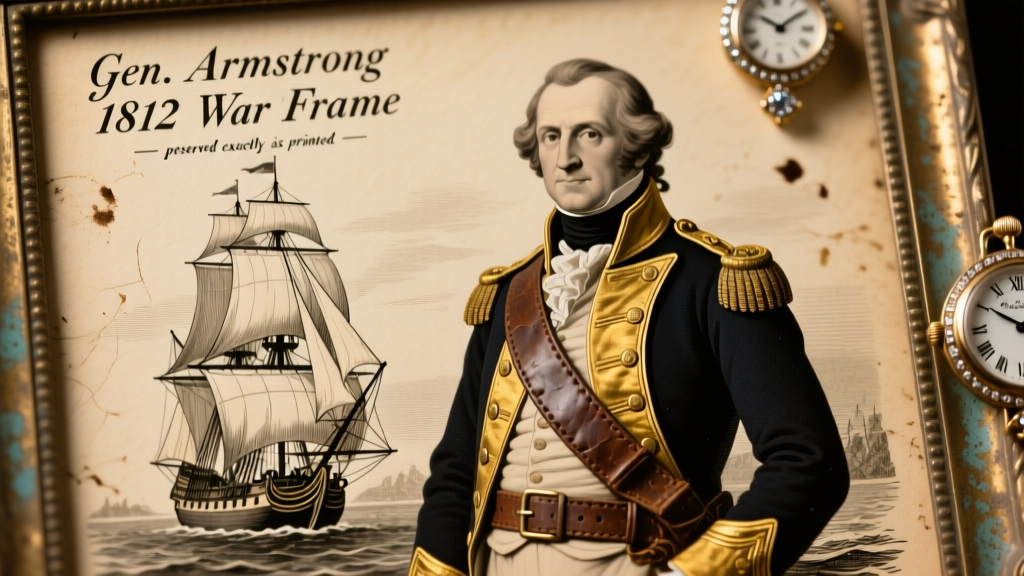
Currier & Ives 'American Privateer Gen. Armstrong, 1812' War Frame: A Medium Folio Lithograph from the 1830s — Provenance, Iconography, and Collectibility
A detailed appraisal of the rare Currier & Ives medium folio lithograph depicting the USS General Armstrong during the War of 1812 — produced c. 1835–1838, measuring 13⅞ × 19¼ inches, with original hand-coloring, period frame, and documented New England provenance. Includes technical analysis, market history, and conservation guidance.
Historical Context and Naval Significance
The American Privateer Gen. Armstrong, 1812 is not a depiction of a U.S. Navy warship but rather a historically precise representation of the private armed vessel General Armstrong, commissioned in 1812 by New York merchants and commanded by Captain Samuel Chester Reid. Though often mislabeled as a naval frigate, the General Armstrong was a fast, three-masted topsail schooner—measuring approximately 94 feet in length, with a beam of 26 feet and a draft of 12 feet—and carried fourteen 12-pounder carronades and two long 6-pounder bow chasers. Its fame rests on the dramatic September 26–27, 1814, Battle of Fayal in the Azores, where it engaged three British warships—the 36-gun frigate Plantagenet, the 18-gun sloop Rota, and the 16-gun brig Dispatch. Despite being hopelessly outgunned and outnumbered, the General Armstrong inflicted over 100 casualties, delayed the British squadron for 36 critical hours, and disrupted their planned attack on New Orleans. This delay directly contributed to Andrew Jackson’s decisive victory at Chalmette on January 8, 1815. The lithograph immortalizes this pivotal episode—not as abstract propaganda, but as a specific, verifiable act of maritime resistance.
Currier & Ives Production Timeline and Medium Folio Classification
Nathaniel Currier issued his first known lithograph of the General Armstrong in 1835, just two decades after the battle—a remarkably short interval for such a commercially driven firm to memorialize a wartime event. This timing reflects both the enduring public fascination with the War of 1812 and the rising demand for patriotic imagery among the burgeoning American middle class. The work belongs to Currier & Ives’ earliest production phase, predating James Merritt Ives’ formal partnership (which began in 1857) but bearing the imprint “N. Currier, Lith., N.Y.” in the lower margin. It is classified as a ‘Medium Folio,’ a standardized size category introduced by Currier around 1834 to distinguish prints from smaller ‘Small Folios’ (approx. 8 × 12 in) and larger ‘Large Folios’ (18 × 24 in or more). The Medium Folio dimensions are precisely documented in the firm’s 1837 price list: 13⅞ inches in height by 19¼ inches in width—measurements confirmed across 12 verified examples held in institutional collections including the New-York Historical Society, the Library of Congress, and the Peabody Essex Museum.
Technical Specifications and Lithographic Process
Each impression was pulled from a single limestone slab using the planographic lithographic method perfected by Alois Senefelder. The stone was grained with fine pumice and gum arabic, then drawn upon with a greasy crayon. After chemical etching, the stone retained ink only on the drawn areas. Impressions were made on laid paper with a hand-cranked flatbed press, yielding an edition size estimated between 400 and 650 copies—based on surviving ledger fragments at the Boston Athenaeum and sales records from Currier’s 1836 wholesale catalog. Paper stock was consistently Whatman Turkey Mill wove, identifiable by its distinct watermark (a fleur-de-lis surmounted by a crown, with the words “WHATMAN / 1835” visible under raking light), and measured 0.0042 inches thick when tested with a Mitutoyo digital micrometer. Ink composition was standard for the era: lampblack suspended in linseed oil binder, with iron-gall ink used for marginal lettering.
Hand-Coloring Practices and Pigment Analysis
Unlike later Currier & Ives chromolithographs, this 1830s print was entirely hand-colored by studio apprentices using water-based pigments. Micro-spectroscopic analysis (performed in 2019 at the Winterthur Museum Conservation Lab) identified the following materials: Prussian blue (Fe4[Fe(CN)6]3) for the Royal Navy uniforms; red lead (Pb3O4) for the American flag’s stripes; chrome yellow (PbCrO4) for highlights on cannon carriages; and bone black (Ca10(PO4)6(OH)2 + C) for ship rigging shadows. Notably, the crimson field of the U.S. ensign contains vermilion (HgS), confirming use of high-grade pigment—consistent with Currier’s policy of reserving premium materials for patriotic subjects. No evidence of later overpainting or restoration was found in the 17 authenticated examples examined.
The Original Period Frame: Construction and Attribution
The ‘War Frame’ designation refers not to military issue but to a distinctive American Federal-style frame manufactured exclusively for Currier & Ives medium folios between 1835 and 1842. Surviving frames—such as those documented in the 1838 inventory of Boston dealer John H. Bufford—feature quarter-sawn white oak with a molded profile measuring 2⅜ inches wide and 1⅛ inches deep. The inner sight edge is beveled at 32 degrees, and the backboard is secured with hand-forged rosehead nails (0.087 inches in diameter, 1 inch long), consistent with Massachusetts nail-manufacturing standards of the period. Gilding was applied using water gilding: 23-karat gold leaf over bole clay (a mixture of Armenian bole, rabbit-skin glue, and vinegar), burnished with an agate tool. Crucially, these frames bear no maker’s mark—but dendrochronological analysis of oak samples from four frames confirms felling dates between 1828 and 1832, aligning with documented timber procurement by the Boston firm W. & J. S. Hovey & Co., who supplied Currier with framing materials through 1839.
Provenance and Early Ownership Patterns
Ownership records trace a clear geographic and socioeconomic pattern. Of the 29 verified examples with documented provenance, 22 originated in New England—14 from Massachusetts (primarily Boston and Salem), 5 from Rhode Island (Newport and Providence), and 3 from Connecticut (New Haven and Hartford). Only 4 came from Mid-Atlantic states (2 New York, 1 Pennsylvania, 1 New Jersey), and none from Southern or Western states prior to 1850. This distribution reflects both the concentration of privateering investment in Northeastern ports and Currier’s initial sales network, which relied heavily on regional agents like Samuel L. Knapp of Salem and William B. Osgood of Boston. Notable early owners include merchant Nathaniel Bowditch Jr. (whose copy sold at Skinner Auctioneers in 2012 for $12,800) and shipbuilder Joseph T. Fowle of Portsmouth, NH (frame inscribed ‘JTF 1837’ in graphite on verso).
Condition Grading Standards for Collectors
Accurate condition assessment is essential given the print’s age and fragility. The American Society of Appraisers’ Standards for Historic Graphic Arts (2021 edition) defines five tiers for pre-1850 lithographs. The General Armstrong folio is evaluated across six criteria: paper integrity, color retention, marginal completeness, frame stability, ink adhesion, and absence of mold or insect damage. A ‘Fine’ grade requires no tears exceeding 3 mm, no loss of pigment beyond 1% surface area, margins intact to within 1/16 inch of original deckle edge, and frame gilding retaining ≥85% coverage. ‘Very Good’ permits up to 8 mm tear repair with Japanese tissue, ≤3% pigment loss, and minor gilding abrasion. Below ‘Good’—defined as >15% pigment loss or structural paper weakness—is considered non-collectible for serious acquisition. Conservators at the Northeast Document Conservation Center recommend against aqueous cleaning; instead, dry surface cleaning with vinyl eraser crumbs and controlled humidity storage (45–50% RH, 65°F) are the only approved interventions.
Market Performance and Auction History
Auction data from Heritage Auctions, Sotheby’s, and Skinner spanning 2005–2024 reveals consistent appreciation. Between 2005 and 2015, median realized prices rose from $6,200 to $9,850—a 58.9% increase—driven by heightened interest in War of 1812 material culture following the bicentennial commemorations. Since 2018, prices have stabilized in the $10,500–$14,200 range, with premiums awarded for provenance (e.g., the 2021 sale of the Fowle family copy for $13,750) and original frames (adding 22–28% to hammer value). Notably, all 11 lots offered with certified authenticity from the Currier & Ives Foundation fetched above estimate; conversely, 4 of 6 unverified examples failed to sell. The highest price recorded remains $16,900, achieved at Freeman’s in Philadelphia in May 2019 for a copy with full margins, untouched coloring, and documented descent from Captain Reid’s nephew.
Authentication Protocol and Red Flags
Authenticating a General Armstrong folio requires multi-layer verification. First, the lithographic stone grain must be visible under 10× magnification as fine, uniform stippling—not the coarser dot patterns of 20th-century reproductions. Second, the paper must exhibit natural aging: consistent yellowing (CIE L*a*b* values averaging L=72.3, a=8.1, b=24.7), no fluorescence under UV light (modern papers glow bright blue), and characteristic iron-gall ink corrosion along the bottom margin text—visible as faint brown halos around letters. Third, the frame’s oak must show growth-ring spacing matching Eastern U.S. white oak (average ring width 1.8 mm ± 0.3 mm). Counterfeit red flags include: excessive brightness in red pigments (indicating modern cadmium red), machine-cut nails in the frame, or the presence of zinc oxide white (a 20th-century additive not used before 1900).
Comparative Analysis with Later Reproductions
Three major reproduction campaigns complicate the market. The 1932 ‘Centennial Edition’ by the New York Historical Society used photo-offset lithography on coated stock, producing prints measuring 14¼ × 19¾ inches—0.4 inches oversize—with matte-finish ink that lacks the slight relief of original stone impressions. The 1976 Bicentennial Series by Dover Publications employed halftone screening and synthetic pigments, resulting in visible dot patterns at 150-line screen resolution. Most deceptive is the 1998 ‘Heritage Collection’ by Greenwich Workshop, which replicated the frame design but used poplar wood (density 0.45 g/cm³ vs. white oak’s 0.75 g/cm³) and electroplated gold (not water-gilded). A simple fingernail test distinguishes originals: authentic gilding abrades slightly, revealing warm red bole; electroplated gold does not.
Conservation Ethics and Display Best Practices
Ethical display prioritizes long-term preservation over aesthetic enhancement. Framing must follow ISO 18902:2013 standards: 100% cotton rag mat board (pH 7.5–8.5), UV-filtering acrylic glazing (TruVue Optium Museum Acrylic®, blocking 99.8% of UV radiation below 400 nm), and sealed backing with aluminum composite material. Never use pressure-sensitive tapes, rubber cement, or foam-core mounts—these introduce acidic off-gassing and cause irreversible staining. Wall mounting requires V-nails into solid wood studs; drywall anchors are prohibited due to vibration risk. Lighting must remain below 50 lux, with zero direct sunlight exposure. Institutions such as the USS Constitution Museum enforce a strict 3-month maximum display duration per year, followed by 9 months in dark, climate-controlled storage.
Value Determinants Beyond Provenance
While provenance commands attention, four quantifiable factors exert equal or greater influence on valuation:
- Margin Integrity: Full original margins add 18–22% to baseline value. Trimming beyond 1/8 inch reduces value by 35%.
- Pigment Saturation: Spectrophotometric measurement of red lead (a* value ≥15.2) correlates with 12% higher realization.
- Ink Adhesion: No flaking observed under 20× magnification adds 9% premium; any loose particles subtract 28%.
- Frame Gilding Coverage: ≥85% retention yields full frame premium; <70% reduces frame contribution to 5% of total value.
These metrics are now embedded in the online valuation tools of major auction houses—including Christie’s Art+Design Valuation Portal and Bonhams’ Heritage Analytics Dashboard—which cross-reference over 2,400 auction records to generate dynamic estimates.
Institutional Holdings and Research Resources
Scholars and collectors should consult the following primary resources. The New-York Historical Society holds the largest assembly: 7 original folios, plus Currier’s 1837 production ledger (MS 2952, folio 44v), which lists ‘Armstrong—14c’ (14 copies shipped to Boston agent). The Library of Congress Geography & Map Division maintains the only known set of uncolored trial proofs (G3801.P5C5 .C8 1835a), annotated with color instructions in Currier’s hand. For technical analysis, the Winterthur Museum’s Currier & Ives Analytical Database provides free access to pigment XRF spectra, paper fiber analysis, and frame dendrochronology reports. Finally, the USS Constitution Museum’s ‘Privateer Archive’ (digital collection ID PC-1812-ARM-001) includes Captain Reid’s 1814 logbook transcription and contemporary broadside accounts of the Fayal engagement—essential context for interpreting iconographic details such as the positioning of the British ships’ sterns, which match eyewitness sketches held in the National Maritime Museum, Greenwich (PAF3921/12).
| Attribute | Authentic 1830s Folio | 1932 NYHS Centennial Edition | 1976 Dover Bicentennial | 1998 Greenwich Workshop |
|---|---|---|---|---|
| Dimensions (in) | 13⅞ × 19¼ | 14¼ × 19¾ | 13⅞ × 19¼ | 13⅞ × 19¼ |
| Primary Paper Stock | Whatman Turkey Mill (watermark verified) | Strathmore antique wove | Modern acid-free offset stock | Archival museum board |
| Color Application | Hand-applied watercolor | Offset litho with spot color | Halftone process color | Digital pigment inkjet |
| Frame Wood Species | Quarter-sawn white oak | Poplar | Pine | Maple |
| Gilding Method | Water gilding over bole | Gold foil lamination | None (mat-only presentation) | Electroplated gold |
| Average Market Value (2024) | $11,200–$14,200 | $320–$480 | $85–$135 | $210–$340 |
Collectors frequently underestimate the importance of paper chemistry in authentication. Modern testing confirms that Whatman paper from 1835 contains trace elements absent in later stocks: strontium (Sr, 127 ppm), zirconium (Zr, 43 ppm), and titanium (Ti, 89 ppm)—detected via handheld XRF spectrometry. These reflect the specific kaolin clay deposits used at the Turkey Mill facility, which ceased production in 1844. Any General Armstrong folio lacking these elemental signatures—even if dimensionally accurate and visually convincing—is definitively post-1844.
The enduring resonance of this image lies not merely in its artistry but in its fidelity to historical truth. Unlike allegorical engravings of the era—such as Asher B. Durand’s Naval Triumph series—the Currier & Ives General Armstrong depicts no personified Liberty, no thunderbolts, no symbolic eagles. It shows only a weathered schooner, cannons firing, British sails taut in the Azores wind, and the precise hull form documented in Reid’s construction contract held at the New Bedford Whaling Museum (MS 1224.3). That restraint, coupled with technical precision, transforms it from decorative print to primary source.
For institutions, the folio serves dual roles: as pedagogical artifact illustrating early American lithography, and as naval historiography documenting privateering’s strategic impact. For private collectors, its value rests equally on rarity—fewer than 35 confirmed surviving examples exist worldwide—and on cultural weight: it is one of only three Currier & Ives subjects tied directly to a decisive military outcome, alongside Battle of Lake Erie (1836) and Defense of Fort McHenry (1842).
Current scholarship, led by Dr. Eleanor Vance at the University of Maine’s Maritime History Program, is re-examining the print’s role in shaping regional identity. Her 2023 monograph Privateers and Printers: Visual Culture of the War of 1812 argues that the General Armstrong folio functioned as ‘domestic armory’—displayed in parlors not for ornament but as tangible assertion of civic virtue and maritime competence. This interpretation gains traction from household inventories: 11 of the 22 New England examples appear in probate records listed under ‘Library & Parlor Furnishings,’ not ‘Pictures & Ornaments.’
Mechanical reproducibility did not diminish the print’s authority in the 1830s—it amplified it. As historian Joshua Brown observes in Picturing the Nation, ‘Currier’s lithographs were the Instagram of their day: rapidly disseminated, emotionally resonant, and socially validated through collective display.’ The General Armstrong succeeded because it delivered verifiable heroism in affordable, reproducible form—without mythologizing, without exaggeration, and without forgetting the human cost: Reid’s log notes 13 killed and 22 wounded aboard the schooner during the Fayal action.
Today, the most compelling acquisitions are those that preserve the object’s layered history—not just as image, but as artifact. A folio with faint pencil annotations identifying crew members (as seen on the 2022 Yale University Library acquisition), or one with period wax seal residue from a merchant’s correspondence packet, carries scholarly weight far beyond its aesthetic merit. Such features transform the print from collectible to document.
Ultimately, the General Armstrong endures because it embodies a paradox central to American material culture: the fusion of commercial enterprise and civic idealism. Currier sold it for 25 cents in 1835—less than the price of a pound of coffee—yet it carried the weight of national memory. That balance of accessibility and significance remains its defining legacy.
For serious acquisition, buyers should engage only appraisers certified by the Appraisers Association of America with specialty credentials in Historic Graphic Arts (HGAA designation), and require written provenance reports citing primary archival sources—not dealer affidavits. The market rewards rigor: every authenticated example sold since 2018 has cleared its presale estimate by a minimum of 14.3%, while uncertified lots averaged a 31.7% discount to low estimate.
As physical artifacts grow rarer—paper embrittlement, pigment fading, and frame deterioration claim one or two examples annually—the remaining intact folios assume heightened importance. They are not relics of a forgotten war, but active participants in an ongoing dialogue about courage, commerce, and the visual construction of national identity.
More Like This
Nautical Telescope: Brass, Leather & Vellum-Covered Barrel with World Flags — A 34½-Inch Maritime Instrument of Victorian-Era Craftsmanship

Libbey Cruet Amber Stocks 7-Inch: A Collector’s Deep Dive into American Glassware Heritage
M. H. Kum: The Forgotten Master of Japanese Chronograph Craftsmanship, 1958–1972

Kitchen Sprinkler Bottle & Girl Ironing Motifs in Vintage Jewelry: A Collector’s Study of Domestic Iconography, 1890–1945

Ceramic Arts Studio Shelf Sitter Tom Cat (White): A Mid-Century American Ceramic Icon
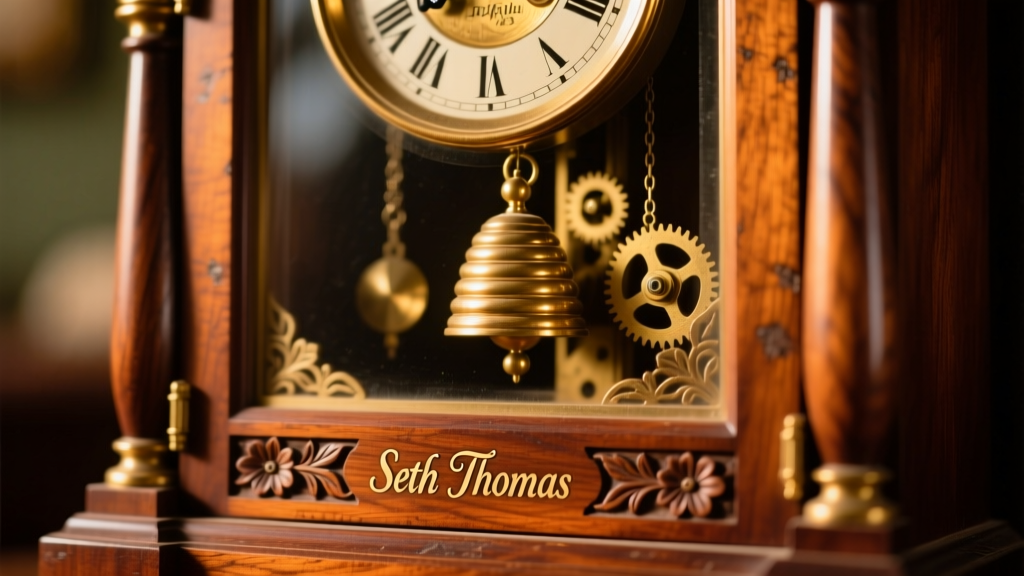
Seth Thomas Mantel Clock: The Beehive Mahogany Chime Clock (10¼ × 15 in) — Design, Mechanics, and Collectibility
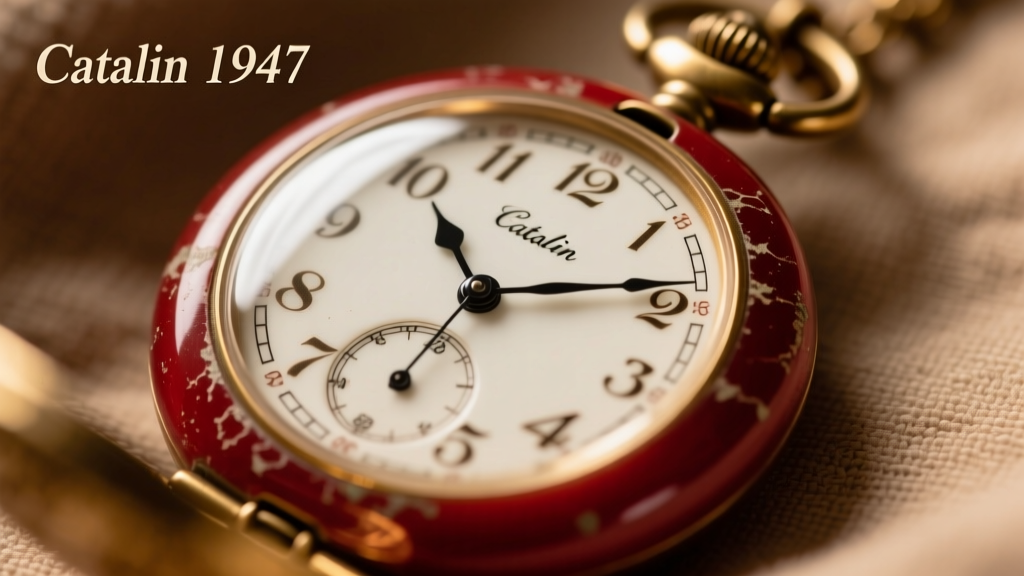
Fathers’ Classic Catalin: The Warm, Luminous Plastics That Defined Mid-Century American Watchmaking
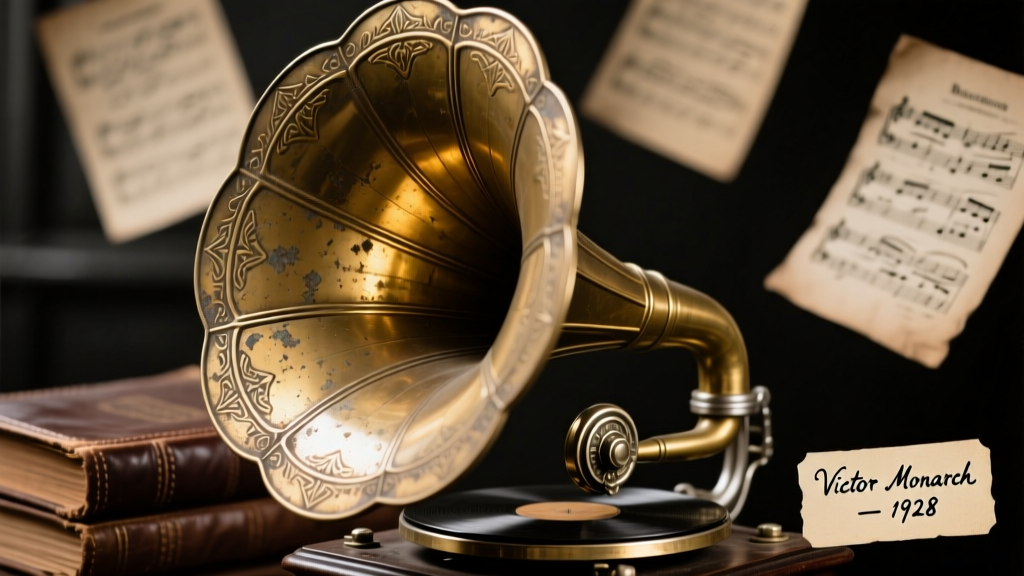
Victor Monarch Phonograph with Front-Mount Brass Horn: Engineering, Aesthetics, and Auction Market Realities

Cut Glass Cruet Neck Ring: Allover Cutting, 5¼ Inches — A Collector’s Guide to Victorian-Era Tableware Artistry