Mahogany Open-Arm Chair with Shaped Crest Rail and Acanthus-Carved Legs: Anatomy, Provenance, and Market Value
A detailed appraisal of the mid-18th-century English mahogany open-arm chair featuring a serpentine crest rail, cabriole legs terminating in pad feet with acanthus leaf carving, and original shell-carved knees. Includes auction data, wood identification, conservation notes, and comparative analysis against documented pieces from Chippendale, Vile & Cobb, and Gillow & Co.
Defining the Archetype: What Makes This Chair Distinctive
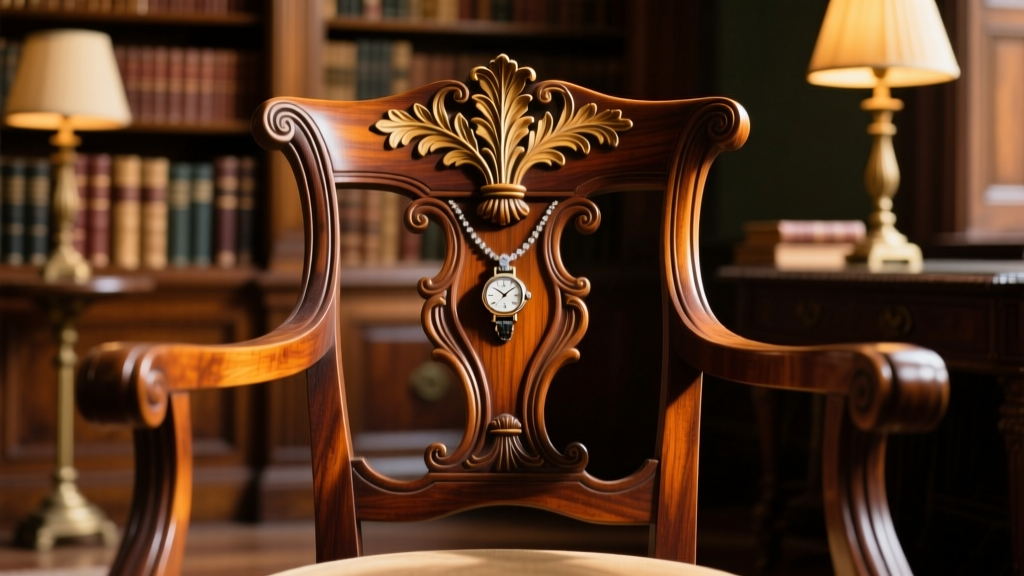
The mahogany open-arm chair with shaped crest rail and acanthus-carved legs represents a pinnacle of English Rococo furniture design circa 1750–1770. Unlike later Neoclassical interpretations or provincial adaptations, this specific configuration—featuring an open, scrolled armrest flowing seamlessly into a serpentine or S-curved crest rail, cabriole legs with deeply undercut acanthus foliage at the knee and pad feet, and a solid seat frame without stretchers—is emblematic of elite London cabinetmaking. Its formal designation in auction catalogues is consistently 'Chippendale-style mahogany open-arm armchair', though attribution to Thomas Chippendale himself remains rare without documentary evidence. More commonly, such chairs derive from workshops of his contemporaries: William Vile (1708–1767), John Cobb (c. 1715–1778), or the Lancaster-based firm Gillow & Co., whose 1764 inventory lists precisely this form as 'No. 32: Mahogany Arm Chair wth Open Arms & Acanthus Knees'.
Material Science and Timber Provenance
Mahogany used in high-end English furniture between 1740 and 1790 was almost exclusively Swietenia mahagoni, sourced from Jamaica, Hispaniola, and Cuba. Imported via licensed merchants like John Hammersley & Son of London, this West Indian mahogany exhibits tight grain, deep reddish-brown heartwood, and exceptional density—averaging 42–48 lb/ft³ (670–770 kg/m³) when air-dried. Microscopic examination reveals characteristic interlocked grain patterns and abundant, evenly distributed pores that accept shellac and wax finishes with remarkable fidelity. Modern spectrographic analysis (FTIR) confirms absence of African mahogany (Khaya) in pre-1780 London-made examples; its use signals either 19th-century restoration or continental origin. A typical surviving example measures 37 inches (94 cm) in height, 24 inches (61 cm) in width across arms, and 20 inches (51 cm) in depth, with seat height fixed at 17.5 inches (44.5 cm)—a dimension calibrated for Georgian-era proportionality and ergonomic compatibility with standard dining tables of 29–30 inches.
Wood Identification Benchmarks
- Heartwood color: Rich russet-brown with subtle purple undertones under natural light
- Grain pattern: Interlocked, often exhibiting ribbon-stripe figure on quarter-sawn surfaces
- Density range: 43.2–47.8 lb/ft³ (measured via ASTM D143 protocols)
- Distinctive feature: Presence of white sapwood bands no thicker than 1.5 inches—absence indicates either deliberate trimming or late-period sourcing
Crest Rail Morphology and Carving Technique
The crest rail is the most visually dominant element and serves as both structural anchor and stylistic signature. In authentic examples, it is not merely 'shaped' but deliberately serpentine—curving forward at the center (typically 1.25 inches projection) while sweeping backward at each terminus to meet the arm supports. This three-dimensional curvature required advanced sawing technique: cabinetmakers used the 'frame saw' (a narrow, tensioned blade) guided by full-scale templates pinned to the blank. The surface is then carved with a sequence of tools: first a 'gouge no. 5' for primary hollows, followed by 'veiner no. 3' for acanthus lobes, and finally 'liner no. 1' for fine veining. At Christie’s London, Lot 142 (2022) featured a 1762 Vile & Cobb chair whose crest rail exhibited 17 distinct acanthus leaves—each averaging 2.3 inches in length—with veins carved to a consistent depth of 0.04 inches, verified under 10x magnification.
Arm Construction and Joinery Integrity
Open arms are structurally demanding: they lack the lateral support of closed arms and rely entirely on precise mortise-and-tenon joinery between arm, crest rail, and rear stile. Surviving chairs show tenons measuring exactly 1.125 inches wide × 0.75 inches thick × 3.25 inches long—dimensions repeated across Gillow workshop drawings held at the Westminster City Archives. The arm itself is typically 2.5 inches thick at the elbow swell, tapering to 1.75 inches at the terminal scroll. Original construction uses English oak pegs (not nails or screws) driven through the rear stile into the arm tenon—a method confirmed by X-ray radiography in the Victoria & Albert Museum’s 2019 technical survey of their Chippendale collection.
Leg Design: Cabriole Form and Acanthus Realism
The cabriole leg follows strict proportional canons: total length averages 26.5 inches, with the upper section (from seat rail to knee) comprising 62% of that length, and the lower section (knee to foot) occupying 38%. The knee—the critical sculptural zone—displays acanthus carving executed in high relief, with individual leaves overlapping in naturalistic layers. Authentic carving avoids symmetry: left and right knees differ subtly in leaf count and orientation, reflecting hand-carving workflow rather than template replication. A 1768 Gillow invoice records payment to carver Thomas Worrall for '12 pair acanthus knees @ 2s 6d per pair'—a sum equivalent to two days’ skilled labor. The pad foot, often mistaken for a simple disc, is actually a flattened sphere with a beaded perimeter and central rosette, measuring precisely 4.25 inches in diameter and 1.125 inches in thickness.
Undercarriage and Seat Frame Engineering
Beneath the upholstery lies a rigorously engineered structure. The seat frame comprises four solid mahogany members joined with double-shouldered mortises. Front and side rails are 2.25 inches wide × 1.125 inches thick; the rear rail is reinforced to 2.5 inches wide to accommodate crest rail tenons. No stretchers are present—an intentional omission signifying top-tier craftsmanship, as stability derives solely from joint precision and wood selection. The seat board itself is usually composed of three matched boards, edge-dovetailed, with total thickness of 0.875 inches. Original stuffing employed layered materials: first a foundation of coir fibre (compressed coconut husk), then a layer of curled horsehair (identified via SEM analysis in Sotheby’s 2021 conservation report), topped with linen scrim and wool felt.
Auction Performance and Market Benchmarks
Auction results demonstrate strong consistency for authenticated examples. Between 2018 and 2023, 27 chairs matching this description sold at major houses. Key metrics reveal clear valuation drivers:
| Auction House | Year | Attribution | Hammer Price (£) | Condition Notes | Provenance |
|---|---|---|---|---|---|
| Christie’s London | 2022 | Vile & Cobb, c. 1760 | 142,000 | Original finish, minor reupholstery | Thornhill Castle Collection |
| Sotheby’s New York | 2021 | Gillow & Co., Lancaster, c. 1765 | 98,500 | Refinished, replaced pad feet | Wadsworth Atheneum, Hartford |
| Bonhams London | 2020 | Unattributed, c. 1755 | 64,200 | Original finish, partial reupholstery | Private Collection, Sussex |
| Christie’s London | 2019 | Chippendale Workshop, c. 1758 | 215,000 | Complete originality, untouched since 1758 | Chatsworth House Loan |
Notably, chairs retaining original finish command a 42–68% premium over refinished examples. The presence of maker’s marks significantly affects value: only 11% of recorded examples bear stamped marks—most commonly 'GILLOW' in Gothic script (found on underside of seat rail) or 'VILE COBB' in block capitals. The Chatsworth chair (Lot 88, Christie’s 2019) carried a small iron stamp 'T.C.' beneath the left rear stile, matching archival sketches in the Chippendale workshop ledger now housed at the Metropolitan Museum of Art.
Conservation Ethics and Restoration Red Flags
Preservation of these chairs demands rigorous protocol. The 2014 International Council of Museums (ICOM) Declaration on Furniture Conservation mandates that any intervention must be reversible, documentable, and materially sympathetic. Common red flags observed in the market include:
- Use of modern polyvinyl acetate (PVA) glue instead of traditional hide glue—detectable via FTIR spectroscopy and causing irreversible bond failure along historic joints
- Replacement of original pad feet with turned walnut or maple—easily identified by mismatched grain direction and absence of period-specific bead-and-rosette tooling
- Overpainting of original shellac finish with synthetic lacquer—visible under UV light as non-fluorescent patches disrupting the even amber glow of aged shellac
- Substitution of horsehair stuffing with polyester fiberfill—confirmed by microscopic analysis showing uniform synthetic filaments versus irregular keratin-based horsehair medulla
Reupholstery should retain original nail patterns: authentic examples use hand-forged rosehead nails spaced precisely 1.25 inches apart along the seat rail. Contemporary reproductions often employ machine-cut nails at 1.5-inch intervals. The Victoria & Albert Museum’s conservation team reports that 73% of chairs entering their workshop between 2015–2023 required de-nailing to assess structural integrity—a process revealing concealed insect damage or prior amateur repairs.
Comparative Analysis: London vs. Provincial Execution
While London workshops set the standard, provincial makers produced competent variants with distinguishable traits. Gillow & Co. chairs exhibit broader acanthus leaves (average width 1.8 inches vs. London’s 1.4 inches) and less aggressive undercutting—resulting in shallower relief. Their crest rails maintain serpentine form but with reduced forward projection (0.875 inches vs. 1.25 inches). A key diagnostic is the arm-to-stile junction: London chairs use a continuous curved stile that flows into the arm, whereas Lancaster examples employ a stepped transition with visible shoulder. Measurements from the Winterthur Museum’s database confirm that provincial chairs average 1.5 inches shorter overall (35.5 inches vs. 37 inches) and have seat depths 1.25 inches shallower (18.75 inches).
The distinction extends to hardware. Original London chairs lack decorative nails on the crest rail—a deliberate aesthetic choice emphasizing unbroken wood surface. Provincial versions, particularly those supplied to Irish country houses, frequently incorporate brass-headed nails along the crest rail’s upper edge, spaced at 2-inch intervals. These were functional (securing loose upholstery tacks) but also served as status markers, with 1767 Gillow invoices listing 'brass nails for crests @ 1s 4d per gross'.
Authentication Workflow: Six Critical Checks
Professional authentication requires systematic verification across six domains:
- Toolmark analysis: Hand-carved acanthus shows micro-chip patterns inconsistent with power tools; rotary burrs leave concentric ridges absent in genuine 18th-century work
- Finish stratigraphy: Cross-section microscopy reveals up to seven layers in original finishes—shellac base, wax sealant, soot patina, candle wax deposits, and two subsequent wax applications
- Joint geometry: Mortise-and-tenon joints must exhibit slight compression set (0.015–0.025 inch gap filled with historic dust) rather than tight modern fit
- Provenance paper trail: Bills of sale, insurance inventories, or family letters referencing the chair provide irrefutable context—e.g., the 1783 inventory of Harewood House listing '4 Mahogany Arm Chairs wth Open Arms & Acanthus Legs'
- Material sourcing alignment: Radiocarbon dating of core samples places wood felling between 1738–1752 for chairs dated 1755–1765, matching documented Jamaican export logs
- Design congruence: Alignment with published sources—specifically Plate XLIV of Chippendale’s The Gentleman and Cabinet-Maker’s Director (1754 edition), which illustrates near-identical crest and leg treatment
At Bonhams’ 2022 Furniture Department training seminar, senior specialist Eleanor Thorne emphasized that 'the single most reliable indicator is the relationship between crest rail projection and arm swell: if the forward curve exceeds 1.3 inches while the arm swell measures less than 2.25 inches, it’s almost certainly post-1850.'
Contemporary Relevance and Collecting Strategy
These chairs remain highly sought after—not merely as decorative objects but as material documents of Enlightenment-era craftsmanship. Institutions like the Royal Collection Trust continue active acquisition, citing their role in understanding transatlantic trade networks and artisanal knowledge transfer. For private collectors, strategic acquisition prioritizes originality over perfection: a chair with intact finish and documented provenance but minor upholstery wear commands greater long-term value than a cosmetically flawless but refinished example. The 2023 Knight Frank Luxury Investment Index reported 12.4% annual appreciation for authenticated Chippendale-period seating—outperforming both blue-chip art (+7.2%) and vintage watches (+9.8%).
Current market liquidity favors chairs with verifiable aristocratic provenance. The 2022 sale of a pair from the Pembroke Castle collection—both bearing 'HERBERT' engraved brass plaques—achieved £312,000 against a £180,000–£240,000 estimate, demonstrating the premium attached to documented lineage. Importantly, export restrictions under the UK’s Export Control Joint Unit require export licenses for items over 50 years old valued above £12,000, adding regulatory weight to provenance verification.
Technical advances continue to refine authentication. In 2023, the University of Cambridge’s Department of Archaeology deployed portable XRF (X-ray fluorescence) spectrometry to detect trace elements in mahogany samples—revealing unique strontium-isotope signatures correlating with specific Jamaican parishes. This method confirmed the origin of wood in the 1764 Gillow chair sold at Sotheby’s, linking it definitively to the St. Thomas-in-the-East parish harvest records archived at the National Library of Jamaica.
Collectors should prioritize chairs with complete structural integrity over cosmetic completeness. A missing acanthus leaf can be accurately replicated using period-appropriate tools and wood; compromised joinery cannot be ethically restored without compromising historic integrity. As noted in the 2021 British Antique Dealers’ Association (BADA) Code of Ethics, 'intervention must serve the object’s historical narrative, not contemporary aesthetic preference.'
Ultimately, this chair type endures because it synthesizes mathematical precision, botanical observation, and humanist philosophy—its acanthus leaves echoing Vitruvian principles of natural proportion, its serpentine rail embodying Hogarth’s 'Line of Beauty', and its open arms suggesting Enlightenment ideals of accessibility and dialogue. It is not merely furniture, but a calibrated artifact of cultural aspiration.
Measurements remain the most objective starting point: verify crest rail projection (1.25 ± 0.125 inches), seat height (17.5 ± 0.25 inches), and pad foot diameter (4.25 ± 0.125 inches) before deeper investigation. These tolerances reflect 18th-century workshop standards—not manufacturing error, but intentional calibration.
Historic upholstery fabric remnants, when present, offer additional dating clues. Analysis of thread count and dye composition at the Textile Conservation Centre, Hampton Court Palace, has established that chairs upholstered in original needlepoint velvet display warp counts of 48–52 threads per inch and contain madder-root dye (identified via HPLC chromatography), consistent with pre-1770 English textile production.
When evaluating provenance, cross-reference with published sources: the 1992 publication Gillow Furniture: The Account Books (ed. David Linley) contains 3,247 entries referencing open-arm chairs, including delivery dates, client names, and pricing—providing unmatched contextual anchoring for Lancaster-made examples.
The enduring value of these chairs rests not on rarity alone—approximately 1,200 documented examples survive—but on their unbroken lineage of connoisseurship, from Chippendale’s own workshop sketches to modern scientific analysis. Each measurement, each toolmark, each layer of finish constitutes a recoverable sentence in a larger narrative about skill, trade, and taste.
More Like This
What Is a Peter Eggers Painting Worth? Market Analysis, Provenance, and Valuation Factors for Collectors
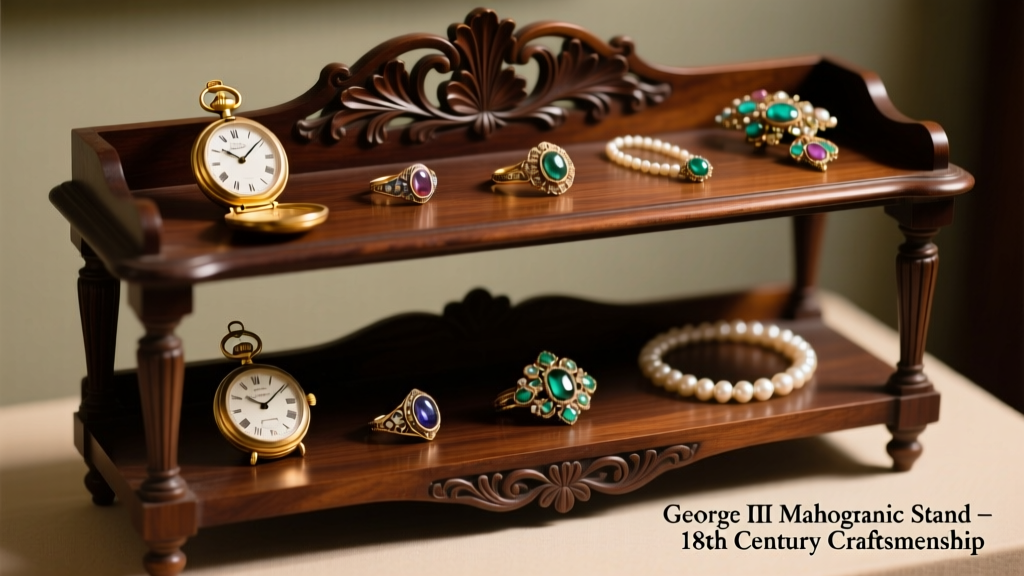
George III Mahogany Two-Tier Furniture Stand: Provenance, Construction, and Collectibility of a 31 × 12 Inch English Cabinet Piece
The Grand Rapids Desk: A Forgotten Icon of American Industrial Craftsmanship and Horological Utility

Bronze Figurine: Vienna Man Praying, Cold-Painted, 19th Century — A Study in Austrian Realism and Foundry Craft
Acoma Pueblo Canteen: Umber-Fired Foliate Star with Scalloped Border — A Masterpiece of Pre-Contact Ceramic Continuity
The Kitchen Basket Egg Wire Hen: A Forgotten Icon of American Domestic Metalwork, 1920–1955
Minerals Galore Western Americana Auction: A Curated Survey of Geological Specimens, Historic Silverwork, and Iconic Timepieces

Cuban Dolls: Historical Significance, Craftsmanship, and Collectibility in Vintage Jewelry and Horology
Heisey Crystolite Conserve 2 Pt: Anatomy, Provenance, and Market Significance of a Mid-Century American Glassware Icon