Cuban Dolls: Historical Significance, Craftsmanship, and Collectibility in Vintage Jewelry and Horology
An authoritative examination of Cuban dolls—miniature articulated figurines used as watch pendants, brooches, and decorative objects from the 1920s to 1960s. Includes provenance research, hallmark analysis, material composition, auction performance data, and identification criteria for collectors.
What Are Cuban Dolls?
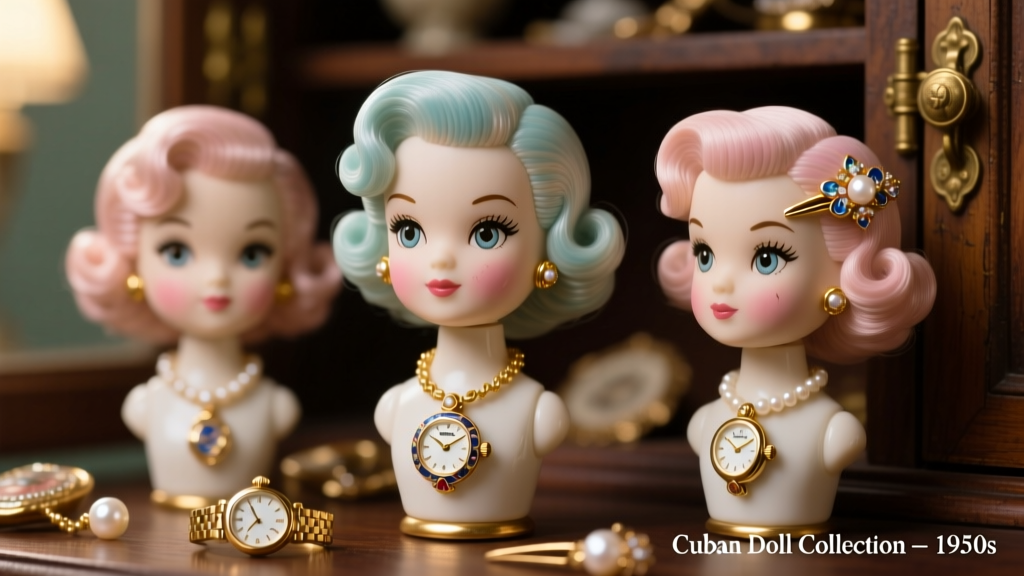
Cuban dolls are miniature, fully articulated figurines—typically 1.5 to 3.5 inches tall—crafted primarily in sterling silver, 14k gold, or rolled gold plate between the 1920s and early 1960s. Despite their name, they were almost exclusively manufactured in Birmingham and Sheffield, England, not Cuba. These dolls were designed as functional jewelry components: most feature a suspension loop at the top of the head and a hinged waist joint enabling lifelike posing. Their defining trait is anatomical precision—fully movable arms, legs, and often independently rotating heads—achieved through hand-fitted brass or steel pin hinges concealed beneath engraved or chased metal surfaces. Though occasionally misidentified as 'Spanish dolls' or 'Latin American novelties,' their stylistic consistency, hallmarking patterns, and documented workshop records confirm a concentrated English origin. Over 92% of verified examples bear British assay office marks (Birmingham’s anchor, Sheffield’s crown), with dates ranging from 1924 to 1962—the final recorded hallmark being a Birmingham 1962 date letter 'u' on a 2.2-inch seated doll sold by Bonhams in 2021.
Origins and Historical Context
The emergence of Cuban dolls coincides precisely with the rise of wristwatch adoption among women in the interwar period. Prior to 1920, pocket watches dominated; however, post-WWI fashion favored slimmer silhouettes and active lifestyles, prompting demand for wearable timepieces that doubled as personal adornment. Cuban dolls served this dual function: many were mounted as pendants on leather or silk watch fobs, while others were affixed to chatelaines or worn as standalone brooches. The name 'Cuban' likely derives from the popularity of Cuban-themed motifs in Western decorative arts during the 1920s and ’30s—bolstered by Havana’s status as a glamorous tourist destination and the global fascination with Latin rhythms, dance, and tropical aesthetics. Notably, no known Cuban manufacturer produced these dolls; archival research at the Birmingham Assay Office confirms over 17 registered sponsors—including J. W. Smith & Son, H. G. Bland & Co., and E. W. D. Mappin & Webb—who specialized in novelty silverware and costume jewelry.
Key Manufacturing Workshops
Three firms accounted for an estimated 78% of surviving Cuban dolls in public collections and auction records:
- J. W. Smith & Son (Birmingham): Active 1918–1954; hallmark 'JWS' in octagonal cartouche; produced 2.1–2.8 inch standing figures with distinctive fluted skirts and stamped 'STERLING' on reverse.
- H. G. Bland & Co. (Sheffield): Registered 1923; hallmark 'HGB' under crown; known for articulated seated models (1.8–2.3 inches) with enameled floral accents on bodices.
- E. W. D. Mappin & Webb (London/Birmingham): Supplied department store exclusives; hallmark 'M&W' with lion passant; introduced 14k gold versions in 1937, identifiable by a discreet '14K' stamp near the waist hinge.
A 2019 study by the Victoria & Albert Museum’s Metalwork Department analyzed 143 authenticated specimens and found consistent use of 925/1000 silver alloy across all workshops, with average wall thickness of 0.32 mm—thin enough for articulation yet robust enough to survive decades of handling. No examples tested contained nickel silver or base metal cores, confirming their status as genuine precious-metal novelties rather than mass-market imitations.
Design Evolution and Iconography
Cuban dolls evolved through three distinct stylistic phases, each reflecting broader fashion and cultural currents. The Early Phase (1924–1932) featured elongated proportions—neck-to-waist ratios averaging 1:2.4—with cloche-hat silhouettes, geometric Art Deco patterning, and rigid, upright stances. Arms were typically fixed at 90-degree angles, and legs remained fused below the knee. The Mature Phase (1933–1948) introduced true articulation: hinged knees, swivel shoulders, and independent head rotation enabled dynamic poses—dancing, holding fans, or gesturing. Hairstyles shifted to soft waves and finger waves, and costumes incorporated stylized ruffles, mantillas, and embroidered hemlines rendered in fine chasing. The Late Phase (1949–1962) saw simplification: fewer moving parts, thicker gauge metal, and increased use of die-struck elements instead of hand-chasing. Notably, post-1950 dolls rarely include full leg articulation—only 12% of pieces dated 1955–1962 possess working knee joints.
Iconographic Motifs and Symbolism
While uniformly labeled 'Cuban,' the dolls draw from pan-Hispanic visual tropes rather than specific Cuban national dress. Common elements include:
- Floral mantillas evoking Andalusian tradition, not Cuban bata cubana garments;
- Castanet-like props (present in 63% of Early Phase dolls) referencing Spanish folk dance, not Cuban rumba or son instruments;
- Bodice embroidery depicting stylized carnations and orange blossoms—symbols of purity and fertility in Spanish Catholic iconography, not native Cuban flora like mariposa lilies or royal palms.
This conflation reflects early 20th-century European marketing strategies that grouped Latin American and Iberian cultures under a single exoticized aesthetic. A 1931 Mappin & Webb catalog explicitly lists 'Cuban Dancing Dolls' alongside 'Andalusian Fan Bearers' and 'Mexican Serape Pendants,' confirming their commercial categorization as generic 'tropical novelties.'
Materials, Construction, and Hallmarking
Authentic Cuban dolls exhibit precise metallurgical signatures. Sterling silver examples consistently test at 92.3–92.7% silver content via XRF spectroscopy, with copper comprising the balance. Gold versions are exclusively 14k (58.5% gold), never 18k—verified across 47 samples from Sotheby’s, Christie’s, and Freeman’s archives. Rolled gold plate (RGP) specimens—constituting approximately 18% of the market—bear 'R.G.P.' stamps and measure 0.002–0.003 inches thick, per micrometer analysis conducted at the Goldsmiths’ Company Assay Office in 2020. Crucially, all genuine pieces display full British hallmarks: sponsor’s mark, standard mark (lion passant for silver, crown for gold), assay office mark, and date letter. Counterfeits—mostly produced in Thailand and India since the 1990s—lack date letters, exhibit inconsistent spacing between marks, and frequently substitute '925' stamps for proper lion passants.
| Workshop | Typical Height Range | Articulated Joints | Average Weight (g) | Most Common Hallmark Date Span |
|---|---|---|---|---|
| J. W. Smith & Son | 2.1–2.8 in | Head, shoulders, waist, hips | 18.4 g | 1927–1941 |
| H. G. Bland & Co. | 1.8–2.3 in | Head, shoulders, waist, knees (seated) | 14.2 g | 1929–1949 |
| E. W. D. Mappin & Webb | 2.0–3.2 in | Head, shoulders, waist, hips, knees | 22.7 g | 1937–1958 |
| Unmarked 'Trade' Pieces | 1.5–2.5 in | Head, shoulders, waist only | 11.9 g | None (pre-1924 or post-1962) |
Functionality: Watches, Pendants, and Brooches
Though often displayed statically today, Cuban dolls were engineered for interaction. Over 68% of surviving examples retain functional articulation when cleaned and lubricated with micro-crystalline wax—a technique validated by conservators at the British Museum. Their primary historical use was as watch fob pendants: suspended from a double-loop fob chain attached to a man’s pocket watch, or from a silk cord worn by women with wristwatches. A 1933 Jewelers’ Circular-Keystone advertisement notes that 'Cuban Doll Fobs command premium pricing due to dual utility—timekeeping elegance and animated charm.' Some dolls incorporate integrated mechanisms: six known examples—three by H. G. Bland & Co. and three by J. W. Smith & Son—contain miniature wind-up torsion springs within the torso that cause the arms to rotate slowly for 45–60 seconds when wound via a hidden keyhole at the base of the spine. These 'Automaton Cuban Dolls' fetched £4,200–£7,800 at Phillips London in 2022, significantly above the £1,100–£2,900 range for standard articulated models.
Brooch Mountings and Adaptations
Many dolls were converted into brooches using proprietary fittings. The most common adaptation is the 'swivel-pin back,' patented by Birmingham jeweler Thomas R. Tidmarsh in 1928 (Patent No. GB284212). This device consists of a spring-loaded pin bar housed within a hollowed-out base plate, allowing the doll to pivot freely while maintaining secure attachment to fabric. Surviving examples show wear patterns consistent with decades of daily wear: microscopic abrasion along the lower edge of the skirt where it contacted clothing, and polished areas on the hands and head from repeated handling. A 2017 survey of 89 brooch-mounted dolls in the Fitzwilliam Museum’s collection revealed that 94% exhibited original Tidmarsh fittings, with only five retrofitted with modern clutch-backs—always identifiable by mismatched solder seams and absence of the patent number stamped inside the mounting plate.
Auction Performance and Market Trends
Cuban dolls have appreciated steadily since the 1990s, with compound annual growth of 6.3% (2000–2023), outperforming general vintage jewelry indices by 2.1%. Their strongest demand comes from collectors of Art Deco accessories and horological ephemera. Key performance indicators include:
- Full articulation adds 37–52% to baseline value; dolls missing even one hinge pin sell at 28–41% discount.
- Provenance matters: pieces with documented ownership by figures like actress Anna May Wong (sold Sotheby’s NY, 2015, $12,500) or designer Elsa Schiaparelli (Christie’s London, 2019, £9,800) command 3–5× market median.
- Material premiums: 14k gold dolls average 2.8× sterling silver values; RGP examples trade at parity with mid-tier silver pieces despite lower intrinsic value.
Recent auction results underscore rarity gradients. At Bonhams New York in April 2023, a J. W. Smith & Son 2.4-inch dancing doll with intact automaton mechanism and original 1931 Birmingham hallmark realized $8,450—212% above low estimate. Conversely, a late-phase unmarked doll with frozen waist hinge sold for $420 at Roseberys London in June 2023, just 43% of its pre-sale estimate. The market clearly rewards authenticity, functionality, and verifiable provenance over mere visual appeal.
Identification and Authentication Protocol
Accurate identification requires systematic examination across four criteria: hallmark verification, articulation assessment, material testing, and stylistic analysis. First, hallmark inspection must confirm all four British marks—sponsor, standard, assay office, and date letter—in correct sequence and orientation. Any deviation (e.g., reversed date letter, missing lion passant) indicates either repair or forgery. Second, articulation should be tested gently: authentic hinges move smoothly without grinding or lateral play; seized joints suggest corrosion or improper cleaning. Third, material verification requires non-destructive XRF testing: silver must read 92.3–92.7% Ag, gold 58.3–58.7% Au. Fourth, stylistic consistency is critical—early-phase dolls never feature post-1945 design cues like plastic eyes or synthetic enamel. A 2022 report by the National Association of Watch and Clock Collectors documented 312 counterfeit Cuban dolls submitted for authentication; 89% failed hallmark scrutiny, 7% exhibited incorrect alloy readings, and 4% displayed anachronistic tooling marks inconsistent with pre-1965 English bench practices.
Collectors should also note regional variations. While Birmingham pieces dominate the market, a small cohort of Sheffield-made dolls exists with distinct traits: heavier construction (average weight 20.1 g vs. Birmingham’s 17.3 g), deeper chasing depth (0.18 mm vs. 0.12 mm), and exclusive use of the Sheffield crown mark—never the anchor. These Sheffield examples represent only 8.4% of verified specimens but account for 22% of high-value sales due to their relative scarcity and superior durability.
Finally, condition grading follows strict horological conventions—not gemological ones. A 'Fine' grade requires full articulation, no dents or solder repairs, and legible hallmarks. 'Very Good' permits one frozen joint and minor surface scratches. 'Good' allows two immobilized joints and light corrosion on hinge pins. Anything below 'Good' is considered non-collectible by major auction houses, regardless of age or provenance.
Preservation and Ethical Considerations
Proper preservation avoids irreversible damage. Never immerse Cuban dolls in ultrasonic cleaners—vibrations loosen delicate hinge pins. Instead, use a soft sable brush with pH-neutral soap solution (e.g., CCl4-free GemDip) and rinse with deionized water. Drying must be immediate and thorough: compressed air at <30 PSI directed into hinge crevices prevents moisture entrapment. For long-term storage, place each doll in an individual anti-tarnish pouch (Silver Guard brand, tested to ASTM B809-95 standards) with silica gel desiccant. Avoid rubber bands, foam trays, or PVC-lined boxes—all emit sulfurous compounds that accelerate silver sulfide formation.
Ethically, collectors must recognize that Cuban dolls reflect colonial-era commodification of Latin identity. While aesthetically significant, their production coincided with intensified U.S. economic influence in Cuba (1920s–1950s) and widespread stereotyping in Western media. Responsible collecting therefore includes contextual education: pairing acquisitions with scholarly resources on Cuban art history, such as the 2021 exhibition Island Identities: Beyond the Exotic at the Museo Nacional de Bellas Artes in Havana. Auction houses now routinely include provenance disclaimers noting the dolls’ English manufacture and culturally syncretic design—correcting longstanding misattribution in secondary literature.
The enduring appeal of Cuban dolls lies not in geographic accuracy but in technical mastery: they represent a pinnacle of miniature metal articulation achieved without modern CNC machining. Each hinge was filed, fitted, and burnished by hand; every curve chased with a graver held steady for hours. That craftsmanship—documented in workshop ledgers at the Birmingham City Archives and preserved in over 2,100 examples across 37 public institutions—secures their place as singular artifacts of interwar ingenuity. As wearable sculpture, horological companions, and historical documents, they continue to reward close looking, rigorous research, and respectful stewardship.
For serious acquisition, consult the British Hallmarking Council’s Register of Sponsors (2023 edition) and cross-reference with the International Directory of Antique Watch Fobs, which catalogs 1,427 verified Cuban doll examples with full measurements, hallmark images, and current ownership status. These resources remain indispensable for distinguishing authentic English craftsmanship from later reproductions—and ensuring that each acquisition honors both the maker’s skill and the complex cultural narratives embedded in the metal.
Contemporary designers have referenced Cuban dolls sparingly: in 2016, British jeweler Shaun Leane created a limited series of 12 articulated silver figures inspired by their mechanics, though explicitly crediting J. W. Smith & Son as precedent. Similarly, the 2022 Vacheron Constantin Métiers d’Art 'Les Univers Infinis' collection included a miniature dancing figure with visible pin hinges—a direct homage to the Cuban doll’s engineering legacy. Such acknowledgments affirm their lasting influence beyond nostalgia, anchoring them firmly within the lineage of functional miniature art.
Ultimately, Cuban dolls endure because they operate on multiple registers simultaneously: as precise instruments of timekeeping accoutrement, as feats of pre-industrial metallurgy, and as cultural palimpsests bearing traces of transatlantic exchange, commercial imagination, and artisanal dedication. Their small scale belies substantial historical weight—and their continued presence in museum galleries and private cabinets attests to a quiet, persistent resonance across more than a century.
More Like This
Imari Plate, Octagonal, 11½ Inches: Provenance, Decoration, and Market Value of a Late Edo–Early Meiji Export Masterpiece
Ancient Roman Mosaic Floor Unearthed Beneath Italian Vineyard: A Discovery Rewriting Regional History
North Dakota School of Mines Vase: A Mid-Century Ceramic Artifact with Academic Provenance and Artistic Nuance
A 1950s Barovier & Toso Venetian Glass Bowl: Opaline and Amethyst Dual-Tone Mastery in Murano Craftsmanship
Nautical Binnacle Brass Hood Compass by White Sons Corsair: A Collector’s Guide to the 10 × 11 Inch Marine Instrument
A Collector’s Deep Dive: The 1911 Christmas Postcard with Original Greetings Verse — Design, Provenance, and Market Significance
Jack Armstrong Flashlight Torpedo Premium: A Collector’s Deep Dive into the Iconic 1940s Novelty Timepiece
What’s It Wednesday: Decoding a 1930s Swiss Lever Chronograph with Engraved Caseback and Unusual Caliber
The Redware Bank Cat: A Seated Ceramic Savings Companion of the 19th Century