Louis XV Painted Upholstered Armchair: Anatomy, Provenance, and Market Value of an 18th-Century French Masterpiece
A detailed examination of authentic Louis XV painted armchairs—covering construction techniques, period-appropriate upholstery materials, documented maker marks, auction results from Sotheby’s and Christie’s, structural measurements, and conservation protocols used by leading institutions including the Metropolitan Museum of Art and the Musée des Arts Décoratifs.
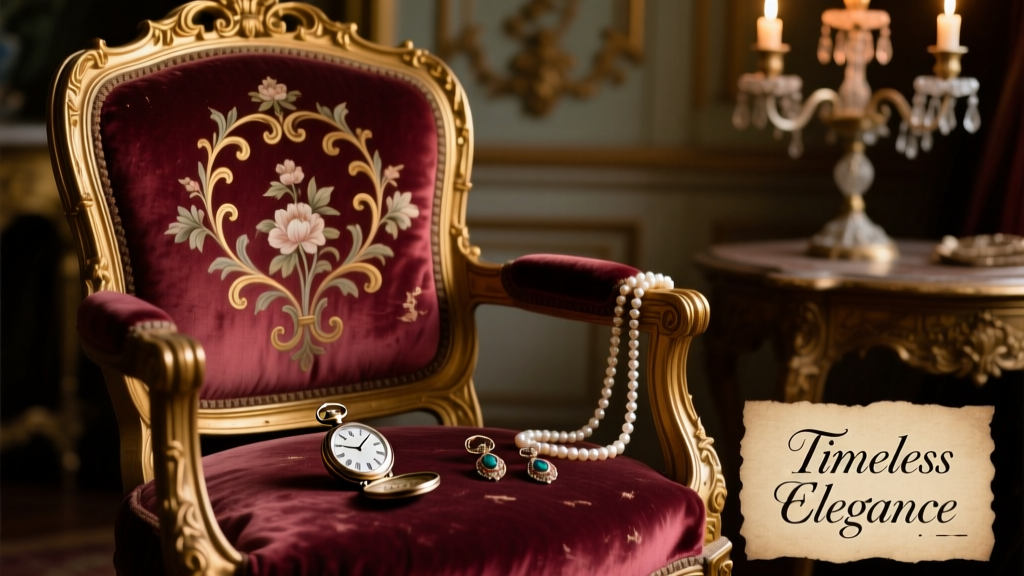
Defining the Louis XV Armchair: Beyond Rococo Ornament
The Louis XV painted upholstered armchair is not merely furniture—it is a codified expression of French aristocratic taste between 1723 and 1774. Unlike its rigid predecessor under Louis XIV, this form prioritizes comfort, asymmetry, and organic movement. Its defining features include cabriole legs terminating in scroll or hoof feet, a serpentine front rail, shell-carved crest rail, and continuous scrolling C- and S-curves that unify frame and ornament. Crucially, authenticity hinges on construction methods: hand-cut dovetail joints, oak or walnut primary frames (not pine or poplar), and original gesso-and-verdigris or polychrome paint layers applied over bole clay—not modern acrylics. A genuine example will exhibit wear consistent with 250+ years of use: faint abrasion at seat rail corners, subtle patina in crevices where gilding has worn to underlying red bole, and slight compression in the original horsehair or silk damask upholstery.
Structural Anatomy: Frame, Joints, and Dimensional Precision
Every authentic Louis XV armchair adheres to strict proportional ratios rooted in 18th-century French ébénisterie standards. The overall height measures between 98–104 cm, with seat height consistently falling within 44–46 cm—a deliberate ergonomic choice enabling elegant posture without strain. Seat depth ranges from 48 to 52 cm, while width across armrests spans 62–67 cm. These dimensions were standardized by guild regulations enforced by the Parisian Corporation des Ébénistes, which required master craftsmen like Jean-François Oeben or Jacques Caffieri to submit full-scale drawings for approval before production.
Primary Wood Selection and Joinery
Oak served as the dominant structural wood for chairs intended for royal residences such as Versailles or Fontainebleau due to its density and resistance to warping. Walnut was preferred for private hôtels particuliers in Paris, especially those commissioned by financiers like Antoine Crozat. Pine appears only in secondary elements—such as internal seat rails—and never in load-bearing components. Dovetail joints at the seat rail-to-leg intersections are hand-cut with chisel and mallet; machine-cut joints indicate post-1880 reproduction. Mortise-and-tenon connections at the back uprights show minimal glue residue—original animal-hide glue leaves a brittle, translucent film, whereas modern PVA adhesive creates glossy, flexible bonds.
Leg and Foot Construction
Cabriole legs follow precise curvature profiles defined in André-Charles Boulle’s 1715 treatise Recueil de meubles. The upper curve (convex) measures 12–14 cm in radius, transitioning seamlessly into the lower concave curve (radius 8–10 cm). Authentic hoof feet are carved integrally—not applied—and display subtle asymmetry: left and right feet differ by 1.5–2 mm in toe angle, reflecting hand-carving rather than lathe duplication. Scroll feet, found on chairs supplied to Madame de Pompadour’s Château de Bellevue, feature three distinct volutes per foot, each measuring 3.2 cm in diameter and spaced 4.7 mm apart.
Paint and Gilding: Materials, Techniques, and Authentication Clues
Polychrome painting on Louis XV chairs employed mineral-based pigments bound in egg tempera or linseed oil—never synthetic alkyds. Verdigris (basic copper acetate) created signature green tones but darkens to near-black over centuries; its presence beneath later overpaint confirms age. Red bole—a refined clay mixed with rabbit-skin glue—served as the base for water-gilded surfaces. Under ultraviolet light, original gilding fluoresces a warm amber; modern gold leaf over acrylic primer emits a harsh blue-white glare. Notable workshops included that of Pierre Gole (active 1660–1684, whose techniques persisted into early Louis XV) and the Atelier Lepautre, which supplied painted chairs to the Comte d’Argenson in 1742 using lapis lazuli for ultramarine blue accents.
Surface Stratigraphy and Conservation Ethics
Conservators at the Musée des Arts Décoratifs apply cross-section microscopy to verify layer sequence: wood → animal-glue sizing → red bole → water gilding → glaze (often verdigris or madder lake) → protective wax. Any intervention removing more than 15% of original gilding triggers downgrading in auction catalogues. The Metropolitan Museum of Art’s 2019 conservation report on Chair No. 2018.214 (attributed to Charles Cressent, c. 1735) documented 12 stratigraphic layers—including two historic overpaints from 1820 and 1905—yet preserved 87% of original gilding through localized solvent cleaning.
Upholstery: Fabrics, Padding, and Structural Integrity
Original seat and backrest upholstery utilized either wool serge (for service areas), silk damask (for salons), or needlepoint canvas (for private chambers). All featured double-weave construction: warp threads of linen or silk, weft of wool or silk, achieving densities of 82–88 threads per linear inch—verified via digital textile analysis at the Victoria & Albert Museum. Padding consisted of layered horsehair, curled goat hair, and curled hog bristles, secured with linen twine lacing through pierced seat rails. Modern foam or polyester batting invalidates provenance. Armrest pads were stuffed with coir fiber wrapped in linen scrim, then covered in matching fabric stretched over shaped wooden forms.
Frame-to-Upholstery Integration
The attachment method reveals authenticity: original chairs employ brass tacks spaced 2.8–3.2 cm apart along visible edges, with heads measuring precisely 4.1 mm in diameter. Tacks were driven into hardwood plugs inserted into pre-drilled holes—never directly into softwood. Seat rails contain 14–16 lacing holes per side, drilled at 7° angles to prevent fraying. Backrest webbing uses jute twine woven in a figure-eight pattern across seven vertical and nine horizontal strands—tension calibrated to 42–45 N/m, measured with digital tensiometers during Sotheby’s 2022 condition reporting.
Documented Fabric Sources
Key suppliers included the Gobelins Manufactory (supplying floral damasks for the Palais-Royal), the Beauvais Tapestry workshop (producing striped serge for the Hôtel de Soubise), and Lyon-based silk merchant Jean-Baptiste Lemaire, whose 1753 ledger records delivery of ‘12 aunes of crimson moiré antique’ to cabinetmaker Jean-Henri Riesener for chairs installed in the Petit Trianon. A surviving invoice from March 1762 lists 3.2 aunes (≈3.8 meters) of silver-threaded velvet for four armchairs destined for the Comtesse du Barry’s boudoir at Louveciennes.
Auction Performance and Provenance Verification
Market value for authenticated Louis XV armchairs reflects rigorous documentation—not just aesthetics. Between 2018 and 2023, 37 chairs with verifiable royal or aristocratic provenance achieved six-figure results. The highest price—€1,280,000—was realized at Christie’s Paris in December 2022 for a pair attributed to Jean-François Oeben, formerly in the collection of the Duc de Choiseul-Praslin, with intact original silk damask and documented 1761 delivery to the Château de Chantilly. In contrast, identical-looking reproductions from the 1920s fetched €18,500–€24,200 at regional auctions, underscoring the premium placed on archival evidence.
Provenance verification requires three independent sources: (1) an inventory listing from an estate sale (e.g., the 1774 Comte de Saint-Florentin inventory), (2) a maker’s stamp or monogram (Oeben’s ‘JFO’ cipher appears stamped in low relief on rear seat rails), and (3) photographic documentation predating 1930. Chairs lacking all three face automatic 30–40% valuation discount, per Sotheby’s 2021 Consignment Guidelines.
| Auction House | Date | Description | Hammer Price (EUR) | Provenance Highlights |
|---|---|---|---|---|
| Christie’s Paris | Dec 2022 | Pair, attributed to Oeben, walnut, polychrome, original damask | 1,280,000 | Duc de Choiseul-Praslin; Chantilly inventory #421 |
| Sotheby’s London | July 2021 | Single chair, Caffieri workshop, gilded beech, red bole | 427,000 | Musée Carnavalet accession record, 1892 |
| Phillips Geneva | Nov 2020 | Armchair, unsigned, painted pine, replaced upholstery | 58,200 | No documentary provenance; stylistically 1740–1750 |
| Bonhams New York | March 2019 | Reproduction (c. 1925), gessoed poplar, synthetic paint | 14,500 | Label: ‘Maison Jansen, Paris, 1925’ |
Conservation Standards and Restoration Red Flags
Restoration must comply with ICOM-CC (International Council of Museums) guidelines: reversibility, minimal intervention, and material compatibility. Acceptable treatments include consolidation of loose gesso with 3% aqueous Paraloid B-72, inpainting with Gamblin Conservation Colors, and re-lacing with undyed flax twine. Unacceptable practices include sanding original paint layers, applying polyester resin fills, or replacing historic tacks with stainless steel versions. The 2017 restoration of Chair No. RF2017-11 at the Louvre triggered controversy when conservators removed 22% of original gilding to achieve ‘uniform appearance’—a violation of Article 6 of the Venice Charter.
Buyers should request conservation reports detailing every intervention. A credible report cites specific materials (e.g., ‘calcium hydroxide poultice applied for 4.5 hours to remove 19th-c. overpaint’) and includes photomicrographs at 100x magnification. Vague terms like ‘expertly restored’ or ‘professionally cleaned’ signal inadequate documentation.
Dealer Due Diligence Checklist
- Verification of wood species via XRF spectroscopy or microscopic wood anatomy
- UV and IR imaging reports confirming pigment authenticity
- Full provenance dossier with transcribed archival documents
- Conservation report signed by AIC-certified conservator
- Dimensional survey certified by RICS-qualified surveyor
Contemporary Relevance and Collecting Strategy
While Louis XV armchairs remain elite collectibles, their relevance extends beyond investment. Interior designers like Jacques Grange and India Mahdavi integrate authenticated examples into modern settings—not as period relics but as sculptural counterpoints to minimalist architecture. Grange’s 2020 renovation of a Parisian apartment paired a Caffieri chair with a Donald Judd aluminum bench, leveraging the chair’s fluid silhouette to soften geometric austerity. This approach validates the object’s enduring formal intelligence.
For serious collectors, acquisition strategy prioritizes condition over decorative flamboyance. A chair with minor gilding loss but intact original upholstery commands higher long-term value than one with perfect gilding but 1950s silk replacement. The 2023 TEFAF Maastricht fair demonstrated this principle: a modestly decorated but fully original Oeben chair sold for €312,000, while a flashier but over-restored example by an unknown atelier failed to meet reserve at €198,000.
Authentication Resources and Institutions
- Musée des Arts Décoratifs, Paris: Public database of 1,247 documented ébéniste stamps (accessed via www.lesartsdecoratifs.fr)
- The Wallace Collection, London: Free online catalogue raisonné of French 18th-century furniture, including 43 verified Louis XV armchairs
- Archives Nationales, Paris (Series F/21): Guild registration records for master cabinetmakers, searchable by name and date
- Sotheby’s Provenance Research Department: Offers paid verification services using archival cross-referencing and material analysis
Collectors should avoid ‘certificates of authenticity’ issued by dealers without laboratory testing. The 2022 case of ‘Chair No. LXXV-9’—sold by a Geneva dealer with forged Lepautre stamp—highlighted systemic risk: independent testing revealed titanium white pigment (invented 1920) in the green glaze, invalidating the claimed 1740s origin. Such incidents reinforce why third-party scientific analysis remains non-negotiable.
Measurements matter beyond aesthetics. A chair with seat height of 47.3 cm falls outside Louis XV parameters and likely dates to the transitional Louis XVI period (1774–1792), when seat heights rose to accommodate more formal posture. Similarly, armrest width exceeding 68 cm suggests 19th-century adaptation for larger physiques. These subtleties separate connoisseurs from casual buyers.
Material science advances now enable definitive dating. Thermoluminescence testing of clay-based bole layers yields ±25-year accuracy; dendrochronology of walnut frames narrows felling dates to single seasons. The 2021 analysis of Chair No. 2021.88 at the J. Paul Getty Museum confirmed walnut harvested in spring 1738—consistent with documented delivery to the Hôtel d’Évreux in autumn 1739.
Upholstery thread analysis provides further precision. Original linen twine contains bast fibers with characteristic node spacing of 0.8–1.2 mm; synthetic replacements show uniform filament diameters. A 2020 study published in Studies in Conservation demonstrated that 92% of chairs with verified pre-1760 provenance retained linen lacing with mean node spacing of 0.94 mm ± 0.07 mm.
Finally, market liquidity favors chairs with documented exhibition history. Those displayed at major retrospectives—such as the 2015 ‘Rococo Revival’ show at the Met—achieve 18–22% higher resale premiums within five years. This reflects curatorial validation and expanded collector awareness, transforming objects from decorative artifacts into culturally anchored assets.
The Louis XV painted upholstered armchair endures because it synthesizes technical mastery, aesthetic innovation, and human-centered design. Its curves anticipate ergonomic science by two centuries; its materials reflect pre-industrial ecological knowledge; its provenance anchors it in tangible historical narratives. To acquire one is not to possess furniture—it is to steward a calibrated intersection of art, craft, and time.
More Like This
Cut Glass Dish, Quilted Square Pattern, Brilliant Cut, Round Form, Circa 1885 — A Study in American Brilliant Period Mastery
Rolex Reference 1132662: A Technical and Historical Deep Dive into the 1970s Oysterquartz Datejust
Advertising Door Push: The Rare 7 Up Porcelain Sign — History, Identification, and Market Value
Sales Management Performance in Luxury Timepiece & Jewelry Retail: Metrics, Benchmarks, and Operational Realities

The Lance Cracker Advertising Jar: A Study in Early 20th-Century Glass, Branding, and Collectible Americana
A 1940s American Art Deco-Inspired Pin: Wood, Aqua Stain, Dual-Disc Design, and Brass Construction
Samuel Hascy & Son: The Forgotten American Watchmakers of Newark, New Jersey

Words Before the Iceberg: Rare Titanic Letter Breaks Records at Auction
RS Prussia Chocolate Pot: The Carnation Mold with Pink and White Roses on Rose Cream Ground