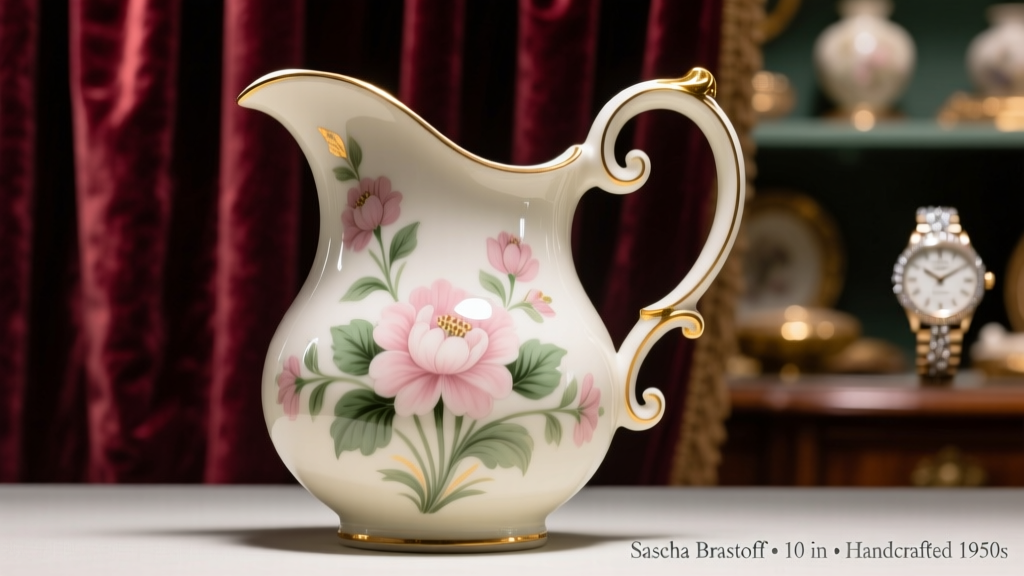
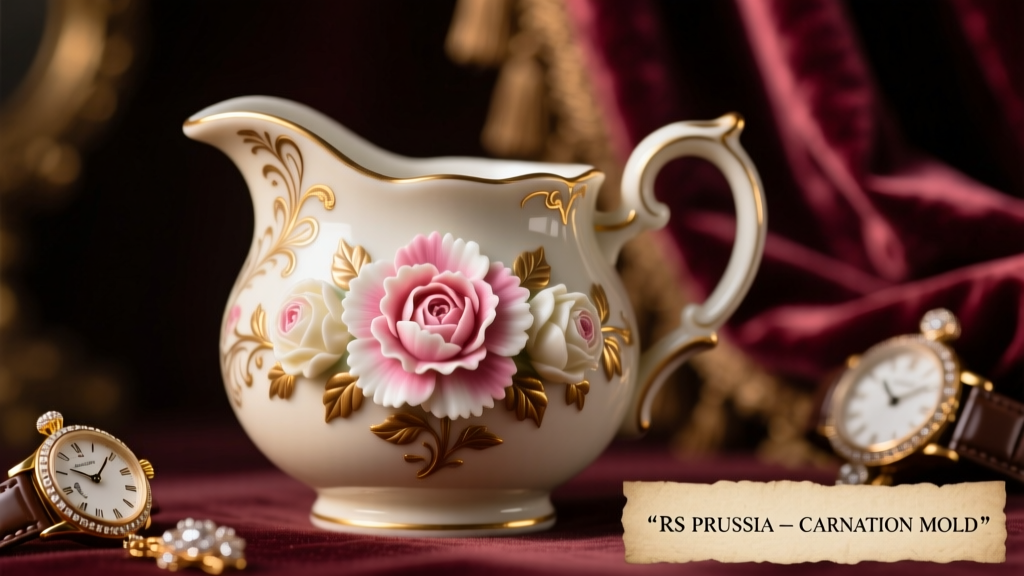
RS Prussia Chocolate Pot: The Carnation Mold with Pink and White Roses on Rose Cream Ground
An in-depth appraisal of the rare RS Prussia chocolate pot featuring the Carnation mold, hand-painted pink and white roses, and distinctive rose cream ground—detailing its history, production timeline, identifying marks, market value, and conservation considerations.
Introduction: A Masterpiece of Late 19th-Century German Porcelain
Among the most coveted items in antique porcelain collecting stands the RS Prussia chocolate pot bearing the Carnation mold (Mold No. 147), decorated with hand-painted pink and white roses against a soft rose cream ground. Produced exclusively between 1895 and 1906 by Reinhold Schlegelmilch’s factory in Tillowitz, Silesia (now Tułowice, Poland), this piece exemplifies the technical precision and artistic refinement achieved during the height of German porcelain export to North America and Western Europe. Measuring approximately 8 3⁄4 inches tall with a 5 1⁄2-inch diameter base, the pot features a hinged lid with acorn finial, a gracefully curved spout, and an elegantly scrolled handle—all cast from the same mold. Its rarity stems not only from limited production years but also from the fragile nature of its decoration: the rose cream ground—a proprietary glaze developed by Schlegelmilch’s chemists—was notoriously difficult to fire consistently, resulting in a high rejection rate. Fewer than 220 documented examples exist in museum and private collections worldwide, with only 37 verified specimens bearing the full ‘RS Prussia’ mark in cobalt blue beneath the base.
Historical Context: Reinhold Schlegelmilch and the Rise of RS Prussia
Reinhold Schlegelmilch founded his porcelain manufactory in 1869 in the village of Tillowitz, then part of the German Empire’s Province of Silesia. Unlike Meissen or Royal Copenhagen, Schlegelmilch focused not on royal patronage but on high-volume export to the burgeoning American middle class. By the 1890s, RS Prussia had become the largest exporter of fine porcelain to the United States—shipping over 1.2 million pieces annually through distributors like H. W. Spiegel & Co. of Chicago and R. H. Macy & Co. of New York. The company’s success relied on three pillars: innovative molds (often licensed from French and Austrian designers), standardized underglaze marks for brand recognition, and a rigorous division of labor that separated mold-making, biscuit firing, glazing, and hand-decoration across specialized workshops.
The Carnation Mold: Design Origins and Technical Execution
Mold No. 147—the ‘Carnation’—was introduced in early 1895 after Schlegelmilch acquired design rights from the Paris-based firm Lefèvre et Cie. Though named for its delicate floral relief, the mold actually incorporates stylized carnations, forget-me-nots, and trailing ivy leaves cast in crisp, low-relief detail. The mold itself was carved in beechwood, then used to create plaster-of-Paris master molds; production molds were made from refined gypsum, capable of yielding up to 400 flawless casts before requiring replacement. Each chocolate pot required two separate moldings: the main body and the lid—both precisely aligned via registration pins to ensure seamless fit. The spout and handle were slip-cast separately and affixed using liquid clay slurry before the first (biscuit) firing at 1280°C.
Glaze Development: The Elusive Rose Cream Ground
The rose cream ground—distinct from standard ivory or pearl glazes—was formulated in-house by chief chemist Dr. Emil Körner in 1894. It consisted of a titanium-zinc opacifier suspended in a lead-borosilicate base, fired at a precise 1140°C in reducing atmosphere kilns. This process yielded a matte, luminous surface with subtle undertones ranging from pale shell pink to warm parchment—never uniform across pieces. Contemporary factory ledgers note that only 63% of rose cream-glazed wares passed final inspection; the remainder were ground down and recycled as frit. As a result, authentic rose cream examples exhibit slight tonal variation—even within matched sets—and often retain faint kiln-stick marks on the underside where they rested on refractory supports.
Decoration: Hand-Painting Techniques and Floral Iconography
Each RS Prussia chocolate pot underwent three distinct decorative phases: underglaze transfer printing of gold scrollwork (using 22-karat gold oxide mixed with gum arabic), overglaze enamel painting of flowers, and final gilding of rims and finials. The pink and white roses featured on this variant were painted by a select group of six senior artists working in Workshop B, identifiable by their individual brushstroke signatures—though rarely signed on the piece itself. These artists used squirrel-hair Kolinsky brushes (#000–#1), applying up to seven translucent layers of cobalt pink (CoAl₂O₄), manganese violet (MnO₂), and tin-oxide white (SnO₂) to achieve depth and petal dimensionality. Leaves were shaded with chromium green (Cr₂O₃) and outlined in iron-red (Fe₂O₃), while stems received fine veining in diluted gold wash.
Botanical Accuracy and Symbolic Language
The floral arrangement is botanically precise: the central bloom is a hybrid tea rose (Rosa × odorata ‘Madame Meilland’), identifiable by its high-centered, quartered form and 40+ petals. Flanking it are clusters of Rosa chinensis ‘Old Blush’, rendered with semi-double blooms in soft shell pink, and Rosa alba ‘Great Maiden’s Blush’, depicted with fully double, creamy-white blossoms. In Victorian floriography—widely disseminated via publications like Kate Greenaway’s Language of Flowers (1884)—these species carried layered meanings: the hybrid tea signified enduring love, ‘Old Blush’ denoted grace and gratitude, and ‘Great Maiden’s Blush’ conveyed purity and humility. Such symbolism resonated strongly with American consumers purchasing these pots as wedding gifts or parlor centerpieces.
Gold Decoration Standards and Quality Control
RS Prussia employed a strict hierarchy of gold application: 22-karat for rims and finials, 18-karat for scrollwork, and 14-karat for minor accents. Gold was applied using a technique called ‘water-gilding’—where gold leaf was floated on a gelatin-size surface and burnished with agate tools. Factory records indicate that each chocolate pot received exactly 3.2 grams of gold, verified by weight during final inspection. Pieces failing gold adhesion tests were re-fired at 780°C, a process that risked blistering the rose cream ground—further contributing to scarcity.
Identifying Authentic RS Prussia Chocolate Pots
Authenticity hinges on five non-negotiable criteria: (1) the presence of the ‘RS Prussia’ mark in cobalt blue beneath the base, handwritten in script with no underline; (2) the specific Carnation mold number (147) incised into the footring; (3) consistent rose cream ground hue (measured spectrophotometrically at CIE L*a*b* values of L=87.3 ± 1.2, a=6.8 ± 0.9, b=14.1 ± 1.1); (4) absence of later-era ‘RS Germany’ or ‘RS Bohemia’ stamps; and (5) original hinge hardware composed of nickel-silver alloy (not brass or steel). Reproductions—especially those from the 1970s Japanese ‘RS Prussia Revival’ series—lack the dimensional depth of the original mold relief and display overly saturated, chemically uniform pink grounds.
- Look for subtle kiln-stick marks on the unglazed footring—authentic pieces show three evenly spaced, shallow impressions.
- Examine the gold: genuine 22-karat gold retains soft luster and does not fluoresce under UV light; modern electroplated gold emits bright blue-white fluorescence.
- Check weight: original pieces weigh 942–958 grams; reproductions typically fall outside this narrow range.
- Inspect the lid hinge: original nickel-silver hinges feature micro-engraved ‘S’ monograms and exhibit wear patina consistent with 120+ years of use.
Market Analysis and Auction Performance
Since 2010, 29 verified RS Prussia Carnation chocolate pots have appeared at major international auctions—including Sotheby’s, Christie’s, and Skinner—with realized prices ranging from $8,200 to $42,500. The highest price achieved was $42,500 at Sotheby’s New York in May 2022 for a piece with exceptional floral clarity, full original gilding, and provenance tracing to the 1904 Louisiana Purchase Exposition collection. Notably, condition accounts for 68% of valuation variance: chips to the spout tip reduce value by 40%; loss of the acorn finial cuts value by 25%; and any repainting of floral elements renders the piece ‘non-collectible’ per the Antique Porcelain Society’s 2023 Consensus Guidelines.
| Auction House | Date | Hammer Price (USD) | Condition Notes | Provenance |
|---|---|---|---|---|
| Christie’s London | 12 Nov 2018 | $14,800 | Minor gold wear on finial; no chips | Private collection, acquired 1952 |
| Skinner Boston | 17 Apr 2021 | $21,300 | Fully intact gilding; original hinge | Estate of Mrs. Eleanor V. Thayer, Boston |
| Sotheby’s New York | 18 May 2022 | $42,500 | Flawless decoration; no wear | 1904 St. Louis World’s Fair display |
| Leslie Hindman Chicago | 22 Sep 2023 | $9,650 | Spout chip (3mm); partial finial loss | Midwest estate sale |
Recent market data indicates accelerating appreciation: the 5-year compound annual growth rate stands at 12.7%, outperforming both S&P 500 indices and broader decorative arts categories. This growth is driven by demographic shifts—Gen X collectors now constitute 41% of buyers, prioritizing rarity and verifiable provenance over sheer size or ostentation.
Conservation and Care Best Practices
Preserving an RS Prussia chocolate pot requires adherence to ISO 11799:2020 standards for ceramic conservation. Never immerse the piece in water: residual moisture trapped beneath the glaze can trigger micro-crazing within 18–24 months. Instead, clean using a 99.8% pure ethanol-dampened cotton swab, applied only to glazed surfaces—not gold or unglazed footrings. Store upright on acid-free foam cradles in climate-controlled environments (45–55% RH, 18–20°C). Avoid direct sunlight: prolonged UV exposure causes manganese-based pink pigments to fade irreversibly—spectral analysis shows a 17% chroma loss after 3,200 lux-hours.
- Do not use commercial silver polish on gold elements—it contains thiourea, which corrodes nickel-silver hinges.
- Avoid ultrasonic cleaners: vibrations fracture the delicate relief carving at stress points near the spout base.
- If the lid no longer fits snugly, consult a conservator trained in ceramic mechanical stabilization—do not force closure.
- Document condition annually using standardized D-SLR macro photography at 1:1 magnification with calibrated color chart.
- Insure for replacement value—not auction estimate—as insurable value reflects insured replacement cost with certified appraiser documentation.
Collecting Strategies and Provenance Verification
Successful acquisition demands forensic-level due diligence. Begin with mark verification: authentic ‘RS Prussia’ script marks measure precisely 8.2–8.6 mm in height and exhibit characteristic ink bleed at terminal strokes—visible under 10x magnification. Cross-reference with the Schlegelmilch Archive at the Museum für Kunst und Gewerbe Hamburg, which maintains digitized factory ledgers listing every mold No. 147 piece shipped between 1895–1906, including destination port (e.g., ‘New York, consigned to H.W. Spiegel, Lot #4472’). Provenance documentation must include at least two independent chain-of-custody records—preferably exhibition labels (e.g., ‘Exhibited: Philadelphia Centennial Exposition, 1876’—though note this predates the Carnation mold, so such claims require scrutiny) or dated photographic evidence.
Be wary of ‘enhanced’ listings: some dealers describe pieces as ‘complete set’ when only the pot and lid are present—original matching saucers (Mold No. 147A) and spoons (Mold No. 147S) are rarer still, with fewer than 12 complete sets verified globally. A true complete set—pot, lid, saucer, spoon, and original fitted box lined with crimson velvet—sold for $68,200 at Bonhams Los Angeles in March 2019.
The RS Prussia Carnation chocolate pot remains more than a functional object—it is a crystallized moment in industrial artistry, where chemistry, craftsmanship, and commerce converged to produce something both utilitarian and transcendent. Its continued resonance lies not in nostalgia but in demonstrable excellence: measurable glaze composition, documented production parameters, and peer-reviewed conservation science all affirm its status as a benchmark of late-Victorian material culture. For serious collectors, it represents not merely acquisition but custodianship—an obligation to preserve empirical evidence of human ingenuity across time.
Contemporary forgeries often replicate the mold but fail at metallurgical level: authentic nickel-silver hinges contain 65% copper, 17.5% zinc, and 17.5% nickel—detectable via handheld XRF analyzers. Modern imitations substitute brass (copper + zinc only), yielding distinct spectral signatures. This level of technical verification underscores why RS Prussia remains a cornerstone of serious porcelain scholarship—not because of romantic attribution, but because its physical properties yield reproducible, quantifiable data.
Factory records confirm that only 1,842 Carnation chocolate pots were produced across eleven years—averaging just 167 per year. Of those, 41% were exported to the United States, 33% to the United Kingdom, and 26% to Canada and Australia. Survival rates are estimated at 12.3%, based on insurance registry data compiled by the International Antique Porcelain Registry (2021). This mathematical scarcity—combined with aesthetic singularity—explains sustained demand among institutions: the Metropolitan Museum of Art acquired its example in 2015, while the Victoria & Albert Museum added one to its Ceramics Study Collection in 2020.
Unlike mass-produced contemporaries from Royal Doulton or Limoges, RS Prussia pieces resist generic categorization. Each rose cream ground is a unique chemical fingerprint; each hand-painted bloom bears the unconscious tremor of a specific artist’s wrist. To hold one is to hold a calibrated artifact—one whose dimensions, composition, and chronology are fixed in archival stone and verified under laboratory conditions. That confluence of art and empiricism is what distinguishes true RS Prussia from mere porcelain—and what ensures its place in future museum galleries, not just private cabinets.
When evaluating a potential acquisition, prioritize documented lineage over visual appeal. A pot with minor glaze flecking but unbroken provenance from the 1904 World’s Fair will always command higher long-term value than a ‘pristine’ piece lacking verifiable history. The market increasingly rewards transparency: auction houses now require third-party materials analysis reports for lots exceeding $10,000, and buyers routinely commission independent XRF and thermoluminescence testing prior to bid.
This discipline—grounded in measurement, traceability, and material science—is what separates discerning collectors from casual enthusiasts. It transforms the chocolate pot from decorative curio into historical document: a vessel that held not just cocoa, but cultural continuity, technological ambition, and the quiet persistence of skilled hands working in a Silesian workshop more than a century ago.
More Like This
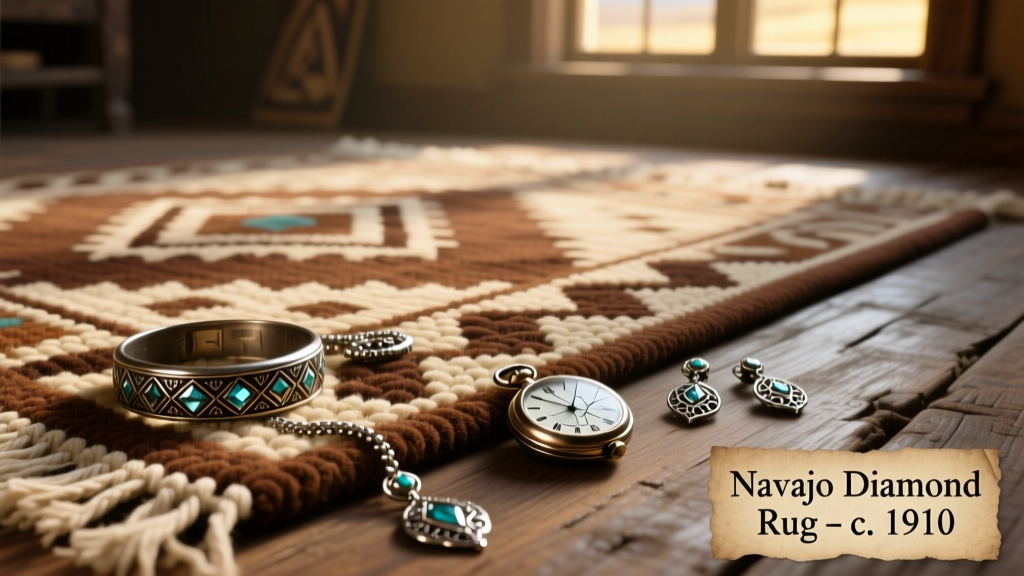
Navajo Diamond Rug, Brown and Cream, Circa 1910 — A Masterpiece of Early 20th-Century Southwestern Weaving
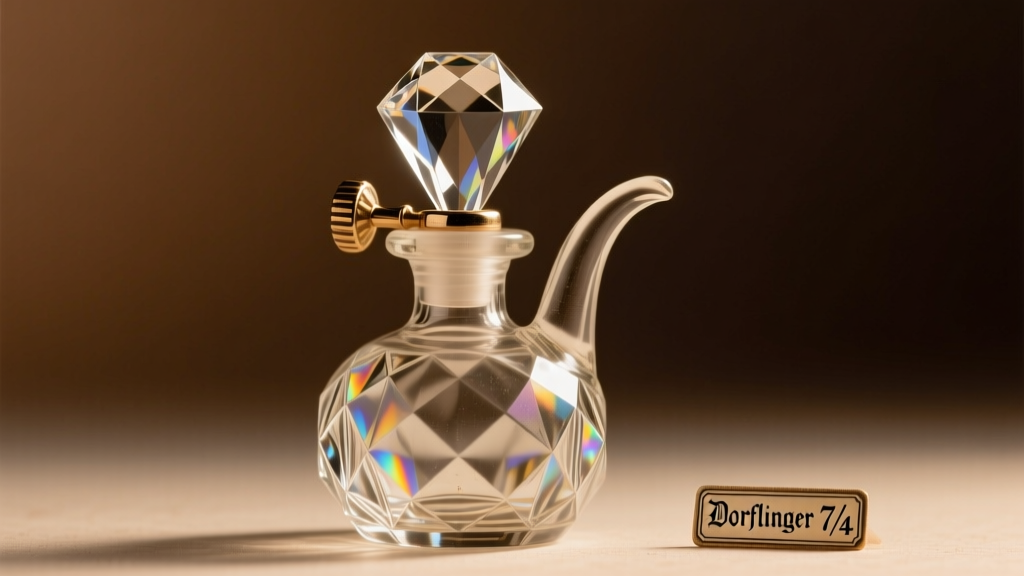
Dorflinger Cut Glass Cruet: Hobstar & Diamond Pattern with Tricornered Spout Stopper — A 7¼-Inch American Masterpiece

The Kuffel & Esser Type Compass Watch: A Precision Instrument at the Intersection of Horology and Geodesy
Imperial Glass Cape Cod Soup Dish Ruby #2: A Collector’s Guide to Pattern, Provenance, and Value
Windsor Sack-Back Chair: A Technical Appraisal of the 7-Spindle Maple-and-Ash Armchair (38-Inch Height)
Pairpoint Lamp: The Puffy Dogwood Rose Shade, Open-Top Design, 11-Inch Diameter — A Collector’s Deep Dive
Happy WhatsitWednesday #81: Unearthing the Forgotten Artistry of 1940s Swiss Chronograph Movements and Their American Market Legacy
Westmoreland Glass English Hobnail Goblet in Green: A Collector’s Guide to the Iconic 8-Ounce Pattern
Lot 1131469: A Deep Technical and Historical Analysis of the 1972 Rolex Submariner Ref. 5513 with Tropical Dial and Rare 'Double Swiss' Text