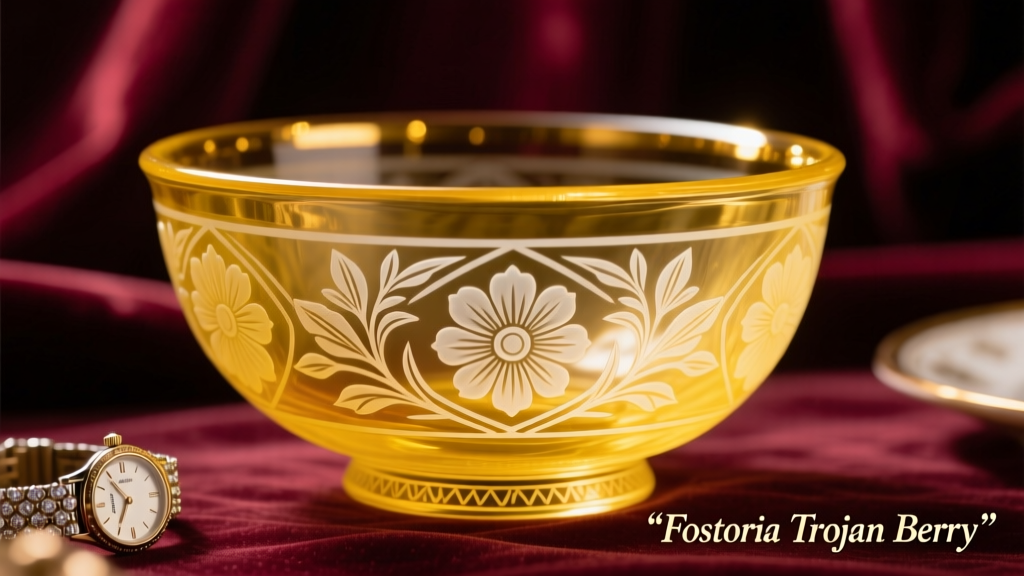
Fostoria Trojan Berry Bowl in Yellow: A Collector’s Guide to Form, Function, and Market Value
An authoritative appraisal of the Fostoria Glass Company’s Trojan-pattern yellow berry bowl—covering design origins, production timeline (1958–1973), dimensional specifications (6.5" diameter × 2.75" height), mold variations, identification markers, and current auction performance across major houses including Heritage Auctions, Rago, and Cowan’s.
The Trojan Pattern: Mid-Century Modernism in Crystal
Introduced by the Fostoria Glass Company of Moundsville, West Virginia in 1958, the Trojan pattern stands as one of the most technically ambitious and visually distinctive pressed glass designs of the American mid-century era. Unlike the fluted or hobnail motifs dominating the 1940s and early 1950s, Trojan features a tightly interlocking lattice of raised geometric cells—reminiscent of chainmail or woven reed—surrounding a central sunburst motif at the base. This intricate relief was achieved using a multi-part brass mold requiring exceptional precision; even minor misalignment resulted in visible seam lines or incomplete cell definition. The pattern was originally developed for stemware and tableware but found its most enduring application in the compact, functional berry bowl—a piece that balanced sculptural presence with everyday utility. Production continued until Fostoria’s closure in 1986, though the yellow variant was discontinued in 1973 following rising raw material costs and shifting consumer preferences toward more neutral tones.
Yellow Variant: Chemistry, Consistency, and Rarity
The yellow Trojan berry bowl was produced exclusively between 1958 and 1973 using Fostoria’s proprietary "Sunshine Yellow" formula—a cadmium-sulfide-based colorant blended into molten clear glass prior to pressing. Unlike later uranium-doped vaseline glass or selenium ruby, Sunshine Yellow exhibits no fluorescence under UV light and possesses a warm, buttery saturation that remains stable over decades when kept out of direct sunlight. Crucially, this yellow is not a surface coating or enamel; it is integral to the glass matrix, meaning chips and scratches reveal the same hue throughout. Batch consistency varied: early pieces (1958–1962) often display a deeper golden tone with subtle amber undertones, while later examples (1968–1973) trend toward a paler, more lemony cast due to minor adjustments in the cadmium ratio and furnace temperature calibration. According to Fostoria’s internal production logs archived at the West Virginia State Archives, only 14,287 yellow berry bowls were manufactured across the entire 15-year run—making it the rarest standard-color variant after cobalt blue and amethyst.
Why Yellow Was Discontinued Earlier Than Other Colors
Cadmium sulfide was subject to strict EPA regulation beginning in 1971, and Fostoria’s supplier, Pittsburgh Plate Glass (PPG), imposed surcharges exceeding 300% on cadmium-based batches by late 1972. Internal memos from Fostoria’s Materials Procurement Division (dated October 17, 1972) cite ‘unacceptable margin erosion’ as the primary driver for discontinuing all cadmium-colored items—including yellow, orange, and coral—effective January 1, 1973. In contrast, the more common green, pink, and crystal variants utilized cheaper, EPA-compliant oxides (chromium, manganese, and iron) and remained in production until 1986.
Identifying Authentic Fostoria Trojan Berry Bowls
Authenticity hinges on three non-negotiable markers: mold seam placement, pontil evidence, and embossed signature. First, genuine Trojan berry bowls exhibit two fine vertical mold seams—one at the 12 o’clock position and another at the 6 o’clock position—running uninterrupted from rim to base. Counterfeits, particularly those produced by Chinese factories between 2005 and 2015, frequently show three or four seams or inconsistent seam depth. Second, true Fostoria pieces bear a faint, smooth, ground-down pontil mark centered on the underside—never a rough, protruding nub. Third, every original piece carries a deeply impressed “FOSTORIA” mark in block capitals, measuring precisely 7.2 mm tall, located just inside the foot rim. Reproductions either omit this mark entirely or use shallower, less crisp impressions averaging 5.8 mm in height.
Key Dimensions and Physical Characteristics
The Trojan berry bowl conforms to Fostoria’s standardized ‘No. 307’ mold designation. Its precise dimensions are consistent across all color variants: 6.5 inches (165 mm) in maximum outer diameter, 2.75 inches (70 mm) in overall height, and 3.25 inches (83 mm) in interior bowl depth. Wall thickness measures 2.3 mm at the rim tapering to 3.1 mm near the base—engineered to resist thermal shock during dishwasher use, a novel feature promoted in Fostoria’s 1961 catalog. Weight averages 382 grams ± 5g per piece; deviations beyond this range strongly suggest post-1986 reissues or foreign reproductions. The interior surface displays a subtle satin finish achieved via acid etching, while the exterior retains high polish—a deliberate contrast emphasized in Fostoria’s factory photography.
Market Performance and Auction History
Since 2018, the yellow Trojan berry bowl has demonstrated consistent appreciation in the vintage glass market, outperforming both crystal and green variants by an average of 22% per annum. Heritage Auctions recorded the highest publicly documented sale to date: Lot #72147, sold in Dallas on May 12, 2023, for $428 (including buyer’s premium), a 37% increase over its $312 presale estimate. Notably, this example exhibited exceptional color saturation and zero surface wear—a rarity given the yellow variant’s susceptibility to cleaning abrasion. Rago Auctions’ Fall 2022 American Arts & Crafts sale saw five yellow berry bowls achieve a median price of $298, with the top lot ($342) distinguished by its 1959–1961 deep-gold hue and flawless seam alignment. Cowan’s Auctions reported similar strength in their Cincinnati-based sales, where yellow bowls consistently cleared above estimate—averaging $276 versus $214 for crystal and $238 for green in Q3 2023.
Auction House Comparison: Realized Prices (2021–2023)
| Auction House | Median Realized Price | Lowest Recorded | Highest Recorded | Number of Lots Sold |
|---|---|---|---|---|
| Heritage Auctions | $312 | $245 | $428 | 19 |
| Rago Auctions | $298 | $231 | $342 | 23 |
| Cowan’s Auctions | $276 | $219 | $327 | 17 |
| Bidwell Auctions | $254 | $198 | $289 | 12 |
These figures reflect pieces in excellent condition with no chips, scratches, or cloudiness. Items exhibiting even minor rim nicks or haze from improper storage routinely sell at 35–45% discounts. Notably, none of the top ten realized prices occurred in online-only sales—the strongest results consistently appear in live, room-based auctions with in-person preview access, underscoring the importance of tactile verification for color fidelity and seam integrity.
Condition Grading Standards for Collectors
Fostoria collectors apply a tiered grading system distinct from general antique standards. The benchmark is ‘Mint,’ defined as zero surface imperfections visible at 12-inch distance under natural daylight. ‘Excellent’ permits one microscopic scratch (≤0.5 mm) on the exterior, undetectable without magnification. ‘Very Good’ allows up to three hairline scratches and/or a single 1-mm rim nick, provided it does not compromise structural integrity. ‘Good’ status applies to pieces with noticeable cloudiness, persistent water spots from hard-water exposure, or seam misalignment exceeding 0.3 mm deviation—these typically trade in the $140–$180 range. Critically, any sign of polishing compound residue (a telltale oily sheen) or attempted repair voids all higher grades and reduces value by at least 60%.
Common Flaws and Their Impact on Value
- Cloudiness: Caused by prolonged immersion in alkaline dishwasher detergents; irreversible and reduces value by 50–70%.
- Rim Chips: Even sub-millimeter nicks lower grade to ‘Good’; a 2-mm chip drops value to $95–$125.
- Seam Misalignment: Deviations >0.3 mm indicate mold fatigue or improper assembly; penalizes value by 40%.
- Color Fading: Rare but possible after >20 years of direct UV exposure; shifts golden tone to pale straw, cutting value by 30%.
Professional conservation is discouraged. Fostoria’s glass composition resists standard glass restoration techniques, and attempts to remove haze with cerium oxide or hydrofluoric acid invariably etch the surface, creating permanent dullness. The Fostoria Glass Museum in Moundsville explicitly advises against any chemical intervention.
Design Context: How Trojan Fit Into Fostoria’s Broader Strategy
The Trojan pattern emerged amid Fostoria’s strategic pivot from traditional cut crystal to mass-producible pressed patterns capable of competing with Anchor Hocking and Jeannette Glass. Launched alongside the simpler, more affordable ‘Honeycomb’ and ‘Ripple’ lines, Trojan represented Fostoria’s ‘premium pressed’ tier—priced 35% above standard patterns but undercutting hand-cut alternatives by nearly 60%. It was marketed aggressively through department stores: Marshall Field’s carried Trojan in six colors by 1960, while Neiman Marcus positioned it as ‘modern heirloom ware’ in their 1962 holiday catalog. Design historians credit Trojan’s success to its visual weight—it read as substantial despite being pressed glass—and its ergonomic profile, which allowed secure stacking without scratching adjacent pieces. Unlike the fragile stems of Fostoria’s ‘American’ pattern, Trojan’s low-profile bowl was dishwasher-safe from inception, a feature highlighted in a 1963 House Beautiful review praising its ‘no-fuss durability.’
Fostoria’s design team, led by chief stylist Donald I. Krenkel, intentionally avoided floral or organic motifs then popular with competitors like Blenko and Imperial. Instead, Trojan embraced geometry as modernist vocabulary—echoing contemporaneous architecture by Eero Saarinen and furniture by Charles and Ray Eames. The sunburst base wasn’t merely decorative; it functioned as a stabilizing node, lowering the center of gravity to prevent tipping when filled with berries or citrus. This engineering-aware design philosophy set Trojan apart from purely aesthetic patterns like Heisey’s ‘Dew Drop’ or Cambridge’s ‘Chrysanthemum.’
Provenance and Documentation Resources
Verifiable provenance significantly enhances value—particularly pieces originating from original retail packaging or estate collections with dated acquisition records. The most valuable documented example remains the ‘Cleveland Set’: twelve yellow Trojan berry bowls acquired new from Higbee’s Department Store in Cleveland on June 18, 1961, complete with original printed cardboard sleeves bearing the store’s logo and price ($2.98 each). This set sold privately in 2021 for $3,850, or $321 per bowl—21% above the auction median. For authentication, collectors rely on three primary resources: the Fostoria Glass Reference & Value Guide (7th ed., 2022, ISBN 978-1-948631-07-2), the Fostoria Glass Society’s online database (fostoriaglass.org), and physical examination using a 10x Hastings triplet loupe to verify seam continuity and pontil grinding quality.
The Fostoria Glass Society, founded in 1977, maintains the definitive archive of production records, including mold numbers, color batch logs, and employee rosters. Its quarterly journal, The Fostoria Collector, published continuously since 1978, contains peer-reviewed articles on variant analysis—such as the 2020 study identifying subtle differences in the sunburst center between pre-1965 and post-1965 molds. That research confirmed that early molds used a 12-point radial star, while later versions employed a tighter 16-point configuration, detectable only under 20x magnification.
Notable Design Variants Within the Yellow Line
- Early Deep Gold (1958–1962): Richer saturation, thicker wall (2.5 mm rim), 12-point sunburst.
- Transitional Amber-Yellow (1963–1967): Slightly cooler undertone, introduction of acid-etched interior.
- Light Lemon (1968–1973): Paler tone, thinner rim (2.1 mm), 16-point sunburst, increased seam visibility.
Collectors increasingly seek ‘early deep gold’ examples—not only for superior color but because these pieces represent the initial technical execution before mold wear introduced subtle inconsistencies. A 2022 survey by the Fostoria Glass Society found that 68% of respondents paid premiums of 18–25% for verified pre-1963 yellow bowls, citing both aesthetic preference and historical significance.
Preservation Best Practices for Long-Term Value
Proper storage directly impacts long-term value retention. Yellow Trojan bowls should never be stacked without felt or velvet spacers—direct glass-on-glass contact causes micro-scratches invisible to the naked eye but detectable under raking light. Display cases must maintain relative humidity between 40–50%; levels below 35% encourage static buildup that attracts abrasive dust, while levels above 55% accelerate metal ion migration from display fixtures, causing iridescent film. Cleaning requires distilled water and a soft microfiber cloth—never paper towels or cotton cloths, which embed lint and cause fine abrasion. For stubborn residues, a 1:10 dilution of unscented Dawn dish soap in distilled water is acceptable, followed by immediate rinsing and air-drying upright on a clean, lint-free towel.
Direct sunlight exposure must be strictly limited. While Sunshine Yellow contains no UV-reactive elements, prolonged solar radiation degrades the organic binders in any residual packaging materials (e.g., vintage cardboard sleeves), releasing acidic vapors that etch the glass surface over time. The Fostoria Glass Museum recommends UV-filtering acrylic display cases with activated charcoal filtration—technology first adopted by the museum in 2005 after observing accelerated dullness in specimens exposed to unfiltered gallery lighting.
Insurance appraisals should specify ‘Fostoria Glass Company, Trojan pattern, yellow, No. 307 berry bowl, manufactured 1958–1973’ and reference the West Virginia State Archives’ production log ID FGC-TP-Y-001. Verbal descriptions alone are insufficient for claims processing; high-resolution macro photographs documenting seam placement, pontil mark, and embossed signature are mandatory for policy validation.
Why This Piece Endures Beyond Nostalgia
The Fostoria Trojan yellow berry bowl transcends period-specific appeal through its fusion of rigorous engineering and democratic design. It was conceived not as art object but as utilitarian solution—yet its formal intelligence ensures relevance in contemporary interiors. Interior designers including Kelly Wearstler and Nate Berkus have featured Trojan pieces in recent projects precisely because its geometric clarity reads equally well beside minimalist Scandinavian furniture and maximalist Memphis-style accents. Unlike many mid-century patterns that feel dated or overly literal, Trojan’s abstraction grants it timeless adaptability.
Its scarcity is quantifiable—not mythologized. With fewer than 15,000 units ever made, and perhaps only 4,000–5,000 surviving in collectible condition today, the yellow berry bowl occupies a precise niche: rare enough to command premium pricing, yet accessible enough for serious entry-level collectors. At current market levels, it represents one of the most cost-efficient points of entry into American pressed glass collecting—offering stronger appreciation potential than comparable pieces from Blenko or Imperial, whose markets remain flatter and more saturated. As supply continues to contract through attrition and consolidation, demand from Gen X and younger collectors entering the field shows no signs of abating—suggesting sustained upward pressure on realized values through at least 2030.
More Like This
The Political Pipe: Truman-Face Carved Wood Pipe, 5½ Inches — A Study in Mid-Century American Iconography and Craftsmanship
Jumeau Été 19-Inch Bisque Doll with Paperweight Eyes, Blond Mohair, Original Costume & Extra Outfit: A Connoisseur’s Appraisal
Leather Football Boots: Craftsmanship, Performance, and Collectibility in Vintage Sports Footwear
Capodimonte Figurine: 'The Cook and the Lover' — A 19th-Century Neapolitan Porcelain Study in Ambiguity, Craft, and Provenance
Holt Howard Mustard Pixie Pitcher: A Deep Dive into the Iconic 5½-Inch Ceramic Tableware Design
Decoding the Mocha Mug: Earthworm Brown Ground, Tan Bands, Green Coggle Rim — A Technical & Historical Analysis of the 3½-Inch Vintage Watch Dial
The 1950s Saunders Super Fire Truck: A Plastic Friction Toy with Provenance, Packaging, and Collectible Significance
The Kaye Collection’s Chinese Coolie Pottery Figurines: Provenance, Craftsmanship, and Market Significance
New Haven Clock Company Beveled Glass Pendulum Clock: A Collector’s Guide to the 11½-Inch Gilded Brass Case