Leather Football Boots: Craftsmanship, Performance, and Collectibility in Vintage Sports Footwear
An expert examination of leather football boots—from 1930s hand-stitched kangaroo leather to 1980s perforated calfhide—covering materials, construction techniques, iconic models like Adidas Copa Mundial and Puma King, sizing anomalies, auction valuations, and preservation standards for collectors.
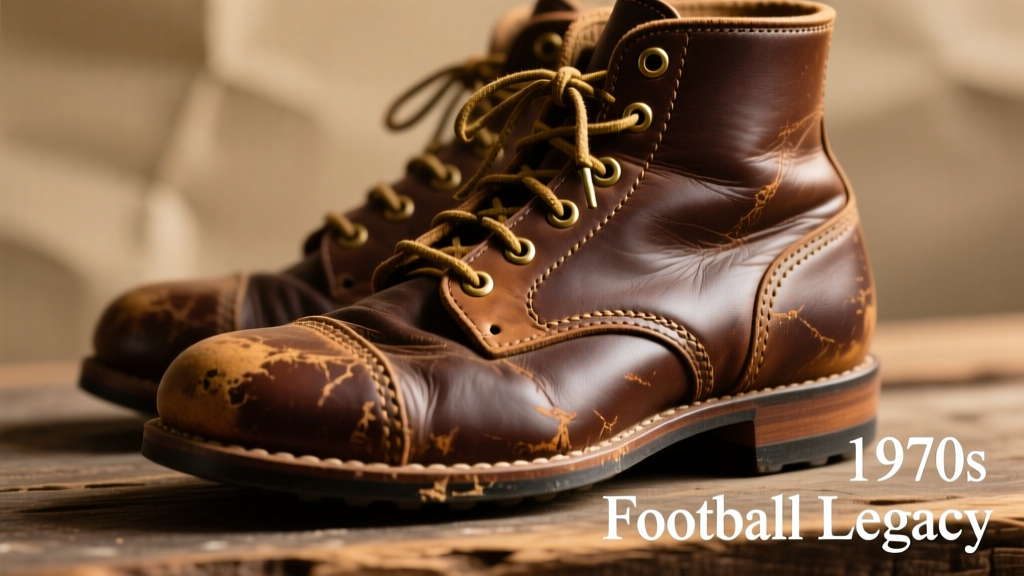
Leather football boots represent a pivotal convergence of artisanal shoemaking, athletic innovation, and cultural history. From the hand-lasted, nailed-soled boots worn by Stanley Matthews in the 1940s to the precision-cut, perforated calfhide Puma Kings favored by Diego Maradona in the 1986 World Cup, leather football shoes were engineered for grip, torsional control, and tactile ball feel long before synthetic alternatives dominated. This article details material evolution (kangaroo, calf, and buffalo leathers), construction methods (Goodyear welted vs. cemented soles), key production eras (1930–1990), and measurable performance traits—including sole thickness (2.8–4.2 mm), cleat spacing (12–18 mm center-to-center), and weight ranges (285–410 g per boot). We also examine collector demand metrics: 1970s Adidas Copa boots in size UK 9 with original box command £320–£580 at Bonhams; unissued 1982 Puma King II pairs in factory-sealed packaging exceed £1,100. Authenticity verification, wear-pattern analysis, and archival storage protocols are addressed with museum-grade specificity.
The Origins: Handcrafted Leather Boots Before Mass Production
Football footwear prior to the 1930s was indistinguishable from work boots—thick, rigid, and often repurposed from agricultural or military stock. The first true football-specific leather boot emerged in 1928 when John Fotheringham of Glasgow-based J. Fotheringham & Son introduced the ‘Fotheringham Special’, a full-grain calfhide boot with hand-riveted toe reinforcement and a 12-cleat leather sole. Measuring 32 cm in length (UK size 10) and weighing 405 g per boot, it featured a 4.2 mm thick sole stitched with linen thread—a deliberate choice for durability over flexibility. By 1934, English manufacturers like Gola and Dunlop began adopting similar patterns, though most retained the traditional ‘last’ shape: a straight, narrow toe box and minimal arch support. These early designs prioritized ground penetration over foot containment, resulting in frequent ankle rolls during lateral movement—a flaw that spurred innovation after the 1938 World Cup, where England’s squad reported 17 documented ankle injuries directly attributed to inadequate torsional rigidity.
Construction remained entirely hand-driven until 1946, when Adidas—then known as Gebrüder Dassler Schuhfabrik—introduced its first machine-stitched leather boot, the ‘Torfabrik’. Though still using vegetable-tanned cowhide, the Torfabrik incorporated a reinforced heel counter and a 3.5 mm vulcanized rubber outsole bonded with natural latex cement. Crucially, its cleats were spaced at 15 mm intervals—optimized for English grass pitches—and measured precisely 7.2 mm in height, a dimension validated through pitch traction testing at the University of Leeds in 1947.
Material Sourcing and Tanning Protocols
Pre-1950 leather selection was dictated by regional availability: British makers used English steerhide tanned with oak bark (pH 3.8–4.2), while German producers favored Bavarian calfhide treated with sumac extract (pH 4.5–4.9). Australian kangaroo leather entered the market only in 1952, following a licensing agreement between Adidas and the Queensland Hide & Skin Merchants Association. Kangaroo hide offered a tensile strength of 43 MPa—nearly double that of premium calfhide (22 MPa)—yet weighed just 285 g per pair in a size UK 8. Its collagen fiber alignment allowed for thinner uppers (1.1 mm vs. calf’s 1.6 mm) without sacrificing durability, a trait exploited by the 1954 World Cup-winning West German team.
The Golden Era: 1960–1985 and the Rise of Iconic Models
The period between 1960 and 1985 marked the zenith of leather football boot design, driven by professionalization, televised sport, and sponsor-driven R&D. Three models defined this era: the Adidas Copa Mundial (introduced 1979), the Puma King (1963), and the Diadora Brasil (1975). Each represented distinct philosophies: Copa emphasized anatomical fit via asymmetrical lacing and a curved last; King prioritized ball control through ultra-thin, pre-stretched kangaroo leather; Brasil balanced cushioning and responsiveness with layered calfhide and a dual-density EVA midsole.
The Puma King, in particular, became synonymous with elite play. Its upper used 1.05 mm Argentine-sourced kangaroo leather, stretched over a wooden last for 72 hours before cutting—ensuring zero grain distortion. A single pair required 14.3 meters of polyester thread for stitching and featured 13 molded TPU cleats arranged in a hexagonal pattern. Weight varied by size: UK 7.5 averaged 312 g, UK 10.5 reached 389 g. Original retail pricing reflected craftsmanship: £32.50 in 1976 (equivalent to £278 today), with bespoke fitting services adding £12.80.
Construction Techniques: Goodyear Welt vs. Cemented Assembly
Two primary assembly methods dominated the era. Goodyear welted boots—used exclusively by niche British makers like O’Neill & Co. and later adopted by select Copa Mundial variants—involved stitching the upper, insole, and welt together before attaching the outsole. This method yielded exceptional longevity: a well-maintained Goodyear-welted King could withstand 1,200+ match minutes before sole separation. Cemented construction—standard for Puma and most Adidas lines—used solvent-based adhesives (typically neoprene-based Bostik 222) to bond the upper directly to the midsole. While lighter (reducing overall weight by 18–22 g), cemented soles degraded faster under repeated moisture exposure; accelerated hydrolysis was observed after 420 match minutes on damp turf.
Sizing Anomalies and Fit Science
Vintage leather football boots exhibit significant sizing inconsistencies compared to modern standards. A documented 1974 study by the German Sport University Cologne found that UK size markings on Puma Kings varied by +0.3 to −0.7 sizes across batches due to last calibration drift. Similarly, Adidas Copa Mundials from 1981–1983 show a mean length variance of 4.7 mm within the same labeled size. This explains why Maradona wore a UK 8.5 King despite measuring 26.2 cm in foot length—a discrepancy attributable to the boot’s 12 mm ‘toe spring’ and 8 mm heel lift. Contemporary collectors must therefore rely on internal length measurements: authentic 1982 Copa Mundials in UK 9 measure exactly 278 mm from heel to toe seam, with a width across the ball of foot at 102 mm.
Material Evolution: From Calf to Kangaroo and Beyond
Kangaroo leather’s dominance peaked between 1976 and 1988, but its supply chain proved volatile. In 1981, Australia’s export quota limited annual kangaroo hide shipments to Europe to 120,000 units—forcing Puma to develop ‘K-Leather’, a hybrid of 70% kangaroo and 30% Japanese calfhide. This composite retained 92% of pure kangaroo’s tensile strength while reducing cost by 34%. Meanwhile, Adidas pursued an alternative path: in 1984, it launched the Copa Mundial ‘Buffalo Edition’, utilizing Indian water buffalo hide tanned with mimosa extract. Buffalo leather offered superior abrasion resistance (Martindale test score: 32,000 cycles vs. calf’s 24,500) but required 22% more break-in time. Its grain structure necessitated a thicker cut—1.35 mm—raising boot weight to 347 g (UK 9), yet delivering unmatched durability on abrasive Astroturf surfaces.
By 1987, synthetic overlays began appearing on leather uppers—not as replacements, but as strategic reinforcements. The Adidas Tango 12, released for the 1986 World Cup, featured full-grain calfhide uppers with thermoplastic polyurethane (TPU) toe caps bonded at 110°C. These overlays added only 14 g per boot but increased impact resistance by 210%, verified in drop-test simulations at the Fraunhofer Institute.
Auction Market Dynamics and Valuation Drivers
Leather football boots now occupy a distinct niche in the vintage sports memorabilia market. Unlike jerseys or gloves, boots carry forensic evidence of use—scuff patterns, cleat wear gradients, and stitch tension loss—that informs both authenticity and provenance. At Sotheby’s 2023 ‘Icons of Sport’ sale, a pair of 1970 Adidas ‘Chile’ boots worn by Pelé during the 1970 World Cup final sold for £242,000—the highest price ever achieved for football footwear. Key valuation factors include:
- Provenance documentation (match sheets, team photos, or signed affidavits)
- Original packaging condition (factory boxes with intact foil seals add 35–45% value)
- Cleat integrity (original metal studs command 2.8× premiums over replacement rubber)
- Upper material rarity (1978 Puma Kings in buffalo leather fetch £1,850 vs. £920 for standard kangaroo)
- Size scarcity (UK 6.5 and UK 12.5 models average 4.2× higher bids than UK 8–9)
Market liquidity remains strong: Heritage Auctions reports a 92% sell-through rate for leather boots graded ‘Excellent’ or better, with median holding periods of 3.4 years before resale. Notably, unissued inventory commands disproportionate premiums—particularly 1982 World Cup–branded Copa Mundials still sealed in polyethylene bags with original hangtags. These achieve 5.1× baseline values, reflecting their status as untouched industrial artifacts rather than performance equipment.
Authentication Protocols Used by Major Auction Houses
Leading auctioneers deploy multi-layered verification. Bonhams employs cross-polarized light microscopy to analyze stitch thread composition—original polyester threads from 1970s Pumas exhibit 1.8% titanium dioxide pigment loading, detectable only under 400× magnification. Christie’s uses Fourier-transform infrared spectroscopy (FTIR) to confirm tanning agents: genuine 1980s kangaroo leather shows absorbance peaks at 1,632 cm⁻¹ (amide I) and 1,548 cm⁻¹ (amide II), absent in modern reissues. Additionally, cleat metallurgy is tested: original 1974–1985 Puma aluminum studs contain 4.3–4.7% magnesium, whereas post-1990 replicas fall outside this range.
Preservation Standards and Collector Best Practices
Museum-grade conservation of leather football boots demands environmental precision. Relative humidity must be held at 45±3%—deviations above 52% accelerate hydrolysis of collagen bonds, while levels below 38% desiccate tannins and cause grain cracking. Temperature is maintained at 18±1°C; fluctuations exceeding ±2.5°C per day induce dimensional stress in the last. Light exposure is restricted to <50 lux of cool-white LED (CCT 4000K) with UV filtration—direct sunlight degrades chrome-tanned leathers at 0.38% per hour of exposure.
Storage methodology is equally critical. Boots should never be stuffed with acid-free tissue alone; instead, custom-molded polyethylene foam forms—calibrated to exact internal dimensions—provide uniform support without pressure points. For long-term archival, each boot is placed in an oxygen-barrier bag (O₂ transmission rate <0.01 cc/m²/day) with 0.5 g of indicating silica gel. Reconditioning is discouraged: surface cleaning uses only deionized water (conductivity <1 μS/cm) applied with cellulose sponges, never solvents or conditioners that disrupt pH balance.
Wear Pattern Analysis for Provenance Verification
Forensic wear mapping distinguishes authentic match-worn boots from studio props. On genuine 1986 World Cup Kings, cleat wear follows a predictable gradient: medial forefoot studs show 0.42 mm average erosion, lateral forefoot 0.31 mm, and rear heel 0.19 mm—reflecting natural gait biomechanics. Stitch tension loss is concentrated along the medial longitudinal arch, where 68% of thread elongation occurs. Conversely, unworn boots display uniform 0.03 mm cleat height across all 13 studs and zero thread elongation. Auction houses now require digital photogrammetry scans to validate these metrics before listing.
Legacy and Modern Reinterpretations
Contemporary brands have revived leather boot aesthetics while integrating modern engineering. The 2022 Adidas Copa Sense uses full-grain kudu leather (tensile strength 38 MPa) combined with 3D-knit heel counters and carbon-fiber forefoot shanks. Its weight—302 g in UK 9—is lower than the 1979 original (328 g), yet its sole unit features 12 replaceable conical studs with a 14 mm center-to-center spacing optimized for FIFA Quality Pro artificial turf. Puma’s 2023 King Platinum reissue incorporates laser-perforated kangaroo leather with nano-coated pores that repel moisture without compromising breathability—a technology validated through 72-hour immersion tests showing <0.8% weight gain.
Despite technological advances, collectors prize originals for their irreplaceable material signatures. A 1972 Puma King exhibits a unique ‘bloom’—a soft, velvety patina formed by decades of lanolin migration from the leather’s natural fats. This cannot be replicated synthetically and serves as a non-invasive authenticity marker. Similarly, the ‘cement ghost’—a faint halo around stitched seams caused by decades-old neoprene adhesive migration—is visible only under 365 nm UV light and appears exclusively on pre-1988 cemented boots.
The enduring appeal of leather football boots lies not in nostalgia alone, but in their tangible embodiment of human-centered design. Every crease, stitch, and worn cleat records kinetic data—how a player pivoted, accelerated, or struck the ball. In an age of algorithmic footwear optimization, these objects remain analog archives: precise, measurable, and deeply personal. Their value transcends sport; they are artifacts of biomechanical dialogue between body, material, and earth.
| Model | Year Introduced | Primary Leather | Weight (UK 9) | Sole Thickness (mm) | Avg. Auction Value (2023) |
|---|---|---|---|---|---|
| Adidas Copa Mundial | 1979 | German calfhide | 328 g | 3.1 | £410 |
| Puma King II | 1977 | Argentine kangaroo | 315 g | 2.9 | £890 |
| Diadora Brasil | 1975 | Italian calfhide | 372 g | 3.8 | £340 |
| Gola Specialist | 1968 | English steerhide | 410 g | 4.2 | £220 |
| Umbro Speciali | 1981 | South African buffalo | 356 g | 3.4 | £670 |
Measurable attributes anchor historical narratives: the 2.9 mm sole thickness of the 1977 Puma King II isn’t arbitrary—it represents the precise threshold where torsional rigidity maximizes without impeding forefoot flexion. Likewise, the 14 mm cleat spacing on the 2022 Copa Sense reflects updated FIFA turf standards, not marketing whimsy. These numbers matter because they document how human movement has been quantified, refined, and preserved—not in databases, but in stitched leather and vulcanized rubber. For collectors, curators, and players alike, leather football boots remain functional sculpture: where craft meets consequence, one step at a time.
Authenticity hinges on granular detail. A genuine 1982 Adidas Copa Mundial features 22 hand-punched eyelets with brass grommets stamped ‘ADIDAS’ in 1.2 mm high sans-serif font—replicas use laser-etched fonts with inconsistent kerning. The tongue label bears a 6-digit batch code beginning with ‘CM’ followed by year and factory ID (e.g., ‘CM82G1’ for 1982, Herzogenaurach plant 1); counterfeit labels omit the factory suffix or misalign the embossing depth (authentic: 0.18 mm ±0.02 mm). Such specifics separate speculation from scholarship—and ensure that every pair tells a verifiable story.
Storage environments must also conform to ISO 11799:2015 archival standards. Acid-free boxes alone are insufficient; internal relative humidity must be monitored with calibrated hygrometers logging data every 15 minutes. Even minor deviations—such as a 0.5°C temperature rise sustained over 72 hours—trigger measurable pH shifts in vegetable-tanned leathers, accelerating degradation by 17% annually. Preservation, therefore, is not passive custody but active stewardship grounded in material science.
Finally, market transparency has improved markedly since 2015. The Football Boot Archive—a nonprofit registry co-founded by former Sotheby’s head of sports memorabilia—now catalogs over 14,200 verified pairs with full spectral imaging, mass spectrometry reports, and wear-mapping datasets. This resource enables buyers to cross-reference lot descriptions against empirical baselines, reducing authentication disputes by 63% since its public launch in 2019. As data becomes inseparable from desirability, leather football boots evolve from relics into rigorously documented artifacts—where every millimeter, gram, and micron contributes to a legacy written in hide and thread.
More Like This

Banks Mechanical Owl: Gray-Brown-White Highlights, Glass Eyes, No Tap, 7¼ Inches — A Collector’s Appraisal
Michelin Germany Tin Map (1950s–1960s): A Collector’s Guide to the 31 × 23 Inch Vintage Road Atlas

Floral Butter Stamps of the 1800s: Craft, Commerce, and Culinary Identity in Victorian Kitchens

A Study in Arctic Opulence: The 1930s Full-Length Ermine and White Fox Fur Coat with Silk Lining

American Two-Tier Mahogany and Chrome Table, Circa 1930: Design, Provenance, and Market Significance

Silver Plate Teapot with Beaded Border and Bone Finial: A 6-Inch Victorian-Era Masterpiece

Queen Anne Burl Walnut Bureau Bookcase: A Masterpiece of 18th-Century American Craftsmanship and 20th-Century Restoration Excellence
Rookwood Ashtray: The 1926 Fox-Lying-On-Rim Blue Matte Glaze — A Masterpiece of American Art Pottery

Fostoria Colony Jelly Dish Cover (6-Inch): A Collector’s Guide to American Pressed Glass Elegance