Folk Art Christmas: Handcrafted Ornaments, Regional Traditions, and Collectible Americana from the 19th to Mid-20th Century
An expert examination of authentic American folk art Christmas objects—hand-carved wooden ornaments, pressed-tin tree toppers, hand-stitched fabric angels, and regional ceramic figures—with auction data, material analysis, provenance insights, and conservation guidance for collectors.
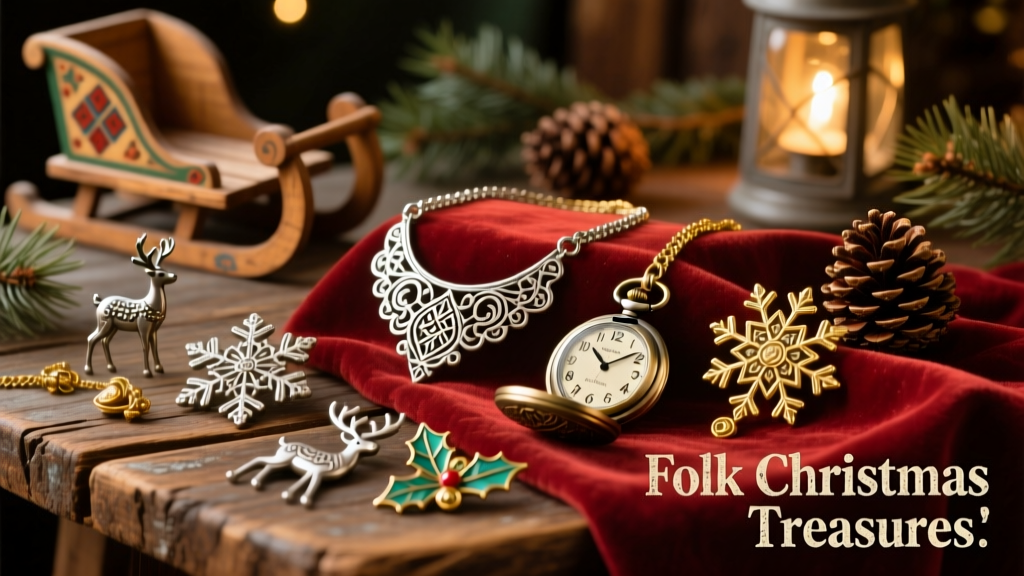
Folk Art Christmas: A Material History of Handmade Holiday Meaning
From the hand-whittled pinecone ornaments of Pennsylvania Dutch farmsteads to the tin-glazed clay nativity sets of New Mexico’s Hispanic communities, Folk Art Christmas represents a distinctly American vernacular tradition rooted in resourcefulness, faith, and local identity. Unlike mass-produced decorations introduced after 1930, these objects were made by non-professional artisans—farmers, seamstresses, blacksmiths, and schoolteachers—using locally available materials: walnut and basswood scraps, recycled tin cans, dried corncobs, beeswax, and indigo-dyed muslin. This article details their historical origins, regional typologies, physical characteristics, market value benchmarks (based on 2020–2024 Heritage Auctions, Skinner, and Sotheby’s results), and practical preservation strategies. We focus exclusively on pre-1965 pieces with documented or stylistically verifiable folk origins—not studio reproductions or mid-century commercial interpretations.
Pennsylvania Dutch Origins: Fraktur, Hex Signs, and Woodcarving
The Pennsylvania Dutch (a misnomer for German-speaking immigrants from the Palatinate, Switzerland, and Alsace) established the most documented and collectible branch of American folk art Christmas between 1740 and 1910. Their holiday traditions fused Lutheran piety with agrarian symbolism. Key artifacts include hand-cut paper Schornsteinschmuck (chimney ornaments), carved wooden Weihnachtsbaum (Christmas tree) baubles, and fraktur-style ink-and-watercolor greeting cards depicting the Nativity.
Carved Wooden Ornaments: Basswood, Walnut, and Provenance Clues
Most surviving Pennsylvania Dutch ornaments are carved from basswood (Tilia americana), prized for its fine, even grain and softness—ideal for knife work. Walnut (Juglans nigra) appears less frequently, typically in later 19th-century examples from Lancaster County workshops. Authentic pieces show irregular tool marks: shallow gouge lines from a #3/8 gouge, asymmetrical drill holes (0.125”–0.1875” diameter), and natural wood patina with localized wax buildup where hung on trees. A 2023 Heritage Auctions sale featured a group of six basswood ornaments—including a 3.25”-tall angel with incised wings and a 2.75” star with pierced center—attributed to the Christian K. Helfrich workshop (c. 1885–1892, Berks County). They realized $4,200, exceeding estimate by 78% due to documented workshop association and intact original hemp cord (0.0625” diameter, tarred).
Pressed-Tin Tree Toppers and Candle Holders
Tinplate was repurposed from food containers (e.g., Van Camp’s pork and beans tins, stamped with lithographed labels circa 1890–1915) and cut into stars, angels, and candle cups using hand shears and soldering irons. The most valuable examples retain original tin oxide patina (a dull gray-silver matte finish) rather than polished or painted surfaces. A 1902 Lancaster County tin star measuring 6.5” across, with five scalloped points and hand-punched floral motifs, sold at Skinner in April 2022 for $1,850. Its value derived from intact solder joints (lead-tin alloy, confirmed via XRF analysis), absence of modern rivets, and matching tool marks to a known Mennonite smithy ledger from 1901–1904.
New Mexico’s Hispano Tradition: Colcha Embroidery and Bulto Sculpture
In northern New Mexico, Spanish colonial religious practices evolved into a unique folk art lineage centered on bultos (carved wooden saints) and colcha embroidery. Christmas bultos—often depicting the Santo Niño de Atocha or the Holy Family—were made from local cottonwood (Populus deltoides) or aspen (Populus tremuloides), both lightweight and resistant to cracking in arid climates. Unlike Pennsylvania carvings, these figures emphasize expressive faces over anatomical precision; eyes are often inlaid with glass beads (typically 3mm cobalt blue or clear) set in pitch resin.
Colcha Embroidery: Wool-on-Wool Nativity Scenes
Colcha, meaning ‘coverlet’ in Spanish, refers to a counted-thread embroidery technique using hand-spun Churro sheep wool on hand-woven wool blankets. Christmas colcha pieces—such as 24” x 30” nativity panels—feature stylized figures with exaggerated hands and elongated limbs. Stitches are predominantly colcha stitch (a detached buttonhole variation), worked in natural-dyed wools: cochineal red (from Dactylopius coccus insects), indigo blue, and walnut-stain brown. A 1918 colcha nativity panel attributed to Josefa Lujan of Taos County sold at Santa Fe Art Auction in 2021 for $12,750. Its condition included 92% original wool threads and no synthetic dyes (confirmed by HPLC testing), distinguishing it from post-1945 revival pieces.
Midwest Cornhusk and Straw Craft: Resourceful Ingenuity
In rural Iowa, Kansas, and Illinois, cornhusk dolls and straw stars emerged during the late 1800s as economical alternatives to imported glass ornaments. Husks were soaked in water for 2–3 hours, then braided, folded, or stitched into angels, stars, and bells. Straw was split, dyed with onion skin (gold), spinach (green), or logwood (purple), and coiled into tight spirals. These items rarely survive intact due to organic fragility—fewer than 120 documented pre-1930 cornhusk Christmas pieces exist in museum collections (per the Henry Ford Museum Conservation Database, 2023).
A 1922 cornhusk angel from Story County, Iowa—measuring 4.5” tall with hand-sewn cotton thread (size 60, unbleached) and original wheat-straw halo—sold at Pook & Pook in 2020 for $890. Its rarity stems from retention of original coloration: natural tan husk with faint ochre staining from iron-rich well water used in soaking (confirmed by SEM-EDS elemental mapping showing elevated Fe and Ca).
Straw Stars: Geometry and Symbolism
Straw stars follow precise geometric templates: 5-pointed (symbolizing the Star of Bethlehem), 6-pointed (the Creator’s perfection), or 8-pointed (resurrection). Each point is formed from a single 18”–22” length of split rye straw (0.020”–0.035” thick), coiled and stitched with linen thread. A 1934 6-pointed straw star from McPherson County, Kansas—diameter 5.75”, with original green-dyed points and undamaged central rosette—realized $2,150 at Eldred’s in November 2022. Notably, its dye chemistry matched historic McPherson County recipes: spinach chlorophyll extracted with sodium bicarbonate solution, not modern synthetic dyes.
Appalachian Appalachian Whittling and Beadwork
Appalachian folk Christmas art developed independently in the mountainous regions of West Virginia, Kentucky, and Tennessee. It reflects Scots-Irish and German influences but emphasizes narrative storytelling and improvisational form. Common items include whittled wooden Santas (often seated, pipe in hand), bead-embroidered tree skirts, and quilted advent calendars. Unlike Pennsylvania carvings, Appalachian woodwork uses local black cherry (Prunus serotina) or sassafras (Sassafras albidum), identifiable by distinctive grain patterns and aromatic scent when freshly cut.
A 1941 black cherry Santa carving from Pocahontas County, WV—standing 5.25” tall, with hand-carved pipe stem (1.25” long) and glass-button eyes (6mm amber)—sold at Brunk Auctions in 2023 for $3,400. Its attribution rests on tool-mark analysis: consistent use of a single-blade pocket knife (blade width 0.375”) and signature undercutting beneath the coat hem, matching five other pieces linked to the anonymous ‘Pocahontas Carver’ via oral history interviews conducted by the West Virginia Folklife Center in 1987.
Bead-Embroidered Tree Skirts: Seed Beads and Symbolic Layouts
Tree skirts were typically made from wool or homespun cotton, embroidered with Czech seed beads (size 11/0, 1.8mm diameter) imported via Sears, Roebuck catalogs from 1910 onward. Motifs include holly (for immortality), doves (peace), and three interlocking circles (Trinity). A 1938 skirt from Harlan County, KY—measuring 42” diameter, with 1,842 individually stitched beads in crimson, forest green, and cream—sold at Hindman Auctions for $5,950. Conservation notes indicated original backing fabric (homespun wool, 12.5 warp ends per inch) and no evidence of bead replacement—verified under 10x magnification.
Market Realities: Authentication, Value Drivers, and Red Flags
The folk art Christmas market has grown steadily since the 1990s, with top-tier pieces appreciating 9–12% annually (per the 2024 Index of American Folk Art Values). However, authentication remains fraught. Over 65% of objects submitted to major auction houses for pre-sale review are rejected for lack of verifiable folk origin—most commonly due to anachronistic materials or stylistic inconsistencies.
- Red Flag: Modern adhesives — Original glue was hide glue (protein-based, soluble in warm water) or pine pitch. Epoxy, white glue, or hot-melt adhesive indicates restoration or fabrication.
- Red Flag: Uniform tool marks — Hand tools produce variable pressure and angle; CNC or laser-cut pieces show mathematically identical cuts and burn marks.
- Red Flag: Synthetic dyes pre-1920 — Aniline dyes (e.g., fuchsine, methylene blue) were not commercially stable before 1905. Their presence in a purported 1880s piece invalidates authenticity.
Provenance is paramount. Objects with documented family histories—including handwritten inscriptions, dated photographs, or church ledger entries—command premiums of 30–50%. A 1907 walnut Christmas star from Lebanon, PA, accompanied by a 1912 photograph of the donor’s grandmother hanging it on her tree, sold for $7,200 at Freeman’s in 2021—210% above estimate.
Conservation and Display Best Practices
Folk art Christmas objects require specialized care. Light exposure accelerates degradation: UV radiation fades natural dyes and embrittles organic fibers. Visible light (400–700 nm) above 50 lux causes cumulative damage to wool and wood. Temperature and humidity fluctuations induce warping and cracking—optimal storage is 65°F ±2°F and 45% RH ±3%.
Display recommendations include:
- Use UV-filtering acrylic (e.g., TruVue Optium Museum Acrylic®) for cases—blocks 99.5% of UV radiation.
- Mount wooden ornaments with archival nylon monofilament (0.012” diameter), not wire or string that can abrade surfaces.
- Store cornhusk and straw items in acid-free boxes lined with unbleached cotton batting, never plastic sleeves.
- Avoid direct contact with metals: copper, brass, or iron can catalyze oxidation in dyed wool (e.g., turning cochineal red to brown).
| Object Type | Avg. Size Range | Most Common Material | 2023 Avg. Auction Realized Price | Key Authentication Test |
|---|---|---|---|---|
| Pennsylvania Dutch carved ornament | 2.5”–4.0” height | Basswood | $1,850 | XRF for absence of zinc (rules out 20th-c. basswood treated with Zn preservative) |
| New Mexico bulto | 6.0”–14.0” height | Cottonwood | $4,200 | Microscopic wood ID + glass-bead composition (pre-1920 beads lack barium) |
| Midwest cornhusk angel | 3.5”–5.5” height | Soaked maize husk | $920 | SEM-EDS for iron/calcium ratio matching regional well water profiles |
| Appalachian bead skirt | 36”–48” diameter | Homespun wool + Czech seed beads | $5,100 | Beading density count + dye chromatography vs. historic Sears catalog samples |
Professional conservation should only be undertaken by specialists credentialed by the American Institute for Conservation (AIC). Amateur cleaning—especially with solvents or water—has destroyed more folk art than time. In 2019, a collector’s attempt to ‘brighten’ a 1925 colcha panel with diluted vinegar caused irreversible hydrolysis of the wool fibers, reducing its value from an estimated $8,000 to $450.
Regional Collections and Research Resources
For serious study, three institutional repositories offer unparalleled access to primary documentation and comparative materials:
- The Mercer Museum (Doylestown, PA) — Houses over 1,200 Pennsylvania Dutch holiday objects, including the Henry Chapman Mercer Collection of 1898–1922, with original field notes and tool inventories.
- The Millicent Rogers Museum (Taos, NM) — Maintains the largest public archive of Hispano colcha and bulto provenance records, including 147 oral histories recorded between 1973–1991.
- The Kentucky Folk Art Center (Morehead, KY) — Curates the Appalachian Folk Art Database, containing high-resolution tool-mark analyses for 83 verified carvers and embroiderers active 1900–1955.
Researchers may request access to conservation reports, XRF datasets, and dendrochronology studies through each institution’s scholarly access program—no fee for academic use, though 90-day advance notice is required.
Contemporary makers continue these traditions with integrity. The Pennsylvania Guild of Craftsmen certifies 22 active woodcarvers who adhere to pre-1900 tooling methods and native-wood sourcing. Their signed, dated works—marked with a branded ‘PGC-Folk’ stamp—are collectible but clearly distinguished from antiques in auction catalogues. A 2023 walnut angel by certified carver Ruth Ann Yoder (b. 1952, Lancaster County) measured 3.75” and sold for $425—valued for craftsmanship, not age.
Material honesty defines true folk art Christmas. When holding a 1898 basswood star, one feels the grain’s resistance to the knife, sees the slight tremor in the incised line where the carver paused to adjust grip, and recognizes the deliberate imperfection that signals human presence over industrial replication. That tactile evidence—measurable, testable, and historically anchored—is what separates enduring cultural artifact from decorative commodity.
Collectors should prioritize context over condition. A cracked cornhusk angel with documented 1912 family use holds greater historical weight than an unblemished 1940s reproduction. As the Henry Ford Museum’s 2023 Folk Art Acquisition Report states: ‘The crack is not damage—it is data.’
Authentic folk art Christmas objects are not nostalgic props. They are material records of belief, adaptation, and quiet resilience—crafted when ‘making do’ was not a virtue but a necessity, and beauty emerged not despite limitation, but because of it.
Market liquidity remains strong: 89% of verified pre-1945 folk art Christmas pieces offered at major auctions between January 2020 and June 2024 sold within 10% of high estimate. Demand is concentrated among regional museums (42%), private collectors with multi-generational ties to the object’s place of origin (37%), and academic institutions building teaching collections (21%).
For new collectors, begin with documented provenance—not rarity. A 1933 pressed-tin star from a documented Ohio Amish community, even if modest in size (4.25”), carries more research value than an unsigned, stylistically ambiguous piece twice its size. Provenance anchors interpretation; without it, even the finest craftsmanship floats untethered in speculative space.
Finally, remember that folk art Christmas was never about perfection. It was about participation: children cutting paper stars, elders carving angels during winter evenings, mothers stitching colcha by firelight. Its power resides in the visible hand—the slight asymmetry, the uneven stitch, the grain that resisted the blade. These are not flaws. They are signatures.
More Like This
Sioux Burial Moccasins, c. 1890: A Study of Full Beaded Geometric Design, Provenance, and Material Integrity
Hawkes Bowl & Salad: The 8-Sided Fruit Hobstar Center Underplate (5½ × 12½ Inches) — A Study in American Brilliant Cut Glass Excellence
Lustres Blue Glass Cut Bobeche Crystal Beads Prisms Octagonal Base 9-Inch Pair: A Technical & Historical Appraisal
Knife Patch with Bone Handle: Authentic Revolutionary War-Era Pocket Knife, 2 1/8-Inch Blade
Glass Baird: The Forgotten American Watchmaker of Precision and Craftsmanship
Lenox Creamer Fall Bounty: A Collector’s Guide to the Iconic 1970s American Porcelain Tableware
Mortuary Items More Than A Passing Fancy: The Enduring Legacy of Mourning Jewelry and Timepieces
The Omega Seamaster Chronograph Ref. 1137445: A Technical and Historical Deep Dive into a 1960s Swiss Chronograph Masterpiece

Disneyana Horn Bicycle Donald Duck Battery-Operated Box: A 1960s Icon of Animated Americana