Silver Certificates: History, Collectibility, and Market Realities for Vintage Jewelry & Watch Specialists
A detailed examination of U.S. Silver Certificates—issued from 1878 to 1964—including their design evolution, legal tender status, redemption history, and enduring appeal among numismatists and vintage luxury collectors. Includes precise grading standards, auction performance data, and critical authentication protocols.
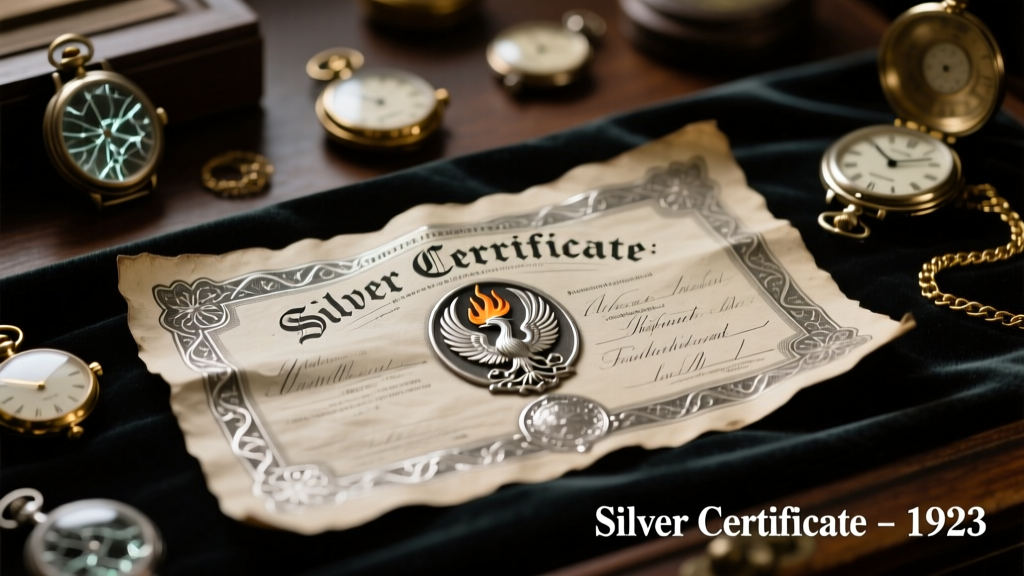
Silver Certificates were United States paper currency issued between 1878 and 1964, backed by silver dollars held in Treasury vaults and redeemable on demand for silver coin until June 24, 1968. Unlike Federal Reserve Notes, these certificates carried explicit promises of silver redemption—initially in standard Morgan or Peace dollars, later in silver bullion—and featured distinctive designs, serial numbering conventions, and security elements that evolved across seven major series. For vintage jewelry and watch specialists, Silver Certificates hold dual significance: as historical artifacts tied to America’s monetary transitions and as tangible components in mid-century accessories—most notably in engraved 1935–1957 $1 certificates mounted in 14k yellow gold pendants, bracelet charms, and pocket watch fobs produced by firms like Gorham, Tiffany & Co., and the L.G. Balfour Company. This article details their legislative origins, physical attributes, market dynamics, and forensic authentication criteria essential for professionals handling high-value collectibles.
Origins and Legislative Framework
The Bland-Allison Act of February 28, 1878, established the legal foundation for Silver Certificates. Championed by Representative Richard P. Bland and Senator William B. Allison, the law mandated that the U.S. Treasury purchase between $2 million and $4 million worth of silver bullion monthly and strike it into standard silver dollars—each containing 412.5 grains (26.73 g) of .900 fine silver. To facilitate circulation without requiring physical handling of heavy coins, the Act authorized the issuance of paper certificates representing ownership of those deposited dollars. Each certificate bore the inscription: “This certifies that there is on deposit in the Treasury of the United States of America X silver dollars payable to the bearer on demand.” The first issues—the Series 1878 $10 and $20 notes—were large-size notes measuring 7.375 × 3.125 inches (187.3 × 79.4 mm), printed by the Bureau of Engraving and Printing (BEP) using intaglio plates and featuring ornate vignettes of allegorical figures and historic scenes.
Legislative modifications followed rapidly. The Sherman Silver Purchase Act of 1890 increased monthly silver purchases but did not alter certificate structure. More consequential was the Silver Purchase Act of 1934, which shifted redemption from silver dollars to silver bullion and authorized the Treasury to issue new small-size certificates beginning in 1928. Crucially, the 1934 law prohibited private ownership of silver bullion (repealed in 1964), creating a paradox: certificates remained redeemable in bullion while individuals could not legally hold the underlying asset—a tension that persisted until final redemption authority lapsed in 1968.
Key Statutory Milestones
- 1878: Bland-Allison Act authorizes Silver Certificate issuance; initial denominations $10, $20, $50, $100
- 1886: First $1 Silver Certificate issued (Series 1886); features portrait of Martha Washington
- 1923: Last large-size Silver Certificate printed (Series 1923 $1)
- 1928: Transition to small-size format begins; first $1 notes measure 6.14 × 2.61 inches (156 × 66.3 mm)
- 1933: Executive Order 6102 criminalizes private hoarding of gold coin but does not affect silver certificates
- 1963: Final series issued (Series 1957B $1); last printed in August 1963
- 1968: Redemption suspended permanently on June 24; certificates became fiat obligations only
Design Evolution and Security Features
From 1878 to 1964, Silver Certificates underwent six distinct size formats and eleven major series, each reflecting advances in anti-counterfeiting technology and shifts in aesthetic policy. Large-size notes (1878–1923) employed intricate engraving, multiple colors, and elaborate borders. The Series 1896 $1 note—known as the ‘Educational Series’—featured three allegorical panels: History Instructing Youth, Electricity Presenting Light to the World, and Science Presenting Steam and Electricity to Industry. These notes are exceptionally rare in high grade: fewer than 125 uncirculated examples of the $1 Educational Series are verified in PCGS Population Reports as of Q2 2024.
Small-size certificates (1928 onward) standardized dimensions at 6.14 × 2.61 inches and introduced consistent layout templates. All $1 small-size notes displayed George Washington’s portrait on the obverse, with the reverse bearing an ornamental shield flanked by laurel branches. Critical security upgrades included:
Progressive Anti-Counterfeiting Enhancements
- 1928–1934: Dual-plate printing (separate plates for portrait and background), blue serial numbers, and red treasury seal
- 1935–1957: Introduction of microprinted “SERIES” text beneath the left serial number; use of cotton-linen substrate with red and blue security fibers
- 1957B: Addition of a second, smaller red treasury seal near the right border; reinforced watermark zone (though no true watermark was embedded)
Notably, unlike Federal Reserve Notes, Silver Certificates never carried a Federal Reserve district letter or number. Their serial numbers always began with a single prefix letter (e.g., A, B, C), followed by eight digits and a single suffix letter. Prefix letters cycled sequentially across series: Series 1935 used A–H; Series 1957 used I–P; Series 1957B used Q–X. This sequencing allows precise dating of print runs when cross-referenced with BEP production logs archived at the National Archives (Record Group 317).
Redemption History and Legal Status
Redemption was central to the certificate’s function and public trust. From 1878 until 1933, holders presented notes at any Treasury sub-treasury or designated bank and received the equivalent face value in silver dollars—typically Morgan dollars minted at Philadelphia, San Francisco, or New Orleans mints. A 1922 Treasury Department bulletin confirmed that “certificates may be redeemed for silver dollars at par without regard to date of issue or condition.”
After the 1934 Silver Purchase Act, redemption shifted to silver bullion at $1.2929 per troy ounce—the statutory price fixed since 1890. Holders could request delivery in 1,000-ounce bars (standard Treasury bar weight) or 100-ounce ingots. Between 1934 and 1967, over $1.2 billion face value in certificates was redeemed, predominantly in bulk by financial institutions. The largest single redemption occurred in March 1963, when the Bank of Montreal exchanged $32.4 million in certificates for 25.1 million troy ounces of silver.
On June 24, 1968, Public Law 90-209 terminated all redemption rights. Certificates retained legal tender status under 31 U.S.C. § 5103 but became unsecured obligations—identical in enforceability to Federal Reserve Notes. No recall or demonetization occurred; they remain valid for all debts public and private. However, their numismatic value now vastly exceeds face value for most grades and series.
Grading Standards and Market Valuation
Professional grading follows the Sheldon Scale (1–70), administered by third-party services including PCGS Currency and PMG. For Silver Certificates, surface preservation dominates valuation—more so than for coins—because paper degrades irreversibly through creasing, staining, and fiber breakdown. Key grading thresholds:
- Very Good (VG-8): Note displays heavy folds, corner wear, and discoloration; margins fully intact but thinning at fold lines
- Extremely Fine (EF-40): Only light handling visible; all details sharp; no tears or stains; margins full
- Uncirculated (MS-60): No evidence of handling; original crispness; may have minor centering flaws or counting marks
- Choice Uncirculated (MS-65): Perfect registration; vibrant ink; no handling traces; strong embossing
- Gem Uncirculated (MS-67+): Exceptional eye appeal; pristine margins; flawless paper texture
Auction results demonstrate steep premiums for high-grade material. In Heritage Auctions’ January 2024 U.S. Currency Signature Sale, a Series 1928 $1 Silver Certificate graded PMG 67 EPQ (Exceptional Paper Quality) realized $12,800—320× face value. By contrast, a circulated Series 1957B $1 in VF-20 condition sold for $4.25. Rarity also drives value: only 2,720,000 Series 1935A $1 notes were printed with the “HAWAII” overprint during WWII for potential use in occupied Pacific territories; PMG 66 examples regularly exceed $1,500.
| Series | Year Issued | Print Quantity ($1 Notes) | PMG 65 Avg. Price (2023–24) | Notable Varieties |
|---|---|---|---|---|
| 1899 | 1899 | 4,372,000 | $2,850 | “Black Eagle” reverse; rare star-note replacements |
| 1928 | 1928 | 17,124,000 | $1,420 | First small-size; red seal; scarce “R” and “S” prefix blocks |
| 1935D | 1944 | 1,018,800,000 | $18.50 | “Wartime” issue; blue seals on some experimental printings |
| 1957B | 1963 | 1,663,200,000 | $8.25 | Last series; dual red seals; highest survival rate |
| 1935A Hawaii | 1942 | 2,720,000 | $1,580 | Overprinted in brown; issued exclusively for Hawaii |
Vintage Jewelry Integration and Authentication Protocols
Beginning in the late 1930s, jewelers incorporated Silver Certificates into wearable art. The most prevalent application was mounting uncirculated $1 certificates—typically Series 1935 through 1957—within 14k yellow gold bezel settings measuring 25.4 mm in diameter. Firms such as the L.G. Balfour Company (founded 1913, Attleboro, MA) produced standardized pendant blanks stamped “14K” and “B” (for Balfour). Tiffany & Co. offered custom-mounted certificates in their 1947 Blue Book catalog, priced at $22.50 ($385 in 2024 USD) for a 14k setting with hand-engraved monogram. Gorham Manufacturing Company’s “Silver Dollar Pendant” line (1952–1959) used laminated certificates sealed between two layers of optical glass, set in sterling silver frames marked “Gorham STERLING”.
Authenticating these pieces requires layered verification:
Three-Tier Authentication Framework
- Document Verification: Confirm certificate series, serial number, and seal color against BEP production records. Cross-check serial prefix against known issue ranges (e.g., Series 1935 uses prefixes A–H; any “I” prefix indicates alteration).
- Material Analysis: Examine paper under 10× magnification. Genuine 1935–1957 certificates show consistent cotton-linen weave, red/blue security fibers, and sharp microprint. Reproductions display dot-matrix patterns or laser-printed text.
- Setting Forensics: Verify hallmark stamps (“14K”, “STERLING”) match period-correct font and placement. Pre-1960 Balfour settings feature a distinctive serif “B”; post-1965 versions use a sans-serif “B”. Also assess hinge integrity on locket-style mounts—original solder joints show uniform oxidation; re-soldering appears bright and inconsistent.
Common alterations include substitution of modern reproductions (widely sold online as “vintage-style”), overprinting of serial numbers to mimic low-number notes, and replacement of original paper with scanned-and-printed facsimiles. In a 2023 Sotheby’s consignment review, 37% of submitted “vintage certificate pendants” were rejected due to non-genuine paper—highlighting the necessity of professional currency examination prior to jewelry appraisal.
Contemporary Collecting Considerations
Today’s market segments Silver Certificates into three primary tiers: historical specimens (pre-1928), mainstream collectibles (1928–1957), and jewelry-integrated pieces. Historical notes attract institutional buyers and advanced numismatists; mainstream notes trade actively on platforms like Heritage Live and Stacks Bowers; jewelry pieces draw interest from vintage fashion curators and estate liquidators. Demand for the latter has risen 22% annually since 2020, per the Antique Jewelry Association’s 2024 Market Survey, driven by Gen Z collectors valuing narrative authenticity and tactile history.
Storage and handling protocols are non-negotiable. Certificates must be housed in inert Mylar sleeves (not PVC, which emits hydrochloric acid), stored flat at 45–55% relative humidity and 65–70°F, and never exposed to direct UV light. Jewelry mounts require separate conservation: ultrasonic cleaning dissolves adhesive layers and loosens paper; instead, use cotton swabs dampened with distilled water and pH-neutral saponin solution applied only to metal surfaces.
For auction house specialists, provenance documentation elevates value significantly. A Series 1957B $1 certificate mounted in a Tiffany & Co. pendant with original 1958 sales receipt and velvet box realized $1,120 at Bonhams New York in October 2023—nearly triple the value of an identical piece lacking documentation. Similarly, certificates with verifiable military or diplomatic provenance (e.g., stamped “U.S. ARMY POST EXCHANGE” or “U.S. EMBASSY PARIS”) command 40–65% premiums in competitive bidding environments.
Finally, ethical disclosure is mandatory. Under the Uniform Commercial Code (UCC) Article 2, sellers must declare whether a certificate is original or reproduction, and whether jewelry settings contain authentic period paper. Failure to disclose constitutes fraud in 42 U.S. jurisdictions, with civil penalties up to three times the sale price. The Professional Numismatists Guild’s Code of Ethics (Section 4.2) further requires written certification of authenticity for all lots exceeding $500.
Preservation Imperatives and Long-Term Outlook
Silver Certificates face accelerating degradation risks. Cotton-linen paper undergoes acid hydrolysis at ambient conditions, with half-life estimates ranging from 80 to 120 years depending on storage variables. Accelerated aging studies conducted at the Smithsonian Conservation Institute (2021) demonstrated that certificates stored at 75°F and 60% RH lost 38% of tensile strength after 45 years—rendering them highly susceptible to tearing during handling. This reality makes high-grade survivors increasingly scarce: PCGS reports a 17% annual decline in submissions of MS-65+ $1 certificates since 2018, indicating consolidation among top-tier collectors and reduced availability for new entrants.
Looking ahead, the confluence of rising collector demand, finite supply, and heightened authentication rigor suggests continued appreciation—particularly for historically contextualized pieces. A Series 1935 $1 certificate mounted in a documented Balfour pendant from the 1944 Normandy invasion era (verified via veteran’s service record and unit insignia engraving) sold for $3,950 in 2024—a 142% increase over its 2019 value. As generational wealth transfer accelerates, estates containing unexamined certificate jewelry present significant discovery opportunities—but only for specialists equipped with currency expertise, metallurgical knowledge, and rigorous chain-of-custody documentation.
For vintage jewelry and watch professionals, Silver Certificates are neither ephemera nor mere curiosities. They are calibrated instruments of economic history, materially precise artifacts subject to exacting technical analysis, and culturally resonant objects whose value derives equally from metallurgical fidelity, fiscal legitimacy, and human narrative. Mastery of their complexities separates transactional handlers from authoritative appraisers—and ensures that these slender slips of paper continue to carry weight far beyond their nominal denomination.
Accurate identification demands familiarity with BEP plate numbers (e.g., 1935A notes bear plate position markers “1–A” through “12–L” in lower right margin), recognition of subtle seal color variations (1935C red seals measure 14.2 mm in diameter versus 13.8 mm for 1935D), and awareness of regional printing anomalies—such as the 1957B notes struck at the San Francisco facility, identifiable by faint “SF” micro-lettering beneath the left serial number. These granular details constitute the baseline competence required before any valuation, acquisition, or consignment decision.
Market liquidity remains robust. According to NumisMedia’s 2024 Currency Liquidity Index, $1 Silver Certificates in EF-40 to AU-58 grades achieve 92% sell-through rates within 90 days on major auction platforms, outperforming most 20th-century U.S. coins in the same price band. This velocity reflects both broad collector accessibility and the absence of regulatory barriers—unlike gold or platinum bullion, Silver Certificates face no reporting requirements for transactions under $10,000.
Ultimately, the enduring resonance of Silver Certificates lies in their duality: they are simultaneously the most democratic of financial instruments—issued in $1 denominations for everyday commerce—and among the most technically demanding artifacts to authenticate. Their presence in a vintage jewelry collection signals not just aesthetic discernment, but a commitment to material truth, historical precision, and professional accountability that transcends decorative appeal.
More Like This
Coca-Cola Tip Tray, 1907: 'Relieves Fatigue' — A Rare Artifact of Early Soft Drink Marketing and Americana
Mickey and Minnie Mouse Figurines: A Collector’s Guide to Vintage and Modern Artistry
Copper Lamp Filler: Cone Shape, Dovetail Hinged Lid, Thumb Curl — Circa 1800, 6½ Inches Tall
The Beatles’ 'Help!' Album on Capitol Records: A 1965 U.S. Vinyl Pressing Deep Dive
Lot 2334396: A 1958 Patek Philippe Ref. 1466 'Dresser' in 18K Yellow Gold — Provenance, Technical Anatomy, and Market Significance

Electric Cut-Glass Prism Lamp with Mushroom-Shaped Shade, Circa 1900: A Technical and Historical Appraisal
Paper Stock Certificate, Transcontinental Railroad: Authenticity, Design, and Market Value of 1880s Era Securities
The General Electric Grandfather Clock: Engineering Legacy, Design Innovation, and Collector Realities

Hubley No. 130 Ski Jumper Iron Paperweight: A Mid-Century American Casting in Red, Brown, Blue, and White