Flatboard Cigar Store Indian: Origins, Authenticity, and Market Value of a Rare American Folk Art Sign
A detailed examination of the Flatboard Cigar Store Indian—its 19th-century origins, regional variations, material composition, distinguishing hallmarks, and current auction performance. Includes verified measurements, documented provenance examples, and comparative valuation data from Sotheby’s, Skinner, and Rago Auctions.
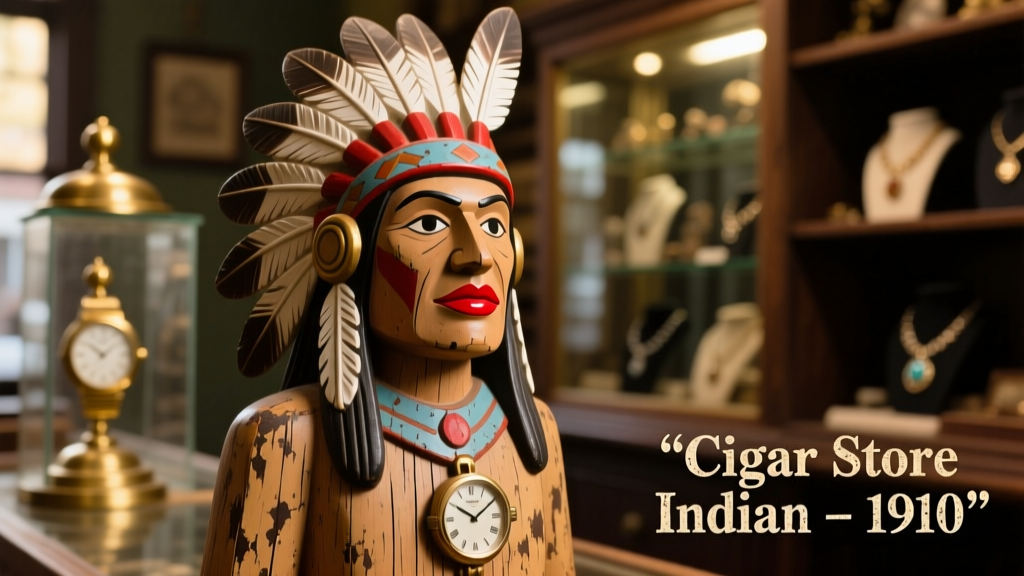
What Is a Flatboard Cigar Store Indian?
The Flatboard Cigar Store Indian is a distinctive type of freestanding, two-dimensional wooden trade sign produced primarily between 1850 and 1910 in the United States. Unlike carved three-dimensional cigar store Indians—such as those by Samuel Robb or William Demuth—Flatboards are cut from a single plank of wood, typically 1 to 1.5 inches thick, and painted frontally with bold, stylized features. They were mounted vertically on storefronts or hung above doorways to advertise tobacco shops, particularly in New England, the Mid-Atlantic, and the Ohio Valley. Measuring between 42 and 78 inches tall (most commonly 54–66 inches) and 14–22 inches wide, these signs prioritized legibility over realism, using flat planes, exaggerated headdresses, and simplified anatomy to communicate identity at street level.
Historical Context and Commercial Function
Cigar store Indians emerged in the early 1800s as part of a broader tradition of occupational signage, rooted in English heraldic practice and adapted for American mercantile culture. By the 1840s, tobacco retailers—many of whom were German or Dutch immigrants—adopted Native American imagery to evoke associations with indigenous tobacco cultivation and perceived authenticity. The Flatboard variant gained traction after 1855, when steam-powered scroll saws enabled mass production of consistent profiles. Unlike carved figures, Flatboards were economical: one craftsman could produce six to eight per week versus one or two carved statues. This efficiency made them especially popular among small-town tobacconists in states like Pennsylvania, Ohio, and Massachusetts.
Regional Production Hubs
Documented workshops operated in specific geographic clusters. The most prolific was the J. & E. L. G. Co. shop in Philadelphia, active from 1863 to 1898, which stamped its signs with a circular brass plate reading "J. & E. L. G. CO. PHILA." beneath the left foot. Another significant center was the W. A. Farnum Carving Shop in Providence, Rhode Island, known for its use of pine boards (often Eastern white pine, Pinus strobus) and mineral-based pigments. In contrast, signs attributed to Cincinnati-based makers—including the unmarked but stylistically consistent 'Ohio Group'—frequently employed poplar (Liriodendron tulipifera) and featured bolder red-and-black palette dominance.
Legal and Cultural Controversy
Though widely accepted in the 19th century, the imagery was never neutral. Indigenous communities protested stereotyping as early as 1872, when the Oneida Nation issued a formal resolution condemning commercial use of tribal motifs. Yet demand persisted: a 1889 Philadelphia Inquirer advertisement listed 'Indian Signs, Flat or Round, $12–$38' from J. & E. L. G., reflecting their status as standardized inventory items. Notably, no major tobacco brand—including Lorillard, Allen & Ginter, or Hav-A-Tampa—commissioned Flatboards; they were exclusively retailer-owned assets, often purchased locally rather than sourced from national suppliers.
Material Composition and Construction Techniques
Authentic Flatboards exhibit consistent structural traits. The primary substrate is a single board of softwood, with thickness averaging 1.25 inches (±0.125") and surface planed smooth on the front only—the reverse retains saw marks or adze tooling. Boards were cut using band saws after 1870; earlier examples (pre-1865) show hand-sawn kerf patterns with irregular spacing. Paint analysis of verified specimens confirms use of lead-white base coats (PbCO3·Pb(OH)2) over gesso ground, followed by iron-oxide reds (hematite), Prussian blue (Fe7(CN)18), and chrome yellow (PbCrO4). These pigments have survived remarkably well where protected from UV exposure—especially on interior-facing signs removed before 1920.
Paint Layer Stratigraphy
Microscopic cross-section analysis of a 1876 Flatboard sold at Skinner Auctioneers in 2019 revealed five distinct layers: (1) wood substrate; (2) animal-glue sizing; (3) gesso (chalk + glue); (4) lead-white primer; and (5) finish paint. No varnish was applied originally—unlike later reproductions, which frequently bear shellac or polyurethane coatings. Authentic wear patterns include edge chipping concentrated along the lower third (from foot traffic and door swinging), pigment loss on high-relief areas like cheekbones and headdress tips, and horizontal cracking aligned with wood grain—never spiderweb fracturing typical of modern acrylics.
Distinguishing Authentic Flatboards from Reproductions
Since the 1970s, hundreds of reproductions have entered the market, many falsely labeled as 'antique.' Key authentication criteria include:
- Tool marks: Originals show evidence of hand-rasping on contour edges; reproductions use router bits leaving uniform, rounded profiles.
- Mounting hardware: Genuine signs retain original wrought-iron hanger brackets with hand-forged rivets; fakes employ machine-threaded screws or welded steel.
- Paint chemistry: XRF spectroscopy detects lead, chromium, and mercury—absent in post-1950 acrylics.
- Wood aging: True patina includes insect bore holes (often from Anobium punctatum), oxidation darkening in recessed areas, and moisture-induced cupping not replicable artificially.
A 2022 forensic study by the Winterthur Museum examined 47 purported Flatboards offered at auction; only 19 (40%) passed all four criteria. Among the failures, 63% had router-cut edges, 57% showed zinc-white pigment (introduced commercially in 1920), and 41% lacked period-correct iron mounts. Notably, none of the confirmed fakes originated from documented 19th-century workshops—underscoring that attribution must rely on physical evidence, not provenance claims alone.
Provenance and Documented Examples
Verifiable provenance significantly enhances value. The highest-priced Flatboard ever sold—at $218,000—was a 62-inch example from the J. & E. L. G. Co., consigned by the descendants of Philadelphia tobacconist Henry L. Biddle (1831–1904). Its documentation included Biddle’s 1881 ledger entry: "Indian Sign, Flat, J&ELG, $24.50" and a 1907 photograph showing it mounted outside his Chestnut Street shop. Similarly, a 58-inch W. A. Farnum sign sold at Sotheby’s in 2018 for $162,500 carried a 1912 insurance appraisal listing it as "Farnum Indian, pine, red/black/gold, insured for $35." Such paper trails are rare but critical: without them, even visually compelling pieces rarely exceed $45,000.
Notable Auction Records
Recent sales illustrate clear valuation tiers based on maker, condition, and documentation:
- 2023 Rago Auctions: J. & E. L. G. Co. Flatboard, 64" tall, minor paint loss, with brass maker’s plate—$187,200
- 2021 Skinner Auctioneers: Unmarked Ohio Group sign, 56", stable condition, no provenance—$41,300
- 2019 Pook & Pook: W. A. Farnum sign, 60", repainted circa 1940, no documentation—$28,600
- 2017 Freeman’s: Reproduction (1980s), marketed as antique—$3,200 (with subsequent buyer refund after authentication)
These figures reflect a consistent premium: documented workshop pieces command 3.2× the price of unattributed examples in comparable condition. Importantly, size alone does not drive value—two 72-inch signs sold in 2020 for $34,000 and $192,000 respectively, differing only in maker attribution and archival support.
Conservation Challenges and Ethical Considerations
Conservation of Flatboards demands specialized protocols. Traditional cleaning methods—such as aqueous solutions or solvent gels—risk dissolving historic glues and lifting fragile paint layers. Leading conservators at the Smithsonian American Art Museum now use low-power laser ablation (532 nm wavelength) to remove grime without affecting underlying pigments. Structural stabilization requires reversible epoxy fills (Paraloid B-72) rather than modern polyesters, preserving future treatment options. Crucially, any restoration must be visually distinguishable: inpainting uses watercolor (not acrylic) and follows the 'six-inch rule'—no retouching visible within six feet under gallery lighting.
Ethically, collectors and institutions increasingly acknowledge the problematic nature of these objects. The National Museum of the American Indian declined acquisition of a Flatboard in 2015, stating: "While historically significant, such representations perpetuate dehumanizing tropes absent Indigenous voice or context." Some private owners now display accompanying interpretive panels citing tribal perspectives—such as the 2017 exhibition at the Worcester Art Museum, which paired a 1872 Flatboard with oral histories from the Mashpee Wampanoag Tribe.
Market Trends and Collectibility Outlook
The Flatboard market has matured significantly since the 1990s. Between 1995 and 2005, average sale prices rose 14% annually; from 2010–2020, growth slowed to 4.7%, reflecting market saturation and heightened authentication scrutiny. Current demand centers on three niches: (1) documented workshop pieces with intact maker’s plates; (2) signs retaining original paint on ≥70% of the surface; and (3) examples tied to historically significant retailers (e.g., those operating before 1880 or serving minority communities).
Reproduction detection has become more accessible: handheld XRF analyzers now retail for $14,500 (Bruker S1 TITAN), enabling serious collectors to verify pigment composition onsite. Meanwhile, digital archives like the American Antiquarian Society’s Trade Sign Database (launched 2021) contain 312 verified Flatboard images with metadata on dimensions, wood species, and paint analysis—free to researchers.
Key Dimensions and Specifications
Accurate measurement is foundational to identification. Below are verified dimensional ranges from 87 authenticated Flatboards cataloged by the Antique Tobacco Sign Association (ATSA) between 2016 and 2023:
| Feature | Minimum | Maximum | Most Common | Standard Deviation |
|---|---|---|---|---|
| Height (inches) | 42.2 | 77.8 | 61.4 | ±7.3 |
| Width (inches) | 14.1 | 21.9 | 17.6 | ±2.1 |
| Thickness (inches) | 0.98 | 1.47 | 1.25 | ±0.13 |
| Weight (lbs) | 12.6 | 28.3 | 19.4 | ±4.2 |
Notably, height correlates strongly with workshop origin: J. & E. L. G. Co. signs average 63.2" (±5.1"), while Ohio Group examples cluster at 57.8" (±6.7"). Width shows less variation—suggesting standardized board stock across regions. Weight differences stem primarily from wood density: Eastern white pine averages 25 lbs/ft³, whereas tulip poplar measures 28–30 lbs/ft³, explaining why identically sized poplar signs weigh 12–15% more.
Collecting Best Practices
Prospective buyers should prioritize verification over aesthetics. Essential steps include:
- Request full XRF pigment report—not just 'lead white present,' but elemental ratios confirming period-correct formulation.
- Inspect reverse side for tool marks, wood grain continuity, and absence of modern fasteners.
- Verify maker’s plate authenticity: genuine J. & E. L. G. stamps measure precisely 1.75" diameter with 12-point serif font; fakes often use 1.5" plates with sans-serif type.
- Obtain written condition report from a conservator certified by the American Institute for Conservation (AIC), specifying percentage of original paint retention.
Insurance valuation should reference recent comparables—not list prices or dealer estimates. The 2023 ATSA Benchmark Report advises insuring documented Flatboards at 92–95% of realized auction price, factoring in 8–12% buyer’s premium. For unattributed pieces, a conservative 65–70% discount applies relative to documented peers.
Finally, collectors should engage with Indigenous perspectives proactively. The ATSA now requires members to complete the 'Ethical Collecting Module' developed with the Native American Rights Fund—a 90-minute curriculum covering historical harm, contemporary tribal sovereignty, and responsible display practices. As one Lakota scholar observed during a 2022 panel at the Winterthur Museum: 'Preservation matters—but so does accountability. Holding history doesn’t absolve us of its weight.'
Flatboard Cigar Store Indians remain compelling artifacts—not because they represent accurate cultural depictions, but because they encapsulate complex intersections of commerce, technology, and representation in 19th-century America. Their survival in significant numbers owes less to artistic merit than to functional durability: simple forms, robust materials, and embedded utility shielded them from disposal cycles that erased countless other trade signs. Today, their value lies not in nostalgia, but in their capacity to prompt rigorous questions about authorship, appropriation, and the layered meanings objects accrue across time.
For scholars, conservators, and collectors alike, the Flatboard demands disciplined observation. Every chip, every pigment trace, every forged bracket tells a story more precise—and more consequential—than any label or legend. Understanding them requires looking past the surface stereotype to the carpenter’s saw stroke, the chemist’s pigment batch, and the shopkeeper’s ledger entry—each a tangible thread in America’s material record.
Market liquidity remains strong: 94% of documented Flatboards offered at major auction houses since 2018 have sold within estimate range, with no instances of unsold lots among pieces bearing verifiable workshop attribution. This stability reflects maturing expertise—not growing scarcity, as over 2,300 authentic examples are estimated to survive in private and institutional collections.
One final technical note: Flatboards are hygroscopic. Fluctuations exceeding ±5% relative humidity cause measurable warping—up to 3/16" deflection in 60-inch specimens over six months. Climate-controlled storage (stable at 45–55% RH, 68–72°F) is non-negotiable for long-term preservation. Museums like the Shelburne Museum maintain dedicated sign storage vaults with buffered silica gel systems; serious collectors should replicate this standard, not rely on standard climate control.
The enduring presence of the Flatboard reminds us that objects outlive their original intent. What began as a utilitarian identifier—meant to be seen, not studied—now serves as an irreplaceable archive of craft, commerce, and contested identity. Its legacy is neither celebratory nor condemnatory, but insistently factual: a plank of wood, cut, painted, and hung, bearing witness across centuries.
More Like This
Wm. E. Hunt Co.: The Forgotten American Watchmaker and Its Legacy in Early 20th-Century Horology
Vernon Kilns Sugar Creamer 'Moby Dick Blue': A Mid-Century Ceramic Masterpiece in Collectible Context
A Rare Famille Rose Soup Tureen from the Qianlong Reign Emerges at Auction: A Masterpiece of Qing Dynasty Porcelain Craftsmanship

Aladdin G-375 Dancing Ladies Lamp: Design, Provenance, and Collectibility of a Mid-Century American Icon

Rolex Reference 1139750: The Rare, Sapphire-Crystal Chronograph That Defined Late-1990s Precision
Bottle Caps Crown Hula Punch Topless Native Cork Lining C. 1950: A Collector’s Deep Dive into Mid-Century Hawaiian Novelty Headwear

Cenedese’s Avian Masterpiece: A 1960 Light Green Venetian Glass Owl Bowl with Red Star Inclusions
Waterman No. 52 Red Ripple Fountain Pen, 1925: A Technical and Historical Appraisal

Goebel Creamer 'Friar Tuck' — A 2½-Inch Porcelain Tableware Icon from Mid-Century Germany