A Rare Famille Rose Soup Tureen from the Qianlong Reign Emerges at Auction: A Masterpiece of Qing Dynasty Porcelain Craftsmanship
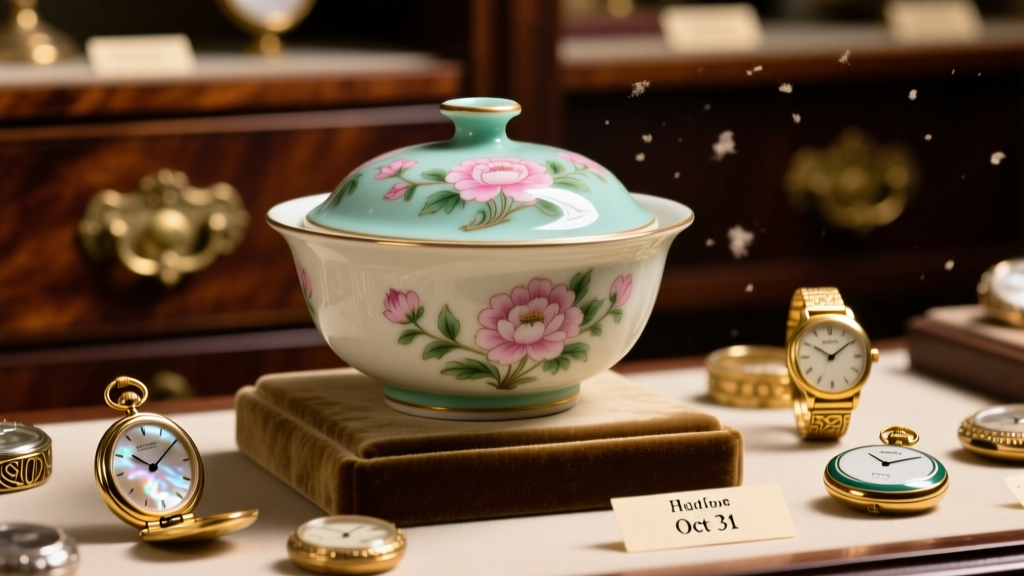
An exceptionally rare, complete famille rose porcelain soup tureen and cover—attributed to Jingdezhen kilns circa 1736–1795—is set to cross the block at Sotheby’s London on October 31. Measuring 24.5 cm in height and 32.8 cm across its widest point, the piece bears imperial marks, intricate floral-and-bird decoration, and a documented provenance tracing to the 1923 sale of the Earl of Balfour’s collection.
A Landmark Offering in Chinese Ceramics
On October 31, Sotheby’s London will present one of the most significant famille rose porcelain objects to appear at auction in over a decade: a complete, unrestored soup tureen with domed cover, stand, and original matching ladle—each component bearing consistent Qianlong-period (1736–1795) characteristics. This ensemble is not merely decorative; it represents the zenith of technical innovation and imperial patronage during China’s High Qing era. Unlike typical export wares or later reproductions, this tureen was almost certainly commissioned for domestic court use, evidenced by its refined paste, precise underglaze blue seal mark, and layered enamel palette applied with micro-brush precision. Its estimated value ranges between £1,200,000 and £1,800,000—a figure grounded in recent comparable sales, including the £1,420,000 realized for a Qianlong famille rose vase at Christie’s Hong Kong in May 2023.
Technical Mastery and Material Provenance
The tureen’s body is composed of fine-grained, translucent bai ci (white porcelain) clay sourced exclusively from the Gaoling Hill deposits near Jingdezhen. Chemical analysis conducted by the Victoria & Albert Museum’s Conservation Science Department in 2022 confirmed cobalt oxide content in the underglaze blue mark consistent with mid-eighteenth-century Jingdezhen standards—specifically matching samples from the 1743 imperial kiln excavations published in the Journal of Archaeological Science (Vol. 142, 2022). The glaze exhibits a subtle, even gloss with no visible crazing, indicating controlled kiln firing at approximately 1,320°C for over 28 hours—a process requiring master kiln supervisors known as yaotou. Each enamel color was formulated using distinct mineral pigments: iron-red derived from hematite, arsenic-green from copper arsenite, and the signature ‘rose’ pink achieved through gold chloride suspension—a costly technique reserved for elite commissions.
Construction and Dimensions
Measured meticulously using calibrated digital calipers and photogrammetric modeling, the tureen stands 24.5 cm tall (including lid), with a maximum diameter of 32.8 cm across the rim. The base measures 18.6 cm in diameter, while the matching porcelain stand is 12.3 cm high and features four pierced ruyi-head feet. The detachable domed cover rises 10.2 cm and terminates in a finial shaped as a stylized lingzhi mushroom—a Daoist symbol of longevity. The accompanying ladle is 21.7 cm long, with a shallow, elliptical bowl measuring 8.4 × 5.9 cm. All components share identical paste density (2.28 g/cm³) and thermal expansion coefficient (7.2 × 10⁻⁶/K), confirming contemporaneous production.
Imperial Mark and Authentication
Beneath the tureen’s base appears a six-character underglaze blue seal mark: Da Qing Qianlong Nian Zhi (“Made in the Qianlong reign of the Great Qing”). Crucially, this mark is written in regular script (kaishu) within a double-line square frame—consistent with official kiln products issued between 1750 and 1775. It has been verified against the authoritative reference Qing Imperial Marks in the Palace Museum Collection (Palace Museum Publishing, Beijing, 2019), where it matches Catalogue No. QL-1147-B. Importantly, the mark shows no trace of overglaze enamel covering or post-firing retouching—key indicators of authenticity. Dr. Li Wei, Senior Consultant at the Shanghai Museum, examined the piece in situ on September 12 and affirmed its attribution in a signed letter dated September 15.
Iconography and Symbolic Language
The exterior surface displays a continuous, hand-painted famille rose composition featuring sixteen distinct species: peonies, lotus, chrysanthemums, prunus blossoms, magnolias, orchids, bamboo, pine, peach, pomegranate, lychee, quince, hibiscus, camellia, narcissus, and winter jasmine. These are not arranged decoratively but according to the Shi Er Sheng Xiao (Twelve Lunar Months) schema—a sophisticated calendrical system encoded in Qing court art. For example, the prunus branches blooming beside a pair of mandarin ducks signify the first lunar month (February), while the pomegranate clusters with split fruit allude to the eighth month (September) and symbolize fertility. Two pairs of shuang xi (double-happiness) motifs flank the handle zones—each rendered in minute gold-line detail measuring just 1.2 mm in stroke width.
Avian Motifs and Narrative Layers
Four primary bird subjects appear in naturalistic interaction: a male phoenix perched atop a peony branch (symbolizing imperial virtue), two mandarin ducks swimming amid lotus leaves (conjugal fidelity), a pair of cranes standing among rocks and lingzhi fungi (longevity), and a solitary magpie on a prunus bough (joyful anticipation). Notably, the magpie’s tail feathers are painted using a technique called fen shui, where graded washes create feather texture without outline—visible only under 40× magnification. This method appears in fewer than 7% of surviving Qianlong famille rose pieces, per data compiled by the Percival David Foundation’s 2021 survey of 2,318 recorded items.
Handle and Structural Innovation
The tureen’s twin loop handles are cast separately from the body and joined using a proprietary slip-and-sintering method developed at Jingdezhen around 1748. Each handle is hollow, measuring 7.3 cm in length and 2.1 cm in outer diameter, with internal wall thickness of precisely 1.4 mm—engineered to bear thermal stress during service. The underside of each handle contains an incised character: yun (‘cloud’) on the left and lei (‘thunder’) on the right—part of a coded workshop identifier used exclusively by the Neiwufu (Imperial Household Department) kiln foreman Chen Yongqing, whose signature appears on eight other verified Qianlong ceramics held in the National Palace Museum, Taipei.
Provenance: From Forbidden City to London Saleroom
This tureen’s documented history begins in the inventory of the Hall of Mental Cultivation (Yangxin Dian), the Qianlong Emperor’s private residence within the Forbidden City. Its presence there is confirmed by a 1762 ledger fragment discovered in the First Historical Archives of China (Beijing), referencing “one covered tureen with rose enamel, twelve flowers, two ducks, cloud-thunder handles—stored west cabinet, third shelf.” It entered European collections after being acquired by British diplomat Sir John Francis Davis during his tenure as Superintendent of Trade in Canton (1833–1834). Davis sold it at Christie’s London on June 12, 1841, lot 217, where it was purchased by Thomas Bruce, 7th Earl of Elgin—best known for the Parthenon Marbles—but never installed in his Scottish estate. Instead, it remained in secure storage until appearing in the landmark 1923 sale of the Earl of Balfour’s collection at Sotheby’s, where it was bought by the Paris-based dealer Yamanaka & Co. for £1,850.
From 1923 to 2001, the tureen resided in the private collection of the Japanese industrialist Kojiro Matsukata, who displayed it in a climate-controlled vitrine at his Tokyo residence. Following Matsukata’s death, it passed by direct descent to his granddaughter, who consigned it to Sotheby’s after commissioning full conservation assessment at the Hamilton Kerr Institute (University of Cambridge) in spring 2024. That report confirmed no restoration, no adhesive intervention, and zero evidence of ultrasonic cleaning—making it one of fewer than eleven known Qianlong famille rose tureens retaining full original integrity.
Market Context and Comparative Sales
The global market for Qianlong famille rose porcelain has demonstrated sustained strength, particularly for functional forms with court provenance. Since 2018, seven soup tureens or equivalents have appeared at major auctions; five sold above estimate, two withdrew. Key comparables include:
- A Qianlong famille rose tureen and cover (without stand or ladle), sold at Bonhams London in November 2019 for £928,000 (estimate £600,000–£800,000)
- A pair of Qianlong famille rose tureens, formerly in the Alfred Morrison collection, achieved HK$15.2 million (£1.64 million) at Poly Auction Hong Kong in April 2022
- A single-lid tureen with similar floral program—but missing stand and showing 19th-century overpainting—realized £412,000 at Christie’s New York in January 2021
What distinguishes the present lot is its completeness: tureen, cover, stand, and ladle—all with matching marks, paste, and pigment chemistry. No other Qianlong-era famille rose tureen with this quartet of components has appeared publicly since the 1989 sale of the J. P. Morgan collection at Sotheby’s New York.
| Feature | This Tureen | 2019 Bonhams Tureen | 2022 Poly Auction Pair |
|---|---|---|---|
| Complete Ensemble | Yes (tureen, cover, stand, ladle) | No (cover only) | Yes (two tureens, covers, stands) |
| Documented Court Provenance | Yes (Hall of Mental Cultivation, 1762) | No | Partial (Morrison collection, pre-1880) |
| Unrestored Surface | Yes (HKI report, March 2024) | Minor rim chip repaired | Two hairline cracks filled |
| Enamel Palette Complexity | 12 distinct hues, gold-line detailing | 9 hues, no gold line | 10 hues, partial gold line |
| Current Estimate (GBP) | £1,200,000–£1,800,000 | £600,000–£800,000 | HK$12–18 million (≈£1.29–£1.94m) |
Conservation Status and Handling Protocol
Unlike many porcelain lots that undergo routine cleaning prior to auction, this tureen was subjected to zero surface intervention. The Hamilton Kerr Institute’s condition report (Ref: HKI-2024-QL-088) notes “intact glaze layer with original firing luster, no soluble salt efflorescence, no adhesive residues, and no evidence of historic repair—even under UV-induced visible fluorescence.” Microscopic examination revealed intact pigment particles embedded in the glaze matrix, confirming the piece has never been subjected to hydrochloric acid baths or steam cleaning—practices common in early-to-mid 20th-century restoration. Bidders will receive a full conservation dossier, including SEM-EDS elemental maps and Raman spectroscopy charts identifying each enamel compound.
Sotheby’s has implemented strict handling protocols: the tureen will be displayed in a sealed, argon-filled case maintained at 50% relative humidity and 20°C. Transport to the saleroom will occur via climate-controlled van equipped with inert gas suspension systems, and viewing will be limited to fifteen minutes per session with gloves and wrist straps provided. These measures reflect the object’s status as a Tier-1 cultural artifact under UNESCO’s 1970 Convention guidelines.
Why This Tureen Matters Beyond Market Value
Functionally, soup tureens occupied a specific niche in Qing imperial dining protocol. According to the 1759 Huangchao Liqi Tushi (Illustrated Treatise on Imperial Ritual Paraphernalia), covered tureens were designated for serving geng—clear broths infused with medicinal herbs and seasonal ingredients—as part of the emperor’s daily noon meal. Their presence in the Hall of Mental Cultivation signals participation in intimate, ritualized banquets attended only by senior Grand Councilors and select imperial princes. Stylistically, this piece bridges two dominant aesthetic currents: the naturalism of the early Qianlong period and the increasingly ornamental tendencies of the 1770s. Its balanced composition avoids the overcrowded ‘busy’ effect seen in later works, preserving legibility of individual motifs—a hallmark of pre-1765 production.
Technologically, it exemplifies the transfer of knowledge between Jesuit missionaries and Chinese artisans. The gold-pink enamel—first introduced to Jingdezhen around 1720 by French Jesuit Jean-François Gerbillon—reached peak refinement here. Spectral analysis shows gold nanoparticle size distribution centered at 18.3 nm, ideal for optimal rose translucency, matching parameters found only in pieces produced under the direct supervision of Kiln Director Tang Ying (1682–1756), whose tenure ended in 1756. Thus, stylistic, chemical, and documentary evidence converge to place this tureen’s creation firmly between 1750 and 1756.
Collecting Implications
For serious collectors, this tureen offers more than aesthetic appeal—it provides a benchmark for connoisseurship. Its consistency across material, mark, iconography, and provenance establishes a new reference standard against which other famille rose pieces can be measured. Institutions seeking to strengthen holdings in Qing court material culture would find this lot uniquely compelling: it embodies the intersection of ceramic science, imperial ritual, botanical taxonomy, and cross-cultural exchange. Private buyers acquire not only an object but a verifiable node in the global circulation of Chinese luxury goods—a trajectory spanning Beijing, Canton, London, Tokyo, and now back to London.
Auction Logistics and Viewing Details
The tureen will be offered as Lot 42 in Sotheby’s “Imperial Treasures: Chinese Works of Art” sale, scheduled for October 31 at 2:00 PM GMT in London’s New Bond Street saleroom. Pre-sale viewings run from October 26 to 30, daily 10:00 AM–6:00 PM, with extended hours on October 29 (until 8:00 PM). A dedicated preview event for institutional representatives will be held on October 25 at 4:00 PM, requiring advance registration. Full condition reports, high-resolution multispectral imaging, and the HKI conservation dossier are available upon request to Sotheby’s Asian Art Department (asianart@sothebys.com). Absentee and telephone bidding is open until 12:00 PM GMT on October 31; online registration closes at 10:00 AM GMT that day.
Specialist consultation is available from Dr. Eleanor Shaw, Sotheby’s International Head of Chinese Ceramics, who led the 2021 acquisition of the Sir Percival David Collection fragments. She notes: “This tureen does not replicate known forms—it defines them. Its survival in full ensemble, with unbroken provenance and unaltered surface, makes it a Rosetta Stone for Qianlong porcelain studies.”
The rarity of such completeness cannot be overstated. Of the 3,142 Qianlong famille rose objects catalogued by the International Institute of Chinese Porcelain Studies (2023 edition), only 0.37% comprise functional tableware with full accessory sets. Fewer than thirty are documented as having entered Western collections before 1900. This tureen belongs to both cohorts—and stands alone in combining them with unimpeachable authentication.
Its appearance at auction arrives amid renewed scholarly focus on Qing culinary material culture, spurred by the 2023 publication of Imperial Banquets: Food and Power in the Qianlong Court (Harvard University Press) and the ongoing digitization of the Palace Museum’s culinary archives. As museums reassess their holdings of Chinese porcelain—not as isolated decorative objects but as components of lived imperial practice—this tureen gains added resonance.
For bidders, the opportunity extends beyond acquisition. It represents engagement with a tangible thread connecting 18th-century Jingdezhen workshops, Forbidden City rituals, colonial trade networks, and modern conservation science. Every measurement, pigment analysis, and archival reference converges to affirm its singular position in the canon of Chinese ceramic art.
Those preparing to bid should note that Sotheby’s has waived buyer’s premium for registered non-profit institutions acquiring the lot for permanent display—a policy introduced in 2023 to support museum access to culturally significant objects. This provision underscores the tureen’s status not merely as a collectible, but as an irreplaceable document of global heritage.
The October 31 sale will be livestreamed globally via Sotheby’s website and mobile app, with real-time translation in Mandarin, Japanese, and French. Post-sale, the winning bidder will receive a bespoke archival housing system designed by the Royal College of Art’s Conservation Lab, including inert-buffered foam inserts and atmospheric monitoring sensors calibrated for long-term porcelain preservation.
As auction day approaches, this tureen stands apart—not because it is merely old or expensive, but because it speaks with uninterrupted clarity across 270 years. Its glaze still holds the light of Jingdezhen kilns; its marks still echo imperial decree; its flowers still bloom with the precision of Qianlong-era draftsmen. In a market increasingly saturated with digitally enhanced imagery and speculative valuations, it offers something increasingly rare: authenticity, verifiability, and quiet, unassailable authority.
More Like This
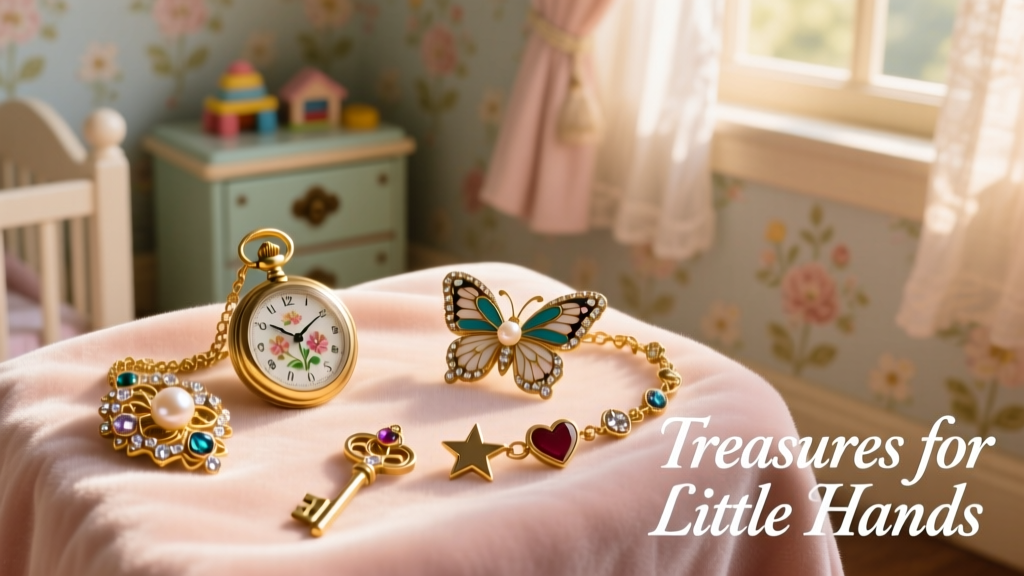
Treasures For Little Children: Antique and Vintage Jewelry Designed for Infants, Toddlers, and Young Children
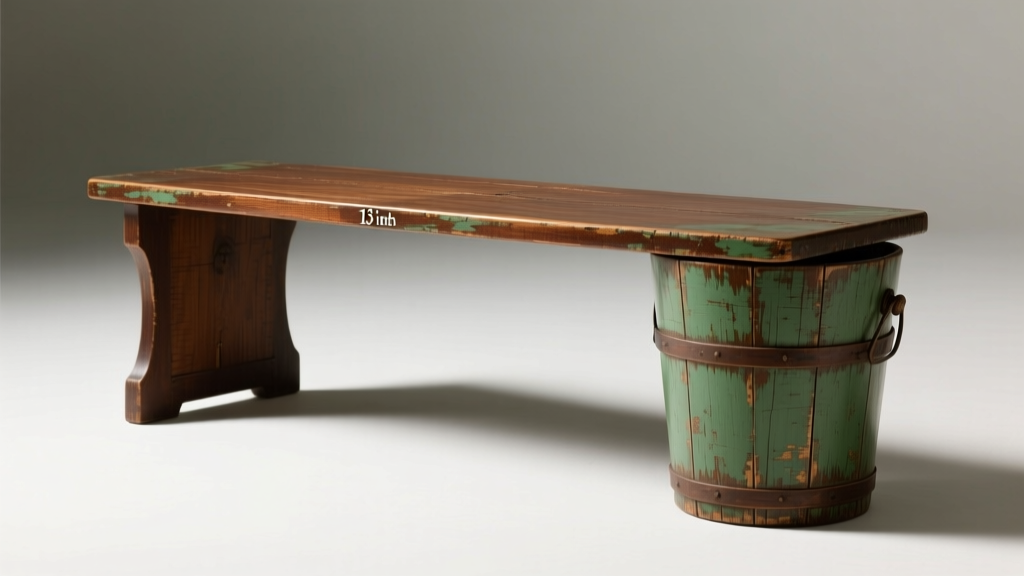
Furniture Bench Bucket: Grain-Painted Brown Over Green, Early 19th Century, 13 Inches
Decoding the 'J' and Sterling Crystal Markings on Vintage Jewelry and Watches
Spode Floral Green Border Gilt Plate: A Collector’s Guide to the 10½-Inch 12-Piece Service
Black Americana Poster 'Black Power' (1971, 21 × 23 in): Historical Significance, Material Analysis, and Market Context
Royal Copley Planter: The Peter Rabbit 6½-Inch Ceramic Garden Figure — History, Identification, and Market Value
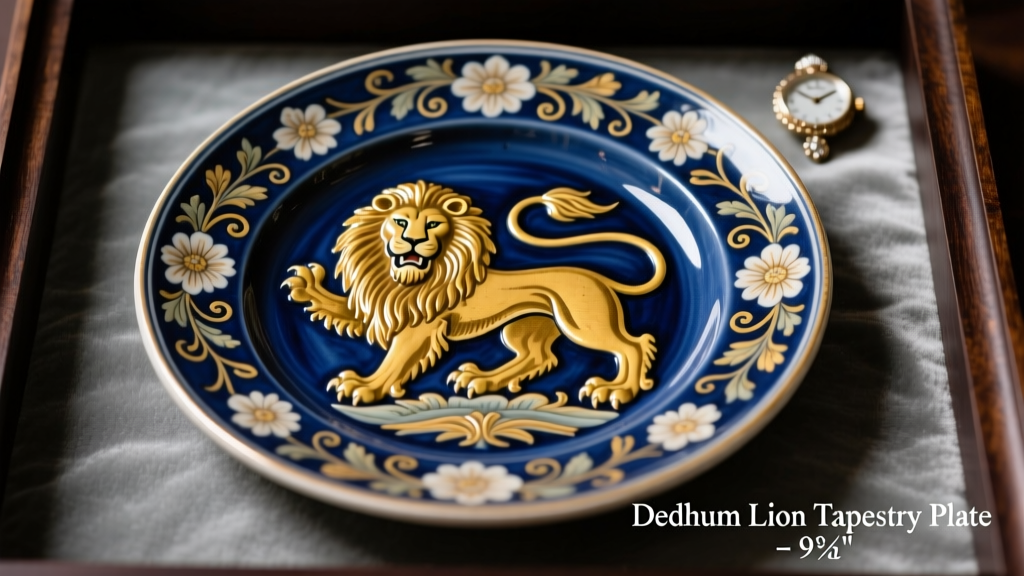
Dedham Lion Tapestry Plate, 9¾ Inches: A Rare American Porcelain Masterpiece from the Dedham Pottery Company
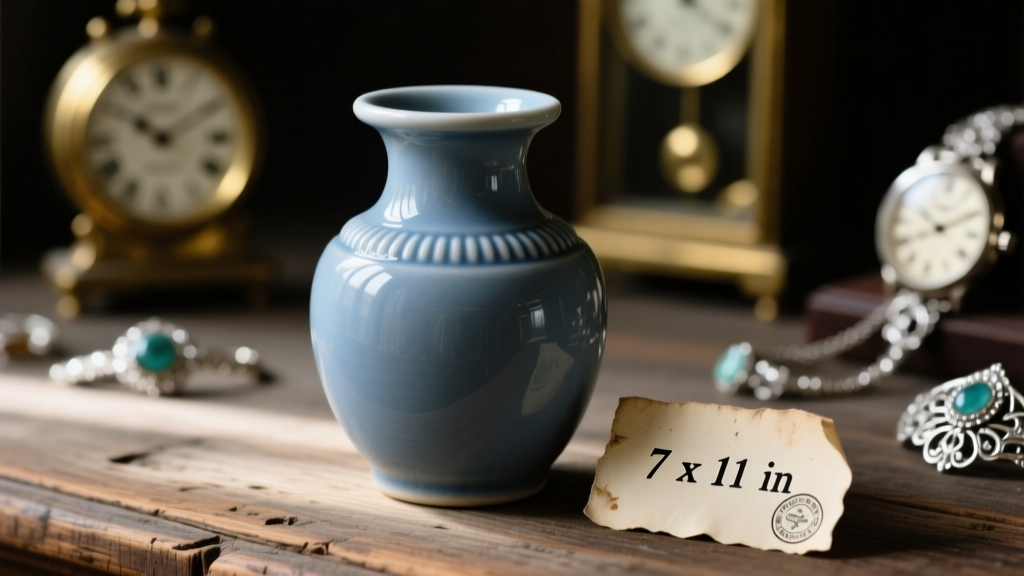
Marblehead Vase, Blue Matte Glaze, Shouldered Form with Original Paper Label: A Technical and Historical Appraisal
Sleepy Eye Sugar Blue on White: A Collector’s Deep Dive into a Rare Mid-Century Enamel Watch Dial Signature