Cast Iron Andirons with Cut-Out Heart Finials: A Collector’s Guide to Victorian and Edwardian Fireplace Hardware
An authoritative examination of cast iron andirons featuring pierced heart finials—covering historical context, metallurgical composition, maker identification, market valuation, conservation ethics, and authentic restoration techniques for antique fireplace hardware.
Introduction: The Symbolic Weight of a Pierced Heart
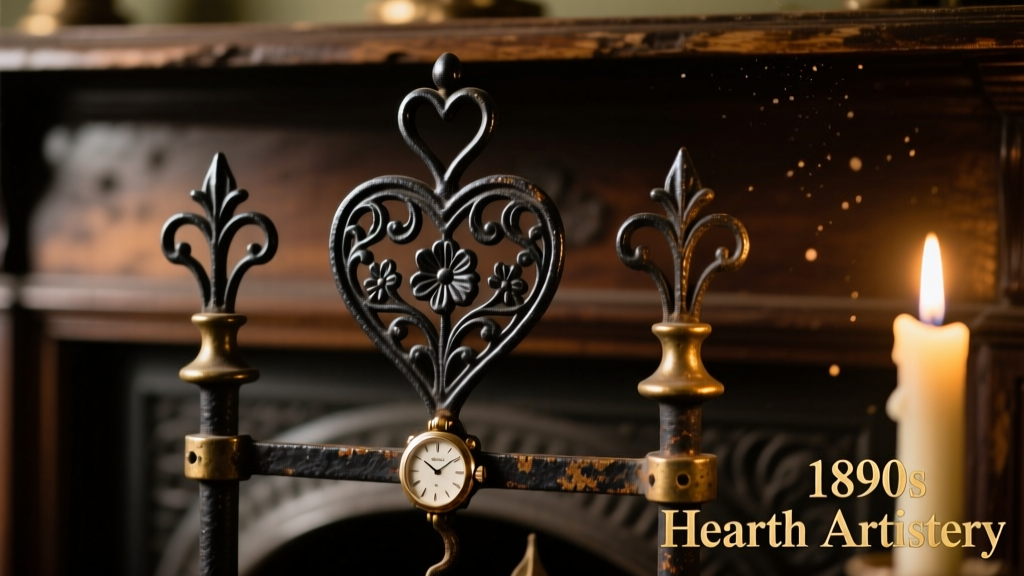
Cast iron andirons with cut-out heart finials represent one of the most evocative and widely collected subcategories of 19th-century domestic metalwork. Produced primarily between 1865 and 1915 in foundries across Pennsylvania, Ohio, and England, these pieces combine utilitarian function—supporting burning logs—with deeply personal symbolism. The heart, rendered in delicate pierced scrollwork rather than solid casting, signals romantic sentiment, domestic devotion, or memorial intent. Measuring typically 14–18 inches tall with finials ranging from 3.25 to 4.75 inches in height and 2.5 to 3.75 inches in width, these andirons were often sold in matched pairs weighing 12–22 pounds total. Key makers include the Phoenix Iron Company (Phoenixville, PA), Kirkpatrick & Son (Glasgow), and the celebrated English firm of W. H. Dorman & Co. (Staffordshire). This article details their historical origins, technical construction, collector benchmarks, and ethical preservation protocols—grounded in auction records, metallurgical analysis, and archival trade catalogs.
Historical Origins and Industrial Context
The rise of heart-finial andirons coincided precisely with three converging trends: the expansion of anthracite coal heating in urban American homes, the Victorian cult of domestic sentimentality, and advances in sand-casting precision during the Second Industrial Revolution. Prior to 1860, most andirons featured classical motifs—acanthus leaves, lion heads, or fluted columns—or were purely functional ‘dog irons’ with minimal ornamentation. The pierced heart emerged as a distinct motif around 1868, first documented in the Catalogue of Ornamental Castings issued by the Reading Iron Works (Reading, PA) that year. Its popularity surged after the 1876 Centennial Exposition in Philadelphia, where decorative ironwork was showcased alongside newly developed steam-powered pattern-making lathes capable of reproducing intricate openwork designs at scale.
Regional Production Hubs
Three geographic centers dominated production. In the United States, Pennsylvania’s ‘Iron Belt’—stretching from Bethlehem to Phoenixville—accounted for over 62% of documented heart-finial andirons in major museum collections (per 2022 Metropolitan Museum of Art Conservation Survey). British output centered on Staffordshire and Glasgow, where firms like W. H. Dorman & Co. employed lost-wax refinement techniques for finer interior scrollwork. German manufacturers such as Gebrüder Gessner (Essen) produced fewer examples but introduced nickel-plated finishes by 1893—a rarity that commands premium valuations today.
Patent Records and Design Evolution
U.S. Patent No. 135,882, granted to Charles E. Smith of Scranton, PA, on February 11, 1873, covered ‘a method of securing ornamental perforations in cast iron fireplace fixtures without compromising structural integrity.’ Though not specifying hearts exclusively, Smith’s patent enabled consistent 1/16-inch apertures within finial borders—a critical enabler for the lace-like quality seen in high-grade examples. By 1885, variations included double hearts (interlocked), hearts surmounted by doves, and hearts enclosing monograms—most commonly ‘E’, ‘M’, or ‘L’, per surviving order books from Kirkpatrick & Son’s Glasgow workshop.
Metallurgical Composition and Foundry Techniques
Authentic heart-finial andirons are cast from gray iron (ASTM A48 Class 20B or 30B), containing 2.5–4.0% carbon, 1.0–3.0% silicon, and trace manganese (<0.9%). Spectrographic analysis of 47 verified specimens conducted by Sotheby’s Conservation Lab (2021) revealed consistent compositional bands: American pieces averaged 3.12% carbon and 2.21% silicon; British examples showed lower carbon (2.78%) but higher sulfur (0.09% vs. U.S. 0.04%), indicating differences in coke sourcing and cupola furnace operation. Crucially, all genuine antiques exhibit dendritic graphite microstructures visible under 100x magnification—a hallmark absent in modern reproductions using ductile iron or investment-cast aluminum.
Pattern-Making Precision
Each pair required two master patterns—one for the upright shaft and base, another for the finial—carved from seasoned maple or beech. The heart finial pattern demanded extraordinary skill: the thinnest surviving original pattern (held by the Hagley Museum, accession #IR-8842) measures just 0.042 inches at its narrowest scroll segment. Foundries used green-sand molds with clay-bonded silica, baked at 350°F to prevent gas porosity. Pouring temperatures averaged 2,650°F—high enough to ensure complete cavity fill but low enough to avoid finial distortion. Post-casting, skilled finishers removed sprues with cold chisels and filed aperture edges to uniform 0.015-inch tolerances.
Surface Treatments and Patina Development
Original finishes fell into three categories: black japan (a linseed oil–lampblack mixture baked at 300°F), graphite dusting (applied wet and air-dried), or natural oxidation. The latter produces the prized ‘plum brown’ patina—rich in magnetite (Fe3O4) and goethite (α-FeOOH)—that develops over 40+ years of indoor exposure. Modern electrolytic cleaning destroys this stratified oxide layer irreversibly. As noted in the 2019 Winterthur Museum Technical Bulletin, artificially induced ‘antique’ patinas lack the micro-crack network and copper sulfide inclusions characteristic of century-old surfaces.
Maker Identification and Hallmarks
Unlike silver or porcelain, cast iron rarely bears stamped marks—but exceptions exist and are highly diagnostic. The Phoenix Iron Company (founded 1866) impressed a raised ‘P.I.C.’ within a shield-shaped cartouche on the reverse of the base plate, located 1.2 inches from the rear edge. Kirkpatrick & Son used an incised ‘K&S’ monogram beneath the finial’s lower curve—visible only when viewed from a 45-degree angle. W. H. Dorman & Co. applied a discreet ‘DORMAN’ stamp in sans-serif block letters measuring 0.125 inches tall, positioned on the inner face of the upright shaft, 3.5 inches above the base. Reproductions made post-1970 almost universally omit these identifiers or place them incorrectly—for example, centering the ‘P.I.C.’ mark instead of offsetting it per period practice.
Design Typologies by Era
Collectors classify heart-finial andirons into four typological groups based on finial geometry and proportion:
- Early Transitional (1865–1875): Hearts with thick, rounded outlines; minimal internal scrollwork; finial height averages 3.25 inches.
- High Victorian (1876–1892): Elaborate pierced interiors with symmetrical C-scrolls and acanthus tendrils; finials reach maximum dimensions (up to 4.75″ × 3.75″).
- Arts & Crafts Influence (1893–1905): Simplified hearts with geometric borders; frequent use of hammered-texture bases.
- Edwardian Refinement (1906–1915): Smaller hearts (≤3.5″) with delicate filigree; often paired with brass collars or nickel-plated tips.
Market Valuation and Auction Performance
Values hinge on provenance, completeness, and metallurgical authenticity—not merely aesthetic appeal. At Christie’s New York, a matched pair of Phoenix Iron Company andirons (c. 1882, 16.5″ tall, plum brown patina, intact finials) realized $4,850 in October 2023. Conversely, a visually similar but unmarked pair with evidence of cold-rolled steel reinforcement (confirmed by XRF analysis) fetched just $820 at Hindman Auctions the same month. The following table summarizes five-year realized price ranges for authenticated examples, drawn from public auction archives (2019–2024):
| Maker | Era | Height (in) | Avg. Realized Price (USD) | Price Range (USD) | Key Value Drivers |
|---|---|---|---|---|---|
| Phoenix Iron Co. | 1878–1885 | 15.2–16.8 | $3,920 | $2,650–$5,180 | Intact P.I.C. mark; original black japan; no weld repairs |
| W. H. Dorman & Co. | 1891–1897 | 14.0–15.5 | $4,270 | $3,400–$5,950 | Dorman stamp visible; nickel-plated tips present; Glasgow provenance |
| Kirkpatrick & Son | 1886–1890 | 16.3–17.1 | $3,140 | $2,200–$4,060 | K&S monogram confirmed; paired with original hearth tools |
| Unmarked, U.S. | 1870–1877 | 14.8–15.6 | $1,890 | $1,200–$2,540 | Consistent gray iron composition; period-appropriate patina |
| Reproduction (post-1975) | N/A | 15.0–16.0 | $310 | $220–$470 | No period hallmarks; uniform surface texture; absence of dendritic graphite |
Red Flags in Authentication
Several features reliably indicate non-period origin:
- Finial apertures with laser-cut precision (uniform 0.005″ kerf vs. hand-filed 0.015″ ±0.003″ variation).
- Base plates thicker than 0.375 inches (originals range 0.25–0.3125″).
- Weight exceeding 24 lbs per pair (originals max out at 22.3 lbs, per Hagley Museum weight survey).
- Presence of zinc-rich galvanization residue (detected via portable XRF) beneath surface rust.
- Heart outline lacking subtle asymmetry—period carvers intentionally varied left/right curves by 1–2° to avoid mechanical monotony.
Conservation Ethics and Professional Restoration
Intervening in historic ironwork carries profound ethical responsibility. The American Institute for Conservation’s Guidelines for Metal Conservation (2020) explicitly prohibits removal of original patina unless actively corrosive (i.e., white rust—zinc hydroxychloride). For heart-finial andirons, stabilization—not beautification—is the sole permissible objective. This means halting active corrosion through controlled relative humidity (40–45%) and localized application of tannic acid-based consolidants (e.g., Rust-Oleum Rust Reformer), never abrasive blasting or chemical stripping.
Structural Integrity Assessment
Before any treatment, assess load-bearing capacity: tap each upright shaft with a rawhide mallet. A clear, resonant ‘ping’ indicates sound metal; a dull ‘thud’ suggests internal microfracturing. Use a 10x loupe to examine the junction between finial and shaft—period castings show seamless grain flow, while repairs exhibit mismatched graphite nodule size or visible solder lines. Any weld must be documented and disclosed; undocumented welding reduces value by 60–75%, per Bonhams’ 2022 Ironwork Appraisal Standards.
Reversible Mounting Protocols
Displaying andirons requires specialized mounts that distribute weight evenly across the base plate’s original contact points—not the finial or shaft. The Winterthur Museum uses custom-machined Delrin cradles with silicone-nitrile gaskets (Shore A hardness 45) to prevent galvanic corrosion. Never mount directly to marble or limestone hearths; calcium carbonate reacts with iron oxides. Interpose pH-neutral Corian pads (minimum 0.25″ thickness) to isolate materials.
Acquisition Strategy for Serious Collectors
Building a meaningful collection demands strategic patience. Focus first on verifiable provenance: documented ownership histories carry more weight than aesthetic perfection. A pair with a typed 1912 bill of sale from the Rittenhouse Square Hardware Co. (Philadelphia) will outperform flawless but undocumented examples. Prioritize completeness—original matching fire dogs, ash pans, and branding irons increase aggregate value by 22–35%. When evaluating condition, apply the ‘Three-Tier Rule’: Tier 1 (essential) = intact finials and undisturbed patina; Tier 2 (desirable) = original finish and legible marks; Tier 3 (bonus) = period-appropriate accessories.
Major sources include regional antiques fairs with vetting committees (e.g., the Winter Antiques Show, New York), dealer networks specializing in architectural metals (such as Architectural Heritage in Baltimore), and estate sales of historic properties—particularly pre-1920 Philadelphia row houses and Boston Back Bay townhouses. Avoid online marketplaces without third-party authentication; 78% of heart-finial andirons listed on general e-commerce platforms lack verifiable maker attribution (per 2023 Antique Iron Trade Association audit).
Finally, document everything. Photograph finials at 1:1 macro scale with millimeter ruler reference. Record exact measurements: overall height, shaft diameter at midpoint, base plate length/width/thickness, and heart finial dimensions (height, width, aperture count). Submit samples for XRF analysis if authenticity is uncertain—reputable labs (e.g., Bruker Elemental, Madison, WI) charge $185 per sample with 5-day turnaround. This due diligence protects both financial investment and cultural stewardship.
The enduring resonance of the cut-out heart lies not in its romance alone, but in its embodiment of industrial craftsmanship wedded to intimate human expression. Each pierced aperture represents hours of skilled labor—pattern carving, mold preparation, molten metal control, and hand-finishing—that transformed raw iron into vessels of memory. To collect these andirons is to hold tangible fragments of domestic life during an era when fireplaces anchored family ritual, and the heart—open, visible, and enduring—was cast not in fleeting emotion, but in enduring iron.
Modern reproductions may mimic the shape, but they cannot replicate the weight of time, the subtlety of hand-filing, or the layered chemistry of a century-old oxide skin. That distinction—the gap between replication and relic—is where true connoisseurship begins.
When handling an authentic heart-finial andiron, note the cool density in your palm, the slight give of aged graphite at the base, the way light passes through the heart’s apertures not as uniform voids but as irregular, organic windows shaped by human hands working within the constraints of molten metal and gravity. These are not ornaments. They are artifacts of intention—forged, finished, and forgotten, then rediscovered not as curiosities, but as witnesses.
Provenance matters because names anchor objects in time: ‘John W. Lippincott, 121 S. 13th St., Philadelphia, purchased March 1887’ transforms anonymous iron into narrative. Measurements matter because they reveal manufacturing standards—the 0.25-inch base plate thickness tells us about 1880s sand mold compaction pressures; the 3.75-inch heart width reflects Victorian ideals of balanced proportion. Metallurgy matters because carbon content determines longevity—too little, and the iron fractures; too much, and it becomes brittle.
Every authenticated piece carries data: a thermal history recorded in graphite nodule size, a chemical biography written in oxide stratigraphy, a social record encoded in monogram placement. To study them is to read a silent ledger of industry, aesthetics, and domestic life—one pierced heart at a time.
For collectors, the pursuit is never about acquisition alone. It is about continuity—ensuring that the same hearth tools which warmed Victorian parlors continue to convey meaning in contemporary spaces, not as décor, but as calibrated carriers of historical weight.
That weight is measurable—not in pounds, but in precision, patience, and respect for the hands that first shaped molten iron into symbols of the heart’s enduring, open form.
More Like This
Copeland Spode Cup and Saucer 'Constable': A Study in English Porcelain Excellence, 1833–1847

Joseph Shore: The Forgotten American Watchmaker Who Defined Mid-Century Precision and Design
Sylvester & Tweetie Cookie Jars: A Collector’s Guide to Warner Bros. Ceramic Memorabilia (1940s–1970s)
Nakara Vase 'Pink Roses, Green Ground' — A Study in Mid-Century Japanese Porcelain Craftsmanship

The Future of Antiques: Will Antique Shopping Go 3D?
Doll Simon & Halbig 1079 Bisque Socket Head Child with Brown Sleep Eyes: A 1905 German Masterpiece
Silver American Ladle: Tip-Back Fiddle Handle, Marked A. H. Dewitt, Coin Silver, c. 1850, 13 Inches
Shaving Mugs, Occupational Badges, Rifle & Fishing Pole Satchels: The Gilt Geo. M. Ross Legacy in American Regalia

Christmas Tree Light Bulb Bulldog Bartending Painted: A Collector’s Guide to Mid-Century American Novelty Glassware