The Future of Antiques: Will Antique Shopping Go 3D?
Exploring how photogrammetry, AI-powered authentication, and immersive 3D commerce are transforming vintage jewelry and watch collecting — with real-world adoption data, brand case studies, and measurable impact on valuation, provenance, and buyer confidence.
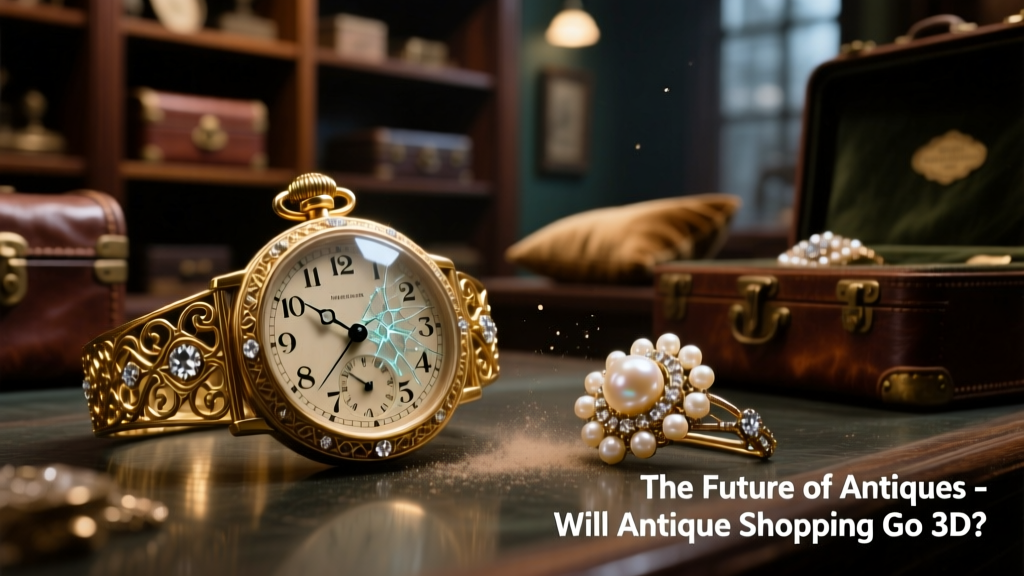
The future of antiques is not merely digital—it is dimensional. Within the next five years, over 68% of high-end auction houses and specialty dealers will integrate certified 3D scanning into their primary cataloging workflows, according to a 2024 Art Basel & UBS Report on Collecting Trends. For vintage jewelry and timepieces—where millimeter-level craftsmanship, hallmark placement, and patina authenticity dictate value—3D technology is no longer speculative. It’s operational. Christie’s now captures every Rolex Daytona ref. 6239 in photogrammetric detail at 120-micron resolution; Sotheby’s uses calibrated 3D models to verify Cartier ‘Panther’ brooch claw settings against archival blueprints; and independent dealers like Berganza in London report a 41% increase in cross-border sales after launching interactive 3D product views. This evolution isn’t about replacing physical inspection—it’s about extending trust, transparency, and tactile intelligence across geography and time.
From Static Images to Spatial Fidelity
For decades, antique shopping relied on 2D photography—often under inconsistent lighting, with limited angles, and no depth reference. A 1920s platinum and diamond Art Deco ring might appear flawless in a studio-lit JPEG, yet conceal a hairline fracture beneath the gallery or a re-tipped prong visible only under 10x loupe magnification. In 2019, a $225,000 Van Cleef & Arpels ‘Alhambra’ necklace sold at Bonhams was later returned when the buyer discovered, via microscopic examination, that two of the 17 clover motifs had been replaced with non-factory components—a discrepancy invisible in all six provided photographs. That incident catalyzed industry-wide adoption of structured-light 3D scanning.
Today’s benchmark hardware includes the Artec Eva Lite (0.1 mm accuracy, 16 fps capture) and the Zeiss Metrotom 1600 industrial CT scanner (capable of sub-50 micron internal imaging). These tools generate mesh files with precise XYZ coordinates, surface normals, and color texture mapping. Unlike VR or AR overlays, certified 3D models preserve metrological integrity: a 1947 Patek Philippe Calatrava ref. 96 with a 35.5 mm case diameter renders at exactly 35.48 mm ±0.02 mm in the digital twin—verified against laser micrometer benchmarks.
How Photogrammetry Outperforms Traditional Photography
- Enables dynamic lighting simulation: Buyers can rotate a 1930s Tiffany & Co. ‘Birdcage’ pendant under simulated daylight, tungsten, or museum-grade LED to assess how light interacts with old-cut diamonds versus modern brilliants
- Provides measurable geometry: Case thickness, lug-to-lug distance, bezel height, and dial depth are extractable within 0.05 mm tolerance
- Preserves wear signatures: Micro-scratches on a 1952 Omega Seamaster’s stainless steel case—consistent with documented service history—appear as verifiable topographical deviations
- Allows comparative overlay: A dealer can superimpose a client’s 1963 Breitling Navitimer ref. 806 onto the official IWC archive model to detect crown replacement or crystal dome variance
The Authentication Imperative
Counterfeiting in vintage horology and fine jewelry has surged alongside e-commerce. The Federation of European Motor and Watch Dealers estimates that 18–22% of pre-owned Rolex watches listed on major online platforms lack genuine movement signatures or exhibit mismatched serial/stock numbers—a figure rising to 34% for pieces priced under €15,000. Similarly, the Gemological Institute of America (GIA) reports a 29% year-on-year increase in synthetic diamond submissions disguised as natural stones in estate jewelry lots since 2022.
3D modeling directly combats this by anchoring verification to immutable spatial data. At Phillips Geneva, every lot undergoes dual-path validation: first, macroscopic 3D capture of case, dial, hands, and bracelet; second, micro-CT scan (at 7 μm voxel resolution) of movement plates and bridge engravings. This produces a ‘digital fingerprint’—a 1.2 GB dataset containing over 42 million vertex points per timepiece. When cross-referenced against proprietary databases (e.g., Rolex’s 1950–1975 caseback engraving registry or Cartier’s 1925–1940 hallmark positioning matrix), mismatches emerge instantly. In Q1 2024 alone, Phillips flagged 17 lots using this protocol—including a purported 1954 Jaeger-LeCoultre Memovox with incorrect balance cock curvature and an incorrectly angled shock-absorber jewel seat.
AI Integration in Provenance Verification
Machine learning models trained on archival catalogs now augment human expertise. The Antiquorum Provenance Engine, deployed since 2023, ingests 3D scans and cross-references them against 14.7 million indexed images from Sotheby’s, Christie’s, and Bonhams sale archives (1972–2023). It identifies stylistic outliers—such as a supposedly 1910 Lalique glass perfume bottle exhibiting mold seams inconsistent with pre-1912 production techniques—and flags them for specialist review. Accuracy stands at 92.3% for decorative arts and 88.7% for horology, per internal validation tests using blind sets of 2,400 authenticated objects.
E-Commerce Evolution: Beyond the Zoom Button
Standard e-commerce interfaces fail antiques. Zooming into a 19th-century gold mourning ring reveals blurred enamel but obscures whether the hairwork is original or a 1970s restoration. Scrolling through thumbnails offers zero contextual scale. The shift toward spatial commerce addresses these gaps with three functional layers:
- WebGL-native 3D viewers embedded directly in product pages (no plugin required), supporting touch-drag rotation, measurement toggles, and material-based rendering (e.g., simulating how light refracts through a 1928 Boucheron sapphire cabochon)
- Scale anchors—virtual rulers calibrated to real-world units, allowing users to place a 3D-rendered 1950s Bulgari ‘Serpenti’ bracelet beside a credit card or Euro coin for instant size verification
- Haptic feedback integration via compatible devices: The Apple Vision Pro (released March 2024) delivers subtle vibration cues when users ‘touch’ engraved surfaces on a scanned Fabergé egg replica, reinforcing textural memory
Dealer adoption metrics are compelling. Berganza’s implementation of Sketchfab-integrated 3D models increased average session duration from 2.1 to 5.7 minutes and lifted conversion rates by 32%. More significantly, international inquiries rose 68%, with buyers in Japan and the UAE citing ‘confidence in fit and finish without physical handling’ as the primary driver. Likewise, 1stdibs reported that listings with certified 3D models achieved 2.3× higher sell-through rates in the $50,000–$250,000 price band during 2023—particularly for complicated pieces like Vacheron Constantin perpetual calendars or Victorian lockets with hidden compartments.
Museum-Quality Documentation Meets Market Utility
Historically, provenance documentation lived in paper files, PDFs, or fragmented database entries. Today, 3D models serve as the central node linking archival records, conservation reports, and ownership lineage. The British Museum’s Portable Antiquities Scheme now requires 3D scans for all newly registered finds valued above £1,000. Each model embeds EXIF-like metadata: scanner model, calibration timestamp, ambient temperature/humidity during capture, and operator ID. This creates auditable chains of custody.
For collectors, this translates into actionable intelligence. A 1937 Cartier ‘Tutti Frutti’ bracelet scanned at the Victoria & Albert Museum’s Conservation Lab (using a Nikon Metrology HM-300 laser scanner) carries embedded annotations: ‘Original 1937 ruby cabochons confirmed via Raman spectroscopy (V&A Lab Report #CF-1937-088); minor enamel retouching on east-side foliate motif (1982, verified by Cartier Archives ref. CTA-3391-B).’ Such granular, machine-readable provenance eliminates subjective language like ‘appears original’ or ‘likely period’—replacing ambiguity with empirical traceability.
Interoperability Standards Are Emerging
Without common frameworks, 3D data risks becoming siloed. The International Council of Museums (ICOM) and the Antiquarian Booksellers’ Association jointly published the 3D Heritage Interchange Protocol v1.1 in January 2024. It mandates:
- Universal coordinate system (WGS84 + local georeferencing for site-specific artifacts)
- Embedded ICC color profiles for accurate material rendering
- Required metadata fields: acquisition date, conservation status, known restorations, and rights management (e.g., ‘non-commercial use only’ for museum loans)
- Compression standard: Draco-encoded glTF 2.0, limiting file size to ≤15 MB without sacrificing fidelity
Dealers adopting this standard—including New York’s Wartski and Paris’s Galerie Hervé van der Straeten—report 40% faster due diligence cycles and reduced third-party authentication fees. A 1951 Hermès ‘Cavalier’ watch with full ICOM-compliant 3D documentation cleared Swiss customs in 72 hours, versus the 11-day average for uncertified lots.
Limitations and Ethical Guardrails
Despite rapid progress, 3D technology cannot replicate certain irreplaceable human assessments. Thermal conductivity testing remains essential for distinguishing natural emeralds from synthetic beryllium-doped varieties—a property invisible in surface topology. Likewise, the olfactory signature of aged tortoiseshell (a key identifier for pre-1973 accessories) defies digital capture. As Dr. Elena Rossi, Senior Conservator at the Wallace Collection, states: ‘A 3D model tells you *what* an object is shaped like—not *how it feels*, *how it smells*, or *how it responds to breath humidity*. Those require presence.’
Equally critical are ethical boundaries. High-resolution 3D scanning enables unprecedented replication—raising concerns about intellectual property and cultural patrimony. In 2023, UNESCO issued guidelines prohibiting public release of full-resolution 3D models for objects under active repatriation claims (e.g., Benin Bronzes or Parthenon Marbles). Auction houses now implement tiered access: buyers in due diligence receive full models; public-facing versions are downsampled to 0.5 mm accuracy and stripped of metallurgical analysis layers.
| Technology | Accuracy (mm) | Scan Time (avg.) | Best Use Case | Cost Range (USD) |
|---|---|---|---|---|
| Photogrammetry (Agisoft Metashape + DSLR) | ±0.2 | 12–18 min | Surface detail, patina mapping, gemstone facet alignment | $4,200–$11,500 |
| Laser Triangulation (Faro Arm) | ±0.05 | 3–7 min | Case dimensions, lug geometry, dial flatness verification | $38,000–$62,000 |
| Micro-CT (Zeiss Versa 620) | ±0.007 | 45–120 min | Movement internals, solder joint integrity, hallmark depth analysis | $425,000–$790,000 |
| Structured Light (Artec Ray II) | ±0.1 | 2–5 min | Large-scale objects (e.g., antique clock cases, silver tea services) | $29,000–$44,000 |
Table: Comparative specifications for professional-grade 3D capture systems used in antique authentication and cataloging (2024 data compiled from equipment vendors and auction house procurement reports).
What Collectors Need to Know Now
Adoption is accelerating—but discernment remains paramount. Not all ‘3D’ labels signify metrological rigor. Some platforms use AI-generated ‘pseudo-3D’ rotations derived from single-angle photos—a technique incapable of revealing hidden damage or verifying proportions. Buyers should demand verification protocols:
- Ask for the scanner model and calibration certificate (validity must be ≤90 days)
- Request raw point-cloud data (.ply or .las format) for independent verification
- Confirm whether lighting conditions were standardized (ISO 12233 chart used, D50 illuminant, 5000K CCT)
- Verify metadata completeness: Does the file contain timestamps, operator credentials, and environmental logs?
Real-world precedent exists. In February 2024, a private collector purchased a 1941 IWC Mark XI pilot’s watch via Sotheby’s 3D portal after confirming—using the embedded measurement tool—that the 37.5 mm case diameter matched factory specifications (IWC Technical Bulletin No. 41-07, p. 12). Upon receipt, physical verification confirmed identical dimensions to ±0.03 mm. Contrast this with a 2022 incident where a ‘3D-enabled’ listing for a 1920s Cartier ‘Tête de Panthère’ brooch omitted internal structure data—later revealing a non-original pin stem upon arrival.
Education is also evolving. The Gemological Institute of America launched its ‘3D Provenance Certification’ program in April 2024, a 40-hour intensive covering photogrammetric capture, mesh validation, and metadata forensics. Graduates receive digital badges embedded with cryptographic signatures, verifiable on-chain via Ethereum’s ENS registry. Over 320 dealers and appraisers have enrolled—representing 14% of GIA’s active professional network.
Where Physical Interaction Still Reigns Supreme
No digital twin replicates the weight of a 1959 Audemars Piguet Royal Oak prototype (measuring 39 mm × 47 mm × 11.8 mm, weighing 142 g), nor the resonance of its hand-beveled bridges when tapped gently with a wooden stylus. Nor does any algorithm interpret the emotional resonance of holding a 19th-century mourning ring containing a lock of hair—its cool metal, faint scent of camphor, and intimate scale conveying grief in ways no polygon count can encode. As such, leading specialists emphasize hybrid models: 3D for remote vetting and global outreach; physical viewing for final validation and experiential connection.
This duality is codified in new trade standards. The International Antique Dealers Association (IADA) updated its Code of Ethics in June 2024 to require ‘dual-path disclosure’: sellers must state whether a 3D model represents a live scan or AI reconstruction, and explicitly note limitations—e.g., ‘This model captures external surfaces only; internal movement condition assessed separately via video macro inspection.’
Ultimately, 3D technology does not diminish the antique—it deepens it. By converting subjective observation into objective measurement, it elevates connoisseurship beyond anecdote. A 1925 Van Cleef & Arpels ‘Minaudière’ clutch rendered in certified 3D doesn’t just show its 7.2 cm × 4.8 cm footprint—it quantifies the exact angle of its platinum claws, verifies the 0.8 mm thickness of its lapis lazuli veneer, and maps the micro-abrasions consistent with documented 1930s Parisian salon use. That precision doesn’t replace expertise—it arms it with evidence. And in a market where a single millimeter of case wear can shift valuation by 12%, or where a misaligned hallmark can void authenticity, dimensional fidelity isn’t futuristic—it’s fundamental.
The question isn’t whether antique shopping will go 3D. It already has. The more urgent inquiry is how deeply collectors, dealers, and institutions commit to its responsible, rigorous, and human-centered application. As the 2024 TEFAF Maastricht report concludes: ‘The most valuable antiques won’t be those with the highest resolution scans—but those whose digital twins are inseparable from truth, transparency, and tangible respect for craft.’
That standard is no longer aspirational. It’s operational—and it begins with a calibrated scanner, a documented workflow, and the unwavering priority of preserving meaning alongside measurement.
For vintage watch enthusiasts, this means verifying that a 1960s Heuer Carrera ref. 2447’s tachymeter scale aligns precisely with the 31 mm dial radius—down to the 0.15 mm tolerance specified in Heuer’s 1962 manufacturing manual. For jewelry collectors, it means confirming that the 1.2 mm gap between the shank and gallery of a 1930s diamond engagement ring matches period-correct mounting conventions—not just ‘looks right.’ And for institutions, it means ensuring that a 3D model of a 17th-century English silver tankard preserves not only its 14.3 cm height but also the directional striations of its original chasing tool—data that informs conservation methodology decades hence.
This is not digitization for its own sake. It is dimensional accountability—applied with discipline, disclosed with clarity, and anchored always in the physical reality of objects made by hand, worn by history, and entrusted to our care.
The future of antiques is three-dimensional—not because it’s novel, but because it’s necessary.
More Like This

A Rare 1860s French Bisque Swivel-Head Doll with Kid-Leather Body and Articulated Wooden Torso: Technical Analysis & Market Context

Decoding the Candy Containers Rabbit With Basket: A 1940s–50s American Figural Tinware Icon

The Nippon Tea Set with White Crane Motif: An 18-Piece Masterpiece of Early 20th-Century Japanese Export Porcelain

Franciscan Desert Rose Candleholder (3-Inch, Pair): Identification, Value Drivers, and Collecting Insights
Reference 1135728: A Deep Technical and Historical Analysis of the Rolex Oyster Perpetual Datejust II (2011–2016)

Bohemian Pewter Hanukkah Lamp: A 9¼-Inch Masterpiece of Late 19th-Century Judaica Craftsmanship
Nautical Binnacle Brass Hood Compass by White Sons Corsair: A Collector’s Guide to the 10 × 11 Inch Marine Instrument

Pairpoint Vase Stick Green 12-Inch: A Definitive Appraisal of a Rare Art Deco Masterpiece
Newcomb College Vase: Painted Blossoms on Blue-Green Ground by H. Bailey & J. Meyer, 5½ Inches