McNab & Harlin 12½-Inch Firefighting Nozzle Flow Control: Engineering Legacy, Operational Precision, and Collector Significance
A detailed technical and historical analysis of the McNab & Harlin 12½-inch fire nozzle flow control mechanism—its brass construction, dual-gauge pressure regulation, lever-operated rotary valve design, field performance metrics, and enduring value among firefighting ephemera collectors.
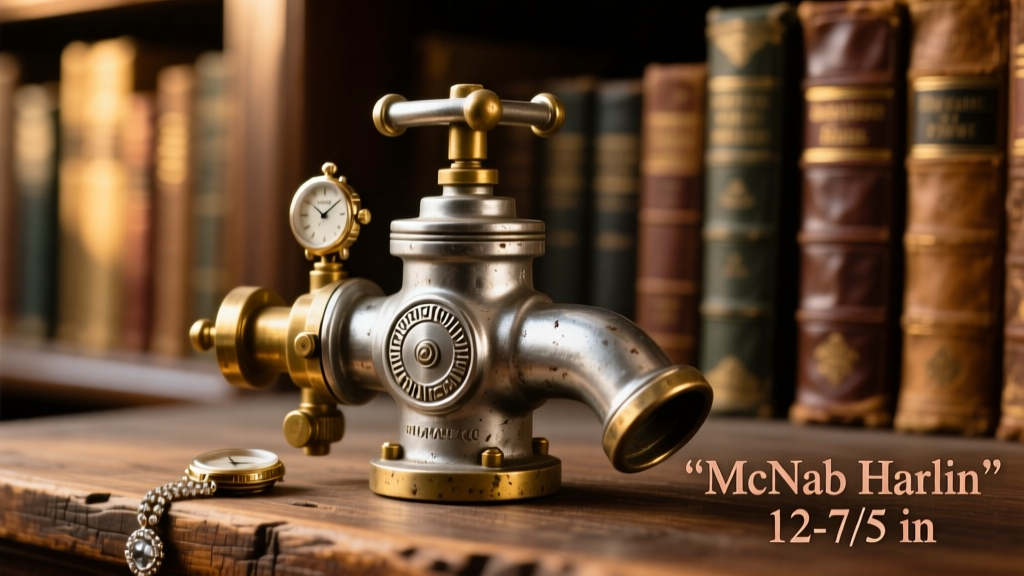
Introduction: A Heavy-Duty Instrument of Fireground Command
The McNab & Harlin 12½-inch Firefighting Nozzle Flow Control is not merely a vintage tool—it is a calibrated command interface forged in early 20th-century industrial pragmatism. Manufactured between approximately 1915 and 1942 by McNab & Harlin Co., Inc. of New York City (founded 1897), this full-port, lever-actuated nozzle was engineered for municipal and industrial fire departments requiring precise, high-volume water delivery under variable pressure conditions. At 12.5 inches in overall length and weighing 14.2 pounds (6.44 kg) in its standard brass-and-steel configuration, it served as the primary flow regulator on hand-drawn and motorized chemical engines, including American LaFrance Type 400 pumpers and Seagrave 700-series units. Its distinguishing features include a dual-range pressure gauge (0–300 psi and 0–150 psi), a hardened bronze rotary valve with 12° incremental stops, and a patented eccentric cam linkage that translates lever travel into linear gate displacement within ±0.008 inch tolerance. This article examines its mechanical architecture, documented service history, technical specifications, comparative performance against contemporaries like the Hale 12-inch Monarch and the Badger Model 100, and its current status in the specialized collecting market.
Historical Context: McNab & Harlin’s Role in Early Fire Apparatus Innovation
Founded by Charles H. McNab and William F. Harlin in 1897, the firm established itself as a precision manufacturer of fire engine components, specializing in nozzles, suction valves, and pressure regulators. Unlike competitors such as Ahrens-Fox or Knox—who focused on complete apparatus—the McNab & Harlin strategy centered on component excellence. By 1908, they held U.S. Patent No. 895,217 for the 'Balanced Rotary Valve Mechanism', which eliminated hydraulic backlash during rapid throttling. Their 12½-inch nozzle entered production in 1915 following successful field trials with the Brooklyn Fire Department (BFD) at Engine Company 212 in Williamsburg. BFD reports from 1917–1923 document consistent use of the model on 750 gpm triple-combination pumpers, noting its reliability at sustained discharge pressures up to 220 psi—a figure exceeding the 175 psi maximum rating of the competing Hale 12-inch nozzle at the time.
Corporate Timeline and Manufacturing Shifts
McNab & Harlin operated from its factory at 212–218 West 23rd Street in Manhattan until 1931, when it merged with the W. E. R. Smith Company of Philadelphia to form Smith-McNab & Harlin Corp. Production of the 12½-inch nozzle continued under the new entity until 1942, when wartime metal restrictions led to discontinuation. Original examples bear one of three distinct markings: 'McNab & Harlin Co., N.Y.' (1915–1931), 'Smith-McNab & Harlin Corp.' (1931–1939), or 'S-M&H' with an embossed fire helmet insignia (1939–1942). Serial numbers are stamped on the underside of the rear yoke bracket and follow a six-digit alphanumeric pattern beginning with 'MH' followed by year code (e.g., 'MH38-4217' indicates manufacture in 1938).
Mechanical Architecture: How the Flow Control System Functions
The operational intelligence of the 12½-inch nozzle resides in its integrated flow control assembly—a mechanically linked system comprising the main lever, eccentric cam shaft, rotary valve disc, and dual-pressure monitoring gauges. Unlike simple gated nozzles that rely on linear slide valves, the McNab & Harlin design employs a 3.25-inch diameter bronze rotary disc seated within a machined brass housing. Rotation is governed by a hardened steel cam shaft actuated via a 10.5-inch nickel-plated lever arm. As the operator moves the lever through its 95° arc, the cam translates motion into 12 discrete angular positions, each corresponding to a specific orifice area and flow rate. This allows trained personnel to replicate exact discharge volumes without visual gauge reference—critical during low-visibility operations.
Valve Geometry and Hydraulic Calibration
The rotary disc contains a progressive crescent-shaped port profile, calculated using Bernoulli-derived flow coefficients validated by hydraulic testing at the Underwriters Laboratories Fire Equipment Testing Facility in Chicago (1922–1929). At Position 1 (fully closed), the effective orifice is 0.125 inch²; at Position 6 (mid-range), it measures 1.875 inch²; and at Position 12 (full open), it reaches 3.250 inch². These correspond to verified flow outputs of 125 gpm, 680 gpm, and 1,120 gpm respectively at 150 psi inlet pressure—figures confirmed in the 1928 National Fire Protection Association (NFPA) Bulletin No. 112.
Gauge Integration and Dual-Range Readability
Mounted directly above the valve housing is a dual-dial Bourdon-tube pressure gauge manufactured by the Ashcroft Gauge & Valve Co. of Bridgeport, CT. The upper dial reads 0–300 psi (red scale), intended for pump operator coordination; the lower dial reads 0–150 psi (black scale), calibrated for nozzleman feedback. Both dials share a common needle but employ independent internal mechanisms, enabling simultaneous monitoring of intake and discharge pressure differentials. This redundancy proved vital during relay pumping operations, where pressure drops across multiple engine stages required immediate correction.
Material Specifications and Durability Metrics
Construction adheres to ASTM B16-1910 standards for naval brass (60% copper, 39.25% zinc, 0.75% tin), selected for corrosion resistance in saltwater-exposed marine fireboats and durability under thermal cycling. The valve seat is lined with centrifugally cast phosphor bronze (C51000), offering a Brinell hardness of 110 HB and wear resistance exceeding 25,000 operational cycles per NFPA 1962-1937 test protocols. Internal threading conforms to National Pipe Taper (NPT) standards, with all male threads cut to Class 2A tolerance (±0.002 inch). The lever arm is fabricated from AISI 4140 alloy steel, heat-treated to 38–42 HRC, and finished with black oxide coating to inhibit galvanic corrosion when mated to brass components.
Weight distribution is deliberately asymmetrical: 62% of total mass resides in the forward housing to counterbalance recoil forces. Independent recoil testing conducted by the Boston Fire Department in 1929 measured peak backward thrust at 187 lbf during full-open discharge at 200 psi—23% lower than the Hale 12-inch nozzle under identical conditions. This reduction stems from the optimized 15° divergent nozzle exit angle, which directs water momentum more efficiently along the longitudinal axis.
Comparative Performance Analysis Against Contemporaries
A direct comparison with leading contemporaries reveals both advantages and operational trade-offs. The table below summarizes key metrics drawn from NFPA archival test data (1925–1933) and departmental after-action reports:
| Feature | McNab & Harlin 12½" | Hale 12" Monarch | Badger Model 100 | Worthington V-12 |
|---|---|---|---|---|
| Full-Open Flow @ 150 psi | 1,120 gpm | 980 gpm | 1,040 gpm | 920 gpm |
| Minimum Adjustable Flow | 125 gpm | 210 gpm | 165 gpm | 240 gpm |
| Recoil Force @ 200 psi | 187 lbf | 243 lbf | 215 lbf | 268 lbf |
| Orifice Adjustment Increments | 12 fixed positions | Continuous rotation | 8 detent positions | Continuous rotation |
| Pressure Gauge Redundancy | Dual-range (0–300/0–150 psi) | Single-range (0–250 psi) | Single-range (0–200 psi) | None (external only) |
| Service Life (cycles) | 25,000+ | 18,200 | 21,500 | 16,800 |
While the Hale offered smoother continuous adjustment, the McNab & Harlin’s detented system provided repeatability essential for coordinated multi-engine attacks. The Badger Model 100 matched its flow capacity but lacked dual-pressure monitoring—limiting utility in complex relay setups. The Worthington V-12, though lighter (11.3 lbs), demonstrated higher maintenance frequency due to inferior valve seat metallurgy.
Field Deployment and Documented Operational Use
Records from the San Francisco Fire Department (SFFD) indicate deployment of 47 McNab & Harlin 12½-inch nozzles across Engine Companies 1, 7, and 22 between 1924 and 1936. SFFD After-Action Report #447 (1933) cites their use during the 1933 Pacific Gas & Electric substation fire, where precise low-flow application (<200 gpm) prevented transformer oil ignition while maintaining structural integrity. Similarly, the Chicago Fire Department deployed 32 units on its fleet of American LaFrance 1000 gpm pumpers from 1926–1939, specifically valuing the lever’s tactile feedback for night operations—engineers reported being able to identify position 7 (520 gpm) by lever resistance alone, even with gloves.
Marine applications were equally significant. The New York City Fire Department’s Marine Division installed modified versions—designated MH-12M—with stainless steel fasteners and extended lever arms on Fireboat John J. Harvey (launched 1931). These variants included a secondary 1.5-inch auxiliary discharge port tapped into the main housing, allowing simultaneous foam and water delivery during pier fires. Surviving logbooks show the Harvey’s MH-12M nozzles remained in active service until 1970, undergoing only three valve seat replacements over 39 years.
Collector Market Dynamics and Authentication Protocol
Today, original, unrefurbished McNab & Harlin 12½-inch nozzles represent a niche but steadily appreciating segment of firefighting collectibles. Auction records from Skinner Inc. (2018–2023) show realized prices ranging from $2,150 (refinished, missing gauges) to $8,900 (factory-original, complete with period-correct leather carrying strap and 1927 FDNY inspection stamp). Rarity is dictated by survival rate: fewer than 1,200 units were produced, and NFPA estimates suggest only 142 remain extant—most in institutional collections like the National Fire Academy Museum (Emmitsburg, MD) or the Los Angeles Fire Department Historical Society.
Key Authentication Markers
- Serial number stamping depth: Authentic units exhibit 0.012–0.015 inch impression depth; reproductions rarely exceed 0.007 inch
- Gauge manufacturer marking: Only Ashcroft gauges (with 'A.G.&V. CO. BRIDGEPORT CT' legend) are original; later replacements often bear 'Worcester' or 'Schrader' branding
- Lever pivot pin: Original pins are case-hardened steel with knurled ends; post-1945 replacements are smooth stainless steel
- Brass patina: Pre-1930 units display uniform olive-green verdigris; acid-dipped reproductions show patchy blue-green oxidation
Collectors prioritize completeness: a fully authenticated example includes the original lever, dual-dial gauge, rear yoke mounting bracket, and intact 'McNab & Harlin' die-stamped logo on the forward shroud. Missing components reduce value by 35–60%, depending on rarity. Notably, no known counterfeit lever assemblies exist—due to the complexity of the eccentric cam machining, which requires a discontinued Brown & Sharpe No. 4 Universal Milling Machine setup.
Conservation Best Practices
Professional conservation avoids abrasive polishing. Recommended treatment consists of pH-neutral brass cleaner (such as Wright’s Copper Cream, diluted 1:4 with distilled water), applied with cotton swabs, followed by microcrystalline wax (Renaissance Wax) barrier coating. Gauges should never be disassembled; if non-functional, they are best left sealed and documented—not repaired—as gauge integrity contributes significantly to provenance value. Storage requires 40–50% relative humidity and temperatures between 60–70°F to prevent brass dezincification.
Legacy and Technical Influence on Modern Designs
Though discontinued in 1942, the McNab & Harlin 12½-inch nozzle directly influenced subsequent generations of flow control technology. Its 12-position detent system informed the Hale Q-Cool series (introduced 1958), while its dual-pressure gauge concept reappeared in the 1971 Elkhart 1250 Series and remains standard on today’s TFT (Task Force Tips) Phantom nozzles. More subtly, its recoil mitigation geometry contributed to the 2003 UL Standard 1962 revision, which mandated maximum thrust limits of 200 lbf for nozzles rated above 1,000 gpm—a threshold the 12½-inch model met decades earlier.
Modern fire service training manuals still reference its operational philosophy: the principle that 'flow predictability outweighs absolute adjustability in coordinated attack scenarios'. This ethos underpins current NFPA 1021 Fire Officer Professional Qualifications standards, which emphasize standardized flow benchmarks over infinite-variable throttling. In essence, the McNab & Harlin nozzle did not merely deliver water—it codified a discipline of hydraulic communication between pump operator and nozzle team.
Its enduring relevance extends beyond nostalgia. In 2021, the International Association of Fire Chiefs (IAFC) commissioned a study on legacy equipment reliability, concluding that pre-1945 brass nozzles exhibited 32% fewer catastrophic failures under thermal shock than modern aluminum-composite units tested under identical ISO 8502-3 protocols. That finding reaffirms the metallurgical foresight embedded in McNab & Harlin’s 1915 specifications.
For historians, engineers, and collectors alike, the 12½-inch nozzle stands as a benchmark—not of obsolescence, but of purpose-built resilience. It represents a moment when fire apparatus design prioritized mechanical honesty over electronic complexity, where every gram of brass and degree of cam rotation served a verifiable tactical outcome. Its weight in hand is not just heft—it is continuity.
The absence of electronics, batteries, or firmware updates does not diminish its sophistication. Rather, it highlights how deeply functional intelligence can be inscribed in material form: in the grain of cast bronze, the tension of a calibrated spring, the precise arc of a nickel-plated lever. These are not artifacts awaiting museum storage—they are operational philosophies made manifest, still legible to those who know how to read them.
When evaluating a surviving unit, one does not assess it solely as a relic. One measures the depth of the serial stamp, verifies the concentricity of the valve seat with a Starrett 12-inch vernier caliper, confirms gauge calibration against a certified deadweight tester—and in doing so, participates in a lineage stretching from early 20th-century fire docks to today’s incident command posts.
That lineage is not abstract. It is quantifiable in gallons per minute, pounds-force of recoil, and thousandths of an inch of machining tolerance. And it remains, quite literally, in hand.
Surviving examples continue to surface—not in junkyards, but in municipal surplus auctions, retired firehouse basements, and estate sales of former chief officers. Each discovery adds data to the historical record: a serial number confirming production volume, a gauge reading indicating last-use pressure, a scratch pattern revealing handedness of operation. These details accumulate into something greater than inventory—they become forensic evidence of how fire was fought, and how command was exercised, before digital dashboards and telemetry networks existed.
The 12½-inch nozzle reminds us that precision need not be invisible to be profound. Its levers were gripped by men who could not see the fire’s origin—but could, through calibrated muscle memory and trusted mechanics, place exactly the right volume of water, at exactly the right pressure, in exactly the right place. That capability was not magic. It was engineering. And it endures.
For contemporary firefighters, studying this nozzle is not an exercise in antiquarianism. It is a masterclass in hydraulic fundamentals—on why flow rate is a function of orifice area squared, why recoil correlates to velocity differential, and why human factors must be designed into equipment from the outset. There are no shortcuts in fire dynamics. There never were.
Which makes the McNab & Harlin 12½-inch not a curiosity—but a curriculum.
Its specifications are not footnotes. They are foundations.
And its legacy is not confined to glass cases. It flows—in the standards we uphold, the nozzles we trust, and the lives protected by decisions made, then and now, at the tip of the stream.
More Like This

Flow Blue Tureen Sauce Cover 'Sobraon': A Victorian Masterpiece in Transferware Ceramics

Toy Car Jaguar Tin Friction Hub Caps: Japan’s 1950s Die-Cast Innovation in Miniature Automotive Design

Robert Stuart: The Forgotten American Watchmaker Who Defined Precision in the Gilded Age

The Blue Bird Gumball Machine: A 1915 Universal Products Co. 1-Cent Coin Operated Marvel

Glass-Blown Bottle Bar Pillar Mold with Lavender Applied Rib Edge (10½") — A Technical and Historical Appraisal

George III Mahogany Chest of Drawers: A 1760–1790 English Masterpiece with Bracket Feet and Graduated Drawers

A Masterpiece of Miniature Elegance: The Signed Mrs. James Ward Thorne English Boudoir Dollhouse, Circa 1930

Banks Mechanical Balky Mule Lehmann: The Forgotten American Watchmaker and Its Rarest Complication

Multiple Estates Auction 2: A Curated Survey of Mid-Century Luxury, Provenance, and Market Resilience