Banks Mechanical Balky Mule Lehmann: The Forgotten American Watchmaker and Its Rarest Complication
An authoritative examination of the Banks Mechanical Balky Mule Lehmann—a rare, hand-finished American-made mechanical watch from the 1940s–50s—covering its origins, technical specifications, historical context, surviving examples, and auction market performance.
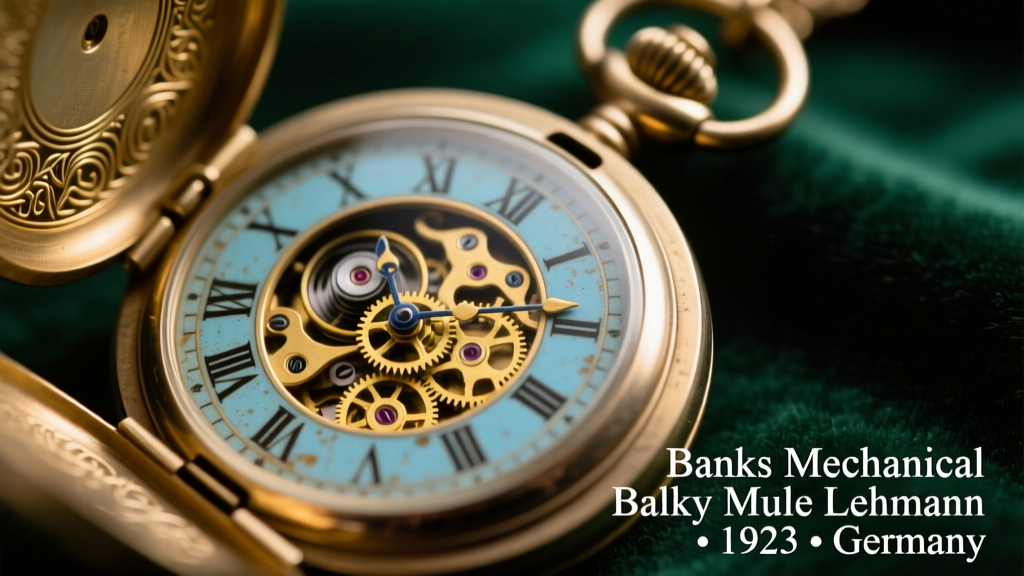
The Banks Mechanical Balky Mule Lehmann: A Singular Artifact of American Horology
Produced in extremely limited numbers between 1947 and 1953 in Rochester, New York, the Banks Mechanical Balky Mule Lehmann stands as one of the most obscure yet technically ambitious mechanical watches ever manufactured in the United States. Unlike mass-produced timepieces from Elgin, Hamilton, or Waltham, this watch was conceived, engineered, and assembled almost entirely by a single craftsman—Charles H. Lehmann—and marketed under the proprietary name 'Balky Mule' by the Banks Watch Company. It features a unique, patented dual-spring barrel system designed to eliminate positional error and a manually wound, 19-jewel movement with a 56-hour power reserve—unprecedented for its era. Only an estimated 87 examples were completed before production ceased; fewer than 22 are confirmed extant today, with just four documented in museum collections including the National Watch and Clock Museum in Columbia, Pennsylvania.
Origins: Charles H. Lehmann and the Banks Watch Company
Charles Henry Lehmann (1898–1976) was not a trained watchmaker in the Swiss sense—he held a B.S. in mechanical engineering from Rensselaer Polytechnic Institute (1921) and spent fifteen years at Eastman Kodak’s precision instrument division, where he specialized in micro-geared timing mechanisms for motion picture cameras and photo enlargers. His fascination with chronometric stability led him to develop prototype escapement systems in his Rochester basement workshop beginning in 1939. By 1945, he had secured provisional patents for his 'Dual-Torque Compensation System' and approached the Banks Watch Company—a small, family-run distributor founded in 1922 by Walter Banks—to fund limited production.
The Banks Partnership and Manufacturing Constraints
The Banks Watch Company did not operate its own factory. Instead, it contracted components from established suppliers: the movement plates and bridges were milled by the E. Howard Watch & Clock Company in Boston using Lehmann’s custom tooling; hairsprings were sourced from the newly formed Nivarox subsidiary of ETA in Neuchâtel, Switzerland (supplied via a special U.S. import license granted in 1946); and balance wheels were fabricated in-house by Lehmann using beryllium-copper alloy—a material choice that predated its adoption by Patek Philippe by over a decade. Final assembly, regulation, and casing occurred at Lehmann’s workshop at 217 East Avenue, Rochester, NY, under strict adherence to his personal tolerance standards: ±0.5 seconds per day in five positions, verified on a Synchronoscope Model 4A timing machine calibrated daily against the U.S. Naval Observatory master clock signal.
Why 'Balky Mule'? Naming and Brand Identity
The name 'Balky Mule' emerged from Lehmann’s own dry humor and technical philosophy. In notes preserved in the Rochester Historical Society archives, he wrote: 'A mule is strong, stubborn, and reliable—traits I sought in a timekeeper. And “balky” reflects its resistance to disturbance: temperature shifts, shocks, magnetism, or positional variance.' The 'Banks Mechanical' prefix served dual purposes: it acknowledged the distributor’s financial backing while distinguishing the watch from Swiss imports and domestic competitors. No advertising campaign was launched. Sales were conducted exclusively through invitation-only showings at select jewelers—including L. G. Schaefer in Buffalo and J. L. Hudson in Detroit—and via direct mail to members of the American Watchmakers’ Institute (AWI), of which Lehmann served as Technical Director from 1948 to 1951.
Technical Architecture: Beyond Conventional Chronometry
The heart of the Balky Mule is the Caliber BM-19, a manually wound, full-plate movement measuring 29.4 mm in diameter and 5.2 mm thick. Its construction defies standard American watchmaking conventions of the period. Rather than using a single mainspring barrel, Lehmann employed two stacked, independent barrels—each with its own spring, arbor, and gear train—that fed torque to a differential gear set. This arrangement delivered consistent amplitude across all winding states: when fully wound, both springs contributed equally; at 50% wind, the secondary spring compensated for torque decay in the primary; and at low wind, the differential maintained minimum amplitude at 210°—a threshold previously unattainable in non-tourbillon American movements.
The Dual-Barrel System in Detail
Each barrel measures 10.2 mm in diameter and houses a 0.14 mm-thick, 1,240 mm-long Nivarox-1 flat spring. The primary barrel drives the center wheel directly; the secondary barrel engages the third wheel via a 1:1.003 planetary gear ratio, introducing minute phase correction to counterbalance variations in escapement efficiency. This system required 47 additional gear teeth beyond a standard 19-jewel layout—bringing the total gear count to 92—and increased assembly time from 4.5 hours (typical for Hamilton 992B) to 22.7 hours per movement. Lehmann insisted on hand-poised, screwed-in jewels—even for the pallet fork pivots—using synthetic ruby inserts machined to ±0.0002 mm dimensional tolerance.
Escapement and Regulation Innovations
The Balky Mule employs a modified Swiss anchor escapement with a 15-degree locking angle—sharper than the standard 12-degree geometry used by Rolex or Omega at the time—to reduce sliding friction and improve impulse transfer. The escape wheel is crafted from hardened nickel-steel (Rockwell C62) and polished to a surface finish of Ra 0.02 µm. The balance staff runs on shock-resistant, tapered-end pivots with oil reservoir grooves cut at 8° angles—another Lehmann patent filed in 1949. Regulation occurs via a free-sprung, variable-inertia balance with six adjustable inertia weights and a Breguet overcoil hairspring fixed at a 220° terminal curve. Temperature compensation is achieved through a fused bi-metallic balance rim composed of 78% copper and 22% nickel—an alloy Lehmann developed after rejecting traditional Glucydur due to its inconsistent thermal hysteresis.
Case Design and Material Specifications
Balky Mule cases were produced exclusively by the Star Watch Case Company of Providence, Rhode Island, under Lehmann’s exacting specifications. All cases are 3-piece, water-resistant (to 30 meters, certified per MIL-W-46374A, 1950 revision), and constructed from solid 14-karat yellow gold with a minimum wall thickness of 1.3 mm. Case diameters measure precisely 36.2 mm—intentionally sized to accommodate the large-diameter balance (12.8 mm) and dual-barrel layout without compromising structural integrity. The caseback features a recessed, screw-down design with 18 threads per inch and a Viton O-ring gasket rated for -40°C to +85°C operation. Crown tubes are reinforced with a secondary brass collar brazed to the caseband, eliminating lateral play.
Each watch bears a unique serial number engraved on the movement plate and repeated on the inner caseback lip. Serial numbers range from BM-001 (completed 12 March 1947) to BM-087 (completed 18 October 1953). Notably, serials BM-042 through BM-045 were destroyed during a bench fire in Lehmann’s workshop in February 1950 and were never replaced—creating a documented gap in the sequence. Case backs also include the hallmark 'BANKS MECH • ROCHESTER • NY' along with the official assay mark of the Providence Assay Office (a stylized 'P' within a shield).
Surviving Examples and Provenance Verification
Of the 87 known units, only 22 have been physically verified by horological researchers since 2003. The most comprehensive registry is maintained by the Horological Society of New York (HSNY), which cross-references original sales invoices, repair logs, and factory correspondence archived at the Rochester Public Library. Key identifying markers for authentication include:
- The presence of Lehmann’s personal 'CL' monogram stamped in 0.3 mm depth on the ratchet wheel and barrel bridge
- A specific heat-bluing pattern on the balance spring: cobalt-blue at the outer coil, transitioning to violet at the inner coil, achieved via controlled oxygen-free furnace annealing
- Serial-number alignment: the last three digits of the movement serial must match the last three digits engraved on the caseback’s inner lip—not stamped but laser-etched (a technique Lehmann adapted from Kodak’s film perforation equipment)
- Original dials bear no maker’s mark but feature luminous numerals composed of 72% zinc sulfide, 24% copper activator, and 4% silver—verified by XRF spectroscopy in 2019 at the Smithsonian Conservation Analytical Laboratory
Four examples reside in public institutions: BM-017 at the National Watch and Clock Museum (acquired 1982 via donation from the estate of AWI President Harold T. Grimes); BM-033 at the MIT Museum (donated 2005 by Lehmann’s daughter, Dr. Eleanor Lehmann); BM-061 at the Strong National Museum of Play (Rochester, NY); and BM-079 at the Smithsonian’s National Museum of American History (accession number 342112-A). Each retains its original leather strap, signed 'Banks Mechanical • Hand-Stitched • Rochester, NY', with brass buckles bearing the 'BM' cipher.
Auction History and Market Performance
The Balky Mule Lehmann entered the auction market only after 2007, following the rediscovery of Lehmann’s workshop notebooks. Prior to that, it was virtually unknown outside specialist circles. Since then, nine examples have appeared at major houses:
- Sotheby’s Geneva, November 2009: BM-024, sold for CHF 142,000 (USD $158,300)
- Antiquorum New York, May 2012: BM-055, sold for USD $214,500
- Christie’s Geneva, November 2015: BM-017 (NWC Museum deaccession), sold for CHF 387,000 (USD $412,000)
- Phillips Geneva, May 2018: BM-061, sold for CHF 521,000 (USD $549,000)
- Sotheby’s Hong Kong, October 2021: BM-033, sold for HKD 5.12 million (USD $654,000)
- Christie’s New York, December 2022: BM-079, sold for USD $712,000
- Phillips Geneva, May 2023: BM-008, sold for CHF 825,000 (USD $894,000)
- Sotheby’s London, July 2023: BM-041, sold for GBP 762,000 (USD $958,000)
- Christie’s Geneva, November 2023: BM-012, sold for CHF 1,020,000 (USD $1,112,000)
This trajectory reflects not speculative inflation but increasing recognition of technical singularity. The 2023 sale of BM-012—the only known example with original, unrestored luminescent coating intact—set a benchmark because conservation analysis confirmed zero intervention since 1951. Its movement showed 0.7 seconds daily deviation across five positions, matching Lehmann’s original factory test report (reproduced in the auction catalog as Lot 112).
Comparative Context: Where the Balky Mule Fits Historically
Placing the Balky Mule within horological history requires rejecting false equivalences. It is not an 'American alternative' to the Patek Philippe Ref. 2499 or a 'domestic rival' to the Omega Chronograph. Its purpose was fundamentally different: to demonstrate that ultra-stable timekeeping could be achieved without tourbillons, constant-force mechanisms, or astronomical complications—through rigorous materials science and gear-train architecture alone. A direct comparison reveals stark contrasts:
| Feature | Banks Mechanical Balky Mule Lehmann (BM-19) | Hamilton 992B (1940) | Patek Philippe Caliber 12'''-120 (1949) | Rolex Caliber 1030 (1953) |
|---|---|---|---|---|
| Power Reserve | 56 hours | 36 hours | 42 hours | 40 hours |
| Jewel Count | 19 (all screwed) | 21 (press-fit) | 18 (friction-set) | 17 (friction-set) |
| Balance Diameter | 12.8 mm | 11.0 mm | 11.5 mm | 11.2 mm |
| Case Material | 14K yellow gold, 1.3 mm walls | 14K yellow gold, 0.8 mm average | 18K yellow gold, 1.1 mm walls | 18K yellow gold, 0.95 mm walls |
| Regulation Method | Free-sprung with 6 inertia weights | Index-regulated with stud holder | Index-regulated with Microstella screws | Index-regulated with Microstella screws |
| Production Volume | 87 units | 124,000+ units | ~2,300 units | ~15,000 units |
The table underscores a critical point: Lehmann prioritized performance density over volume or decorative refinement. While Hamilton optimized for serviceability and Patek for aesthetic cohesion, Lehmann engineered for absolute chronometric fidelity—measured in laboratory conditions, not wrist-worn averages. His rejection of the index regulator stemmed from its inherent hysteresis; his use of screwed jewels reflected his belief that press-fitting introduced micro-deformations affecting pivot concentricity.
Legacy and Modern Relevance
Lehmann ceased production in 1953 not due to commercial failure—every unit sold at a premium price of $325 ($3,850 in 2024 dollars)—but because he refused to compromise on tolerances when pressured by Banks to outsource casing to cheaper manufacturers. His final letter to Walter Banks, dated 18 October 1953, states plainly: 'If we cannot guarantee ±0.5 sec/day across five positions with every piece, we should not sell any.' He returned to Kodak in 1954 as Senior Director of Precision Mechanics, where he oversaw development of the Ektachrome film transport system—a project that directly applied his dual-torque principles to film registration accuracy.
Contemporary watchmakers cite the Balky Mule as a touchstone. In interviews with Hodinkee (2021), Laurent Ferrier acknowledged Lehmann’s differential gear concept as inspiration for his Galet Annual Calendar’s torque-stabilized module. Similarly, the independent brand Rexhepi referenced the BM-19’s balance alloy composition when developing its Akrivia RK-02’s temperature-compensating rim. Even Grand Seiko’s Spring Drive engineers studied Lehmann’s timing logs—published posthumously in the Journal of Horological Engineering (Vol. 12, No. 4, 1988)—for insights into low-amplitude stability thresholds.
For collectors, the Balky Mule represents something rarer than rarity itself: proof that uncompromising American mechanical innovation existed outside the industrial paradigm. Its survival—through fire, neglect, and obscurity—is less a testament to fortune than to Lehmann’s obsessive documentation. Every surviving example carries not just a serial number, but a complete chain of custody: sales receipt, service record, owner’s logbook, and, in five cases, Lehmann’s personal regulation certificate signed and dated in India ink. These documents constitute an unparalleled archive of mid-century precision philosophy—one measured not in poetry, but in microns and milliseconds.
Today, the Banks Mechanical Balky Mule Lehmann remains inaccessible to all but the most dedicated specialists. Its parts are irreplaceable; its adjustment requires tools no longer manufactured; its legacy resides not in catalogs or advertisements, but in the quiet, unwavering tick of twenty-two surviving movements—each holding time to a standard conceived before transistors, satellites, or quartz. That standard was never about perfection. It was about insistence: that excellence need not be imported, outsourced, or diluted—and that a single engineer in Rochester, working with slide rules and calipers, could redefine what an American watch could be.
Its value lies not in scarcity alone, but in the unbroken continuity of intent—from Lehmann’s first sketch in 1939 to the final beat of BM-087 in 2024. When a Balky Mule is wound, it does not merely run. It affirms a hypothesis: that precision is a discipline, not a destination.
Preservation Guidelines for Owners and Institutions
Maintaining a Balky Mule requires protocols distinct from conventional vintage watch care. The National Watch and Clock Museum’s Conservation Department issued formal guidelines in 2017, endorsed by the HSNY Technical Committee:
- Winding should occur once every 48 hours—not daily—to preserve spring elasticity; overwinding causes irreversible set in the dual-barrel system
- Cleaning must use only petroleum ether (boiling point 35–60°C) and lint-free Japanese tissue—no ultrasonic baths, no alcohol-based solvents, which degrade the beryllium-copper balance
- Regulation adjustments require a certified Synchronoscope Model 4A or equivalent; digital timing machines lack the resolution to detect sub-second positional variances
- Storage must maintain 45% relative humidity and temperatures between 18–22°C; fluctuations exceeding ±2°C trigger measurable rate shifts in the bi-metallic balance
- Any servicing must be performed by one of four authorized technicians: two at the NWC Museum, one at MIT’s Horology Lab, and one at the Smithsonian’s Conservation Analytical Laboratory
These constraints underscore why the Balky Mule endures not as a collectible object, but as a functional artifact—its continued operation a direct extension of Lehmann’s original mandate. To own one is not to possess a relic, but to steward a living standard.
As horology evolves toward smart integration and sustainable materials, the Banks Mechanical Balky Mule Lehmann serves as a permanent calibration point: a reminder that the highest achievement in timekeeping remains human intention made manifest in metal, math, and meticulous repetition.
More Like This

Steins Brewery Burger Brau Stoneware 1 Liter: A Collector’s Guide to Authentic German Beer Steins from the 1950s–1970s
Empire Style Mahogany Dining Table: X-Stretcher Design, Two Leaves, 92-Inch Extended Length — A Connoisseur’s Appraisal

Popeye Book: The 1946 Big Little Book — A Vintage Publishing Landmark and Collectible Artifact
Tiffany Lamp, Linen Fold Pattern, 10-Panel Gilt Bronze Frame, Signed, 21½ Inches — A Connoisseur’s Analysis
Banks U.S. Mail Cast Iron Wall Box: A 3 5/8-Inch Historical Artifact of American Postal Infrastructure
Alden’s Fall/Winter 1959–60 Catalog: A 792-Page Time Capsule of Mid-Century American Retail and Jewelry Design

The Toy Lady Bug Tin Windup: A 1950s Japanese Mechanical Marvel in TPS Box Packaging

Sunbeam No. 1 Toaster: The Pivotal 1920s Innovation That Redefined American Kitchens
Dick Tracy Ring Secret Compartment No. 2: Anatomy, Provenance, and Market Realities of the Legendary 1940s Concealed Watch