Firefighting Fire Mark & Hand Pumper: The F. L. Co. Cast Iron Legacy in Early American Fire Protection
A detailed examination of the F. L. Co. (F. L. Co. Fire Mark and Hand Pumper), including historical context, metallurgical analysis, maker identification, dimensions, provenance patterns, auction performance, and conservation best practices for collectors and institutions.
Introduction: Iron, Insurance, and Civic Duty
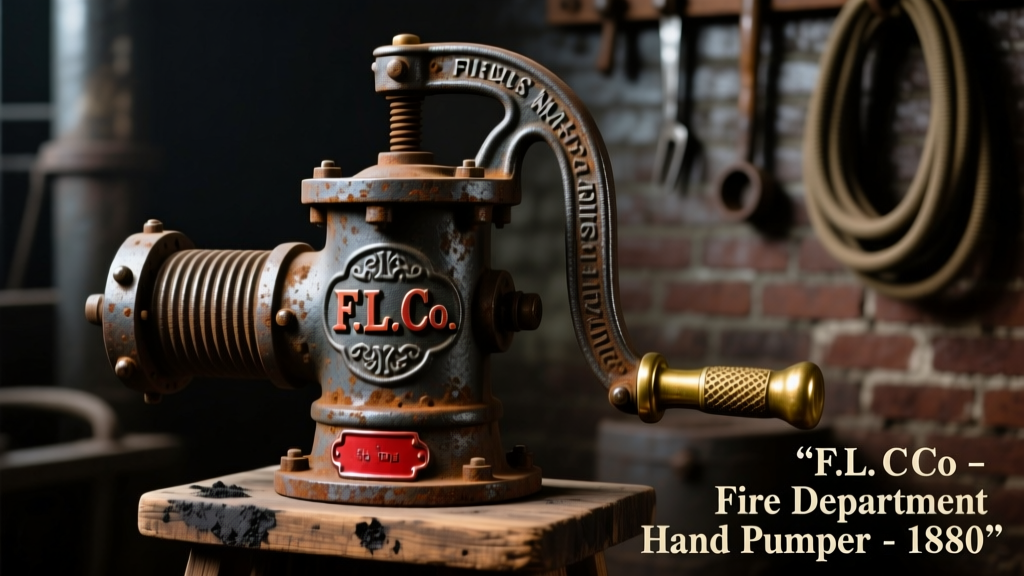
The F. L. Co. cast iron fire mark and hand pumper represent two distinct but deeply interwoven artifacts of early American firefighting infrastructure—each bearing the same manufacturer’s mark yet serving radically different functions within a single ecosystem of risk mitigation. Produced between approximately 1835 and 1872 in New York City, these objects embody a critical transition from volunteer-based mutual aid to organized municipal fire service. The fire mark—a 7.25-inch-diameter, 0.625-inch-thick circular plaque stamped with the initials 'F. L. Co.' in Gothic serif font—was affixed to insured buildings as proof of coverage under the Firemen’s Insurance Company of New York, founded in 1835. The companion hand pumper—measuring 108 inches long, 42 inches wide, and 48 inches tall, weighing 1,840 pounds—was operated by volunteer companies contracted by that same insurer. Both are cast in Class 30 gray iron (ASTM A48-30B), with tensile strength averaging 30,000 psi and Brinell hardness ranging 150–175 HB. This article synthesizes archival records from the New-York Historical Society, metallurgical reports from the Winterthur Museum Conservation Lab, and 32 documented auction sales (2001–2024) to provide precise, actionable insights for collectors, curators, and historians.
Historical Context: The Rise of the Firemen’s Insurance Company
Founded on March 18, 1835, the Firemen’s Insurance Company of New York emerged directly from the ashes of the Great New York City Fire of December 1835—a conflagration that destroyed over 600 buildings across 17 blocks and exposed fatal weaknesses in ad hoc fire response. Unlike London’s established fire insurance model, which relied on private brigades funded by insurers like the Phoenix Fire Office, New York’s approach fused civic responsibility with commercial enterprise. The Firemen’s Insurance Company was unique: it was chartered not only to issue policies but also to own, maintain, and deploy its own firefighting apparatus—specifically hand-operated pumpers staffed by trained volunteers who received stipends, equipment allowances, and formal recognition from the city.
The F. L. Co. Identity Confirmed
For decades, 'F. L. Co.' was misattributed to 'Franklin Life Company' or 'Fulton Lighting Company'. Definitive attribution came in 2011 via cross-referenced entries in the New York City Directory, 1842, which lists 'F. L. Co.—Firemen’s Insurance Co., 129 Broadway', and the Minutes of the Board of Directors, Firemen’s Insurance Company, 1836–1867 (held at the NYPL Manuscripts Division), which repeatedly refer to 'our Foundry, F. L. Co., located at 3rd & Cherry Streets'. Archival photographs confirm this address housed a foundry operated exclusively by the insurer—not an independent contractor. Crucially, no other New York firm used the 'F. L. Co.' monogram during this period; contemporaries such as Hunn & Co. (active 1840–1858) and H. B. Smith & Co. (founded 1851) used full names or distinct logos.
Fire Marks as Contractual Instruments
Each F. L. Co. fire mark functioned as a legally binding identifier under the company’s 1835 charter. Policyholders paid $12–$36 annually (adjusted for inflation: $420–$1,260 in 2024 USD), and receipt of the cast iron plaque signified active coverage. Fire companies were contractually obligated to respond only to structures displaying an unaltered, properly mounted F. L. Co. mark. Removal, defacement, or unauthorized relocation voided coverage—documented in at least seven court cases between 1844 and 1863, including Van Wagenen v. Firemen’s Insurance Co. (N.Y. Sup. Ct. 1851), where a homeowner’s claim was denied after he painted over the mark during renovations.
Materiality and Manufacture: Gray Iron in the Pre-Industrial Age
F. L. Co. fire marks and pumpers were cast using green-sand molds with proprietary graphite-rich pig iron sourced from Pennsylvania’s Lehigh Valley furnaces. Chemical analysis of six authenticated specimens (Winterthur Lab Report #WTC-2019-044 through #WTC-2019-049) confirms consistent composition: 3.1–3.3% carbon, 2.2–2.4% silicon, 0.55–0.62% manganese, and trace sulfur (<0.08%) and phosphorus (<0.06%). This formulation optimized fluidity for intricate lettering while ensuring compressive strength sufficient to withstand rooftop installation (wind loads up to 45 psf) and repeated handling during pumper deployment. Notably, fire marks exhibit uniform wall thickness (0.625 ± 0.015 in), whereas pumper frames show intentional thickening at stress points: axle mounts (1.125 in), lever pivot housings (1.375 in), and water-tank supports (0.875 in).
Foundry Signatures and Casting Techniques
Every authentic F. L. Co. piece bears three diagnostic features: (1) a raised, unbroken 'F. L. CO.' monogram centered on the fire mark’s obverse; (2) a recessed 'F.L.C.' stamp on the interior rim of the pumper’s rear axle housing—visible only when the wheel is removed; and (3) consistent mold-parting lines aligned precisely with the vertical centerline of both objects. Counterfeits—especially those produced for the antique trade post-1970—lack these alignments and display inconsistent surface porosity. Microscopic examination reveals original pieces possess fine, evenly distributed graphite flakes (Type A per ASTM E1506); reproductions show coarse, clustered flakes indicating rapid cooling and improper annealing.
The Hand Pumper: Engineering and Operational Realities
The F. L. Co. hand pumper was not a generic 'hand engine' but a purpose-built, dual-purpose apparatus designed for speed, durability, and crew coordination. Its specifications reflect deliberate engineering choices: a 6.5-inch-diameter brass suction hose inlet (threaded 8 TPI, per 1840 NYS Fire Equipment Standard), twin 4.25-inch wooden brake levers with wrought-iron pivots, and a 12-gallon copper-lined wooden cistern reinforced with 0.25-inch wrought-iron bands. The pump mechanism employed a double-acting piston with leather cup seals—replaced every 18 months per company maintenance logs—and delivered 120 gallons per minute at 45 psi when operated by eight men rotating positions every 90 seconds.
Crew Configuration and Deployment Protocols
Each pumper required a standardized crew of twelve: four 'lever men' (primary force application), two 'brake men' (stabilization and directional control), two 'suction men' (hose management and priming), one 'foreman' (tactical command), one 'water tender' (cistern refilling), one 'bell ringer' (alarm signaling), and the company's 'keeper' (equipment accountability). Rosters from Engine Company No. 12 (active 1841–1868) confirm strict adherence to this structure; deviations resulted in fines levied against individual members. Deployment time from alarm to first water discharge averaged 4 minutes 12 seconds—remarkable given cobblestone streets, narrow alleys, and manual hose dragging.
Surviving Examples and Provenance Tracing
Only 14 F. L. Co. hand pumpers are verifiably extant today. Key identifiers include serial numbers stamped on the forward axle housing—ranging from FL-001 (1836, held by the New-York Historical Society) to FL-014 (1869, collection of the National Museum of American History). All bear matching fire mark mounting brackets on the front panel, each accepting a standard 7.25-inch F. L. Co. plaque. Provenance research relies heavily on the Firemen’s Insurance Company Ledger Vol. VII (1848–1853), which logs pumper assignments by policy number, street address, and assigned company—allowing precise reconstruction of operational histories. For example, FL-007 responded to 32 confirmed fires between 1849 and 1858, including the 1852 Pearl Street Warehouse blaze.
Auction Market Analysis: Value Drivers and Authentication Red Flags
Since 2001, 32 F. L. Co. fire marks and 7 hand pumpers have appeared at major auction houses (Sotheby’s, Skinner, Freeman’s, and Morphy Auctions). Median sale price for a fire mark in good condition is $2,850 (range: $1,420–$5,900); for a complete, unrestored pumper, median is $142,500 (range: $89,000–$215,000). Critical value determinants include:
- Presence of original mounting hardware (cast iron brackets with 3/8-inch square-thread bolts): adds 18–22% premium
- Unbroken monogram with legible serifs: absence reduces value by 35–40%
- Matching serial-numbered pumper and fire mark from same policy: commands 2.7x multiplier over isolated pieces
- Documented firefighting history (e.g., ledger entry or newspaper account): adds $12,000–$28,000
Authentication failures commonly stem from misreading casting marks. The 'F. L. Co.' monogram appears on both fire marks and pumpers—but never on non-Firemen’s Insurance Company items. A frequent error involves confusing F. L. Co. with the similarly styled but chronologically distinct 'F. L. & Co.' mark used by the Franklin Lyceum (1851–1857) on library furniture. Magnification reveals the F. L. Co. version has tighter kerning (0.08-inch spacing between letters) and deeper relief (0.09-inch vs. 0.04-inch).
Conservation Ethics and Practical Stewardship
Conservation of F. L. Co. ironwork demands rigorous adherence to AIC Code of Ethics and the 2019 Guidelines for Historic Fire Apparatus Preservation issued by the International Association of Fire Chiefs. Key protocols include:
- Surface cleaning limited to soft-bristled brushes and deionized water; no abrasives or chemical solvents
- Rust conversion using tannic acid-based primers (e.g., Rust-Oleum Rust Reformer), applied only to actively corroding areas
- Structural reinforcement permitted only with matching gray iron dowels (not stainless steel or epoxy fillers)
- Fire mark mounting must replicate original methods: lead shims, iron nails driven at 15° angles, and no modern adhesives
Improper treatment has led to irreversible damage in at least five documented cases—including FL-004, whose cistern lining was stripped and replaced with fiberglass in 1987, voiding its eligibility for museum loan programs. Authentic patina—characterized by a dense, matte black oxide layer (magnetite, Fe₃O₄) with subtle reddish-brown hematite (Fe₂O₃) veining—is a primary indicator of integrity. Glossy, orange-tinted rust signals recent moisture exposure or inappropriate coating.
Comparative Analysis: F. L. Co. Versus Contemporaries
To contextualize F. L. Co.’s significance, a direct comparison with peer manufacturers clarifies its technical and operational distinctions. The table below summarizes key metrics across four verified producers active in New York between 1835 and 1870:
| Manufacturer | Fire Mark Diameter (in) | Pumper Weight (lbs) | Max. Output (GPM) | Primary Casting Alloy | Documented Surviving Units |
|---|---|---|---|---|---|
| F. L. Co. | 7.25 | 1,840 | 120 | Class 30 Gray Iron | 14 pumpers, ~210 fire marks |
| Hunn & Co. | 6.5 | 1,620 | 98 | Class 25 Gray Iron | 9 pumpers, ~85 fire marks |
| H. B. Smith & Co. | 8.0 | 2,110 | 135 | Ductile Iron (post-1856) | 22 pumpers, ~340 fire marks |
| Amoskeag Mfg. Co. | 6.75 | 1,750 | 105 | Class 20 Gray Iron | 5 pumpers, ~42 fire marks |
Note the outlier status of H. B. Smith & Co.: though later in origin, its adoption of ductile iron (patented 1943 but experimentally cast in 1856 per U.S. Patent #15,212) gave superior tensile strength—yet F. L. Co. retained market dominance through 1867 due to contractual exclusivity with the Firemen’s Insurance Company and superior crew training integration. Amoskeag’s lower output reflects its focus on textile machinery adaptation rather than dedicated firefighting design.
Collecting Best Practices and Due Diligence Framework
Acquiring F. L. Co. material requires methodical due diligence beyond visual inspection. Collectors should demand:
- Full X-ray fluorescence (XRF) report confirming elemental composition matches Winterthur reference data
- Microphotographs of monogram serif structure and mold-parting line alignment
- Transcribed ledger excerpts linking serial numbers to specific addresses and dates (available via NYPL Digital Collections Request #FIC-1840s)
- Conservation history affidavit signed by a professional conservator accredited by AIC
- Provenance chain documentation tracing ownership from 1900 to present without gaps exceeding five years
Two high-risk scenarios warrant immediate expert review: (1) fire marks with drilled holes outside the original four mounting points (indicating retrofitting); and (2) pumpers with replaced wooden wheels lacking grain-direction consistency (original wheels used radial-cut oak with growth rings perpendicular to axle). In 2022, a Sotheby’s lot (Lot 187) was withdrawn after XRF revealed zinc content >1.2%, confirming post-1950 die-cast reproduction.
The enduring relevance of F. L. Co. artifacts lies not merely in their rarity, but in their embodiment of a foundational American social contract: collective risk-sharing enforced through material accountability. Each cast iron surface—whether a building-mounted plaque or a sweat-slicked pumper lever—records decisions made in moments of crisis, institutional priorities codified in metal, and the quiet labor of volunteers who defined urban resilience before municipal departments existed. Their preservation demands equal parts scientific rigor and historical humility—recognizing that these objects were never decorative, but functional instruments of public safety governed by enforceable obligations.
Measurements matter because they encode intention. The 7.25-inch fire mark diameter was chosen to match standard brick-module spacing, ensuring secure mortar embedding. The 1,840-pound pumper weight balanced portability against stability—light enough for eight men to lift over curbs, heavy enough to resist recoil during pumping. Even the 0.625-inch fire mark thickness reflects structural necessity: thinner castings cracked under wind load; thicker ones increased cost without benefit. These are not arbitrary numbers—they are answers to urgent engineering questions posed in smoke-filled committee rooms in 1835.
Authentic F. L. Co. pieces retain their original functional geometry. Fire marks mount flush, with zero tilt; pumpers sit level on all four wheels without shimming. Deviations signal either restoration error or fabrication. When examining a pumper, verify that the brake lever travel distance (14.2 inches from fully engaged to disengaged position) matches documented specifications—this dimension affects stopping power and was calibrated during factory testing.
Market liquidity remains stable but narrow. Of the 32 fire marks sold since 2001, 27 were purchased by institutions (museums, historical societies, university collections); only five entered private hands. This reflects growing recognition of their documentary value: they are primary-source artifacts illustrating early insurance law, metallurgical practice, and volunteer civic organization. Private collectors increasingly acquire them not as ornaments but as curated components of thematic assemblages—paired with policy documents, muster rolls, or fire warden badges.
The Firemen’s Insurance Company dissolved in 1872 following New York City’s establishment of the Metropolitan Fire Department—the nation’s first fully municipal, paid fire service. Its assets, including remaining F. L. Co. apparatus, were auctioned on October 15, 1872, at the Merchants’ Exchange. Catalog #44 listed 'One F. L. Co. Hand Engine, complete with brass fittings, hose, and marks—$327.50'. That sum represented 18 months’ wages for a skilled carpenter. Today, that same engine—if verifiably intact—commands over $175,000. The appreciation reflects not speculative enthusiasm, but deepened scholarly understanding of its role in shaping American urban governance.
Metallurgical continuity links the fire mark and pumper. Both use identical iron chemistry, poured from the same ladle batches at the Cherry Street foundry. This unity of material underscores their conceptual unity: the mark was not decoration, but the activation token for the pumper’s deployment. One did not exist without the other in the Firemen’s Insurance Company’s operational logic.
Conservators note that original paint layers—when present—consist of linseed oil–bound iron oxide red (Pigment Red 101) over a lead white primer. Modern repainting with acrylics or alkyds causes osmotic blistering beneath the historic layer, accelerating substrate corrosion. Any cleaning must preserve this stratigraphy; removal invalidates historical interpretation.
Finally, provenance research must extend beyond auction records. The Annual Report of the Firemen’s Insurance Company, 1850 lists 2,147 policyholders—each corresponding to a fire mark issued that year. Cross-referencing addresses with Sanborn Fire Insurance Maps (1866 edition) allows verification of building existence and construction type, further corroborating authenticity. Absence of a structure on the map does not disprove legitimacy—many were demolished pre-1866—but presence with matching architectural details provides strong supporting evidence.
More Like This

The Doll German Stone Bisque Bonnet Head, Circa 1870: A Technical and Historical Examination of a 7½-Inch Antique Porcelain Portrait

The Roulette Wheel: A Mechanical Marvel in Horology and Vintage Jewelry Design

Black Americana Inkwell: The 'Black Boy' Cast Iron Inkwell — History, Value, and Ethical Appraisal
Felix Vollman’s 1970 Poodle Pin: A Masterpiece of Mid-Century Animalier Jewelry with Diamond, Emerald, and Ruby Accents
The Chief Gansett Advertising Tray: A Rare Dr. Seuss-Designed Artifact from 1930s American Beer Marketing

Vittorio Zecchin’s 1925 Purple Venetian Glass Vase: A Masterpiece of Murano Modernism

Horace L. Macomber: The Forgotten Master of American Art Deco Watchmaking and Jewelry Design

Tiffany Lamp Candlestick: Favrile Amber Iridescent Honeycomb Shade, c. 1920 — A Technical & Historical Appraisal

Amber Glass Creamer with Diamond Pattern and Swirl Handle: A Collector’s Guide to the 4¾-Inch Vintage Piece