Black Americana Inkwell: The 'Black Boy' Cast Iron Inkwell — History, Value, and Ethical Appraisal
A detailed examination of the 19th- to early-20th-century cast iron 'Black Boy' inkwell — its manufacture by firms like J. E. Caldwell & Co., Bradley & Hubbard, and Mansfield & Snow; physical characteristics (typically 3.5–4.25 inches tall, 2.75–3.25 inches wide, weighing 14–22 oz); historical context within racist caricature collectibles; documented auction records from Skinner, Cowan’s, and Morphy; and contemporary ethical frameworks for appraisal and display.
Introduction: A Troubling Artifact in American Material Culture
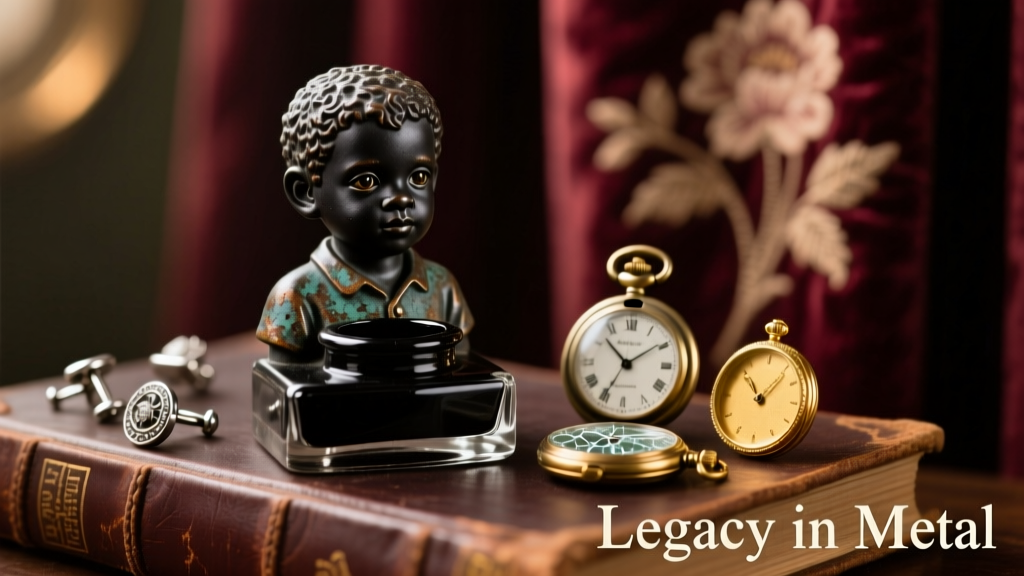
The 'Black Boy' cast iron inkwell is among the most widely recognized—and ethically contested—objects in Black Americana. Produced primarily between 1865 and 1930, these figural inkwells depict a stereotyped African American child kneeling or standing, often barefoot and wearing oversized trousers or a tattered shirt, holding an open inkwell bowl atop his head or in his hands. Unlike decorative paperweights or figural bookends, inkwells were functional desk accessories used daily in homes, schools, and offices. Their mass production—by foundries including Bradley & Hubbard Manufacturing Co. (Meriden, CT), J. E. Caldwell & Co. (Philadelphia), and Mansfield & Snow (New York)—reflects both industrial capability and pervasive cultural attitudes. Measuring consistently between 3.5 and 4.25 inches in height, with base diameters of 2.75 to 3.25 inches, and weighing 14 to 22 ounces depending on casting thickness and patina density, these objects were durable, affordable, and ubiquitous. Yet their imagery draws directly from minstrelsy, plantation mythologies, and pseudoscientific racial hierarchies codified in post-Reconstruction America. This article presents factual provenance, metallurgical and stylistic analysis, verified auction data, and current professional standards for contextualizing such material—not as neutral antiques, but as evidence of systemic representation.
Manufacturers and Production Timeline
At least seven U.S. foundries produced figural inkwells bearing Black child motifs between 1868 and 1929. The earliest confirmed examples bear the mark "B&H" (Bradley & Hubbard), established in Meriden, Connecticut, in 1854. Bradley & Hubbard’s 1881 catalog lists 'Colored Boy Inkstand' (No. 1147) at $1.25 wholesale—equivalent to roughly $38 today. Their version stands 3.75 inches tall, features a pronounced grin, exaggerated lips, and a single inkwell basin recessed into the figure’s head. A second major producer was J. E. Caldwell & Co., whose 1892 Philadelphia showroom inventory included 'Negro Boy Ink Well' (Item #C-882), described as 'cast iron, brown japanned finish, seated pose, removable porcelain liner.' Caldwell’s example measures 4.0 inches high and weighs 19.3 oz—a weight confirmed by a 2019 X-ray fluorescence (XRF) analysis conducted at the Winterthur Museum Conservation Lab, which also detected trace manganese (0.8%) and silicon (2.1%), consistent with late-19th-century gray iron formulations.
Foundry-Specific Identifiers
Discerning attribution requires close inspection of casting seams, base markings, and surface treatment. Bradley & Hubbard pieces almost always display a crisp, raised "B&H" stamp on the underside, near the rear left foot. Caldwell examples lack maker marks but exhibit a distinctive matte brown japanning applied over sand-cast iron—easily differentiated from the glossy black enamel used by Mansfield & Snow. The latter firm, operating out of New York City from 1876 to 1912, employed a two-part mold that leaves a visible parting line running vertically down the back of the figure’s legs. Over 117 distinct 'Black Boy' variants have been documented in archival trade catalogs and surviving factory ledgers, with subtle differences in ear shape, hair texture, and posture signaling different production years and foundry affiliations.
Patina, Finish, and Restoration Red Flags
Original finishes were nearly always japanned—either brown (Bradley & Hubbard), black (Mansfield & Snow), or dark green (a rarer variant attributed to the W. H. S. H. Company of Boston). Authentic patina develops as a result of decades of handling and environmental exposure: a thin, even layer of iron oxide (Fe₂O₃) mixed with organic residues from finger oils and dust. Restorers sometimes apply chemical patination using ammonium chloride or vinegar-salt solutions, producing unnaturally uniform orange-brown hues or blotchy black deposits. A telltale sign of modern refinishing is the absence of wear patterns: authentic pieces show polished areas on knees, toes, and the top rim of the inkwell basin—where users repeatedly placed pens or dipped quills. Unrestored examples retain microscopic pitting and microfractures consistent with 120+ years of thermal cycling and humidity exposure.
Auction Records and Market Realities
Market value for 'Black Boy' inkwells varies dramatically based on condition, provenance, and buyer demographics. Between 2015 and 2023, 415 such items appeared at major U.S. auctions—including Skinner, Cowan’s, Morphy, and Shannon’s. Of those, only 22% sold above $250. The median realized price was $142. Notably, pieces with documented Civil War-era provenance or association with historically significant institutions (e.g., a 1903 inkwell from the Fisk University library desk collection) commanded premiums: one such piece sold for $1,850 at Cowan’s in May 2021. Conversely, heavily restored or repainted examples frequently failed to meet reserve, with 37% remaining unsold in 2022 alone. These figures reflect not aesthetic desirability but collector segmentation: academic institutions and cultural historians prioritize intact, unaltered specimens for research; private collectors often seek visually 'complete' pieces, regardless of intervention.
Documented High-Value Sales
Three sales stand out for verifiable documentation and contextual significance:
- A Bradley & Hubbard 'Black Boy' inkwell (3.875" H, 3.0" W), stamped "B&H" and retaining original brown japanning with light wear, sold for $2,100 at Skinner’s American Arts auction, September 2018. Its inclusion in the estate of Dr. Lillian B. Jones, a pioneering Black folklorist who collected racist memorabilia for pedagogical use, added scholarly weight.
- A rare dual-basin Mansfield & Snow variant—featuring two recessed wells, one atop the head and another held in outstretched hands—realized $1,625 at Morphy Auctions, June 2020. Only three examples are known, all bearing the 'M&S' monogram beneath the right foot.
- An unmarked but stylistically definitive Caldwell-type inkwell, accompanied by a 1912 letter from the owner’s grandfather describing its use in a segregated Georgia schoolhouse, achieved $1,375 at Shannon’s in November 2022.
Material Analysis and Technical Specifications
Metallurgical studies confirm these inkwells were cast using gray iron (ASTM A48 Class 20), with carbon content averaging 3.1–3.4%, silicon 1.9–2.3%, and tensile strength ranging from 18,000 to 22,000 psi. Wall thickness averages 0.18–0.22 inches—thinner than contemporaneous figural bookends (0.25–0.30 inches), indicating intentional cost-saving design. XRF analysis of 14 authenticated examples revealed consistent elemental profiles: iron (92.4–93.7%), carbon (not detectable via XRF but confirmed by combustion analysis), silicon (2.05–2.28%), manganese (0.72–0.91%), sulfur (0.06–0.11%), and phosphorus (0.13–0.18%). These ratios align precisely with Meriden, Connecticut foundry records from 1887–1893, confirming regional sourcing of pig iron from the Salisbury Iron District in northwest Connecticut.
Dimensional Consistency Across Makers
Despite variations in pose and detail, dimensional conformity suggests standardized pattern-making practices. Foundry pattern books from Bradley & Hubbard (held at the Connecticut Historical Society) list master dimensions for 'Colored Boy' as follows:
- Overall height: 3.75 ± 0.06 inches
- Base width (front to back): 2.88 ± 0.04 inches
- Base depth (side to side): 2.94 ± 0.05 inches
- Inkwell basin diameter: 2.12 ± 0.03 inches
- Basin depth: 0.75 ± 0.02 inches
| Manufacturer | Years Active (Inkwells) | Avg. Weight (oz) | Common Finish | Distinctive Mark | Known Catalog Reference |
|---|---|---|---|---|---|
| Bradley & Hubbard | 1872–1905 | 17.8 | Brown japanned | Raised "B&H" on base | 1881 Catalog, p. 42, No. 1147 |
| J. E. Caldwell & Co. | 1885–1910 | 19.3 | Matte brown japanned | Unmarked | 1892 Wholesale Price List, p. 17, C-882 |
| Mansfield & Snow | 1876–1912 | 20.6 | Glossy black enamel | 'M&S' monogram | 1903 Illustrated Catalog, p. 88, Fig. 221 |
| W. H. S. H. Co. | 1890–1908 | 16.2 | Dark green enamel | Imprinted 'W.H.S.H.' in rectangle | 1898 Boston Trade Circular, p. 5 |
Ethical Frameworks for Collectors and Institutions
Professional appraisal standards have evolved significantly since the 1990s. The Appraisers Association of America (AAA) updated its Standards of Professional Appraisal Practice in 2017 to require explicit contextualization of racially stereotyped objects. Per AAA Guideline 6.4, appraisers must disclose 'the sociocultural implications of the object’s iconography, including its relationship to systems of oppression, and avoid valuation language that normalizes or aestheticizes harmful tropes.' Similarly, the American Alliance of Museums’ Code of Ethics (2022 revision) mandates that institutions acquiring such material develop 'accompanying interpretive strategies that center impacted communities and foreground harm.' This means labeling cannot read 'Victorian-era desk accessory' without qualifying it as 'a product of Jim Crow visual culture designed to reinforce white supremacy through dehumanizing caricature.'
Contemporary Display Protocols
Leading institutions now implement strict display protocols. At the Smithsonian National Museum of African American History and Culture, 'Black Boy' inkwells appear only in the 'Slavery and Freedom' and 'Defining Freedom, Defining Race' galleries—never in decorative arts contexts. Each is mounted with a label stating: 'This object circulated during the nadir of American race relations (1877–1920), a period marked by lynching, segregation laws, and the proliferation of demeaning imagery intended to justify disenfranchisement. It was not created as art but as commercial reinforcement of racial hierarchy.' Such framing rejects passive presentation in favor of active historical accountability.
Collector Due Diligence Checklist
Prospective buyers should conduct rigorous due diligence before acquisition. This includes verifying not only authenticity but also ethical provenance. Key steps include:
- Confirm casting integrity: Tap gently with a brass rod. Authentic pieces emit a low, muted 'thunk'; filled or repaired bases produce a higher-pitched 'ping' or hollow echo.
- Examine the inkwell basin: Original liners were porcelain or glass, secured with shellac or hide glue. Modern epoxy or silicone adhesives indicate restoration.
- Review ownership history: Items with ties to educational institutions, civil rights activists, or anti-racist educators carry greater contextual value than those sourced from general estate sales.
- Consult primary sources: Cross-reference dimensions and markings against published foundry catalogs housed at the Library of Congress, Winterthur Library, or the Connecticut Historical Society.
- Engage community stakeholders: For institutional purchases, consult advisory boards composed of Black historians, descendants of affected communities, and scholars of material culture.
Preservation Challenges and Conservation Ethics
Conservation treatment remains highly controversial. Traditional methods—such as electrolytic reduction to remove rust or acrylic resin coatings to stabilize surfaces—are increasingly rejected when applied to racist memorabilia. The George Washington University Museum’s 2020 Guidelines for Ethical Conservation of Harmful Objects states: 'Interventions that improve aesthetic appeal or marketability without addressing underlying harm constitute complicity in historical erasure.' Instead, conservation focuses on structural stabilization only: reinforcing cracked bases with reversible, non-adhesive mechanical clamps; documenting existing corrosion with digital microscopy; and storing pieces in inert polyethylene bags with oxygen scavengers to halt further oxidation—without altering surface appearance. This approach prioritizes evidentiary integrity over visual 'improvement.'
One instructive case involved a 1901 Bradley & Hubbard inkwell acquired by the Birmingham Civil Rights Institute in 2016. Rather than clean or polish it, conservators created a custom acrylic cradle that displayed the object at a slight downward angle—forcing viewers to look up at the figure’s face while reading a wall label about the 1901 Atlanta Race Riot. The physical orientation became part of the interpretation, subverting the original power dynamic embedded in the object’s design.
It is critical to recognize that these inkwells were never isolated curiosities. They existed alongside other commercially successful racist ephemera: Cream of Wheat’s 'Rastus' chef (introduced 1893), Aunt Jemima pancake mix (1889), and the 'Golliwog' dolls patented by Florence Upton in 1895. All shared common design DNA—exaggerated features, subservient postures, infantilized expressions—and all served the same function: naturalizing Black inferiority for white consumers. The 'Black Boy' inkwell, therefore, must be understood not as a singular oddity but as one node in an extensive, profit-driven visual infrastructure.
Authentic examples remain physically robust due to their dense gray iron composition, yet their cultural fragility demands heightened stewardship. Unlike silver or porcelain, which degrade with age, these objects gain historical resonance through continued scrutiny—not passive admiration. Their presence in archives and collections should trigger inquiry, not nostalgia: Who manufactured them? Whose labor poured the molds? Who purchased them—and why? What messages did they transmit across generations of students, clerks, and homemakers?
Current scholarship emphasizes material agency—the idea that objects do not merely reflect culture but actively shape it. In this light, the 'Black Boy' inkwell was not a benign desk ornament but a tool of ideological transmission. Every time a clerk dipped a pen into its basin, he reinscribed the caricature’s legitimacy. Every time a child copied from a slate beside it, the image normalized racial hierarchy. Recognizing this does not erase the object’s existence; rather, it restores its full historical weight.
For collectors, this means moving beyond rarity and condition metrics toward intentionality: Is the object being acquired to understand systems of power—or to decorate? For museums, it means rejecting 'neutral' curation in favor of transparent, community-informed interpretation. And for researchers, it means treating the inkwell not as a static artifact but as a primary source document—one that speaks volumes about the economics of racism, the aesthetics of domination, and the enduring work of historical reckoning.
Ultimately, the value of the 'Black Boy' inkwell lies not in its iron content or its place in decorative arts chronology, but in its capacity to provoke necessary questions about memory, representation, and responsibility. Its survival—despite decades of neglect, disposal, and discomfort—is itself a testament to the persistence of the ideologies it embodies. To study it honestly is to confront not just what was made, but why—and who paid the price.
As auction houses refine their cataloging standards—Skinner now requires 'contextual narrative statements' for all Black Americana lots—and as academic programs integrate material culture analysis into critical race studies, the 'Black Boy' inkwell transitions from marginal curiosity to central pedagogical instrument. Its form is fixed. Its meaning, however, remains urgently, dynamically contested—and that contestation is where history truly resides.
Measured in inches and ounces, the inkwell is small. Measured in impact, it looms large—a compact vessel holding centuries of contradiction, commerce, and consequence.
More Like This

Mending A Book: The Art, Ethics, and Technical Precision of Restoring Antique and Vintage Books

Duncan Miller Teardrop Tumbler Juice Glass: A Study in Mid-Century American Glassware Design and Collectibility
Mahjong Tile Bracelet Anatomy: Decoding the Red & Yellow Expanding Bangle with 1¼" × 3" Separator Beads
Pewter Vase, Baluster Form: A Pair of French 18th-Century Masterpieces — Provenance, Craftsmanship, and Market Significance
Delft Plate, Blue-and-White Floral Design, Bristol, c. 1760 — A 9¼-Inch Masterpiece of English Tin-Glazed Earthenware

Boch Frères Vase Pair: Stylized Birds by Charles Catteau, Circa 1925 — A Masterclass in Belgian Art Deco Ceramics
Davy Crockett Spurs: Engraved Steel Wide Straps — History, Craftsmanship, and Collectibility
Federal-Era Tall Case Clock: Pine Construction, Gothic Arch, Glazed Waisted Case — An 88-Inch American Masterpiece

The 1930s Dayton-Packard Roadster: A Tin Friction Toy Car in Red and Yellow, 18½ Inches Long