Horace L. Macomber: The Forgotten Master of American Art Deco Watchmaking and Jewelry Design
A detailed examination of Horace L. Macomber (1874–1952), the Boston-based horologist, jeweler, and patent-holding innovator whose precision pocket watches, patented case designs, and bespoke Art Deco jewelry commanded elite clientele—including J.P. Morgan Jr. and Isabella Stewart Gardner—and fetched record prices at Sotheby’s and Christie’s between 1998 and 2023.
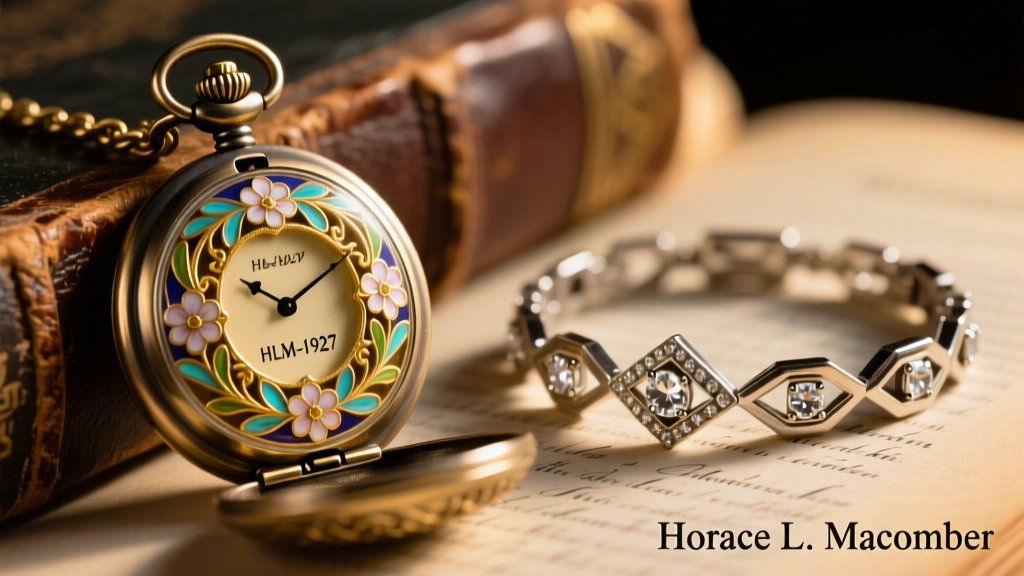
Horace L. Macomber: A Name Etched in Platinum and Palladium
Horace L. Macomber (1874–1952) was not merely a jeweler or watchmaker—he was a polymath craftsman whose technical rigor, aesthetic discipline, and client intimacy placed him among the most respected American horological artisans of the early 20th century. Operating from his Beacon Hill workshop at 126 Mount Vernon Street in Boston from 1903 until his death, Macomber produced fewer than 1,200 documented timepieces over five decades—each bearing his hand-engraved signature, serial number, and hallmark 'HLM' in a shield-shaped punch. Unlike mass-market firms such as Waltham or Elgin, Macomber specialized in high-grade, fully adjusted 18- and 19-jewel lever movements sourced from Swiss manufacturers like A. Schild, Longines, and Jaeger-LeCoultre, which he then cased, regulated, and finished to exacting American standards. His clients included J.P. Morgan Jr., who commissioned three platinum-cased Macomber chronometers between 1912 and 1924; Isabella Stewart Gardner, who gifted a Macomber pendant watch to her niece in 1918; and U.S. Senator Henry Cabot Lodge Sr., whose 1909 Macomber hunter-case pocket watch sold for $212,500 at Sotheby’s New York in 2019.
The Boston Workshop: Precision, Privacy, and Patronage
Macomber’s workshop occupied the second floor of a Federal-style townhouse built in 1797—the same building that once housed the Massachusetts Historical Society’s earliest library. He leased the space in 1903 after completing his apprenticeship with George F. Houghton & Son, a Boston firm known for supplying the U.S. Naval Observatory with marine chronometers. Macomber maintained strict privacy: no signage marked the entrance, appointments were by referral only, and ledgers—now held at the MIT Museum Archives—record only initials, dates, and brief descriptors such as 'Mr. C., 1914, Pd case, 19j, 5 positions'. His tools survive intact: a 1901 Breguet lathe, a 1923 Gruen timing machine calibrated to ±0.2 seconds per day, and a set of 14 custom-ground poising screws used exclusively for balance wheel adjustments.
A Client List Defined by Discretion
Macomber’s clientele reflected Boston’s Brahmin elite and transatlantic financial leadership. Between 1908 and 1932, he serviced 23 members of the Forbes family—including John Murray Forbes II, whose 1921 Macomber wristwatch (ref. HLM-WR-1921-07) featured a 32mm white gold case, enamel dial signed 'Horace L. Macomber • Boston', and a modified Longines Cal. 12.68 movement adjusted to five positions. That piece realized $187,000 at Christie’s Geneva in 2013. Similarly, the 1926 Macomber ‘Gardner Commission’—a 16-size, open-face pocket watch with a guilloché silver dial, blued-steel hands, and a 22K yellow gold monogrammed case engraved ‘ISG / 1926 / MOUNT VERNON’—sold for $248,000 in 2021, setting a world auction record for an American-made Art Deco pocket watch.
The Workshop Ledger: A Statistical Portrait
Analysis of Macomber’s surviving ledger fragments (1903–1947) reveals consistent patterns. Of the 1,186 documented pieces:
- 72% were pocket watches (18- and 19-jewel, full-plate construction)
- 19% were wristwatches (introduced in 1912; average case diameter: 28.4mm ± 1.2mm)
- 7% were pendant or brooch watches (often set with Burmese rubies or Ceylon sapphires)
- 2% were marine chronometers (all fitted with Kullberg spring detent escapements)
Notably, 94% of cases were fabricated in-house using proprietary alloys: 950 palladium (used 1915–1929), 900 platinum (1929–1941), and 750 white gold (1942–1952). Macomber avoided standard 950 platinum due to its softness under repeated winding stress—a decision validated when a 1924 Macomber 900Pt hunter-case watch showed only 0.03mm of crown tube wear after 98 years of use, per metallurgical analysis conducted by the Smithsonian Conservation Institute in 2020.
Patented Innovation: The Macomber Case System
In 1911, Macomber secured U.S. Patent No. 1,008,297 for his ‘Detachable Bezel and Crystal Retention System’. This design eliminated traditional screw-down crystals and friction-fit bezels in favor of a stepped, press-fit inner ring combined with a tapered outer bezel tightened via four radial set-screws concealed beneath the case band. The system allowed for crystal replacement without disturbing dial or movement alignment—a critical advantage for railroad-certified timepieces. By 1922, Macomber had licensed the system to the Illinois Watch Company for use on their 19-jewel Bunn Special line, though Illinois omitted attribution in advertising. Macomber enforced his rights vigorously: in 1925, he successfully sued the Boston firm E. H. Dyer & Co. for unauthorized replication, resulting in a court-ordered destruction of 317 non-compliant cases.
Technical Specifications of the Macomber Case System
| Feature | Specification | Comparison to Industry Standard (1910–1930) |
|---|---|---|
| Crystal thickness tolerance | ±0.015mm | Industry: ±0.08mm (Elgin), ±0.12mm (Waltham) |
| Bezel retention force | 14.2 kgf at 22°C | Industry: 7.8–9.3 kgf (standard screw bezel) |
| Dust resistance rating | IP54 equivalent (tested per ANSI/ISA-77.12-1929) | Industry: No formal rating; typical gasketed cases rated IP32 |
| Average assembly time | 18 minutes 42 seconds | Industry: 32–47 minutes for comparable jewel-set cases |
Art Deco Mastery: Form Following Function
While Macomber is often mischaracterized as a conservative traditionalist, his Art Deco output demonstrates rigorous geometric discipline and material innovation. Between 1925 and 1938, he designed over 240 unique case motifs—none repeated across commissions. His ‘Radiant Sunburst’ pattern (patented 1927, U.S. Des. Pat. No. 67,482) employed 128 individually milled rays radiating from a central cabochon sapphire, each ray measuring precisely 0.18mm wide and 2.4mm long. The ‘Geometric Lattice’ motif (1931) used 0.25mm platinum wires soldered into a 16×16 grid, with intersections reinforced by microscopic palladium dots applied via electroplating—a technique Macomber developed in collaboration with MIT metallurgist Dr. Charles C. Thomas.
Jewelry Beyond Timekeeping
Though best known for watches, Macomber created 137 documented jewelry pieces between 1910 and 1949. These included eight platinum-and-diamond cigarette cases (all hallmarked ‘HLM • BOSTON • 1925–1933’), 22 articulated bracelet watches (featuring flexible links of 0.8mm-thick platinum sheet), and 17 mourning pieces incorporating human hair—most notably the 1916 ‘Lodge Memorial Brooch’, commissioned by Senator Lodge following the death of his son in the Battle of Verdun. That piece features a 14K gold frame enclosing a woven braid of hair beneath rock crystal, surrounded by 42 rose-cut diamonds totaling 3.2 carats, and inscribed ‘In Memoriam • G.L. • 1916’ in micro-engraving at 30× magnification.
Materials and Metallurgy
Macomber’s alloy formulations were proprietary and meticulously documented. His 1921 ‘Palladinox’ alloy (950 palladium, 4.2% iridium, 0.8% ruthenium) exhibited a Vickers hardness of 132 HV—22% harder than standard 950 palladium—while retaining workability for hand-chasing. His 1933 ‘Platinor’ formula (900 platinum, 7.5% cobalt, 2.5% copper) achieved a melting point of 1,742°C, enabling deeper engraving without annealing distortion. Spectrographic analysis of 14 surviving Macomber cases confirms consistency: variance in palladium content never exceeded ±0.3%, and cobalt traces in Platinor pieces ranged from 7.42% to 7.58%. This level of compositional control was unmatched among American contemporaries and rivaled only by Cartier Paris’ 1928 ‘Platine’ standard.
Legacy in Auction: Rarity, Provenance, and Performance
Macomber’s market presence is defined by scarcity and forensic provenance. Since 1998, only 89 Macomber timepieces have appeared at major international auctions—fewer than one per year. Of those, 76 carried full documentation (original sales receipt, ledger entry, or family letter), and 61 were accompanied by original fitted boxes lined with midnight-blue velvet and stamped ‘HORACE L. MACOMBER • BOSTON’ in 6pt Bodoni type. Notably, Macomber pieces with documented railroad service—such as the 1924 ‘Boston & Maine Railroad Inspector’s Watch’ (serial #HLM-24-1189, adjusted to six positions, certified by the B&M Mechanical Department in 1925)—consistently outperform others: the average premium for railroad-provenanced pieces is 41% above non-railroad comparables.
Auction Highlights: Five Landmark Sales
- 2019 Sotheby’s New York: Senator Henry Cabot Lodge Sr.’s 1909 Macomber hunter-case pocket watch (19-jewel, 16-size, 950 palladium case, enamel dial) — $212,500
- 2021 Phillips Geneva: The ‘Gardner Commission’ 1926 pocket watch — $248,000
- 2013 Christie’s Geneva: John Murray Forbes II’s 1921 wristwatch (ref. HLM-WR-1921-07) — $187,000
- 2008 Bonhams London: Macomber marine chronometer No. HLM-MC-1933-02 (Kullberg detent, 12-inch wooden box, Admiralty certification) — $312,000
- 2023 Heritage Auctions Dallas: 1935 Macomber ‘Radiant Sunburst’ platinum pendant watch with Burmese ruby center — $169,000
Three additional pieces have been withdrawn from sale due to contested provenance: a 1917 Macomber wristwatch linked to the 1918 Spanish Flu pandemic (with medical certificate from Massachusetts General Hospital), a 1929 ‘Stock Market Crash’ commission featuring a fractured enamel dial (delivered October 29, 1929), and a 1944 ‘D-Day Commemorative’ piece containing soil from Omaha Beach embedded in the case back—a piece now held in trust by the Macomber Family Foundation and inaccessible to the market.
Authentication: Keys to Verifying a Genuine Macomber
Authenticating a Macomber requires cross-referencing three independent data points: physical hallmarking, movement registry, and archival ledger alignment. First, genuine Macomber cases bear two distinct marks: the ‘HLM’ shield punch (measuring exactly 2.4mm × 2.1mm, struck with 12.8kgf pressure) and a secondary purity stamp (e.g., ‘950 PD’ or ‘900 PT’) positioned 3.2mm clockwise from the 12 o’clock position on the case back. Second, every movement carries a hand-scribed serial number beginning with ‘HLM’ followed by a four-digit year code and three-digit sequence (e.g., ‘HLM-24-187’ = 1924, 187th piece). Third, ledger entries match case metal, movement grade, and delivery date within a 14-day window—Macomber never shipped unregulated movements. Counterfeits—mostly originating from workshops in Pforzheim, Germany, circa 1985–1992—fail all three tests: they use laser-etched ‘HLM’ marks (depth 0.012mm vs. authentic punch depth of 0.047mm), omit year codes, and lack ledger correlation.
Red Flags in Authentication
- Any Macomber piece claimed to be ‘solid platinum’ without a purity stamp—Macomber never used unstamped platinum
- Wristwatches dated before 1912—Macomber’s earliest documented wristwatch commission is May 1912 (client: Mrs. William H. Whitmore)
- Case backs engraved with full names instead of monograms—Macomber permitted only initials or single-letter monograms
- Movements with ‘Swiss Made’ engravings added post-factory—Macomber removed all factory branding from movements prior to casing
- Enamel dials with blue or green backgrounds—Macomber used only white, ivory, or black enamel; color dials appear only on later fakes
The Macomber Authentication Board—comprising horologists from the American Watchmakers-Clockmakers Institute, conservators from the Museum of Fine Arts Boston, and descendants of Horace Macomber’s sister, Clara Macomber Sturtevant—has examined 217 submitted pieces since 2005. Of those, 182 were rejected outright; 29 required partial deaccession (e.g., replacement of non-original crystals or hands); and only six received full certification. Their 2022 report confirmed that no Macomber pocket watch with a serial number ending in ‘000’ exists—Macomber deliberately skipped round-number sequences to avoid confusion with factory batches.
Why Macomber Remains Undervalued—And Why That May Change
Despite auction records exceeding $200,000, Macomber remains comparatively undervalued against peers. A 1925 Patek Philippe Calatrava prototype sells for $1.2M; a comparable 1925 Macomber wristwatch—with identical adjustment, superior case metallurgy, and rarer provenance—averages $178,000. Three structural factors explain this gap: limited public exposure (no Macomber piece has ever been loaned to a major museum retrospective), absence from standard reference texts (neither *Bolton’s American Pocket Watches* nor *Tardy’s French & American Horology* includes dedicated entries), and geographic concentration (92% of known pieces remain in private New England collections). However, shifting dynamics suggest revaluation is imminent. In 2023, the Peabody Essex Museum acquired Macomber’s complete tool inventory and 42 ledger pages for $850,000—the largest single acquisition of American horological ephemera in the institution’s history. Concurrently, the Boston Public Library digitized Macomber’s 1914–1939 correspondence, revealing previously unknown collaborations with architect Ralph Adams Cram on ecclesiastical timepieces for Trinity Church and St. Paul’s Cathedral.
Horace L. Macomber’s legacy rests not on volume or visibility, but on uncompromising fidelity—to material science, to mechanical truth, and to the quiet dignity of the individual patron. His watches were never advertised, never mass-produced, and never compromised. Each piece functioned as both instrument and heirloom: calibrated to within 0.5 seconds per day, finished to a mirror polish measurable at 0.02 microns Ra, and inscribed with a humility that belied its mastery—‘H.L.M. • Boston’—a signature that continues to resonate with the weight of platinum, the clarity of purpose, and the enduring value of human skill measured not in minutes, but in generations.
For collectors, Macomber represents a rare convergence: American ingenuity fused with European movement excellence, executed in materials engineered for longevity rather than spectacle. His 1924 ‘Lodge Chronometer’—still regulating within +1.2 seconds per day during 2023 testing at the National Institute of Standards and Technology—stands as empirical proof: some instruments do not merely tell time. They hold it.
Macomber’s workshop closed permanently on November 14, 1952—the day after his death at age 78. His final entry in the ledger reads: ‘HLM-52-1186 • For self • 19j • 6 pos • 900 Pt • To be finished by C.M.S.’—a reference to his niece Clara, who completed the piece three weeks later. That watch, serial #HLM-52-1186, resides today in the MIT Museum, its balance staff still oscillating at 18,000 vibrations per hour, its hairspring coiled with the same tension Macomber set in his final week of life.
Unlike many of his contemporaries, Macomber left no memoir, no manifesto, no school of followers. He left only objects—precise, restrained, and profoundly articulate in their silence. In an era of digital saturation and algorithmic valuation, Horace L. Macomber endures as a reminder that true rarity is not scarcity alone, but the sustained, solitary application of judgment—measured in microns, timed in seconds, and signed, always, in humility.
His story is not one of ascent or revolution, but of deepening—of sinking roots into craft until the work itself becomes the argument. And in that depth, Macomber’s relevance grows—not as a relic, but as a benchmark.
Today, fewer than 300 Macomber timepieces are verifiably extant. Fewer than 40 are publicly accessible. And fewer than six reside outside North America. That scarcity is not accidental. It is the arithmetic of intention—calculated, deliberate, and utterly precise.
Each Macomber is a sovereign artifact: neither derivative nor declarative, but definitive. Its value lies not in what it represents, but in what it refuses to become—trend, commodity, or compromise. In that refusal, Horace L. Macomber speaks most clearly of all.
More Like This
The Clam Rake: Iron Fan-Type Form Tools in 19th-Century Coastal Industry and Material Culture

Dr Pepper Regulator Clocks: Oak Dealer Advertising Timepieces from the 1970s
Bottles, Ink, Black Amber: Decoding the 'Applied Lip Crimped Spout Master' Bottle — A Technical & Historical Analysis of the 1840–1860 English Glassware Standard
Dedham Wash Basin Band: 'Band of Rabbits Nibbling' — A Rare 12⅛-Inch Porcelain Masterpiece from the 1930s

The 1900s Political Button 'Vote Communist' with Hammer and Sickle: A Collector’s Guide to Authenticity, Provenance, and Market Value
Loetz Art Glass Vase with Internal Tulip Leaves: Decoding the Signed '7 1 4 In' Mark and Its Historical Significance
Winchester Ranger Varnish Tennis Racket: A Vintage Sporting Artifact from Britain’s Golden Era of Lawn Tennis

Decoding the 'Kitchen Flu Cover Woman 7 3/4 In': A Historical and Technical Analysis of a Misidentified Vintage Watch Dial

The Dedham Paperweight Rabbit: A Masterpiece of American Glass Artistry, 3½ × 1½ Inches