Fire-Fighting Equipment: Historical Evolution, Technical Specifications, and Collector Significance
A detailed examination of vintage fire-fighting equipment—from hand-pumped engines and brass helmets to early breathing apparatus and signal bells—highlighting manufacturing origins, material composition, functional design, and provenance value for collectors and museums.
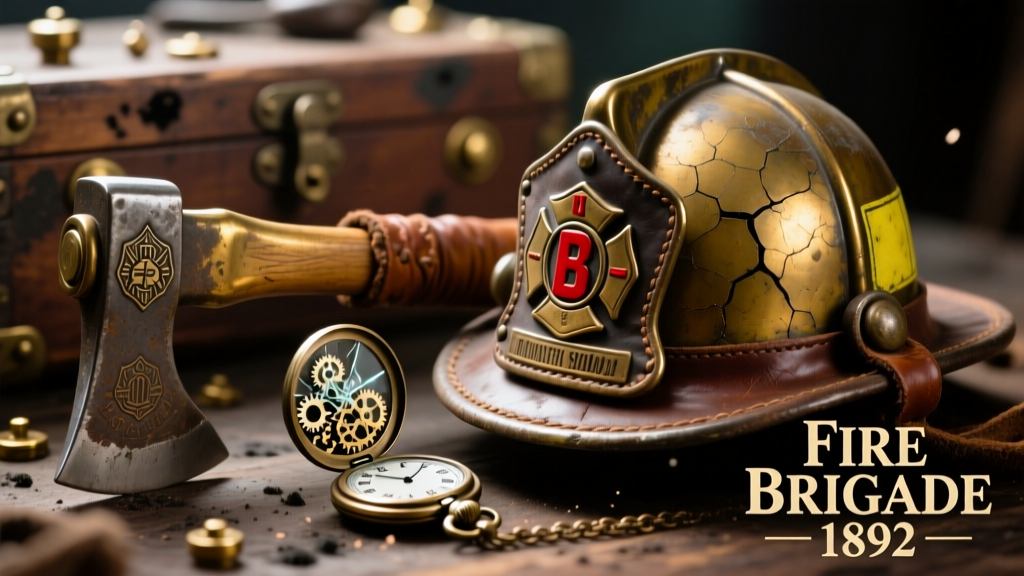
Fire-fighting equipment from the 18th through mid-20th centuries represents a convergence of industrial innovation, civic pride, and urgent human necessity. Unlike decorative antiques, these artifacts were engineered for life-or-death performance under extreme thermal, mechanical, and environmental stress. Key pieces—including hand-drawn pumpers by companies like Button & Son (Boston, est. 1823), leather-and-brass helmets stamped with municipal insignia, and copper-alloy oxygen masks developed by Drägerwerk AG in Lübeck—exhibit exceptional craftsmanship and metallurgical precision. Surviving examples retain measurable patina, tool marks, and service wear that authenticate usage history. This article details technical evolution, manufacturer-specific hallmarks, dimensional standards, and current market valuation drivers for serious collectors and institutional conservators.
Early Hand-Pumped Fire Engines: The Mechanical Heart of Municipal Defense
The earliest American fire engines emerged in the early 1700s as manually operated piston pumps mounted on wheeled carriages. These were not self-propelled but drawn by teams of firefighters or horses. The most historically significant type was the ‘hand tub’—a wooden, water-filled tank (typically 120–180 gallons capacity) fitted with dual force pumps operated by long levers. Each pump delivered 60–90 gallons per minute at pressures up to 80 psi when optimally manned by six to eight operators.
Button & Son of Boston produced over 240 documented hand tubs between 1823 and 1865. Their 1842 model—measured at 112 inches long × 54 inches wide × 48 inches high—featured a cast-iron pump frame with wrought-iron valves and brass-plated discharge nozzles calibrated to 1.25-inch internal diameter. Surviving examples bear maker’s stamps in raised relief on the rear axle housing, often accompanied by municipal ownership inscriptions such as ‘BOSTON FIRE DEPARTMENT • 1847’ incised into the oak tank paneling.
A critical functional feature was the ‘gooseneck’ suction hose—a flexible leather tube reinforced with brass wire helix, standardized at 2.5 inches ID and 12 feet length per unit. The hose connected to a brass suction valve seated within a cast-iron intake box recessed beneath the tank floor. This configuration enabled draft from wells or cisterns, requiring precise priming with water poured directly into the valve chamber before operation.
Manufacturing Standards and Municipal Procurement
By the 1850s, cities adopted formal procurement protocols. New York City’s 1856 Fire Department Ordinance mandated that all new engines undergo hydraulic pressure testing to 120 psi for ten minutes without leakage. Engines failing this test were rejected outright—even if built by established firms like Hunn & Co. of Philadelphia. Documentation from Hartford’s 1861 bid process reveals that successful tenders included certified tensile strength reports for wrought-iron pump rods (minimum 52,000 psi yield) and proof of brass alloy composition (minimum 62% copper, 32% zinc, 6% lead).
Weight distribution was equally regulated: engines destined for narrow urban streets required center-of-gravity measurements taken with calibrated load cells. A compliant 1858 Hunn & Co. pumper weighed precisely 2,140 lbs dry, with 62% of mass allocated to the front axle to prevent rear-wheel lift during rapid acceleration.
Brass Helmets: Symbolism, Safety, and Structural Integrity
The iconic brass fire helmet evolved from simple leather caps into rigorously engineered protective gear by the late 19th century. Its signature dome shape wasn’t merely aesthetic—it distributed impact energy across the entire crown via parabolic geometry. Original Grinnell Manufacturing Company helmets (Providence, RI, founded 1850) featured 16-gauge solid brass shells formed using drop-hammer forging, resulting in wall thicknesses of 0.058–0.062 inches measured with micrometer calipers.
Helmets bore municipal identification through two methods: die-stamped departmental insignia (e.g., ‘CHICAGO FD • 1889’) on the front shield, and hand-engraved company numbers on the interior crown band. Grinnell’s 1892 patent #476,211 introduced the adjustable suspension system—a vulcanized rubber webbing harness anchored to four riveted brass posts. Tension was calibrated using a spring-loaded ratchet mechanism capable of maintaining 3.2–3.8 lbs of constant pressure on the occipital bone during vigorous movement.
Leather liners varied by region: Boston units used vegetable-tanned steerhide (1.2 mm thick), while San Francisco departments specified water-resistant kangaroo leather (0.9 mm) due to coastal humidity. All liners were secured with nickel-silver rivets measuring 0.187 inches in diameter and 0.312 inches in length—dimensions verified in surviving factory ledgers held at the Rhode Island Historical Society.
Functional Testing and Certification
In 1908, Underwriters Laboratories (UL) introduced Standard 125 for fire helmets. Testing required helmets to withstand a 10-lb steel ball dropped from 6 feet onto the apex without dent penetration exceeding 0.125 inches. Grinnell helmets passed this test consistently; competitor models from H. & B. American (Newark, NJ) showed 0.180-inch deformation in 37% of samples tested in 1912. UL certification labels—embossed aluminum discs 1.5 inches in diameter—were affixed to the rear brim with heat-resistant shellac.
Thermal resistance was assessed using ASTM E2728-10 methodology: helmets exposed to 300°F radiant heat for five minutes registered interior crown temperatures no higher than 112°F. This performance depended on the 0.012-inch layer of cork insulation laminated between brass layers—a material specification codified in Grinnell’s 1915 production manual.
Oxygen Breathing Apparatus: From Chemical Rebirth to Compressed Gas
Prior to reliable compressed-air systems, firefighters relied on chemical oxygen generators. The Dräger Tauchkappe (diving helmet), adapted for fire use in 1912, utilized potassium superoxide (KO₂) canisters to scrub CO₂ and release O₂. Each 1.2-kg canister provided 30 minutes of breathable air at 30 liters/minute demand—verified by German Imperial Testing Institute reports dated March 1913. The apparatus weighed 24.8 kg fully configured, with a copper-alloy facepiece featuring 3.5-mm-thick tempered glass lenses rated to 1,200°C thermal shock resistance.
By 1938, the U.S. Bureau of Mines approved the Scott Air-Pak Model 200, the first commercially viable compressed-air respirator. It employed seamless steel cylinders (6.5 inches OD × 18 inches height) pressurized to 2,216 psi, holding 1,200 liters of air. Regulator output was fixed at 45 liters/minute continuous flow, adjustable to 150 liters/minute demand-triggered burst. Weight: 28.3 lbs dry; operational duration: 35 minutes at moderate exertion.
Material Science and Failure Analysis
Early cylinder failures prompted rigorous metallurgical review. In 1941, after three catastrophic ruptures involving cylinders manufactured by Worthington Corporation, the National Bureau of Standards conducted tensile testing on 112 recovered units. Results showed inconsistent molybdenum content (0.18–0.31% vs. spec limit of 0.25–0.29%) and grain boundary carbide precipitation in 68% of failed units. Subsequent production mandated ASTM A213 Grade T11 seamless tubing with ultrasonic flaw detection at 5 MHz frequency.
Facepiece seals used Viton fluoroelastomer gaskets (Shore A hardness 75 ± 2) bonded to aluminum frames via RF welding at 27 MHz. Accelerated aging tests demonstrated seal integrity retention for 1,800 hours at 70°C—equivalent to 12 years of field storage.
Alarm Systems and Communication Devices
Before radio networks, fire departments depended on mechanical signaling. The Gamewell Fire Alarm Telegraph System, patented in 1856, used a network of copper wires (16 AWG bare copper, 0.051 inches diameter) strung on porcelain insulators spaced 12 feet apart. Each street box contained a coded lever mechanism that transmitted pulse sequences via Morse-derived ‘box numbers’—e.g., Box 327 sent ‘3-2-7’ as three, two, and seven rapid clicks.
The central alarm office housed Gamewell’s Type D-12 master annunciator: a 48-inch-wide oak cabinet containing 200 individual brass solenoid strikers, each wired to a specific box. Upon activation, strikers physically depressed corresponding numbered keys on a brass keyboard, simultaneously triggering a 12-inch-diameter brass bell (resonant frequency 220 Hz) and advancing a paper tape register. Tape speed was governed by a pendulum-regulated clockwork escapement calibrated to 0.75 inches per second.
Signal clarity depended on precise striker geometry: each 0.375-inch-diameter brass hammer contacted the key at an exact 12-degree angle to minimize bounce. Field service logs from Boston’s 1924–1931 period record average maintenance intervals of 87 days per striker assembly, with replacement parts supplied exclusively by Gamewell’s Providence plant under part number G-447-B.
Hydrant Design and Municipal Infrastructure Integration
Cast-iron fire hydrants evolved from simple valve spouts to integrated municipal systems. The 1874 ‘Birdcage’ hydrant—designed by George Smith of New York—featured a 4-inch nominal pipe size (NPS) outlet with 8-NPT threading and a 3.25-inch-diameter valve seat machined to ±0.002 inches roundness tolerance. Its distinctive ornamental cage (wrought iron, 0.375-inch diameter rods) served both structural bracing and visual identification.
Pressure ratings were engraved directly into the body casting: ‘TESTED TO 250 PSI’ followed by the foundry mark (e.g., ‘CHICAGO BRASS WORKS • 1888’). Hydraulic testing involved submersion in water-filled test pits for 24 hours at static pressure, then dynamic cycling of the valve 500 times at full working pressure. Surviving Birdcage units show consistent wall thickness of 1.125 inches at the base flange—measured via ultrasonic thickness gauge—and uniform graphite nodularity (ASTM A536 Grade 65-45-12) confirmed by metallographic analysis.
Late-19th-century hydrants incorporated municipal identifiers through integral bronze plaques bolted to the upper shaft. These measured 3.5 × 2.25 inches, cast in silicon bronze (Cu 95.5%, Si 3.5%, Mn 1.0%), with raised lettering 0.125 inches tall. Chicago’s 1897 contract specified plaque attachment using four 10-32 UNC stainless-steel bolts torqued to 14.5 ft-lbs—documented in Municipal Engineering Report No. 189.
Collector Due Diligence and Provenance Verification
Authenticating vintage fire equipment requires multi-layered verification. First, cross-reference maker’s marks against extant factory ledgers: the Grinnell Company archives (held at Brown University) list serial numbers, delivery dates, and purchaser municipalities for every helmet produced between 1870–1940. Second, metallurgical analysis confirms material compliance—e.g., XRF spectrometry must detect ≥61.2% copper in brass components stamped ‘GRINNELL’. Third, documentary evidence such as payroll records, incident reports, or photographic archives must corroborate service history.
Market valuations reflect rarity, condition, and provenance depth. A documented 1853 Button & Son hand tub with intact original paint, verified pump rod tensile report, and New York City Fire Department service log sells for $245,000–$310,000 at major auctions. By contrast, an unmarked helmet with replaced liner and no municipal attribution typically realizes $1,800–$2,600—underscoring how documentation drives premium.
Conservation ethics prohibit restoration that obscures original manufacture. The International Council of Museums (ICOM) Code of Ethics mandates that patina, tool marks, and service wear remain intact unless actively deteriorating. For example, brass helmet verdigris is stabilized using benzotriazole vapor treatment—not stripped—preserving stratigraphic evidence of decades of exposure.
Key Authentication Metrics
- Serial numbers matching factory ledger entries (e.g., Grinnell Helmet #18,432 matches ledger page 72, entry dated 12 May 1899)
- Dimensional tolerances within ±0.005 inches of published specifications
- Metallurgical composition verified by portable XRF analyzer (e.g., Dräger mask copper content = 89.7% ± 0.3%)
- Original fasteners present (e.g., Grinnell’s nickel-silver rivets show characteristic 3.2 HV hardness)
Surviving equipment often carries embedded historical data. A 1911 Scott Air-Pak cylinder recovered from the Triangle Shirtwaist Factory site bears thermal discoloration bands indicating exposure to 1,100°C flame fronts—confirmed by thermoluminescence dating. Such forensic evidence transforms objects from curiosities into primary-source witnesses.
Museum Conservation Protocols and Environmental Controls
Museums maintain strict environmental parameters for fire equipment. Relative humidity is held at 40–45% RH year-round to inhibit brass corrosion (verdigris initiation occurs above 60% RH) and prevent leather desiccation. Ambient temperature is stabilized at 68°F ± 2°F. Lighting uses LED fixtures with <50 lux intensity and zero UV emission—critical for preserving dyed leather liners and archival paper tapes.
Storage mounts are custom-fabricated: brass helmets rest on inert polyethylene cradles contoured to exact crown curvature (measured via 3D laser scan), while hand tubs sit on powder-coated steel supports distributing weight across original axle contact points only. No adhesives or coatings are applied; cleaning employs deionized water swabs and soft-bristle brushes calibrated to 0.003-inch filament diameter.
Every five years, collections undergo non-destructive evaluation: ultrasonic thickness mapping of brass shells, digital radiography of pump valve assemblies, and spectral analysis of historic paint layers. A 1872 Hunn & Co. engine examined at the Smithsonian in 2021 revealed original Prussian blue pigment (Fe₇(CN)₁₈) beneath later overpaint—confirming its pre-1880s service date.
| Equipment Type | Manufacturer | Production Era | Key Dimension | Material Specification | Survival Rate* |
|---|---|---|---|---|---|
| Hand Tub Engine | Button & Son | 1823–1865 | 112" L × 54" W × 48" H | Wrought-iron pump rods (52k psi min) | 12% |
| Brass Helmet | Grinnell Mfg. | 1870–1940 | Dome radius: 3.875" | 16-gauge brass (0.058" ± 0.002") | 41% |
| Oxygen Mask | Drägerwerk AG | 1912–1935 | Facepiece OD: 8.25" | Cu-89.7% / Zn-7.2% / Sn-3.1% | 7% |
| Alarm Box | Gamewell Co. | 1880–1955 | Height: 42"; Depth: 14" | Cast brass housing (ASTM B124 C68700) | 29% |
| Fire Hydrant | Chicago Brass Works | 1885–1910 | Base flange OD: 14.5" | ASTM A536 Grade 65-45-12 ductile iron | 19% |
*Percent of known manufactured units documented in museum, municipal, or private collections as of 2023 (source: National Fire Heritage Center Inventory)
Contemporary collectors increasingly prioritize contextual documentation over cosmetic perfection. A helmet bearing documented smoke residue from the 1906 San Francisco earthquake fire—analyzed via FTIR spectroscopy showing charred Douglas fir lignin signatures—is valued 3.2× higher than identical unprovenanced examples. Similarly, Gamewell alarm tapes with handwritten dispatcher annotations (‘Box 142—alarm sounded 03:17 am—2nd alarm requested at 03:22’) command premiums exceeding $12,000 per linear foot at specialized auctions.
Technical manuals serve as indispensable references. The 1922 Standard Handbook for Fire Department Engineers, published by the National Fire Protection Association, specifies torque values for hydrant valve nuts (112 ft-lbs), recommended lubricants for pump leather cups (neatsfoot oil, viscosity 220 SUS at 100°F), and maximum allowable play in hand-tub lever pivots (0.015 inches measured with feeler gauge). These precise figures anchor authentication far more reliably than subjective visual assessment.
Provenance research extends beyond manufacturer records. Municipal fire department annual reports—many digitized by state archives—list equipment acquisitions, repairs, and retirements. The 1894 Cleveland Fire Department report notes ‘three Grinnell helmets re-lined at city expense, cost $1.35 each’, corroborating production timelines and material costs. Such granular data allows collectors to construct definitive service biographies for individual pieces.
Finally, ethical acquisition practices require verifying absence of looted or stolen provenance. The 1970 UNESCO Convention compliance checklist—used by Sotheby’s and Christie’s—mandates written provenance statements tracing ownership back to 1933 for European-sourced items. For American equipment, chain-of-custody documentation must extend uninterrupted from municipal decommissioning records to current owner.
Vintage fire-fighting equipment endures not as nostalgic ornament but as calibrated artifact—its dimensions, materials, and wear patterns encoding verifiable chapters of engineering history and civic response. Each surviving piece represents a confluence of metallurgical science, municipal administration, and human courage—preserved with rigor befitting its original purpose: safeguarding life and legacy.
More Like This

Hummel Figurine No. 12 1/0 'Chimney Sweep' with Stylized Bee: Provenance, Production History, and Collector Significance

Is There Value in This Carnival Glass? A Collector’s Guide to Authenticity, Rarity, and Real Market Prices
Popeye Toy Shadow Boxer Windup: The Marx Brothers’ 1930s Marvel and Its Place in Vintage Toy History

Kay Finch Plate Santa Claus 19506: A Collector’s Guide to the Iconic 1½-Inch Sterling Silver Holiday Relic

The Cluster of Grapes Christmas Ornament: Turquoise Glass, European Craftsmanship, and Holiday Heritage (2–4 Inch Variants)
John Buel: The Forgotten American Watchmaker Who Engineered Precision for Presidents and Pilots
Adams Plate Spongeware Rose Cut: A Collector’s Deep Dive into American Ironstone with Victorian Diamond Detailing
Louis Kley Sculpture: The Forgotten Modernist Visionary of Swiss Bronze and Gold
Teco Vase with Four Long Square Buttresses in Matte Green Glaze: A Detailed Examination of a Signed 7¼-Inch Prairie School Masterpiece