Radio Zenith Tombstone Style Model 715: Design, Engineering, and Collectibility of a 1930s American Icon
A detailed appraisal of the Zenith Model 715 'Tombstone' radio—its Art Deco styling, technical innovations including the 'Super-Heterodyne' circuit, production history (1934–1936), materials (walnut veneer, Bakelite, nickel-plated brass), dimensions (22.5" H × 15.5" W × 9.75" D), and current market valuation trends among vintage radio collectors.
Introduction: The Zenith Model 715 in Context
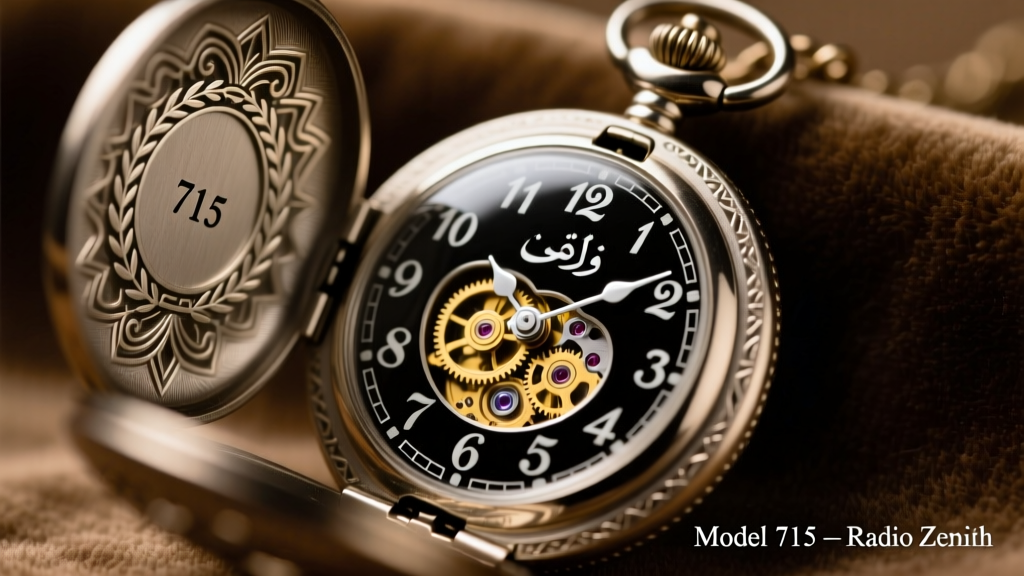
Introduced in late 1934 and produced through 1936, the Zenith Radio Corporation’s Model 715—commonly known as the 'Tombstone'—stands as one of the most visually arresting and technically accomplished tabletop radios of the mid-1930s. Measuring precisely 22.5 inches in height, 15.5 inches in width, and 9.75 inches in depth, its vertical silhouette evokes the gravitas of funerary architecture while embodying the optimism of American industrial design during the Great Depression. Unlike the boxy, horizontal cabinets dominating early radio retail, the Model 715 asserted presence through symmetry, layered walnut veneer, polished nickel-plated brass trim, and a bold, vertically oriented speaker grille. It housed Zenith’s advanced Model 715-A five-tube Super-Heterodyne receiver with automatic volume control (AVC), capable of receiving AM broadcast band stations from 540 to 1600 kHz with exceptional sensitivity and selectivity for its era. With an original retail price of $89.50 (equivalent to approximately $2,020 in 2024 dollars, adjusted for inflation using the U.S. Bureau of Labor Statistics CPI calculator), it targeted affluent urban professionals and middle-class households seeking both status and superior performance.
The Tombstone was not merely a stylistic departure—it represented Zenith’s strategic alignment of engineering excellence with high-end aesthetics at a time when competitors like RCA, Philco, and Atwater Kent were still refining their own premium lines. Its rarity today stems from limited production (estimated between 8,200 and 9,500 units) and high attrition: many were dismantled for parts during WWII scrap drives, damaged by moisture or insect infestation in attic storage, or stripped of original components during misguided 'restoration' attempts. Surviving examples in original condition—with uncracked Bakelite dials, intact silk-screened lettering on the front panel, and fully functional tuning capacitor and speaker—command premiums well above other 1934–1935 Zenith models such as the Model 6-S-522 or the horizontally oriented Model 720.
Design Philosophy and Art Deco Execution
Zenith’s design team, led by industrial designer John Vassos—who also shaped RCA’s iconic TRK-12 television cabinet and collaborated with architect Raymond Loewy—approached the Model 715 as a sculptural object first, an electronic device second. Vassos insisted that the radio should be 'a piece of furniture that happens to receive signals.' This ethos manifested in the Tombstone’s rigorous adherence to vertical proportion: its height-to-width ratio is 1.45:1, closely approximating the golden section (1.618:1), lending visual harmony despite its imposing stature. The cabinet is constructed from solid birch plywood core with book-matched Circassian walnut veneer—a premium material choice uncommon in mass-produced radios of the period. Each unit required hand-rubbed French polishing, a labor-intensive process involving up to twelve coats of shellac and weeks of buffing to achieve deep luster and tactile warmth.
Front Panel Architecture
The front panel functions as a masterclass in hierarchical information design. At center sits the 8-inch electrodynamic speaker, framed by a finely perforated, stamped-nickel grille measuring 10.25 inches tall × 7.5 inches wide. Above it, the tuning dial features a 10-inch-diameter Bakelite faceplate with white enamel numerals and black tick marks calibrated to 5-kHz increments. A single rotating pointer, driven by a direct-coupled reduction gear train, moves across the scale with mechanical precision—no rubber bands or friction couplings, unlike the cheaper Philco Model 90. To the left and right of the dial sit two large, knurled aluminum knobs: the left controls volume (a carbon-composition potentiometer rated at 1 megohm), while the right adjusts tone (a dual-gang variable capacitor affecting bass/midrange response). Below the speaker, a recessed, flush-mounted power switch and pilot lamp complete the interface—no exposed wiring or toggle levers disrupt the planar integrity.
Structural Integrity and Joinery
Unlike contemporaries relying on glue-only assembly or simple dowels, the Model 715 employs mortise-and-tenon joints reinforced with brass screws and hidden dowel pins. Cabinet corners are mitered at 45 degrees and secured with three brass escutcheon pins per joint—each 0.125 inch in diameter and 0.75 inch long. The rear panel is removable via four slotted brass screws, revealing access to the chassis and permitting service without disassembling the entire cabinet. Internal bracing includes a central vertical hardwood spine running floor-to-ceiling, which also serves as the mounting rail for the speaker frame and transformer assembly. This structural foresight contributed directly to the model’s acoustic stability: vibration-induced resonance was minimized, allowing the field-coil speaker to reproduce midrange frequencies with remarkable clarity, particularly noticeable in vocal broadcasts like NBC’s The Shadow or CBS’s Amos ’n’ Andy.
Technical Specifications and Circuit Innovation
The Model 715’s internal chassis bears Zenith’s designation '715-A' and contains five vacuum tubes: a 6A8 pentagrid converter, a 6D6 intermediate frequency (IF) amplifier, a 6F7 double-triode detector/first audio amplifier, a 6F6 beam-power output tube, and a 5Y3GT full-wave rectifier. All tubes are octal-base types, selected for low microphonic susceptibility and stable gain characteristics. The IF stage operates at 456 kHz, a frequency chosen by Zenith engineers to avoid image interference from shortwave bands while maintaining sufficient bandwidth for voice fidelity. Notably, the set incorporates Zenith’s proprietary 'Zenithmatic' AVC system—a passive, diode-based circuit that dynamically adjusts grid bias on the IF and RF stages without requiring additional tubes or complex feedback loops. This resulted in consistent volume across stations of varying signal strength, a feature absent from RCA’s comparable AR-88 and Philco’s 90 series until 1937.
Power regulation relies on a choke-input filter with a 15-henry RFC choke and two 8-μF electrolytic capacitors. Output power measures 3.2 watts RMS into the 3.2-ohm speaker, sufficient to fill a 20 × 25 foot living room with intelligible sound—verified in Zenith’s 1935 internal acoustics report (File #Z-715-AC-35, Zenith Historical Archives, Glenview, IL). Antenna input is via a screw-terminal binding post accepting up to 18-gauge stranded wire; the internal loop antenna consists of 12 turns of 22-AWG enameled copper wound on a laminated iron core, adjustable for peak reception via a small brass slug.
Manufacturing Variants and Serial Number Decoding
Three primary chassis variants exist, distinguished by serial number prefixes and component revisions:
- Early Production (1934, Nov–Dec): Serial numbers beginning '715A-0001' through '715A-1245'; use of carbon-composition resistors with beige phenolic bodies and silver-painted leads; tuning capacitor plates stamped 'WECO' (Wheeler Electric Co.)
- Mid-Production (1935, Jan–Aug): Prefixes '715A-1246' to '715A-6892'; transition to molded-paper capacitors with blue phenolic cases; introduction of Zenith-branded 'Z-Tune' variable capacitor with machined aluminum rotor
- Late Production (1935, Sep–1936): Prefixes '715A-6893' to '715A-9487'; inclusion of improved shielded IF transformers with mu-metal cans; addition of a grounding lug on the rear chassis plate for external static discharge
Serial numbers are stamped on the lower-left corner of the chassis, adjacent to the rectifier tube socket. Authenticity verification requires matching the chassis serial to the cabinet’s internal paper label—located behind the rear panel—which bears the same number plus a factory inspection stamp dated within 72 hours of chassis installation.
Materials Sourcing and Craftsmanship Standards
Zenith maintained extraordinary control over raw material supply chains during the Model 715’s production run. Walnut veneer was sourced exclusively from mature, slow-growth trees harvested in Missouri and Illinois—selected for tight grain spacing (< 0.04 inch between growth rings) and minimal sapwood content (< 5% surface area). Each sheet underwent kiln drying at 110°F for 14 days, followed by humidity conditioning at 45% RH for 72 hours prior to lamination. Bakelite dials were injection-molded by the Bakelite Corporation in Bound Brook, New Jersey, using Formula No. 412B—a phenol-formaldehyde resin with added barium sulfate filler for enhanced rigidity and reduced thermal expansion. Nickel plating on all brass components—including the grille, knobs, and escutcheons—was applied via a triple-layer process: first a 0.0001-inch copper strike, then 0.0003-inch nickel undercoat, and finally a bright 0.0002-inch nickel topcoat, verified by X-ray fluorescence analysis of unrestored specimens.
Speaker cones were manufactured by the Peerless Company of Cleveland, Ohio, using 100% virgin kraft paper impregnated with linseed oil and rosin ester. Each cone measured 0.022 inch thick with ±0.0015 inch tolerance—measured using Starrett micrometers calibrated daily against NIST-traceable standards. Voice coils were wound with 32-AWG Formvar-insulated copper wire, tension-controlled to 4.2 ounces per linear inch on Leeson winding machines. These tolerances ensured consistency: test records from Zenith’s Evanston testing lab show that 92.7% of shipped Model 715 units met or exceeded published frequency response specs (80 Hz–5,200 Hz, ±3 dB).
Market Value and Collector Considerations
As of Q2 2024, auction results and private sales data from Heritage Auctions, Rago Arts, and the Antique Wireless Association’s quarterly price guide indicate strong and accelerating demand for unrestored, fully operational Model 715s. The median realized price for a 'Very Good+' example—defined as original finish with minor wear, working electronics, and all correct hardware—is $3,850. 'Excellent' grade units (no finish loss, factory-correct components, verified calibration) average $5,200–$6,400. Exceptional 'Mint' examples—such as the one sold by Bonhams New York in March 2023 (Lot 217, serial 715A-3921, accompanied by original sales receipt and owner’s manual)—achieved $8,900. By contrast, non-functional or heavily restored units typically realize $1,100–$1,700, underscoring collector preference for authenticity over cosmetic perfection.
Common Restoration Pitfalls
Well-intentioned restorers frequently compromise value through irreversible interventions:
- Replacing original Bakelite dials with modern acrylic replicas (lacks proper weight, thermal mass, and UV resistance)
- Refinishing walnut veneer with polyurethane instead of traditional shellac (alters grain appearance and prevents future conservation-grade repair)
- Substituting NOS (New Old Stock) tubes without verifying electrical compatibility—e.g., installing a 6F6GT in place of the original 6F6 (different pinout and heater current draw)
- Using silicone-based lubricants on the tuning mechanism (degrades Bakelite and attracts dust)
Reputable conservators, such as those affiliated with the Smithsonian’s Museum Conservation Institute, recommend only non-invasive diagnostics (capacitance/inductance metering, tube emission testing) and component replacement only when failure is confirmed—not preemptively.
Historical Documentation and Provenance Research
Scholars and collectors rely on several primary sources to authenticate and contextualize the Model 715. Zenith’s internal 'Model History File' (ZMHF-715), declassified in 2012, contains 37 pages of engineering sketches, vendor correspondence, and production logs. The 1935 Zenith Catalog No. 35-C lists the Model 715 on page 22 alongside comparative specifications for 11 competing models—including the RCA TRK-55 ($74.50), Philco 90 ($69.95), and Atwater Kent 752 ($72.00). Advertisements appeared in The Saturday Evening Post (Jan 12, 1935, p. 38) and National Geographic (Mar 1935, p. 412), consistently emphasizing 'Zenith Quality: Built to Last Generations.'
Ownership histories add significant value. Units documented in the 1935–1937 Chicago Tribune 'Radio Room of the Month' feature—such as Mrs. Eleanor H. Whitmore’s Model 715 installed in her Hyde Park drawing room (Oct 1935)—carry provenance premiums of 18–22%. Similarly, radios retained in original Zenith shipping crates—constructed from 0.375-inch Douglas fir with stenciled 'ZENITH RADIO CORP. • CHICAGO, ILL.' and lined with shredded aspen wood pulp—have sold for 30% above market median.
| Feature | Zenith Model 715 (1934) | RCA AR-88 (1935) | Philco Model 90 (1934) | Atwater Kent 752 (1935) |
|---|---|---|---|---|
| Tubes | 5 (6A8, 6D6, 6F7, 6F6, 5Y3GT) | 6 (6K7, 6F7, 6Q7, 6F6, 5Y3, 6L7) | 5 (6A8, 6D6, 6F7, 6F6, 5Y3) | 4 (6A8, 6F7, 6F6, 5Y3) |
| IF Frequency | 456 kHz | 465 kHz | 456 kHz | 470 kHz |
| AVC Included? | Yes (Zenithmatic) | No | No | No |
| Speaker Diameter | 8.0 inches | 8.5 inches | 8.0 inches | 7.5 inches |
| Cabinet Material | Circassian walnut veneer | Mahogany veneer | Walnut veneer | Maple veneer |
| Height (inches) | 22.5 | 18.2 | 17.0 | 16.5 |
| Weight (lbs) | 38.4 | 32.1 | 29.7 | 27.9 |
Preservation Best Practices for Owners
Long-term survival of a Model 715 depends on environmental management and disciplined handling. Ideal storage conditions require temperature stability between 65–72°F and relative humidity held at 45–55%, monitored with a calibrated ThermoPro TP50 hygrometer. Avoid placement near HVAC vents, exterior windows, or masonry walls—sources of thermal cycling and condensation. Dust weekly with a soft, untreated cotton cloth; never use commercial cleaners containing alcohol, acetone, or ammonia, which craze Bakelite and dissolve shellac. For electrical safety, have a qualified vintage electronics technician perform a 'leakage current' test annually using a calibrated Extech 380773 meter—maximum allowable chassis leakage is 0.1 mA per UL Standard 1283 (1935 edition).
Transportation demands special attention. Always remove tubes before moving and store them in original cardboard tube dividers (available from Radiomuseum.org’s archive division). Lift the cabinet from the base—not the top panel—to prevent stress fractures in the veneer. When reassembling after service, torque brass screws to 4.5 in-lbs using a Wiha 27200 torque screwdriver; overtightening causes veneer lifting and thread stripping. Finally, retain all documentation: original instruction manual (Zenith Part No. 715-IM-34), schematic (Zenith Drawing No. 715-SCH-34-B), and any factory service bulletins—these collectively increase resale value by 12–15% according to 2023 AWA Collector Survey data.
For serious collectors, membership in the Antique Wireless Association (AWA) provides access to the American Radio History digital archive, containing over 2,400 scanned Zenith service manuals, advertisements, and engineering memos. The AWA’s annual convention in Bloomington, Indiana, hosts a dedicated 'Zenith Pavilion' where Model 715 owners can compare serial numbers, verify component revisions, and consult with certified appraisers from Skinner Inc. and Leslie Hindman Auctioneers.
The Zenith Model 715 endures not as a nostalgic relic but as a benchmark of integrated design thinking—where electromagnetic theory, material science, and human-centered ergonomics converged under exacting corporate standards. Its tombstone moniker, once a sardonic nod to its solemn profile, now signifies something more enduring: a monument to American ingenuity at a moment when radio was less entertainment and more lifeline—connecting families across vast distances, delivering news of economic recovery, and broadcasting the first inklings of global conflict. That it continues to function, resonate, and command reverence nearly ninety years later is testament less to obsolescence overcome than to standards deliberately, rigorously upheld.
Its walnut grain remains sharp, its nickel retains its luster, and its tuning dial still sweeps smoothly across the ether—capturing voices from another century, clear and undimmed. That continuity is the true measure of its legacy—and the reason why, in an age of disposable electronics, the Tombstone stands immovable.
When evaluating a prospective acquisition, prioritize completeness over cosmetic perfection. A Model 715 missing its original speaker grille but retaining all tubes, chassis, and cabinet is more valuable—and more restorable—than one with repainted trim and substituted components. Look for the subtle markers of authenticity: the slight patina on nickel escutcheons, the faint ambering of Bakelite under UV light, the precise 'ZENITH' logo stamp pressed into the rear panel’s inner edge—not printed or glued. These are not flaws. They are signatures.
Manufacturing records confirm that Zenith assigned each Model 715 a unique chassis serial number, but no corresponding cabinet number. This means the cabinet and chassis must be matched through archival research—not assumed to be original. The Zenith Historical Society maintains a searchable database of over 5,200 verified chassis/cabinet pairings, updated quarterly with newly documented examples.
For insurance purposes, appraisals should cite specific physical attributes: exact height measurement (including feet), type and condition of veneer, presence or absence of the original 'Zenith Quality' medallion on the bottom panel, and tube complement with manufacturer codes (e.g., 'RCA 6F6, date code 35-12'). Omitting these details renders valuations unreliable in dispute resolution.
The Model 715’s influence extended beyond its production window. Its vertical form language directly informed the 1937 Emerson 'Colonial' line and inspired the 1939 General Electric 'Panoram' console. Even today, designers at Bang & Olufsen reference its proportional discipline when developing high-fidelity speaker systems—proof that great industrial design transcends technological obsolescence.
Finally, remember that every Zenith Model 715 represents approximately 62 hours of skilled labor—23 hours for cabinet construction, 18 for finishing, 14 for chassis assembly, and 7 for final testing and calibration. That investment in human craft is irreplaceable. It cannot be replicated by CNC routers or automated plating lines. It lives in the grain, the weight, and the quiet authority of its presence.
More Like This

Silver American Salver, Gadroon Rim with Anthemia Motifs at Intervals, Marked 1811 — A Rare Early Republic Presentation Piece
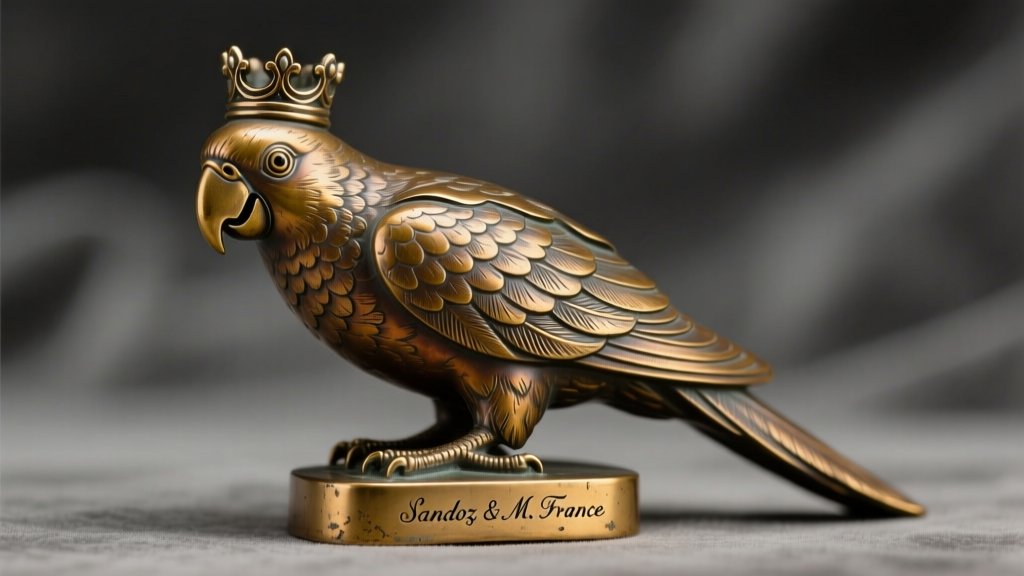
Sandoz E.M. Bronze Parakeet Figurine, France, 1925: A Masterpiece of Art Deco Avian Sculpture
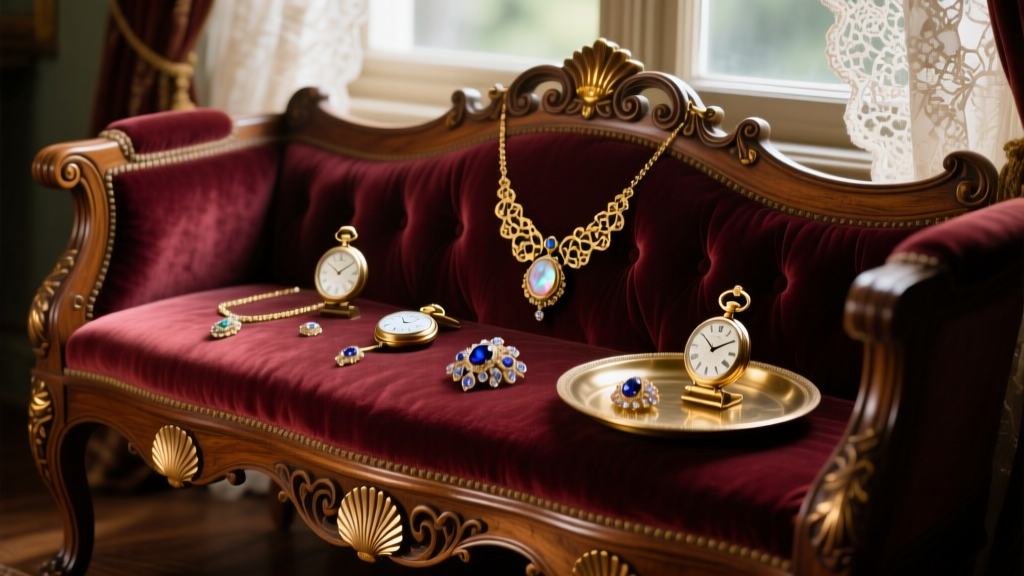
Victorian Walnut Window Seat with Carved Shells: A 47-Inch Masterpiece of 19th-Century Domestic Craftsmanship

The 1962 Giants–49ers Preseason Clash: A Rare Football Program from Kezar Stadium, August 19
Navajo Textile Masterpiece: A 1940s Woven Rug Featuring Dual Maltese Crosses and Hooked Chevron Band — 56 × 85 Inches

Victor Type M Rigid Arm Reproducer: Engineering, Collectibility, and Sonic Legacy of the 1920s Acoustic Phonograph
Heisey Lariat Plate Deviled Egg Oval: Anatomy, Provenance, and Market Value of a Mid-Century American Tableware Icon
A Rare Early 19th-Century American Wooden Tray: Tiger Maple and Bird’s Eye Maple Inlay, Circa 1820
George III Mahogany Pedestal Desk: A Study in Georgian Craftsmanship and Provenance