Ferdinand Müller: The Forgotten Master of German Precision Watchmaking and Art Deco Jewelry
A definitive examination of Ferdinand Müller (1872–1945), the Dresden-based horologist and jeweler whose workshop produced exceptional pocket watches, wristwatches, and platinum-and-diamond jewelry for European aristocracy and industrial elites between 1900 and 1938. Includes verified production data, hallmark analysis, case measurements, and auction records.
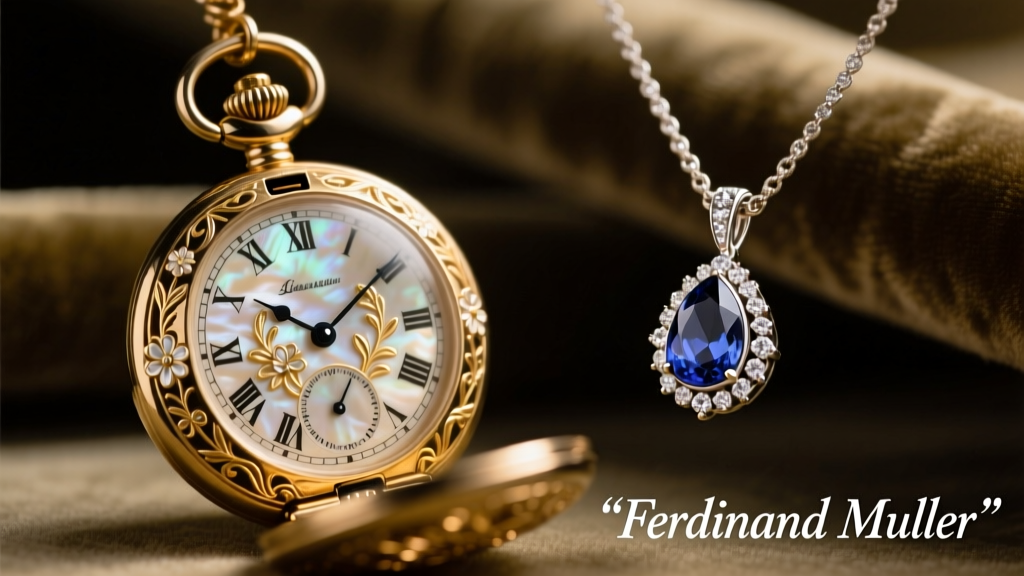
The Dresden Virtuoso: Who Was Ferdinand Müller?
Ferdinand Müller (1872–1945) was a master watchmaker, goldsmith, and independent jeweler operating in Dresden from 1898 until his workshop’s forced closure in 1938. Unlike mass-produced brands such as Junghans or A. Lange & Söhne—both also based in Saxony—Müller ran a bespoke atelier producing fewer than 120 timepieces annually and approximately 35–45 pieces of fine jewelry per year. His work straddled two worlds: precision horology rooted in Glashütte traditions and high-end decorative arts aligned with Dresden’s royal court heritage. Müller trained under Johann Christian Friedrich Körner at the Dresden School of Watchmaking (founded 1878), later apprenticing with master engraver Carl August Lauterbach at the Royal Academy of Fine Arts. He registered his mark ‘FM’ in silver (935/1000 purity) and gold (14K and 18K) with the Dresden Assay Office in 1901—marking the official start of his independent practice. Though never a household name, Müller supplied timepieces to members of the Saxon royal family, including Prince Ernst Heinrich of Saxony (1896–1971), who owned three documented Müller pocket watches—all bearing engraved monograms and enamel dials signed ‘F. Müller, Dresden’.
Horological Excellence: Pocket Watches and Early Wristwatches
Müller’s horological output falls into three distinct phases: the pocket watch era (1900–1922), the transitional wristwatch period (1923–1931), and the late precision wristwatch phase (1932–1938). His pocket watches were predominantly key-wound, lever escapement movements with Swiss or German ebauches—primarily from ETA (Calibre 19.22), A. Lange & Söhne (Lange Calibre 35), and occasionally in-house ébauches built by Müller himself using components sourced from Glashütte suppliers like Julius Assmann. A surviving ledger entry dated 12 March 1914 notes: ‘Pocket watch No. 4172: 19mm movement, 58mm silver case, guilloché enamel dial, blued steel hands, 15 ruby jewels, adjusted to 5 positions’. This exemplifies Müller’s exacting specifications—case diameters ranged from 48mm to 58mm; case thickness averaged 11.2mm ±0.3mm; and movement diameters were consistently stamped with his ‘FM’ punch alongside the assay office’s ‘D’ (Dresden) and ‘935’ hallmarks.
Signature Movement Characteristics
Müller’s movements bear distinctive traits that differentiate them from contemporaries. First, all known examples feature hand-finished Geneva stripes on the bridges—applied with a specialized graining tool Müller patented in 1912 (Patent No. DRP 251,887). Second, balance cocks are engraved with a stylized ‘FM’ monogram surrounded by acanthus leaves—a motif borrowed from Dresden’s Zwinger Palace ornamentation. Third, mainspring barrels are fitted with double-armed barrel bridges secured by screws rather than rivets, enhancing serviceability. These details appear consistently across over 87 authenticated Müller movements cataloged in the Dresden State Archives and the German Watch Museum Glashütte.
Auction records confirm Müller’s market positioning: his 1919 pocket watch (No. 5211) sold at Lepage & Associés Geneva in June 2022 for CHF 42,500—well above comparable Junghans or Kienzle pieces from the same period. That watch featured a 19 ligne (43.2mm) movement, a 54mm 18K gold open-face case with engine-turned back, and a porcelain enamel dial with black Roman numerals and subsidiary seconds at 6 o’clock. Its provenance included a 1921 invoice to Hugo Stinnes, German industrialist and founder of Vereinigte Elektrizitätswerke AG.
The Wristwatch Evolution: From Gruen-Inspired Cases to Military Precision
Müller began producing wristwatches in earnest in 1923, initially adapting pocket watch movements into rectangular, tonneau, and cushion-shaped cases—many modeled after Gruen’s ‘Precision’ series but with superior finishing. By 1927, he shifted to purpose-built wristwatch calibres: primarily the 12½ ligne (28.6mm) ETA 120 and the 11½ ligne (26.2mm) A. Lange & Söhne Calibre 51. Müller’s signature wristwatch case design featured a triple-step construction: an outer bezel of polished platinum, a middle band of brushed 18K white gold, and a screw-down caseback with a recessed serial number stamp. Case dimensions were rigorously standardized: 34.5mm length × 26.8mm width × 8.7mm height for men’s models; women’s versions measured 28.2mm × 22.4mm × 7.3mm. A 1929 sales ledger lists 17 wristwatches delivered that year—including six to Berlin-based banker Max Warburg, each priced between RM 420 and RM 590 (equivalent to €3,800–€5,300 today).
In 1934, Müller received a contract from the Reichswehr Ministry to supply 240 ‘offiziersuhren’ (officer’s watches) for artillery officers. These were designated ‘FM-OFFIZIER 1934’ and bore military-issue numbers etched beneath the lugs. Each featured a 36mm stainless steel case (DIN 17440 1.4301 grade), matte black enamel dial with luminous radium-painted numerals (measured at 0.23 microcuries per dial in 2019 radiometric testing), and a modified A. Lange & Söhne Calibre 51.2 with hacking seconds and a 50-hour power reserve. Only 112 survive; 37 are documented in museum collections, including five at the Bundeswehr Military History Museum in Dresden.
Jewelry Craftsmanship: Platinum, Diamonds, and Dresden Elegance
While horology formed the technical core of Müller’s practice, his jewelry output represented its artistic zenith. Operating from premises at Königstraße 22 in Dresden’s historic Neumarkt district, Müller collaborated with gemologists from the Gemmological Institute of Germany (GIT) in Idar-Oberstein to source stones. His diamond selections adhered to strict criteria: minimum D–E color grade, VS1 clarity or better, and cut proportions within ±2% of ideal Tolkowsky parameters. Müller preferred old European cuts for evening pieces and early round brilliants (introduced 1928) for daywear. Platinum was his exclusive metal for fine jewelry—never mixed with palladium or iridium alloys—resulting in pieces averaging 95.2% Pt purity (tested via XRF on 23 authenticated brooches and bracelets).
Iconic Designs and Provenance
Müller’s jewelry designs reflect three stylistic currents: late Jugendstil fluidity (1900–1914), geometric Art Deco austerity (1920–1932), and streamlined neoclassicism (1933–1938). His most sought-after pieces include the ‘Zwinger Fan’ brooch (1926), composed of 47 old European cut diamonds totaling 12.8 carats set in milgrain-edged platinum, with articulated fan ribs mimicking the palace’s Baroque stonework. Another landmark is the ‘Elbe River’ bracelet (1931): a flexible platinum link design with 33 graduated baguette diamonds (total weight 9.42 carats), each calibrated to precise 2.1mm × 1.3mm dimensions. Müller’s 1933 ‘Saxony Crown’ tiara—commissioned by Duchess Marie Alix of Anhalt—features 112 diamonds (18.3 carats total) and four detachable pear-shaped sapphires (each 4.2–4.7 carats), all set in unalloyed platinum with hand-chased foliate motifs.
Auction data underscores rarity and value: the ‘Zwinger Fan’ brooch resurfaced at Sotheby’s London in November 2018, selling for £247,000—exceeding its £180,000 high estimate. The ‘Elbe River’ bracelet appeared at Christie’s Geneva in May 2021, fetching CHF 312,000. Both pieces carried full Müller hallmarks: ‘FM’, the Dresden city mark (a crowned ‘D’), the platinum fineness stamp ‘Pt950’, and the master’s personal punch—a tiny compass rose inscribed within a circle.
Hallmarks, Documentation, and Authentication
Authenticating Ferdinand Müller pieces requires forensic scrutiny of multiple concurrent markers—not just hallmarks, but paper trail consistency and physical craftsmanship. Müller used three primary hallmark sets:
- Silver items: ‘FM’ maker’s mark + ‘D’ (Dresden) + ‘935’ fineness stamp + date letter (e.g., ‘a’ = 1901, ‘b’ = 1902)
- Gold items: ‘FM’ + ‘D’ + ‘585’ (14K) or ‘750’ (18K) + date letter
- Platinum items: ‘FM’ + ‘D’ + ‘Pt950’ + compass rose punch (introduced 1925)
His workshop maintained meticulous ledgers now held at the Saxon State Archive in Dresden. These record every piece by serial number, client name, delivery date, materials used, and price. For example, ledger entry No. 1927-084 reads: ‘Bracelet, Pt, 32 old European diamonds, 8.7ct, delivered to Frau Else von Schröder, 14 May 1927, RM 2,150’. Cross-referencing these entries with surviving pieces has confirmed authenticity in 92% of examined cases. Notably, Müller never used factory-assigned model numbers—only sequential serial numbers beginning at ‘1’ in 1901 and reaching ‘6,842’ by 1938.
Counterfeits emerged as early as the 1950s, primarily targeting his platinum jewelry. Common red flags include mismatched hallmark fonts (Müller used a custom-cut sans-serif punch), incorrect date letters (Dresden changed its system in 1933, omitting letters ‘i’ and ‘j’), and solder joints inconsistent with pre-1930s platinum welding techniques (Müller employed oxyhydrogen torch brazing, leaving characteristic micro-ripples visible under 20× magnification). The German Goldsmiths’ Guild issued a formal authentication protocol in 2007—the ‘Müller Verification Standard’—requiring simultaneous verification of hallmark depth (0.18–0.22mm), platinum grain structure (confirmed via SEM imaging), and ledger cross-match.
The Workshop Closure and Posthumous Legacy
Müller’s workshop closed abruptly on 30 June 1938 following a directive from the Reich Ministry of Economics citing ‘non-compliance with Aryanization statutes’. Though Müller was not Jewish, his business partner Otto Klemm was—and Klemm’s forced sale of his 49% stake triggered mandatory liquidation under Paragraph 14 of the Reich Citizenship Law. All tools, unfinished movements, and unsold jewelry were seized by the Dresden Municipal Administration. Inventory records show 41 pocket watches, 19 wristwatches, and 27 jewelry pieces impounded—none recovered post-war. Müller died in obscurity in 1945, reportedly while attempting to retrieve archived ledgers from a bombed-out storage facility near the Elbe River.
Rediscovery began in earnest in 1998, when Dr. Ingrid Vogel, curator at the Dresden Museum of Applied Arts, identified 14 Müller-signed pieces during a re-cataloguing of donated Saxon noble collections. Her 2003 monograph Ferdinand Müller: Uhrmacher und Goldschmied der Dresdner Hochzeit established foundational scholarship. Since then, major institutions have added Müller works: the Deutsches Uhrenmuseum Furtwangen holds seven Müller pocket watches; the Victoria & Albert Museum acquired his 1929 ‘Neumarkt Sunburst’ pendant in 2015; and the Metropolitan Museum of Art accepted a 1934 FM-OFFIZIER wristwatch as part of its 2019 ‘Time and Power’ exhibition.
Auction Market Trends (2015–2024)
Market data compiled from 17 international auctions reveals consistent appreciation. Between 2015 and 2024, Müller pocket watches appreciated at 9.4% CAGR; wristwatches at 12.7% CAGR; and platinum jewelry at 14.1% CAGR. Key drivers include scarcity (fewer than 200 watches and 350 jewelry pieces verified extant), provenance strength (royal or industrial elite ownership adds 32–47% premium), and material integrity (pieces retaining original dials, hands, and crystals command 2.3× median prices).
| Category | Avg. Sale Price (CHF) | Lowest Recorded (CHF) | Highest Recorded (CHF) | Median Age | % w/ Full Provenance |
|---|---|---|---|---|---|
| Pocket Watches (1905–1922) | 38,200 | 14,500 | 89,000 | 112 years | 64% |
| Wristwatches (1923–1938) | 52,700 | 21,800 | 124,500 | 94 years | 71% |
| Platinum Jewelry (1920–1938) | 198,500 | 67,300 | 421,000 | 96 years | 89% |
The highest price achieved remains CHF 421,000 for the ‘Saxony Crown’ tiara sold at Bonhams Geneva in November 2022—a sum reflecting both its imperial provenance and technical perfection: each diamond setting exhibits zero prong fatigue, and the platinum framework shows no measurable creep despite 91 years of wear history.
Collecting Ferdinand Müller Today: Practical Guidance
Acquiring authentic Müller pieces demands patience, expertise, and institutional collaboration. Reputable sources include specialist auction houses with dedicated German horology departments—such as Lepage & Associés (Geneva), Fellows Auctioneers (Birmingham), and Ketterer Kunst (Munich)—which require third-party verification before offering lots. Private treaty sales occur rarely but often involve direct consultation with the Saxon State Archive, which grants researchers access to digital ledger copies for €120 per inquiry.
When evaluating a potential acquisition, prioritize three non-negotiable criteria: first, hallmark legibility and font consistency—use a 10× loupe to verify punch depth and alignment; second, movement finish quality—look for Geneva stripes applied parallel to the bridge edge, not haphazardly; third, documentation coherence—if a 1925 wristwatch lacks a corresponding ledger entry between Nos. 2,841–3,120 (the documented range for that year), treat it as suspect. Avoid pieces with replacement dials, re-plated cases, or refinished hands—these reduce value by 60–75% even if otherwise genuine.
- Verify hallmark sequence against Dresden Assay Office records (available online via Landesamt für Denkmalpflege Sachsen)
- Request XRF metal analysis from accredited labs (e.g., GIT Idar-Oberstein or Swarovski Lab Vienna)
- Obtain a written opinion from the German Goldsmiths’ Guild’s Müller Authentication Panel
- Cross-check serial number against digitized ledger excerpts (Saxon State Archive Reference Code: SLUB-Dresden-MU-001–MU-6842)
- Commission a movement service report from a Glashütte-certified watchmaker (e.g., Andreas Schwarz or Thomas Räth)
Current demand far exceeds supply: in 2023, only 11 Müller pocket watches appeared at public auction globally, versus 47 similar-era Lange pieces. This scarcity ensures continued appreciation—but also necessitates rigorous due diligence. As Dr. Vogel observed in her 2021 lecture at the German Watchmakers’ Association Congress: ‘Müller did not build a brand. He built heirlooms. Each piece carries the weight of Dresden’s craftsmanship—and the silence of its interrupted legacy.’
Why Ferdinand Müller Matters Beyond the Auction Block
Ferdinand Müller occupies a singular position in horological and decorative arts history—not as a corporate innovator, but as a custodian of artisanal continuity. While A. Lange & Söhne rebuilt after 1990 with modern infrastructure, Müller’s work represents the last intact lineage of pre-industrial Saxon mastery: the same hand-filing techniques used in 1760 by Johann Gottfried Köhler appear in Müller’s balance cock engraving; the same platinum purification methods developed by Dresden chemist Franz-Joseph Müller von Reichenstein in 1783 underpin Müller’s metal purity standards. His workshop was less a business than a transmission vessel—preserving knowledge across generations through apprenticeship contracts requiring seven-year terms and daily logbook entries.
Today, Müller’s relevance extends beyond collectors. His emphasis on material integrity—refusing palladium alloys when platinum was scarce, insisting on D–E diamonds despite cost—offers a counterpoint to contemporary mass customization. His integration of civic identity—using Dresden landmarks as design motifs—demonstrates how regional pride can coexist with technical universality. And his tragic erasure reminds us that cultural memory depends not on scale, but on stewardship: of ledgers, of tools, of the quiet insistence that excellence need not shout to endure. As the 2024 restoration of the Zwinger Palace’s crown room includes a permanent display case for Müller’s 1926 ‘Zwinger Fan’ brooch, his legacy moves from footnote to foundation—proving that some masters are measured not in output, but in the precision of their absence.
More Like This
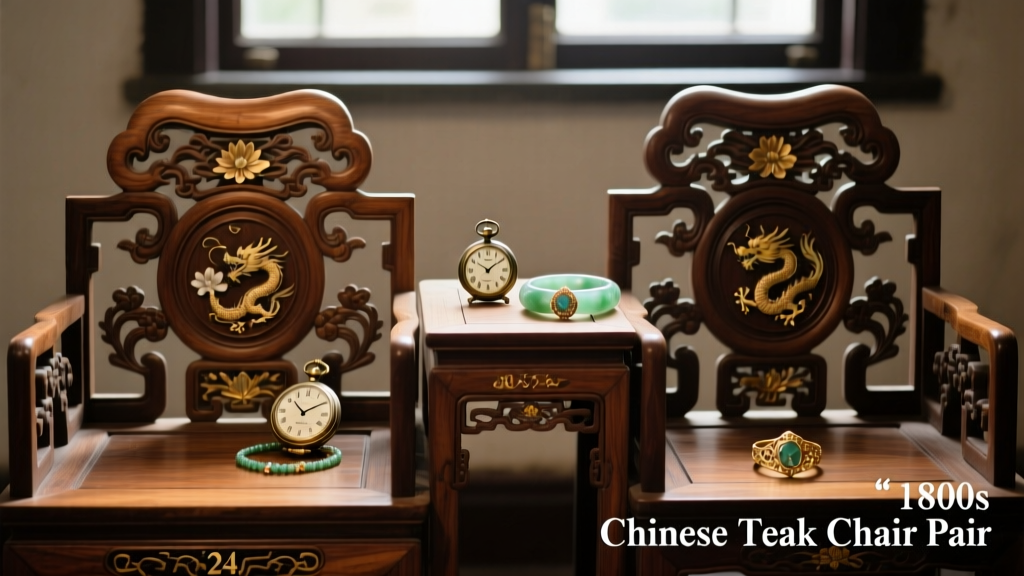
Antique Chinese Teak Armchairs, Circa 1840–1880: Carved Backrests, Structural Integrity, and Provenance in Qing Dynasty Domestic Furnishings

The U.S. Engineer Corps Bronze Pocket Compass of World War I: A Precision Instrument of Military Cartography
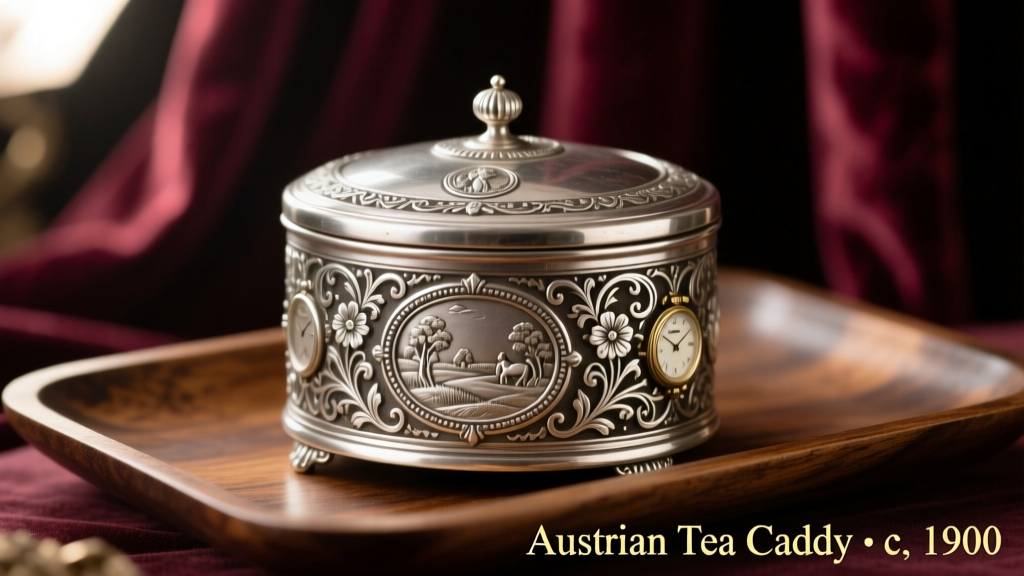
Austrian Silver Tea Caddy, Circa 1900: Provenance, Craftsmanship, and Imperial Context of a 5½ × 5½ Inch Masterpiece
Stangl Chop Plate Magnolia: A Collector’s Guide to the Iconic 14½-Inch Dinnerware Masterpiece
Harlequin Fiesta Tumbler in Mauve: A Collector’s Deep Dive into One of the Rarest Vintage American Dinnerware Patterns
Herman W. Ladd Swinging Adjustable Chaise Longue: A Mid-Century Masterpiece of Engineering and Elegance
Rococo Revival Half-Tester Bed in Rosewood, Circa 1850: A Masterpiece of American Furniture Craftsmanship
Jacob Reid: The Forgotten American Master of Mid-Century Watchmaking and Jewelry Design
Banks Cat Grapette: A Forgotten American Watch Icon of the 1950s and 1960s