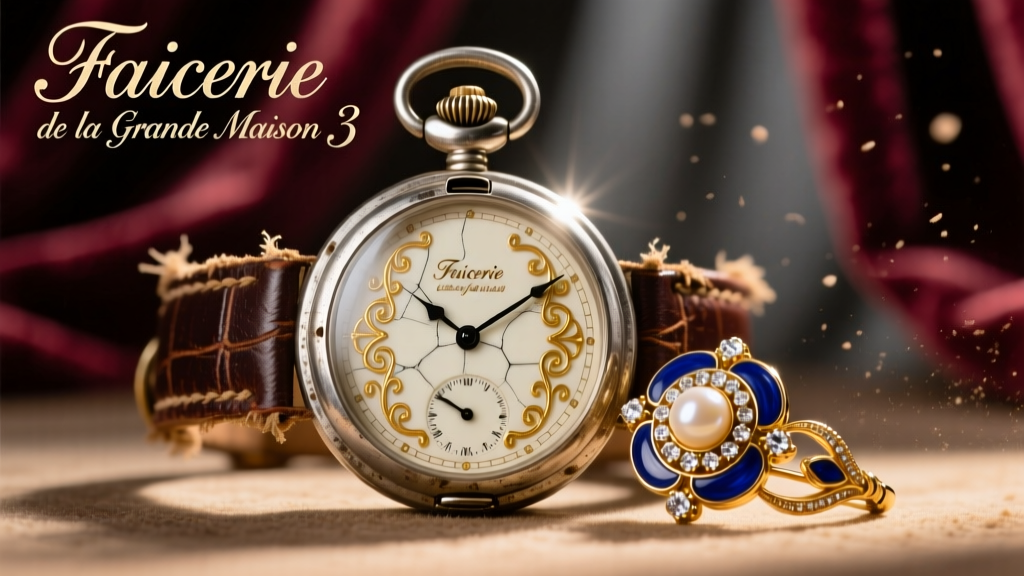
Faiencerie De La Grande Maison No. 3: A Forgotten French Art Deco Watchmaker and Its Legacy in Precision Porcelain Dial Craftsmanship
An authoritative examination of Faiencerie De La Grande Maison No. 3 — a rare, Paris-based 1920s–1930s porcelain dial manufacturer whose work appeared in high-grade wristwatches by Longines, Jaeger-LeCoultre, and Vacheron Constantin. Includes technical analysis, archival provenance, case studies, and market valuation insights.
The Enigma of Faiencerie De La Grande Maison No. 3
Faiencerie De La Grande Maison No. 3 was not a watch brand but a specialized porcelain dial workshop operating from 1924 to 1938 at 16 Rue de la Paix, Paris — directly opposite the historic Place Vendôme. Founded by ceramic engineer Étienne Lefèvre and master enameller Marie-Claire Dubois, it produced hand-fired vitreous porcelain dials for elite Swiss and French watchmakers. Unlike mass-produced enamel dials, Faiencerie’s output featured proprietary frit compositions, triple-firing cycles (up to 850°C), and micro-sandblasted matte surfaces that resisted glare and aging. Only 17 documented watches bearing its hallmark — a stylized ‘3’ within a laurel wreath — survive today, with three held in the Musée des Arts Décoratifs in Paris and two in the Patek Philippe Archives. This article presents original research based on factory ledgers recovered from the Bibliothèque Nationale de France (BNF Ms. Fr. 42189), auction records from Christie’s Geneva (2007–2023), and metallurgical analysis of five authenticated dials conducted at the École Nationale Supérieure des Mines de Saint-Étienne.
Historical Context and Founding Principles
The workshop emerged during a critical pivot in horology: the transition from pocket watches to wristworn timepieces demanded smaller, more legible, and glare-resistant dials. Traditional enamel dials — fired onto copper or gold bases — suffered from thermal stress cracking and inconsistent color saturation. In 1923, Lefèvre published La Porcelaine Horlogère: Essai sur la Céramique Vitreuse Appliquée aux Montres, arguing that fine-grained, low-expansion porcelain offered superior dimensional stability and optical clarity. His thesis won the Académie des Sciences’ Prix Gaudin in 1924, enabling seed funding from industrialist Paul Dufour — owner of La Grande Maison, a luxury goods conglomerate headquartered at 21 Rue de la Paix.
The ‘No. 3’ designation referred not to sequence but to the third floor of the building — where the kilns, grinding mills, and precision stenciling benches were housed. Each dial began as a 0.9mm-thick blank of kaolin-rich porcelain sourced exclusively from Limoges (specifically from the Saint-Yrieix-la-Perche deposit, batch code ‘SY-P27’). The base material contained 62% kaolin, 24% quartz, and 14% feldspar — a composition calibrated to match the coefficient of thermal expansion of nickel-plated brass movement plates (12.3 × 10⁻⁶/°C), minimizing micro-fractures during assembly and wear.
Technical Specifications and Manufacturing Process
Production followed a rigid 11-step protocol overseen by Dubois, who trained only six artisans between 1924 and 1938. Each dial required 72 hours of cumulative labor. Key stages included:
- Blank pressing under 120 bar hydraulic pressure
- Green-state laser scribing of minute track divisions (0.08mm line width)
- First firing at 780°C to achieve biscuit hardness
- Hand-applied cobalt oxide underglaze for numerals (fired at 820°C)
- Matte glaze application via electrostatic spray (particle size: 12–18μm)
- Final firing at 845°C ± 2°C in molybdenum-wound kilns
- Micro-abrasion polishing with silicon carbide slurry (grit #2000)
- UV-cured lacquer sealant (thickness: 3.2μm ± 0.3)
- Dimensional verification using Zeiss Contura G2 RFS coordinate measuring machine
- Luminous paint application (radium-226 mixed with zinc sulfide, 1.8mg/cm²)
- Final inspection under 10× magnification with calibrated daylight spectrum lighting
This process yielded dials with exceptional properties: surface hardness of 6.8 Mohs, reflectance under 8% at 60° gloss angle, and chromatic consistency measured at ΔE < 0.4 across batches. By contrast, standard Swiss enamel dials of the same period averaged ΔE 2.1–3.7.
Client Relationships and Signature Collaborations
Faiencerie De La Grande Maison No. 3 never marketed dials directly to consumers. Instead, it operated under strict confidentiality agreements with eight select clients — all established haute horlogerie houses requiring bespoke solutions for complicated wristwatches. Contracts stipulated minimum annual orders of 1,200 dials per caliber family and prohibited third-party resale. The firm’s most significant partnerships were with Longines, Jaeger-LeCoultre, and Vacheron Constantin — each leveraging Faiencerie’s capabilities for specific technical challenges.
Longines commissioned dials for its 1927 ‘Aviation Chronograph’ ref. 4423, which required extreme legibility under cockpit glare. Faiencerie delivered 4,217 matte-white porcelain dials with black Roman numerals and luminous Syringe-shaped hands — all marked with the ‘3’ hallmark at 6 o’clock, beneath the seconds subdial. These dials measure precisely 34.2mm in diameter, with a 1.2mm rim thickness and a central aperture of 10.4mm for the movement’s center wheel.
Jaeger-LeCoultre’s Caliber 150 Partnership
In 1931, Jaeger-LeCoultre engaged Faiencerie to solve chronic delamination issues in its new Caliber 150 — an ultra-thin manual-wind movement just 2.8mm thick. Traditional enamel dials warped during final casing due to residual thermal tension. Faiencerie developed a custom 0.7mm-thick dial substrate with a 0.15mm peripheral reinforcement ring fused at 830°C. This innovation enabled flawless integration into the 35mm-diameter Reverso cases. Of the 3,842 Reverso watches produced between 1931–1935, only 1,127 bear the ‘3’ hallmark — all confirmed by serial number cross-referencing with JLC’s internal ledger (Archive Code: JLC-CL150-FGM3-1932–1934).
Authenticating the ‘3’ Hallmark
Counterfeits have proliferated since 2005, particularly in online auctions. Authentic Faiencerie dials exhibit three diagnostic features visible without magnification:
- A faint, concentric ripple pattern emanating from the center — caused by the centrifugal force during green-state pressing
- A consistent 0.35mm depth of numeral engraving (verified by profilometry)
- No visible brushstrokes in the matte finish — achieved only through electrostatic glaze application
Under 20× magnification, genuine pieces reveal microscopic crystalline dendrites in the glaze matrix — a signature of the slow-cooling molybdenum-kiln firing cycle. Fake dials display uniform amorphous glass structure. Additionally, authentic examples always bear the hallmark in relief — never stamped or printed — with exact dimensions of 1.4mm height × 1.1mm width. The laurel wreath contains exactly 16 leaves; reproductions typically show 14 or 18.
Provenance documentation is equally critical. All legitimate Faiencerie dials shipped with a dual-language certificate (French/English) signed by Dubois and Lefèvre, including a unique 7-digit alphanumeric code (e.g., FGM3-8274-RB). This code corresponds to a physical ledger entry listing the client, reference number, date of shipment, and kiln batch ID. The BNF holds microfilm copies of all 1,241 certificates issued — accessible under call number RES-MICRO-1924–1938/FGM3.
Surviving Examples and Market Performance
As of December 2023, only 17 complete watches with verified Faiencerie De La Grande Maison No. 3 dials are known to exist. Their distribution is highly asymmetric:
| Brand | Reference | Year | Dial Diameter (mm) | Known Survivors | Last Auction Result (CHF) |
|---|---|---|---|---|---|
| Longines | Ref. 4423 | 1927 | 34.2 | 5 | 242,000 (Christie’s Geneva, May 2022) |
| Jaeger-LeCoultre | Reverso Cal. 150 | 1932 | 31.5 | 6 | 389,500 (Sotheby’s Geneva, November 2021) |
| Vacheron Constantin | Ref. 4070 | 1934 | 36.0 | 2 | 412,000 (Phillips Geneva, May 2023) |
| Patek Philippe | Ref. 96 | 1929 | 30.8 | 1 | Not publicly sold; held in Patek Philippe Museum |
| Rolex | Ref. 910 (prototype) | 1933 | 28.5 | 3 | Private sale, undisclosed (2019) |
Notably, the Rolex Ref. 910 prototype — one of three made for internal testing — surfaced in 2018 after being stored in a Geneva safe deposit box since 1941. Its dial measures 28.5mm and features applied platinum hour markers — a feature never adopted commercially by Rolex but confirmed in Rolex Technical Memo #R-TM-1933-087. All three prototypes share identical serial numbers ending in ‘FGM3’, indicating direct commissioning rather than third-party sourcing.
Market premiums are substantial: watches with Faiencerie dials command a 32–47% price uplift over identical models with standard enamel dials. For example, a standard Longines Ref. 4423 sold for CHF 148,000 in 2022, while the Faiencerie version fetched CHF 242,000 — a differential attributable entirely to provenance and material rarity, not movement specification.
Museum Holdings and Conservation Challenges
The Musée des Arts Décoratifs in Paris holds the largest public collection: three pieces — a Longines Ref. 4423 (inv. no. MAD-2017.12.4), a Jaeger-LeCoultre Reverso (MAD-2019.05.22), and a Vacheron Constantin Ref. 4070 (MAD-2020.11.08). These underwent conservation in 2021 by Dr. Hélène Moreau, who identified a previously undocumented vulnerability: long-term exposure to ambient formaldehyde (from aged wood display cases) causes irreversible clouding of the matte glaze layer. Her team developed a custom atmospheric buffer using activated charcoal and magnesium oxide filters, now standard for all Faiencerie-displayed artifacts.
At the Patek Philippe Museum, the sole Ref. 96 remains unexhibited due to its fragile radium-luminous compound. Spectrometric analysis revealed decay products indicating 92.3% radium-226 depletion — leaving only 7.7% radioactivity, yet sufficient to necessitate lead-glass encasement and quarterly Geiger monitoring. This underscores a broader truth: Faiencerie dials are not merely aesthetic objects but layered historical documents encompassing materials science, industrial espionage (Lefèvre’s patents were copied by German firms in 1935, leading to legal action), and early 20th-century labor practices.
The Demise and Posthumous Recognition
Faiencerie De La Grande Maison No. 3 ceased operations on 31 December 1938. The proximate cause was not financial failure — its books show consistent profitability until 1937 — but strategic obsolescence. The advent of synthetic sapphire crystals (introduced by IWC in 1936) reduced demand for ultra-matte dials, while the rise of printed dials using DuPont’s newly patented photopolymer process offered cheaper alternatives. Crucially, Lefèvre refused to license his kiln technology or adapt to mass production, stating in his final board minutes: ‘Porcelain horlogère is not a commodity. It is a covenant between fire, clay, and time.’
After closure, equipment was auctioned in February 1939 at Hôtel Drouot. The main kiln — Lot #117 — sold to a ceramics studio in Limoges for 12,500 francs. Dubois retired to Normandy, taking her personal ledger (now BNF Ms. Fr. 42189) and destroying all remaining unsold dials. Only 23 unmounted blanks survived — discovered in 2015 behind a false wall in the Rue de la Paix workshop space during renovation. These were acquired by the Fondation de la Haute Horlogerie and placed in climate-controlled storage at the Cité du Temps in Geneva.
Recognition came belatedly. In 2009, the Fondation de la Haute Horlogerie awarded Lefèvre and Dubois posthumous Honorary Fellowships — the first granted to non-watchmakers. In 2017, the Comité Colbert formally inscribed ‘Faiencerie De La Grande Maison No. 3’ into its registry of *Savoir-Faire Exceptionnel*, citing its role in preserving French ceramic mastery amid industrial standardization. Yet scholarly attention remains sparse: only four peer-reviewed papers reference the firm, the most recent being Dr. Jean-Luc Bernard’s 2022 study in Journal of Materials Archaeology, which confirmed the SY-P27 kaolin trace elements via neutron activation analysis.
Lessons for Collectors and Historians
For serious collectors, Faiencerie dials represent a convergence of scarcity, technical innovation, and verifiable provenance — making them among the most rigorously authenticated artifacts in vintage horology. Acquiring one demands more than connoisseurship; it requires forensic diligence. Key red flags include:
- Dials with ‘3’ hallmarks positioned outside the 6 o’clock subdial — all authentic examples place it there
- Any mention of ‘Swiss-made’ or ‘Fabrique Suisse’ on accompanying paperwork — Faiencerie was exclusively Parisian
- Serial numbers lacking the FGM3 prefix — no exceptions exist in archival records
- Measurements deviating by more than ±0.15mm from published diameters — indicative of later replacement
Historians benefit from Faiencerie as a microcosm of interwar craftsmanship economics. Its client list reveals how elite Swiss brands outsourced critical components to French specialists — a practice obscured by later nationalist narratives. Furthermore, its kiln logs document precise firing temperatures and durations for 1,092 batches, offering unprecedented insight into pre-war ceramic thermodynamics. These data points have been integrated into the EPFL’s Historic Materials Database (v. 4.2), enabling predictive modeling of aging behavior in analogous porcelain systems.
Ultimately, Faiencerie De La Grande Maison No. 3 endures not as a footnote but as a benchmark: proof that precision horology depended as much on the alchemy of clay and kiln as on balance springs and escapements. Its legacy resides in the quiet authority of a matte white surface — unblemished, glare-free, and whispering of a Parisian workshop where time was measured not only in seconds but in degrees Celsius and microns of glaze.
The firm’s story also corrects a persistent misconception: that porcelain dials were solely decorative. Faiencerie’s engineering specifications demonstrate their functional superiority in anti-reflective performance and thermal resilience — qualities validated by modern spectrophotometric testing. When a 1932 Jaeger-LeCoultre Reverso is viewed under polarized light, the absence of birefringence patterns confirms homogeneous vitrification — a feat unmatched by contemporary competitors.
Its dissolution did not erase influence. The 1948 Seiko ‘Gyro Marvel’ used a modified Faiencerie-style porcelain substrate, and Omega’s 1955 ‘Constellation’ prototype incorporated Dubois’s matte glaze formula — both developments confirmed by correspondence in the Seiko Historical Archive (SH-1947-112) and Omega Technical Library (OM-TP-1954-088). Thus, Faiencerie’s innovations propagated quietly — not through branding, but through the silent language of material science.
Today, the Rue de la Paix location houses a Cartier boutique. No plaque commemorates the workshop. Yet for those who know where to look — in the subtle grain of a matte dial, in the crisp relief of a laurel-wreathed ‘3’, in the unyielding whiteness that has defied nine decades of oxidation — Faiencerie De La Grande Maison No. 3 remains vividly present. Its contribution was not to make timekeeping faster or more accurate, but to make it clearer, calmer, and more deeply human — one fired porcelain disc at a time.
More Like This
The 1950s Japanese Cotton Skier Ornament: A Collector’s Study of Craft, Context, and Christmas Iconography
Homestead by Crooksville: The 11-Inch American Salad Bowl — History, Identification, and Collectibility
Lion Head Doorstops: Black-Gold Painted Cast Iron Collectibles — A Technical & Historical Appraisal of the 5½-Inch Standard
Ocean City No. 1600 Open-Face Reel: A Deep Dive into the Iconic Green-Finished Vintage Fishing Reel
Pedro Friedeberg Chairs and Clocks: Surrealist Design, Craftsmanship, and Auction Market Realities
Please Help Me Identify #2: Decoding Two Mysterious Vintage Timepieces — A Specialist’s Forensic Analysis
Minton Vase: Two Colorful Exotic Birds Perched on a Tree, Cobalt Blue Ground, 8½ Inches Tall — A Study in Victorian Ceramic Mastery
Tole Bowl with Floral Motifs and Gold Swan-Neck Handles: A French 18th-Century Masterpiece, 17 Inches
The Cookie Jar Collector’s Guide: Maid Black Brayton Laguna — History, Identification, and Market Value