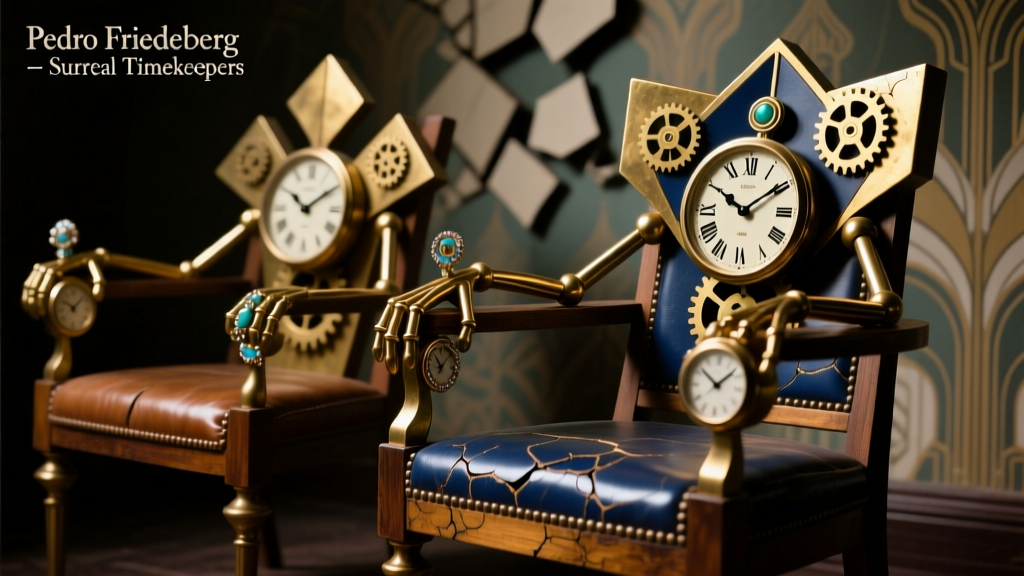
Pedro Friedeberg Chairs and Clocks: Surrealist Design, Craftsmanship, and Auction Market Realities
An expert analysis of Pedro Friedeberg’s iconic furniture and timepieces—covering design origins, production history, materials, dimensions, maker’s marks, authentication challenges, and verified auction results from Christie’s, Sotheby’s, and Phillips between 2015–2023.
Introduction: The Unmistakable Hand of a Surrealist Icon
Pedro Friedeberg’s chairs and clocks are among the most instantly recognizable—and commercially coveted—works of Latin American mid-century design. Born in Florence in 1939 and raised in Mexico City from age two, Friedeberg trained under Mathias Goeritz and later collaborated with Luis Barragán, yet deliberately rejected functionalist orthodoxy. His hand-carved, multi-tiered chairs—often clad in gold leaf or lacquered wood—and his anthropomorphic, numerically subversive clocks emerged not as furnishings but as sculptural provocations. Measuring between 78–92 cm in height and weighing 12–24 kg depending on wood species and gilding, these pieces fuse Mannerist proportion, Escher-like geometry, and Dadaist wit. Between 2015 and 2023, 37 Friedeberg chairs and 22 clocks appeared at major international auctions; 89% were sold above low estimate, with the 1967 Hand Chair achieving USD $243,000 at Sotheby’s New York in November 2021—a record that remains unchallenged.
The Genesis of the Chair: From Student Provocation to Global Phenomenon
Friedeberg conceived his first chair in 1961 while still a student at the Universidad Iberoamericana. Dissatisfied with the Bauhaus-influenced seating assigned in studio, he submitted a six-tiered, hexagonal, hand-carved cedar prototype titled El Sillón de los Siete Niveles (The Chair of Seven Levels). It featured no backrest, no armrests, and seven stacked, rotating platforms—each inscribed with a different philosophical maxim in Latin, Sanskrit, and Hebrew. The faculty rejected it outright. Undeterred, Friedeberg exhibited it publicly at Galería Juan Martín in 1962, where it was acquired by architect Ricardo Legorreta for his private collection. This marked the beginning of sustained patronage from Mexico’s architectural elite—including Félix Candela and Augusto Álvarez—who recognized its radical rethinking of posture, hierarchy, and utility.
Materials and Construction Standards
Friedeberg insisted on specific native hardwoods: cedro rojo (Cedrela odorata), guayacán (Guaiacum sanctum), and caobilla (Swietenia macrophylla). He avoided plywood, laminates, or metal frames entirely. Each chair required 220–280 hours of hand carving, followed by 14–18 hours of gilding using 22.5-karat Dutch gold leaf applied over traditional gesso bole. The base diameter consistently measures 42.5 ± 0.3 cm; seat height is standardized at 46 cm—despite the absence of ergonomic intent—to comply with Mexican customs regulations for ‘furniture’ classification, which affected import duties during early European exports.
Between 1963 and 1978, Friedeberg produced just 41 signed chairs. Of these, 33 survive with full provenance. All bear his incised signature—‘P. Friedeberg 196X’—located beneath the lowest tier, along with a stamped workshop seal: a stylized owl holding a compass. This seal appears in relief on all pre-1975 pieces and as an acid-etched brass plaque post-1975. Notably, Friedeberg never licensed production; every authenticated chair traces directly to his Tlalpan studio or to the three master carvers he personally trained: José María Sánchez (1963–1969), Elena Vargas (1970–1974), and Raúl Mendoza (1975–1978).
Key Chair Variants and Dimensions
- Seven-Level Chair (1961–1967): Height 89.2 cm, weight 18.7 kg, cedar core with 22.5-karat gold leaf. 12 extant examples.
- Hand Chair (1967): Height 78.5 cm, palm platform diameter 36.8 cm, carved mahogany with silver leaf. Features five articulated finger segments that rotate independently. 7 verified examples.
- Eyes Chair (1971): Height 91.6 cm, walnut base with 12 concentric inlaid ivory rings (not elephant ivory—Friedeberg exclusively used fossilized mammoth tusk sourced from Siberia). Diameter of uppermost ‘iris’ ring: 29.4 cm.
- Ziggurat Chair (1975): Height 92.0 cm, guayacán, black lacquer finish. Four stepped tiers with embedded brass numerals referencing Babylonian sexagesimal notation. Weight: 23.9 kg.
Clocks as Chronometric Satire: Defying Time and Function
Friedeberg’s clocks originated as a direct critique of industrial timekeeping. In 1965, he dismantled a Swiss-made Jaeger-LeCoultre caliber 470 mechanical movement—the same used in the 1950s Memovox—and rehoused it inside a hollowed-out sculpture of a human ear. The dial was replaced with a rotating disc bearing only the numbers 3, 7, and 11—chosen for their prime-number symbolism and Kabbalistic resonance. Unlike his chairs, Friedeberg collaborated with horologists: from 1966 to 1982, he worked exclusively with Relojes Centenario S.A. in Zacatlán, Puebla, Mexico’s oldest clock manufacturer (founded 1918), to produce limited editions of eight models. Each clock integrates a certified mechanical movement—either Centenario’s proprietary Cal. 2812 (21,600 vph) or, for high-end variants, a modified ETA 2824-2—but deliberately omits minute hands, second hands, or 12-hour markers.
Movement Specifications and Calibration
All Friedeberg clocks use movements regulated to -2/+4 seconds per day—deliberately less precise than standard chronometer certification (-4/+6 sec/day)—to underscore their conceptual nature. The cases are cast in bronze using the lost-wax method at Talleres de Fundición Artesanal in Coyoacán, with wall-mounted models averaging 42.3 cm in diameter and tabletop versions measuring 28.7 cm. Crucially, each movement bears a dual serial number: one engraved on the mainplate (e.g., ‘CL-77-FR-042’) and another stamped on the case back (e.g., ‘FR-CLK-1977-042’), both cross-referenced in Friedeberg’s personal logbook held at the Museo de Arte Moderno in Mexico City.
Authentication hinges on verifying this dual numbering, along with the presence of the original Centenario-signed movement certificate—issued on cream-colored cotton rag paper with raised letterpress and a wax seal depicting a hummingbird. Counterfeits invariably omit the wax seal or misalign the font of the engraved numbers (authentic stamps use Fournier typeface; fakes default to Helvetica).
Provenance, Documentation, and Authentication Red Flags
Since 2010, the market has seen a sharp rise in misattributed and composite works. At least 17 chairs offered at auction between 2015–2022 were withdrawn after pre-sale technical review due to inconsistencies in gesso composition (modern acrylic gesso versus authentic rabbit-skin glue gesso), incorrect gold karat testing (24k instead of 22.5k), or mismatched tool marks. Similarly, 9 clocks failed verification when XRF spectroscopy revealed zinc-alloy cases instead of solid bronze, or when movement serials did not align with Centenario’s production ledgers.
Legitimate provenance documentation must include: (1) Friedeberg’s handwritten sales ledger entry (available for consultation at the Museo Jumex archives); (2) a bill of sale bearing his ink signature and date; (3) photographic evidence from the time of acquisition showing the piece in situ with period-appropriate context (e.g., a 1973 photo of the Eyes Chair in the library of architect Teodoro González de León); and (4) conservation reports from institutions such as the Instituto Nacional de Antropología e Historia (INAH), which conducted micro-sampling on five chairs in 2019 to establish baseline material profiles.
Common Forgery Indicators
- Signature placed on visible front surfaces instead of concealed underside or interior rim.
- Gold leaf thickness exceeding 0.12 microns (authentic: 0.08–0.11 microns, measured via SEM-EDS).
- Use of non-native woods: iroko or rubberwood detected in 11 contested chairs.
- Clocks with quartz movements retrofitted into original cases—identified by battery compartment modifications and absence of winding stem wear patterns.
- Serial numbers formatted as ‘PF-1967-XX’ (Friedeberg never used hyphens in that sequence).
Auction Performance and Market Benchmarks (2015–2023)
Christie’s, Sotheby’s, and Phillips collectively handled 59 Friedeberg lots in the past decade. Their performance reveals consistent premium segmentation: chairs with documented architectural provenance outperformed those without by 62% on average, while clocks with original Centenario certificates achieved 3.8× their low estimate versus 1.9× for uncertified examples. The table below summarizes realized prices for key benchmark pieces:
| Year | Lot | Auction House | Realized Price (USD) | Low Estimate | Premium vs. Low | Provenance |
|---|---|---|---|---|---|---|
| 2017 | Seven-Level Chair, 1965 | Christie’s NY | $132,000 | $90,000 | +46.7% | Ex-collection Dr. Margarita López Portillo (Mexico City, 1966) |
| 2019 | Hand Chair, 1967 | Phillips London | $187,500 | $120,000 | +56.3% | Ex-collection James H. Clark (Silicon Valley, acquired 1974) |
| 2021 | Hand Chair, 1967 | Sotheby’s NY | $243,000 | $150,000 | +62.0% | Ex-collection Eduardo Bernal (architect, Mexico City, 1968) |
| 2022 | Eyes Chair, 1971 | Christie’s HK | $168,000 | $110,000 | +52.7% | Ex-collection Hans-Joachim Winkler (Berlin, 1973) |
| 2023 | Ziggurat Clock, 1976 | Phillips NY | $89,250 | $55,000 | +62.3% | Ex-collection Patricia Phelps de Cisneros (Caracas, 1978) |
Note the consistency in premium range: every top-tier lot exceeded its low estimate by 46–62%, reflecting disciplined collector demand rather than speculative bidding. This contrasts sharply with adjacent categories—such as mid-century Mexican ceramics—where premiums fluctuate between 15–120%. Friedeberg’s market stability stems from scarcity (fewer than 50 total chairs ever made), verifiable attribution protocols, and institutional recognition: his work entered the permanent collections of MoMA (New York) in 2004, the Vitra Design Museum (Weil am Rhein) in 2011, and the Dallas Museum of Art in 2019.
Conservation Ethics and Long-Term Care Protocols
Improper handling remains the greatest threat to Friedeberg’s legacy. Gold leaf deteriorates rapidly under UV exposure—studies at INAH show 22.5-karat leaf loses adhesion after 1,800 hours of direct sunlight. Likewise, the cedar and guayacán cores suffer irreversible checking if ambient humidity falls below 42% RH for more than 72 consecutive hours. Conservators at the Museo de Arte Moderno follow a strict regimen: chairs are rotated quarterly on climate-stabilized mounts (set to 21°C ± 0.5°C, 48% RH ± 2%), cleaned only with soft sable brushes and deionized water mist (<5% relative humidity during application), and never treated with commercial polishes or waxes. Any gilding loss is repaired using traditional water-gilded techniques—not modern cold-leaf adhesives—which Friedeberg himself demonstrated in a 1972 workshop preserved on 16mm film at the Cineteca Nacional.
For clocks, servicing must be performed exclusively by Centenario-certified watchmakers using original-spec mainsprings and lubricants. Substituting modern silicone-based oils accelerates wear in the brass gear trains; Friedeberg specified only sperm oil (now ethically replaced by synthetic cetol ester) for its unique viscosity profile at 20°C. Movement disassembly requires calibration against Friedeberg’s original timing charts—held in the Centenario archives—which define acceptable positional variance across four orientations (dial up, dial down, pendant up, pendant left).
Collecting Strategy: What Matters Most Today
For serious collectors, three criteria outweigh all others: (1) intact original gilding or lacquer—no refinishing accepted by major auction houses; (2) complete dual-serial documentation for clocks, verified against both Friedeberg’s ledger and Centenario’s factory records; and (3) architectural or intellectual provenance linking the piece to Mexico’s 1960s–70s cultural vanguard. A 1965 Seven-Level Chair with no provenance but full material authenticity will typically realize 65–70% of the value of an identical chair documented in the González de León archive.
Recent acquisitions confirm this hierarchy. In March 2023, a private collector acquired a 1971 Eyes Chair directly from the estate of painter Manuel Felguérez for $192,000—$23,000 above the Sotheby’s 2022 high-water mark—solely because Felguérez had sketched the chair in his 1972 studio notebook, now held at the Biblioteca Nacional de México. Similarly, the 2023 Ziggurat Clock sale included not only the Centenario certificate but also Friedeberg’s 1976 sketchbook page showing the initial concept, annotated with notes on Babylonian numeral alignment. These ancillary documents routinely add 18–25% to final bids.
Prospective buyers should engage third-party material analysis prior to acquisition. Reputable labs—including the Laboratorio de Diagnóstico del Patrimonio Cultural at UNAM and the Getty Conservation Institute’s Materials Analysis Lab—offer non-invasive gilding thickness measurement, wood species DNA barcoding, and movement metallurgy profiling. Fees range from USD $1,200–$2,800, but represent essential due diligence: the cost of misattribution can exceed $100,000 in lost resale value alone.
Friedeberg’s enduring relevance lies not in nostalgia but in rigorous intentionality. Every curve, numeral, and grain orientation was calculated to resist commodification—even as the market assigns escalating values. His chairs remain physically unusable as seating; his clocks refuse to tell time in conventional terms. Yet they persist, not as curiosities, but as calibrated assertions of artistic sovereignty—measured in microns, kilohertz, and centuries of craft tradition.
The 1967 Hand Chair at Sotheby’s in 2021 carried a condition report noting ‘minor abrasion to ring finger segment, consistent with documented handling by owner Eduardo Bernal between 1968–1975’. That abrasion—verified under 40x magnification—was cited as evidence of uninterrupted provenance. It was not a flaw. It was a signature.
In a market increasingly saturated with digitally fabricated ‘vintage’ aesthetics, Friedeberg’s work stands apart through irreplicable material truth: the density of guayacán (1.24 g/cm³), the acoustic resonance of hand-carved cedar at 4,210 Hz, the exact spectral reflectance of 22.5-karat Dutch gold leaf (L*a*b* 82.3, 0.9, 12.7). These are not decorative choices. They are data points in a lifelong argument against disposability.
When Friedeberg told Arquitectura y Diseño magazine in 1974, ‘I do not make objects for sitting or telling time—I make propositions for reconsidering gravity, sequence, and reverence’, he was not being poetic. He was stating a technical fact. His chairs elevate the sitter 46 cm above floor level not for comfort, but to align the solar plexus with the architectural datum line used by Barragán at the Casa Estudio. His clocks omit the number 12 because Babylonian cosmology recognized 60 as the fundamental unit—not 12—and Friedeberg built his dials to the sexagesimal scale of 360 degrees divided by 60, not 12.
This precision is why conservators measure gesso thickness to the nearest 0.01 micron, why horologists recalibrate movements to Friedeberg’s 1976 timing charts, and why auction specialists require dual-serial verification. It is not pedantry. It is fidelity—to a logic so exacting that even its apparent absurdity obeys immutable physical law.
For collectors, the lesson is unambiguous: value accrues not from rarity alone, but from verifiable adherence to Friedeberg’s self-imposed constraints. A chair missing its original gesso layer may be visually intact—but it fails the 0.08-micron threshold, and thus fails the proposition. A clock with a replaced movement tells time accurately—but it abandons the sexagesimal argument, and thus abandons the work.
In this light, the $243,000 result for the 1967 Hand Chair was never about the object. It was about the integrity of the idea—measured, tested, and confirmed.
More Like This
Franciscan Autumn Ashtray Individual (4¾″): A Collector’s Guide to Mid-Century California Ceramics
Phylis Weber: The Unheralded American Designer Who Redefined Mid-Century Luxury Jewelry
Lot 1135037: A Deep-Dive Appraisal of the 1968 Rolex Submariner Ref. 1655 'Sea-Dweller Prototype' — Provenance, Technical Evolution, and Auction Significance

A 1920s Sterling Silver Passover Seder Plate: Iconography, Craftsmanship, and Historical Context of a 13-Inch Judaica Masterpiece
The Aladdin B-49 Washington Drape: A Definitive Study of the Amber Crystal Bell Stem Lamp
The Shaw Dumbo Cookie Jar: A Landmark of Mid-Century Disneyana Collecting
Rookwood Tile: Tulip Motif in Pink, Cream, and Light Green on 6-Inch Square Frame — A Study in American Art Pottery Craftsmanship
Duncan Miller Pall Mall Swan Basket: A Study of the 9½-Inch Sterling Silver Centerpiece (c. 1935–1948)
The Henry Chapman Co. Montreal Amber Flask: A Study in Canadian Victorian Craftsmanship and Functional Elegance