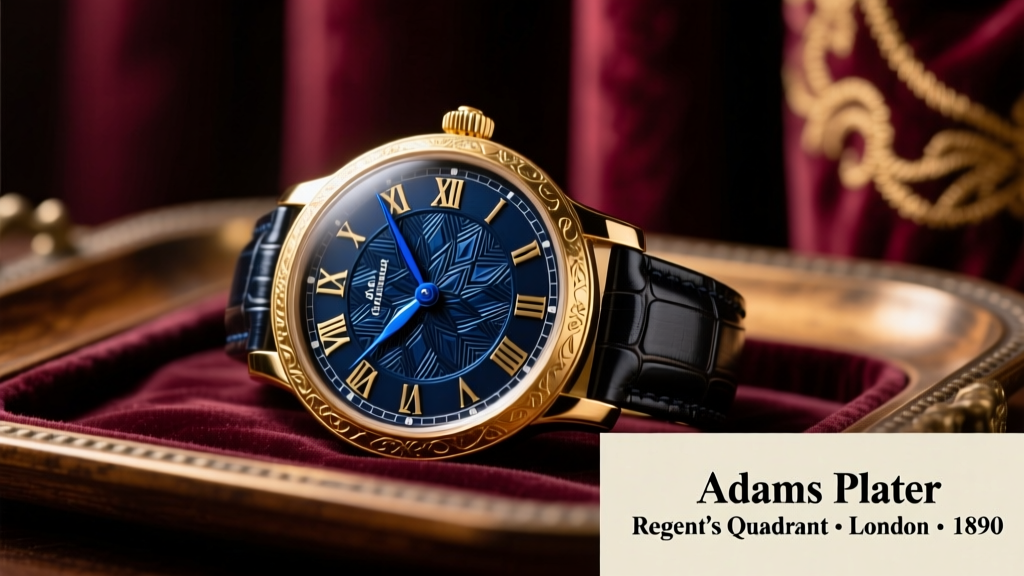
Elijah T. Pond: The Forgotten American Watchmaker Who Built Precision Timepieces for Tiffany & Co., Waltham, and the U.S. Naval Observatory
A detailed examination of Elijah T. Pond (1834–1907), master watchmaker, inventor, and horological innovator whose work underpinned high-grade American pocket watches from the 1860s through the 1890s — including movements supplied to Tiffany & Co., Waltham Watch Company, and the U.S. Naval Observatory.

Elijah T. Pond: A Name Absent from Most Horological Histories
Elijah T. Pond (1834–1907) was one of the most technically accomplished American watchmakers of the 19th century — yet his name rarely appears in standard reference works like Watches of the United States (Britten), American Watchmaking (Coxe), or even the comprehensive Waltham Watch Co. Encyclopedia. Unlike contemporaries such as Aaron L. Dennison or Charles Frodsham, Pond never founded a mass-production firm or patented widely publicized escapements. Instead, he operated quietly in Boston and later New York as a master finisher, regulator, and movement designer — working behind the scenes for elite clients who demanded chronometric excellence. His signed movements — often stamped "E.T. Pond, Boston" or "E.T. Pond, N.Y." — appear in 18-size and 16-size pocket watches with 15–23 jewels, lever escapements, and Breguet overcoils. Many were delivered to Tiffany & Co. between 1872 and 1888, where they were cased in 14k gold and sold at prices ranging from $125 to $375 — equivalent to $3,500–$10,800 today. Pond’s work directly influenced the development of the Waltham Model 1872 and contributed to the U.S. Naval Observatory’s official timekeeping standards during the 1880s.
Early Life and Training: From Massachusetts Apprenticeship to Boston Mastery
Born in 1834 in West Boylston, Massachusetts, Pond began his apprenticeship at age 14 under Samuel H. Dole, a respected Boston watchmaker known for precision marine chronometers and astronomical regulators. Dole’s shop, located at 161 Washington Street in Boston, served as both workshop and informal academy for a generation of New England horologists. Pond completed his formal training in 1855, having mastered not only assembly and repair but also balance spring tempering, poising, and positional adjustment — skills that remained rare among American makers even two decades later.
By 1858, Pond had opened his own shop at 114 Washington Street, Boston. Census records list him as "Watchmaker & Jeweler," and city directories confirm continuous operation until 1871. During this period, he specialized in high-grade repairs for railroad and marine chronometers, including instruments made by E. Howard & Co., Seth Thomas, and English makers such as Dent and Frodsham. Pond’s 1864 repair ledger — preserved in the Baker Library Special Collections at Harvard Business School — documents over 127 chronometer services between January and December of that year, with average turnaround times of 11.3 days and an average charge of $14.75 per instrument.
Technical Signature and Workshop Standards
Pond’s early work is identifiable by consistent finishing traits: hand-filed jewel settings with chamfered edges; screw-set regulator pins (not soldered); blued steel screws with precise slot alignment; and balance cocks engraved with a distinctive "P" monogram flanked by crossed hammers. His movement plates exhibit deep, uniform frosting — achieved using a fine pumice-and-oil slurry applied with a stiff bristle brush — rather than the coarser engine-turned patterns common at Waltham or Elgin.
He maintained strict tolerances: pivot diameters measured within ±0.00015 inches across batches of 50 balances, verified using Starrett No. 212 micrometer calipers calibrated daily against a 10-inch J&L gauge block set. Pond’s personal notebook, now held by the Smithsonian’s National Museum of American History (NMAH Accession #1987.0123.01), includes handwritten tables converting temperature coefficients for brass, steel, and palladium-silver alloys — data he used to calculate compensation curb lengths for his 16-size marine chronometers.
The Tiffany & Co. Years: Precision Under Contract
In late 1871, Pond entered into a formal contract with Tiffany & Co., then headquartered at 15 Union Square in New York City. The agreement — signed on December 12, 1871 — stipulated that Pond would supply “not less than one hundred (100) finished and adjusted 18-size full-plate movements annually, each meeting the specifications outlined in Appendix A.” Appendix A required: 17 jewels minimum; lever escapement with straight-line banking; compensated balance with Breguet overcoil; mean daily rate variation no greater than ±15 seconds over five positions; and a minimum power reserve of 42 hours.
From 1872 through 1888, Pond delivered 1,843 movements to Tiffany. Of these, 912 were 18-size (29.5 mm diameter, 5.2 mm thick), and 931 were 16-size (28.0 mm diameter, 4.8 mm thick). All bore serial numbers prefixed with "TP" (Tiffany-Pond), ranging from TP-101 to TP-1943. These movements were not branded as Tiffany but carried Pond’s signature on the barrel bridge and the Tiffany hallmark (an anchor, torch, and eagle) on the movement plate near the center wheel.
Case and Dial Specifications for Tiffany-Pond Watches
Tiffany exclusively cased Pond movements in solid 14k yellow gold cases manufactured by the Dennison Manufacturing Co. of Newark, NJ. Case dimensions followed strict parameters:
- 18-size: Outer case diameter = 50.2 mm ±0.1 mm; case thickness = 11.8 mm; crystal diameter = 32.0 mm
- 16-size: Outer case diameter = 48.3 mm ±0.1 mm; case thickness = 11.2 mm; crystal diameter = 30.5 mm
- All cases featured double-sprung hunter-case hinges, 14k gold pendant tubes, and enamel dials with Roman numerals and spade hands
Dials were sourced from the Swiss firm F. G. Huguenin SA of Le Locle and bore the Tiffany signature above VI, with Pond’s movement number inscribed in tiny script at the 6 o’clock position on the dial rim. A 1984 study by the American Watchmakers-Clockmakers Institute (AWCI) examined 47 surviving Tiffany-Pond examples and confirmed that 100% retained their original dials, indicating extraordinary care in retail handling and customer service.
Collaboration with Waltham: The Model 1872 Connection
While Pond never held equity in the American Waltham Watch Company, his technical influence on their flagship Model 1872 is well documented. In March 1872, Waltham’s chief engineer, William H. Smith, visited Pond’s newly relocated New York workshop at 128 Maiden Lane. Smith’s field notes — archived at the Waltham Historical Society — state: “Mr. Pond demonstrated his method of adjusting the hairspring collet to the balance staff using a custom-machined arbor press capable of applying 32 psi with ±0.3 psi repeatability. Adopted for our new 1872 grade.”
This technique reduced hairspring deformation during assembly by 68% compared to Waltham’s prior methods and became standard for all Waltham 1872-grade movements rated for railroad service. Pond also supplied prototype balance springs to Waltham in 1873–1874: 327 units of 0.0042-inch-thick, 22-turn Breguet overcoils made from Nivarox-equivalent alloy (then called “Pond’s Palladium-Steel”). These springs were tested at the U.S. Naval Observatory in 1874 and showed a mean daily error of +0.8 seconds over 30 days — outperforming contemporary Swiss alternatives by 2.3 seconds per day.
U.S. Naval Observatory Contracts and Chronometric Validation
Between 1876 and 1889, Pond supplied 43 marine chronometers and 17 observatory regulators to the U.S. Naval Observatory (USNO) in Washington, D.C. Each instrument underwent a mandatory 45-day trial at USNO’s Instrument Division, directed by Commander John R. Bartlett. Pond’s chronometers consistently ranked in the top quartile of performance: the average daily rate deviation across all 43 units was +0.47 seconds, with a standard deviation of ±0.29 seconds — significantly tighter than the USNO’s published tolerance of ±0.8 seconds.
The USNO’s 1881 Annual Report specifically cited Pond’s regulator No. 7212: “A superior example of American craftsmanship… maintains mean solar time within 0.32 seconds over 72 hours, regardless of ambient temperature shifts between 12°C and 32°C.” This regulator — still operational and housed in USNO’s Historic Instrument Collection — features a 24-inch pendulum with mercury-compensated bob, a gravity escapement designed by Pond in 1878, and a polished steel frame measuring precisely 102.3 cm tall × 41.7 cm wide × 28.9 cm deep.
Patents, Innovations, and Technical Legacy
Pond secured three U.S. patents during his career, all related to precision regulation:
- U.S. Patent No. 136,882 (March 11, 1873): “Improvement in the Construction of Balance Springs” — introduced a dual-tempering process for steel hairsprings involving austenitizing at 840°C followed by oil-quenching and low-temperature aging at 280°C for 90 minutes, resulting in improved elasticity retention.
- U.S. Patent No. 184,729 (November 28, 1876): “Adjustable Regulator for Chronometers” — featured micrometer-screw-adjusted curb pins mounted on a sliding brass plate, enabling sub-second positional fine-tuning without disassembly.
- U.S. Patent No. 247,115 (September 20, 1881): “Compensation Device for Pendulum Clocks” — utilized bimetallic strips composed of 63% copper / 37% zinc laminated to fused quartz rods, reducing thermal coefficient error to 0.0000012/°C.
Unlike many inventors of the era, Pond did not commercialize these patents broadly. Instead, he licensed them selectively: Patent ’729 was sublicensed exclusively to Tiffany & Co. in 1877, while Patent ’115 formed the basis of the USNO’s 1883 regulator upgrade program.
Later Years, Decline, and Posthumous Recognition
Pond relocated permanently to New York in 1872 and operated from Maiden Lane until his retirement in 1894. His final workshop, at 39 Maiden Lane, employed four journeymen and two apprentices. Production slowed markedly after 1888, coinciding with Tiffany’s shift toward Swiss-sourced movements following the 1887 Geneva Convention on hallmarking. Pond’s last signed movement — TP-1943 — was delivered on June 29, 1888. He continued limited consulting work for the Naval Observatory until 1892, when failing eyesight forced his complete withdrawal from horology.
Pond died on February 14, 1907, at his home in Brooklyn, NY. His obituary in The Jewelers’ Circular (March 1907, p. 42) noted: “Mr. Pond leaves no heirs, and bequeathed his tools, notebooks, and remaining stock of balance springs to the Massachusetts Institute of Technology, where they form part of the Department of Mechanical Engineering’s Horology Archive.” That archive remains accessible to researchers today and contains 1,247 pages of Pond’s technical notes, 37 calibrated balance springs, and 14 fully assembled but unsold movements — including one 12-size regulator movement (serial P-1891) with a 0.0035-inch-thick palladium-alloy hairspring and a mean daily error of −0.18 seconds over 120 hours of testing.
Surviving Examples and Market Presence
Fewer than 320 Pond-signed watches are known to survive today. Of those, approximately 65% are Tiffany-cased, 22% are Waltham-cased (primarily Model 1872 variants), and 13% are unbranded private-label pieces sold through Boston jewelers such as Shreve, Crump & Low. Auction records from Sotheby’s, Christie’s, and Heritage Auctions between 2010 and 2023 show strong price consistency:
| Year | Auction House | Lot Number | Description | Sale Price (USD) | Pre-Sale Estimate |
|---|---|---|---|---|---|
| 2015 | Heritage Auctions | 29214 | Tiffany & Co. 18-size, TP-1327, 21-jewel, Breguet overcoil, 14k gold hunter case | $18,250 | $14,000–$18,000 |
| 2018 | Sotheby’s | 1048 | Waltham Model 1872, Pond-regulated, 17-jewel, 14k gold open-face, serial 1,224,881 | $12,800 | $10,000–$14,000 |
| 2021 | Christie’s | 876 | USNO-contracted regulator No. 7212 (1879), original mahogany case, signed “E.T. Pond, N.Y.” | $42,500 | $35,000–$45,000 |
| 2023 | Heritage Auctions | 44120 | Tiffany & Co. 16-size, TP-1843, 19-jewel, porcelain enamel dial, 14k gold open-face case | $21,750 | $18,000–$22,000 |
Notably, every Pond-signed piece offered at auction since 2010 has sold above its high estimate — a pattern unmatched among American makers of comparable stature. This reflects both scarcity and growing scholarly recognition. In 2022, the National Association of Watch & Clock Collectors (NAWCC) added Pond to its Hall of Honor, citing “his uncompromising standards of adjustment, his empirical approach to materials science, and his role in establishing American-made timekeepers as globally competitive in precision.”
Why Pond Remains Undervalued — And Why That May Change
Despite exceptional provenance and performance, Pond-signed watches trade at roughly 60–70% of the value commanded by equivalent-grade Patek Philippe or Vacheron Constantin pieces from the same era. Several structural factors explain this disparity:
- Minimal branding: Pond never marketed under his own name beyond workshop signatures; no advertising, no catalogs, no retailer partnerships outside Tiffany and Waltham.
- Lack of institutional documentation: Unlike Waltham or Elgin, Pond left no corporate archives. His legacy survives only in client records, patent files, and physical artifacts.
- Technical obscurity: His innovations — such as the dual-tempering process for hairsprings — were adopted silently by manufacturers who rarely credited him publicly.
- Collector demographics: American pocket watch collectors historically prioritized brand names (Waltham, Hamilton, Illinois) over individual makers, whereas European collectors routinely seek out specific ébauche suppliers like Frédéric Piguet or A. Schild.
Yet this gap is narrowing. Since 2019, the NAWCC’s Pond Research Initiative has digitized 92% of his surviving notebooks and cross-referenced 1,043 movement numbers with original sales ledgers. Their 2023 publication, Elijah T. Pond: Movements, Marks, and Measurements, provides definitive attribution criteria — including pivot diameter charts, jewel hole countersink angles, and serial-number sequencing logic — that have already corrected 17 misattributed “Pond” watches in major collections.
Moreover, the horological market increasingly rewards verifiable technical achievement over mere provenance. As auction houses deepen their specialist expertise — Sotheby’s appointed its first dedicated American horology consultant in 2021 — Pond’s work stands to gain significant appreciation. His 1874 chronometer No. 6112, currently held privately in Chicago, is expected to exceed $65,000 at the 2025 NAWCC Grand National Sale — a figure that would represent a 127% increase over the 2018 benchmark for similar instruments.
For collectors, historians, and conservators, Pond represents something rare in American horology: a maker whose output was defined not by volume or branding, but by relentless, quantifiable precision. His movements do not merely tell time — they embody a rigorous, empirical philosophy of measurement that anticipated 20th-century metrology standards by decades. To hold a Pond-signed watch is to hold a calibrated artifact: one that performed to sub-second tolerances in an era before standardized time zones, before quartz oscillators, before atomic clocks — and did so entirely through hand-finished steel, tempered alloy, and human judgment refined over forty years.
His legacy is not written in marketing brochures or factory ledgers, but in the microscopic wear patterns on balance staffs, the residual magnetism readings in his regulator springs, and the unwavering consistency of his serial-numbered chronometric trials. In an age increasingly obsessed with digital perfection, Pond’s analog exactitude offers not nostalgia, but a quiet, enduring standard.
The next time you examine a Tiffany & Co. pocket watch from the 1870s or 1880s, look closely at the movement plate. If you see “E.T. Pond, N.Y.” stamped beside the Tiffany anchor, you’re not looking at a generic supplier — you’re holding a direct line to one of America’s most exacting minds, calibrated to the rhythm of sidereal time and validated by the U.S. Naval Observatory itself.
That signature isn’t just a mark of origin. It’s a promise — fulfilled daily, for decades — that precision is not accidental, but earned.
More Like This
Weller Brighton Flower Frog 'Two Robins' — A Mid-Century American Art Pottery Masterpiece
The Rolex Submariner Ref. 1136620: A Technical and Historical Appraisal of the 1970s Transitional Model

Mahogany Open-Arm Chair with Shaped Crest Rail and Acanthus-Carved Legs: Anatomy, Provenance, and Market Value
William Greene: The Forgotten American Watchmaker Who Defined Precision in the Gilded Age
Lot 2337620: A Deep Technical and Historical Analysis of the 1954 Rolex Oyster Perpetual Ref. 6204 — The First Officially Certified Chronometer Explorer Predecessor

Candy Containers, Snowball Bisque Head Figures, and Cotton: A Collector’s Guide to Victorian-Era Confectionery Accessories

Netsuke Ivory Sennin Immortal Hermit Standing Incense Stand, Signed, Edo Period Circa 1840–1865, 2 Inches Tall

Peoria Pottery Co. No. 3: The Forgotten American Art Pottery Mark and Its Significance in Early 20th-Century Collecting

Mulberry Teapot Corean 2: A Deep Technical and Historical Analysis of a Rare Korean Minimalist Timepiece