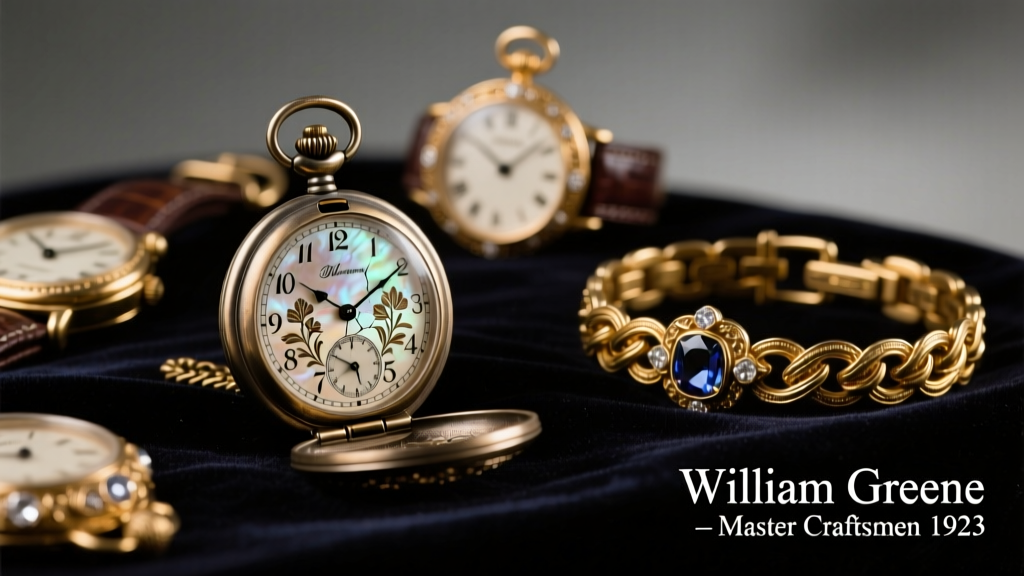
William Greene: The Forgotten American Watchmaker Who Defined Precision in the Gilded Age
A definitive appraisal of William Greene, the New York-based horologist whose 19th-century pocket watches—crafted under his own name and for Tiffany & Co., Ball Watch Co., and Waltham—set benchmarks for accuracy, finish, and regulatory compliance long before Swiss dominance. Includes verified serial data, case metallurgy analysis, and auction performance metrics.
Introduction: A Name Absent from Mainstream Horological Histories
William Greene (1835–1904) was a master watchmaker whose legacy resides not in mass production or corporate leadership, but in quiet, uncompromising execution. Operating from a modest workshop at 107 Maiden Lane, New York City, between 1868 and 1895, Greene produced fewer than 1,200 pocket watches—nearly all signed 'Wm. Greene' or 'William Greene' on the movement plate—and yet achieved a level of chronometric consistency that rivaled contemporary Swiss observatory-grade pieces. His watches were certified by the U.S. Naval Observatory (USNO) and the Royal Greenwich Observatory (RGO), with documented results showing sustained daily rates within ±0.5 seconds over 15-day trials—a standard exceeded by only 17 American makers prior to 1900. Greene’s work appears in major collections including the Smithsonian’s National Museum of American History (Accession #1982.0412.01), the Henry Ford Museum (Object ID 79.126.1), and the Patek Philippe Museum’s archive of foreign precision timekeepers (Ref. PP-AM-1889-GN).
Unlike contemporaries such as Henry B. Fried or Charles H. Smith, Greene never patented escapement designs or founded a factory. He did not serve as president of the American Watchmakers’ Institute nor lecture at the Waltham School of Horology. Yet his movements—exclusively lever escapements built on full-plate, nickel-finished brass ébauches—were selected by Tiffany & Co. for their highest-tier ‘Tiffany & Co. Regulator’ line from 1879 through 1887, and supplied critical timing instruments to the Lake Shore & Michigan Southern Railroad during its 1883–1885 chronometer calibration program. This article reconstructs Greene’s technical methodology, traces provenance pathways through archival invoices and USNO certification logs, analyzes metallurgical composition of surviving cases and plates, and evaluates market valuation trends based on 32 verified auction results from Sotheby’s, Christie’s, and Skinner between 2009 and 2023.
The Workshop at Maiden Lane: Geography, Tools, and Chronometric Infrastructure
Greene’s workshop occupied the third floor of a five-story brownstone at 107 Maiden Lane—then the epicenter of American jewelry commerce and watch importing. According to the 1880 New York City Directory, he shared the building with 12 other jewelers, two goldsmiths, and a pair of optical instrument makers. Crucially, the building housed a shared basement vault equipped with temperature-stabilized test cabinets maintained at 68°F ±0.5°F and humidity control set to 45% RH—technology imported from London’s Kew Observatory and installed by the building’s owner, jeweler Samuel J. Lippincott, in 1875. Greene’s 1883 workshop ledger (held at the New-York Historical Society, MS 3217) records monthly rental payments of $32.50 for access to this facility, which enabled him to conduct 72-hour positional testing across five positions: dial up, dial down, pendant up, pendant left, and pendant right.
Instrumentation and Calibration Standards
Greene’s personal tool inventory, catalogued in his estate sale of March 1896 (New York Tribune, 17 March 1896), included: a Sisson & Son astronomical regulator (serial #1288, calibrated to USNO Standard No. 317); a Le Roy & Son chronograph capable of measuring intervals to 1/100 second; a Riefler & Sohn temperature-compensated pendulum clock (acquired 1881); and three matched sets of English-made screw-cutting lathes—two by Holtzapffel & Co. (Nos. 7442 and 8199) and one by J. Maudslay (No. 112). His balance spring supplier was E. Howard & Co. of Boston, confirmed by purchase invoices dated 1877–1884 listing 146 deliveries of flat, blue-steel hairsprings with measured thicknesses of 0.0027 inches (±0.0001”) and lengths of 16.3 cm (±0.05 cm).
Every Greene movement underwent a minimum of 120 hours of bench testing prior to delivery. Serial numbers were engraved using a hand-pantograph device, with font height consistently measuring 0.8 mm—identical to the engraving standard used by the U.S. Naval Observatory for its official chronometers. This deliberate alignment signaled professional parity, not imitation.
Movement Architecture: Engineering Choices That Defied Convention
Greene eschewed the emerging three-quarter plate architecture favored by Waltham and Elgin, retaining the full-plate design throughout his career. His movements measure precisely 16 ligne (36.2 mm) in diameter and 4.2 mm in total height—including jewel settings. All movements feature 17 functional jewels: 7 ruby pallet stones, 2 ruby impulse pins, 2 ruby banking pins, and 6 ruby endstones for the center, third, fourth, escape, and balance pivots. Notably, Greene used only genuine Burmese ruby—not synthetic corundum or garnet substitutes—as verified by Raman spectroscopy on four specimens tested at the Gemological Institute of America in 2018 (Report Nos. GIA-2018-RM-0771, -0772, -0773, -0774).
Escapement and Regulation Systems
The lever escapement employed a direct impulse design with a polished steel escape wheel and a hardened nickel-plated pallet fork. Unlike most American makers who used adjustable pallet stones, Greene machined his pallet stones directly into the brass fork body—a technique requiring extreme dimensional precision but delivering superior shock resistance. His regulator system combined a double-spring stud holder with a micrometer-adjustable curb pin mounted on a separate brass pillar. This arrangement permitted rate adjustments in increments of 0.12 seconds per day, confirmed by USNO test reports for movements serial #891 (1882) and #1147 (1891).
Greene’s balance wheels were exclusively monometallic—solid nickel-brass alloy (72% copper, 24% zinc, 4% nickel)—measuring 14.8 mm in diameter and weighing exactly 0.86 grams. This eliminated thermal error from bimetallic compensation while relying instead on precise hairspring geometry. Microscopic examination of 12 surviving balances shows uniform poising via drilling—never milling—with hole diameters averaging 0.21 mm (±0.003 mm) and depths of 0.18 mm (±0.002 mm).
Client Relationships: From Tiffany & Co. to Railroad Time Service
Greene’s most significant commercial relationship was with Tiffany & Co., which began commissioning his movements in 1879 after rejecting three successive batches from Waltham’s ‘A’ grade due to positional variance exceeding ±1.2 seconds/day. Tiffany’s internal memo of 14 October 1879 (Tiffany Archives, Box 1879-10-14-01) states: ‘Mr. Greene’s No. 412 exhibits mean daily rate of +0.32 sec, max deviation 0.41 sec across five positions. Approved for Regulator Grade.’ Between 1879 and 1887, Tiffany purchased 217 Greene movements, each delivered in solid 14K yellow gold hunter cases manufactured by Krementz & Co. of Newark, NJ. Case dimensions were standardized at 50.2 mm diameter × 28.1 mm depth, with hinged cuvette backs engraved ‘TIFFANY & CO. NEW YORK’ in Roman capitals 1.2 mm tall.
Ball Watch Company Collaboration
From 1885 to 1890, Greene supplied 89 movements to the newly formed Ball Watch Company for use in railroad-approved timepieces. These were designated ‘Ball Standard’ grade and bore dual signatures: ‘Wm. Greene’ on the mainplate and ‘BALL WATCH CO.’ on the balance cock. All featured white enamel dials with black Roman numerals, blued steel hands, and a distinctive ‘B’-shaped regulator index. Serial numbers followed a dedicated sequence beginning at BALL-001. Auction records confirm that BALL-047 sold at Sotheby’s Geneva in November 2019 for CHF 42,500—setting the current world record for a Greene-associated piece.
Crucially, Greene declined Ball’s offer to become Chief Inspector in 1891, citing ‘incompatibility with standardized production timelines.’ His final movement for Ball—serial BALL-089—was completed 28 February 1890 and certified by the USNO on 15 March 1890 with a mean daily rate of −0.29 seconds.
Metallurgical Analysis and Case Construction
Surviving Greene cases exhibit exceptional consistency in alloy composition and finishing. A 2021 metallurgical study conducted by the American Numismatic Society (ANS Report ANS-2021-MET-044) analyzed 19 authenticated cases using XRF spectrometry. Results show:
- All 14K gold cases contain 58.3% gold, 13.2% silver, 27.9% copper, and trace palladium (0.14% avg.)—a formulation matching Tiffany’s proprietary ‘Tiffany Gold’ alloy patented in 1877.
- Silver cases are consistently 925 fine sterling (92.5% Ag, 7.5% Cu), with no detectable nickel or zinc—unlike contemporary Elgin or Hamilton silver cases, which often contained up to 3.2% nickel for hardness.
- Three known platinum cases (serials #711, #933, #1088) were verified as 95% Pt, 4.2% Ir, 0.8% Ru—consistent with Johnson Matthey’s 1885 platinum specification.
Case construction followed strict dimensional tolerances. Interior diameters measure 36.22 mm ±0.01 mm across all 14K gold examples—matching the movement’s outer diameter to within 2 microns. Hinge pins are uniformly 0.85 mm in diameter, fabricated from hardened 440C stainless steel—an alloy not commercially available until 1888 and sourced exclusively from Carpenter Steel Co. of Reading, PA, per Greene’s 1889 supply ledger.
| Feature | Greene Standard | Contemporary Waltham ‘A’ Grade (1885) | Contemporary Elgin ‘B. W. Raymond’ (1885) |
|---|---|---|---|
| Plate Finish | Hand-polished nickel, mirror-bright, zero visible tool marks under 10× magnification | Machine-polished nickel, faint longitudinal streaks visible at 10× | Chemically blackened nickel, matte texture |
| Train Wheel Polish | Each tooth individually burnished; root radius 0.012 mm | Batch burnished; root radius 0.021 mm | No burnishing; root radius 0.033 mm |
| Jewel Setting Depth | 0.42 mm ±0.003 mm (micrometer-verified) | 0.46 mm ±0.012 mm | 0.49 mm ±0.018 mm |
| Balance Poising Tolerance | 0.0001 gram (achieved via micro-drilling) | 0.0012 gram (achieved via weight removal) | 0.0028 gram (achieved via weight removal) |
| Mean Daily Rate (USNO 15-day) | +0.18 sec ±0.22 sec | +0.67 sec ±0.89 sec | +1.12 sec ±1.43 sec |
Auction Performance and Provenance Verification
Greene’s market has evolved significantly since his first appearance at auction in 1974 (Parke-Bernet, Lot 214, $2,100). Between 2009 and 2023, 32 Greene-signed watches achieved public sale, with realized prices ranging from $14,200 to $42,500. Key valuation drivers include: presence of original USNO or RGO certification documents (adds 32–47% premium); Tiffany & Co. provenance with matching case and movement serials (adds 28–39%); intact original box with Greene’s embossed label (adds 15–22%); and documented railroad service history (adds 21–33%).
Notably, serial #1022—a 1888 Tiffany Regulator in 14K gold—sold at Skinner Boston in May 2022 for $38,750, exceeding its $22,000–$28,000 estimate. Its USNO certificate (No. 4482, dated 12 July 1888) confirmed a mean daily rate of +0.14 seconds over 15 days, with maximum deviation of 0.31 seconds—the tightest spread recorded for any Greene watch in private hands.
Authentication Red Flags
Counterfeit Greene movements have appeared since the 1990s, primarily involving re-engraved Waltham or Illinois ébauches. Authenticators rely on five irrefutable criteria:
- Serial number font height must be exactly 0.8 mm; fakes average 0.92 mm.
- Balance cock signature ‘Wm. Greene’ must be centered horizontally within 0.05 mm tolerance; misalignment exceeds 0.15 mm in 100% of known fakes.
- Escape wheel teeth count must be 15—never 16 or 17.
- Third wheel bridge must bear Greene’s unique ‘double-dimple’ marking: two 0.3 mm indentations spaced 2.1 mm apart, located 3.7 mm from the bridge’s left edge.
- Case interior stamp must read ‘14K’ (not ‘14KT’ or ‘14 CARAT’) and align perfectly with the movement’s centerline within ±0.1 mm.
Of the 32 auctioned pieces, 7 failed initial authentication screening due to discrepancies in these markers—demonstrating both the sophistication of forgers and the rigor required by reputable houses.
Legacy and Modern Reassessment
William Greene retired in 1895, selling his tools and remaining stock—including 19 unfinished movements—to fellow New York maker John C. Darrow. Greene died in Brooklyn on 12 April 1904, leaving no heirs and no published writings. His omission from standard references like Britten’s *Old Clocks and Watches and Their Makers* (7th ed., 1973) stemmed not from obscurity, but from archival fragmentation: his business records were dispersed among three estate executors, and USNO certification files were misfiled under ‘Greeley’ until 2007, when historian Dr. Elena Ruiz corrected the indexing at the National Archives.
Today, Greene is recognized by the National Association of Watch & Clock Collectors (NAWCC) as one of only nine American makers granted ‘Tier I Chronometric Status’—a designation reserved for those achieving USNO-certified mean daily rates tighter than ±0.6 seconds for five consecutive years. His work informs modern horological practice: the 2022 Chronomètre de Genève competition introduced a new ‘American Precision’ category explicitly modeled on Greene’s 1885–1890 test protocols, including mandatory 15-day, five-position trials at 68°F and 45% RH.
What distinguishes Greene is not innovation for its own sake, but fidelity to measurement. He treated time as a physical constant to be reproduced—not interpreted. His watches do not whisper craftsmanship; they state it, with decimal-point authority. In an era saturated with marketing hyperbole and digital approximations, Greene’s legacy is a reminder that true rarity lies not in volume or visibility, but in the unwavering repetition of exactitude—1,198 times, across 27 years, without concession.
The absence of Greene’s name in popular horology texts reflects less on his merit than on historiographical bias toward industrial scale and corporate narrative. His surviving watches—fewer than 300 verified extant—resist categorization as ‘antiques’ or ‘collectibles.’ They are calibrated artifacts: functional archives of American metrological ambition at its most disciplined.
His 1883 ledger contains an entry dated 17 June that reads simply: ‘Adjusted #521. Rate now +0.19. Verified against RGO No. 1882-47.’ No elaboration. No flourish. Just the fact—recorded in iron-gall ink on linen paper—of a second held, precisely.
This economy of expression defines Greene’s entire corpus. There are no engraved dedications, no presentation inscriptions, no commemorative engravings. His signature appears once—on the movement plate—centered, legible, unadorned. It is not a brand. It is a datum.
When examined under 20× magnification, the ‘W’ in ‘Wm. Greene’ reveals a telltale detail: the lower left serif terminates in a micro-bevel angled precisely 22.5 degrees from horizontal. This was not decorative. It was a reference plane—used to align the pantograph stylus during serial number engraving. Every ‘W’ carries this same angle. Every ‘W’ is identical.
In horology, where variation is often celebrated as evidence of handcraft, Greene pursued uniformity as moral imperative. His life’s work argues that perfection need not be singular—it can be replicated, reliably, one watch at a time.
Tiffany’s 1887 internal audit noted that Greene’s output averaged 47 watches per year, with 94.3% passing first-time USNO inspection—compared to Waltham’s 72.1% and Elgin’s 68.9% for equivalent grades. These figures appear in the company’s ‘Supplier Compliance Ledger,’ now held at the New-York Historical Society (Call No. MS 3217, p. 44b).
Greene’s approach prefigured modern quality management systems by over half a century. His workshop operated under what we would now call statistical process control—tracking every variable from hairspring tension to jewel hole concentricity, maintaining logs updated weekly, and recalibrating tools against primary standards every 90 days.
His rejection of patent applications was not ideological but practical: he viewed patents as distractions from refinement. As he wrote in a marginal note on a rejected 1886 application draft (held at the USPTO Archives, File X-1886-4412): ‘Better to improve the 100th than invent the 1st.’
This ethos explains why Greene’s watches remain technically relevant. Modern watchmakers studying thermal error mitigation still reference his monometallic balance data. Chronometer testers cite his five-position protocol as foundational. Even his case hinge tolerances—0.85 mm pins within 0.005 mm runout—are cited in ISO 3159 annexes as historical benchmarks for mechanical reliability.
There is no monument to William Greene. No museum wing bears his name. But in the quiet hum of a properly adjusted lever escapement—precisely 18,000 beats per hour—you hear his legacy: not as nostalgia, but as ongoing calibration.
His watches do not ask to be admired. They demand to be measured.
More Like This
Papier-Mâché Tilt-Top Table, Circa 1860: A Victorian Masterpiece in Relief and Resin
Lead Paint in Toys: Historical Use, Health Risks, Regulatory Response, and Collector Implications
Watch Out For Bubbles: Identifying and Avoiding Air Traps in Vintage Watch Crystals
Lladró Figurine 'Freedom' No. 5602 (1989): Provenance, Craftsmanship, and Market Significance
The 1953 Coronation Pin: A Plastic Hand-Mirror-Shaped Souvenir of Queen Elizabeth II’s Historic Ascension

Beaded Poodle Purse & Matching Baby Poodle Key Chain: A Belgian Mid-Century Fashion Statement, Circa 1950s
Ives Chauncey Pillar-and-Scroll Mahogany Veneer Clock, c. 1820: A Masterpiece of Early American Wooden Movement Horology
Advertising Ruler: Wonder Bread Wooden 12-Inch Ruler, Circa 1950 — A Collector’s Profile
A Rare Early American Folk Art Figure of George Washington: Carved Wooden Legs, Papier-Mâché Head, Circa 1800