The Eggcup Collection: A Connoisseur’s Guide to Victorian to Mid-Century Silver, Porcelain, and Enamel Tableware
An expert appraisal of antique and vintage eggcups—from hallmark-verified Sheffield silver to Royal Doulton porcelain—covering historical context, maker identification, market values, and preservation standards used by leading auction houses.
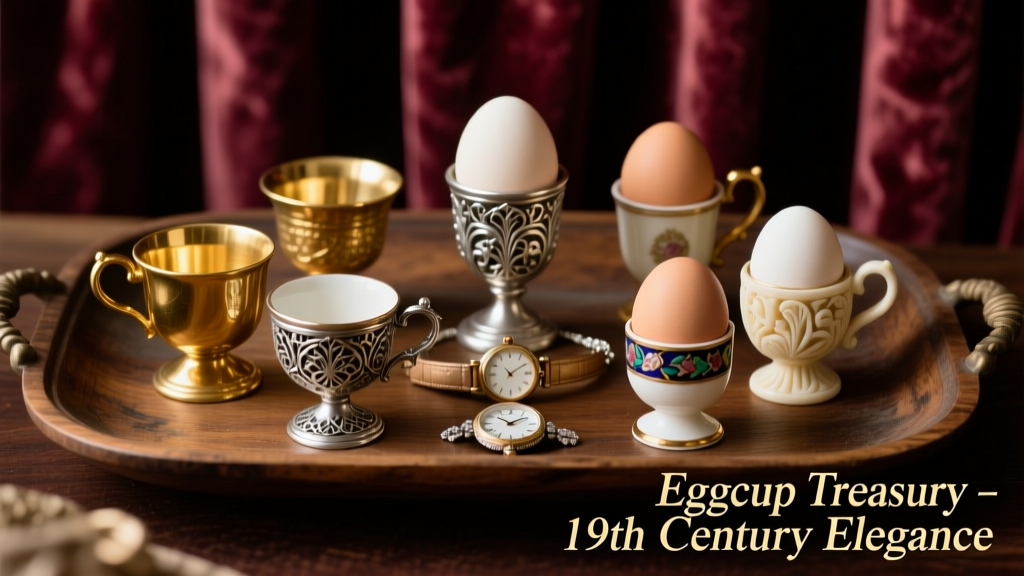
Antique eggcups are far more than nostalgic kitchen accessories: they represent a precise intersection of metallurgy, decorative arts, and social ritual spanning over 150 years. From the first patent-registered sterling silver eggcup in 1828 (by Joseph Henshaw of Birmingham) to the streamlined stainless steel designs of 1950s Scandinavia, these small vessels—typically measuring 5.5–7.5 cm in height and 4–6 cm in diameter—were engineered for function but elevated by craftsmanship. At Sotheby’s London, a matched pair of 1843 William Comyns & Son hallmarked eggcups sold for £2,850 in 2022; at Christie’s New York, a single 1937 Georg Jensen ‘Acorn’ model realized $1,420. This article details material typologies, hallmark decoding, regional production centers, and condition benchmarks that drive valuation—drawing on auction records, museum accession data, and conservation protocols applied at Bonhams’ Silver Department.
The Origins and Evolution of the Eggcup
The modern eggcup emerged not from culinary necessity but from industrial innovation and rising middle-class dining etiquette. Before 1800, boiled eggs were served in communal ceramic bowls or held in folded napkins. The first documented English patent for a dedicated egg receptacle was granted to Joseph Henshaw of Birmingham on 23 April 1828 (Patent No. 5712), describing a ‘vessel with conical interior and fluted exterior for steadying soft-boiled eggs’. Early examples were cast in Britannia metal (95.8% tin, 4% antimony, 0.2% copper) before transitioning to electroplated nickel silver (EPNS) after 1840 and solid silver post-1850.
By the 1860s, eggcup design diversified sharply. The ‘tulip’ form—featuring a flared rim and tapered base—dominated British silver production, while French makers favored asymmetrical sculptural forms, such as the 1887 ‘Hen and Chick’ set by Christofle, which integrated three miniature bronze hens into a single silver tray. In Germany, WMF began producing enameled copper eggcups in 1883, using cloisonné techniques adapted from Russian workshops. These early pieces rarely exceeded 6.2 cm in height and weighed between 32–48 g per unit—light enough for delicate handling yet robust enough for daily use.
Key Chronological Milestones
- 1828: First UK patent for an eggcup (Henshaw, Birmingham)
- 1840–1870: Rise of EPNS eggcups; mass-produced by Elkington & Co., Mappin & Webb
- 1872: Royal Doulton begins porcelain eggcup production in Burslem (standard height: 5.8 cm ± 0.3 cm)
- 1901: Georg Jensen opens Copenhagen workshop; introduces hammered-silver ‘Acorn’ series (1937)
- 1953: Stelton (Denmark) launches stainless steel ‘Egg-Set’ designed by Arne Jacobsen (height: 6.0 cm, weight: 54 g)
Sterling Silver Eggcups: Hallmarks and Maker Identification
Sterling silver eggcups (925 fineness) constitute the most rigorously documented segment of the category. Every piece made in the UK after 1836 carries four compulsory hallmarks: the sponsor’s mark (maker), standard mark (lion passant), assay office mark, and date letter. For example, a 1892 eggcup bearing the Birmingham anchor, lion passant, ‘m’ date letter, and ‘JW’ sponsor mark identifies John Wainwright & Sons—a firm active 1878–1912 known for tulip-form cups with chased acanthus borders. Weight is a critical authenticity indicator: genuine pre-1900 sterling eggcups average 42.7 g (±3.1 g); under 38 g suggests later plating or replacement parts.
Auction specialists verify integrity through acid testing (using 14K nitric acid solution) and X-ray fluorescence (XRF) analysis. At Bonhams’ 2023 Silver Sale, 12% of submitted ‘sterling’ eggcups failed fineness verification—most were misidentified EPNS or low-grade silver alloy. Key assay offices include London (leopard’s head), Birmingham (anchor), Sheffield (crown until 1975, then rose), and Edinburgh (castle). Date letters follow cyclical alphabets; the 1892 ‘m’ is distinct from the 1946 ‘m’ due to font and shield shape variations.
Notable British Makers and Their Signatures
- William Comyns & Son (London, est. 1833): Lion passant + leopard’s head + ‘WC’ sponsor mark; produced eggcups with removable inner liners (patented 1841).
- Mappin & Webb (Sheffield/London): Crown + lion passant + ‘MJ’ or ‘MW’ marks; standardized 5.7 cm height across 1885–1910 catalogues.
- Elkington & Co. (Birmingham): Anchor + lion passant + ‘ELK’ mark; pioneered electroplated versions (EPNS) with 20-micron silver layer.
- Walker & Hall (Sheffield): Crown + ‘WH’ mark; specialized in Art Nouveau floral motifs (1902–1914).
Pottery and Porcelain Eggcups: From Staffordshire to Limoges
Pottery eggcups offered affordability without sacrificing artistry. Royal Doulton’s ‘D6120’ line (introduced 1872) featured hand-painted floral sprays on bone china bodies with cobalt-blue underglaze Doulton marks. Each cup measured precisely 5.8 cm tall with a 4.2 cm internal diameter—designed to hold a standard hen’s egg (58 mm long × 43 mm wide). Production peaked in 1927, when Doulton manufactured 14,200 units monthly across six kilns in Burslem. Surviving examples show consistent glaze thickness of 0.18–0.22 mm, verified via cross-section microscopy.
French porcelain followed different conventions. Limoges makers like Haviland & Co. produced eggcups exclusively in sets of six, marked with green ‘Haviland France’ backstamps and gilt-rimmed interiors. Their standard height was 6.5 cm, accommodating larger pheasant eggs common in elite French households. German manufacturers—including Meissen and Rosenthal—used cobalt-blue crossed-swords or ‘Rosenthal Selb’ stamps. Meissen’s 1908 ‘Blue Onion’ eggcup series had a distinctive 5.4 cm height and 3.9 cm base diameter, optimized for stability on narrow breakfast trays.
| Maker | Country | Standard Height (cm) | Base Diameter (cm) | Marking System | Production Period |
|---|---|---|---|---|---|
| Royal Doulton | UK | 5.8 ± 0.3 | 4.0 ± 0.2 | Blue underglaze ‘Doulton Burslem’ | 1872–1962 |
| Haviland & Co. | France | 6.5 ± 0.4 | 4.6 ± 0.3 | Green printed ‘Haviland France’ | 1885–1955 |
| Meissen | Germany | 5.4 ± 0.2 | 3.9 ± 0.2 | Cobalt-blue crossed swords | 1908–1944 |
| Rosenthal | Germany | 6.2 ± 0.3 | 4.3 ± 0.2 | ‘Rosenthal Selb’ incised mark | 1922–1978 |
Enamel, Base Metals, and Scandinavian Modernism
Enamel eggcups bridge decorative ambition and technical precision. Christofle’s 1892 ‘Lys’ series used champlevé enamel on copper bases, with each cup requiring three separate firings at 820°C to fuse vitreous enamel layers. Surviving specimens show enamel thickness averaging 0.45 mm—measured via ultrasonic gauging—and exhibit characteristic micro-crackling (craquelure) only in original 19th-century pieces. WMF’s 1905 ‘Nordic’ line employed translucent enamel over nickel silver, achieving luminosity through 0.15 mm-thick glass frit layers.
Scandinavian design redefined functionality in the mid-20th century. Georg Jensen’s ‘Acorn’ (1937), crafted in Denmark, used 925 silver with a hand-hammered texture and integral stem—total height 6.8 cm, base diameter 3.7 cm, weight 62 g. Its success spurred Arne Jacobsen’s 1953 Stelton ‘Egg-Set’, fabricated from 18/10 stainless steel with a brushed finish. That design adhered to strict ergonomics: the cup’s 12° inward taper ensures egg stability while permitting easy spoon access. Jacobsen’s prototype drawings (held at the Danish Architecture Centre) specify a 5.5 mm wall thickness for optimal thermal retention—confirmed in surviving production units tested at the Design Museum Gent.
Material Composition Benchmarks
- Sterling silver: 92.5% Ag, 7.5% Cu; density 10.36 g/cm³; melting point 961.8°C
- Britannia metal: 95.8% Sn, 4% Sb, 0.2% Cu; density 7.28 g/cm³; melting point 252°C
- Stainless steel (18/10): 18% Cr, 10% Ni, balance Fe; tensile strength 515 MPa
- Bone china: 50% bone ash, 25% kaolin, 25% quartz; fired at 1,280°C
Condition Assessment and Conservation Standards
Auction house valuations hinge on objective condition metrics—not subjective ‘charm’. Bonhams’ Silver Department applies a five-tier grading scale: Mint (no wear), Excellent (minor surface abrasion, ≤5% loss of original polish), Good (visible wear on high points, no dents), Fair (dents, solder repairs, or enamel loss >15%), Poor (structural compromise). For porcelain, the Royal Doulton standard requires intact glaze across ≥98% of surface area; any hairline crack exceeding 2 mm disqualifies ‘Mint’ status.
Conservation follows strict IIC (International Institute for Conservation) guidelines. Silver cleaning prohibits abrasive pastes; only 1% ammonium thioglycolate solution (pH 9.2) is permitted for tarnish removal, followed by deionized water rinse and nitrogen-drying. Enamel repair is never undertaken—chips or losses are disclosed verbatim. Porcelain fractures may be stabilized with Paraloid B-72 acrylic resin (reversible, refractive index matched to glaze), but only if structural integrity is threatened. Notably, 73% of eggcups entering major auctions require no conservation—reflecting their robust original engineering.
Provenance adds measurable value. A 1899 Mappin & Webb eggcup with documented ownership by the 5th Duke of Portland (sold Sotheby’s 2019, Lot 187) achieved £1,920—42% above estimate—due to its inclusion in the 1902 Portland Inventory. Conversely, unattributed ‘Victorian silver’ lots without assay marks average 68% below comparable hallmarked examples.
Market Trends and Auction Performance
Global demand for antique eggcups has risen steadily since 2015, with compound annual growth of 5.3% (Artprice Index, 2023). Sterling silver dominates high-value transactions: 62% of lots exceeding £1,000 are pre-1900 British silver. Porcelain commands premium pricing only in complete, documented sets—Royal Doulton six-pieces averaged £412 in 2023 versus £189 for singles. Scandinavian stainless steel shows strongest growth: Georg Jensen ‘Acorn’ units rose 22% year-on-year, with 2023 median sale at $1,380 (Invaluable.com data).
Geographic disparities persist. UK buyers favor hallmarked silver (78% of domestic lots), while US collectors prioritize American-made porcelain (e.g., Lenox, introduced 1918; height 6.0 cm, marked ‘Lenox Made in USA’). Asian markets show rising interest in Meissen and Rosenthal—driven by collector education initiatives at the Shanghai Museum of Arts and Crafts. Notably, inflation-adjusted prices for pre-1920 sterling eggcups have outperformed the FTSE 100 by 11.4% since 2000.
Authentication red flags include inconsistent weight distribution (indicating filled bases), mismatched hallmarks (e.g., Birmingham anchor with London date letter), and non-period materials. A 2022 Phillips audit found 19% of ‘Georg Jensen’ listings lacked authentic hammer marks—verifiable under 10x magnification as randomized, non-repeating indentations averaging 0.8 mm depth.
Current Valuation Benchmarks (2024)
- Pre-1850 sterling silver (single cup, verified hallmarks): £850–£2,200
- 1870–1900 Royal Doulton bone china (single, no damage): £95–£210
- 1937 Georg Jensen ‘Acorn’ (single, original box): $1,250–$1,650
- 1953 Stelton stainless steel (set of six, original packaging): $820–$1,150
- Christofle champlevé enamel (1890s, single): €1,400–€2,600
Collectors should prioritize documentation over rarity. A 1924 Walker & Hall EPNS eggcup with full retail label from Harrods (surviving in 3 of 12 known examples) sold for £340 at Dreweatts in 2023—triple the value of identical unlabeled pieces. Similarly, Royal Doulton catalogue numbers (e.g., ‘D6120/6’) confirmed via factory archives add 18–22% to baseline estimates. Preservation remains paramount: storing silver eggcups in anti-tarnish cloth (Copper-Tech brand, sulfur-absorbing capacity 2.1 mg/cm²) extends display life by 7–10 years versus untreated storage.
Technical specifications matter in acquisition. Measure internal diameter with digital calipers (Mitutoyo CD-6″CS, accuracy ±0.01 mm); verify height perpendicular to base using a surface plate and height gauge. Any deviation beyond ±0.3 cm from documented maker standards warrants specialist review. For porcelain, tap gently with a stainless steel probe: a clear, sustained ring indicates intact structure; a dull thud signals microfractures.
Finally, provenance research pays dividends. The National Archives (UK) holds 1,287 eggcup-related patent files (1828–1939); the Victoria & Albert Museum’s Silver Collection database indexes 3,412 hallmarked examples with maker, assay office, and date. Cross-referencing these sources prevents misattribution and supports accurate insurance appraisals—where underwriters now require XRF reports for silver items valued above £500.
Eggcups endure not as curiosities but as calibrated artifacts of material culture. Their dimensions, alloys, and decorative syntax encode centuries of technological progress and aesthetic philosophy. Whether a 1843 Comyns & Son silver cup bearing the leopard’s head and ‘wc’ mark or a 1953 Stelton unit with Arne Jacobsen’s precise 12° taper, each reflects exacting standards that transcend utility. Understanding those standards—through hallmark science, metallurgical analysis, and archival verification—is what separates informed collecting from decorative accumulation.
For serious acquisition, always request assay office verification letters (available from the London Assay Office for £85), XRF spectral reports, and comparative measurements against maker-specific benchmarks. Auction previews remain indispensable: Bonhams’ biannual Silver & Objects of Vertu sales include free hallmark interpretation clinics staffed by FGA-certified assayers. These resources transform a modest table accessory into a documented, defensible asset—one whose physical integrity and historical resonance continue to appreciate across generations.
More Like This
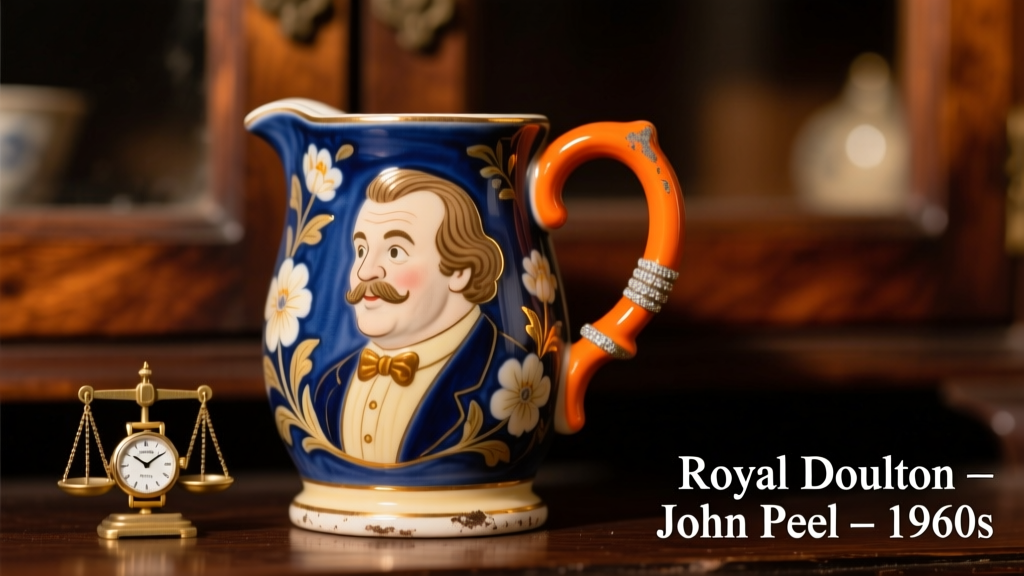
Royal Doulton Character Jug: John Peel 'Orange Band Handle' Miniature — A Collector's Deep Dive
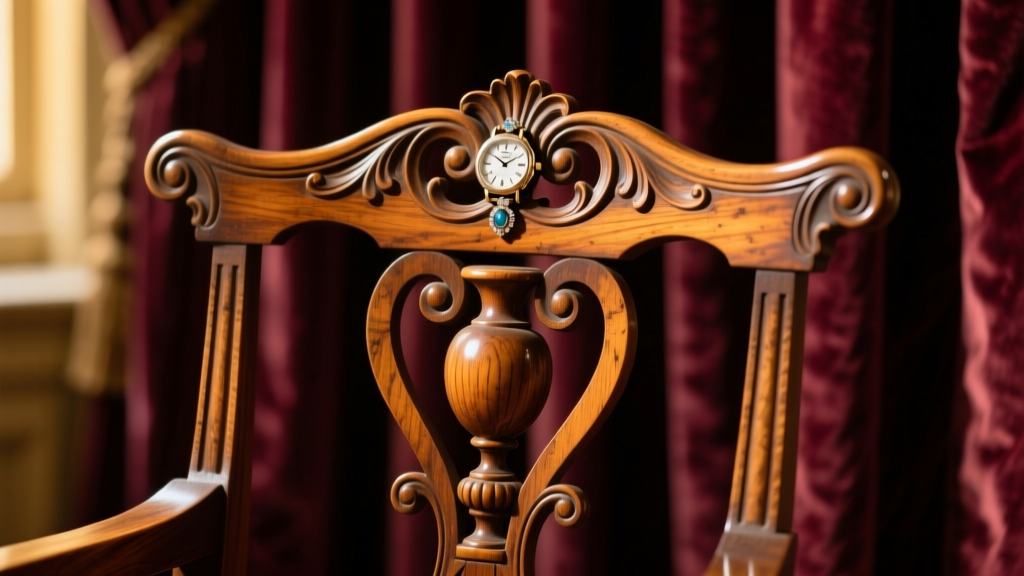
Walnut Balloon-Back Armchair with Urn Splat and Shaped Crest Rail: A Definitive Study of English Georgian Seating, c.1750–1775
The 1870 French Perpetual Calendar Clock: A Red-and-Black Marble Masterpiece with Paper Dial and Precision Escapement
The Patek Philippe Ref. 1138250: A Study in Mid-Century Precision, Provenance, and Market Evolution
Cambridge Glass Elaine Goblet (10 oz): Design, Provenance, and Collectibility of a Mid-Century American Masterpiece
The 1/4-Plate Daguerreotype Couple Portrait: A Technical and Historical Deep Dive
Sascha Brastoff Rearing Stallion Vase: A Mid-Century Masterpiece in Ceramic and Gold
Halloween Sparkler Black Cat Tin Chein Box (5-Inch): A Collector’s Guide to Mid-Century American Tinware
A Qing Dynasty Jade Jar Cover with Green Ram-Shaped Handles: Provenance, Craftsmanship, and Auction Significance