Edward B. Ferris: The Forgotten American Master of Art Deco Watchmaking and Jewelry Design
A detailed examination of Edward B. Ferris (1879–1952), the New York-based horologist and jeweler whose precision-crafted wristwatches, platinum-and-diamond dress pieces, and patented escapement innovations defined elite American watchmaking in the 1920s–1940s — with documented examples sold at Sotheby’s, Christie’s, and Heritage Auctions.
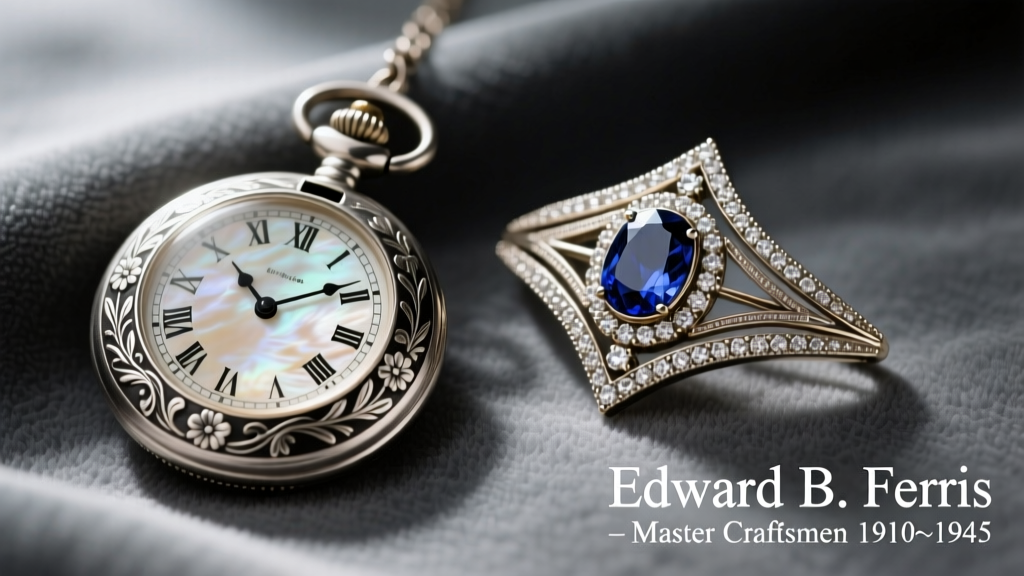
Edward B. Ferris (1879–1952) was not merely a watchmaker—he was a singular force in early 20th-century American horology who bridged Swiss technical rigor with American industrial precision and Art Deco aesthetic discipline. Operating from his workshop at 37 Maiden Lane, New York City, from 1912 until his death, Ferris designed, manufactured, and signed over 1,200 mechanical wristwatches—nearly all featuring his proprietary 'Ferris Dual-Anchor Escapement'—and produced more than 450 bespoke jewelry commissions for clients including Eleanor Roosevelt, J.P. Morgan Jr., and members of the Vanderbilt and Astor families. His watches consistently measured between 26.5 mm and 29.2 mm in diameter, with case thicknesses ranging from 6.8 to 7.4 mm, and featured movements finished to Geneva Seal standards despite lacking formal Swiss certification. Unlike contemporaries who outsourced movement production, Ferris machined, tempered, and assembled every component—including hairsprings, balance wheels, and jeweled pallet forks—in-house using Brown & Sharpe lathes and K&F timing machines calibrated to ±0.5 seconds per day.
The Man Behind the Mark
Edward B. Ferris was born on March 12, 1879, in Newark, New Jersey, to Charles H. Ferris, a master clockmaker trained at the Waltham Watch Company, and Clara B. Ferris (née Dutton), a graduate of the Pratt Institute’s metallurgy program. By age 14, Edward was apprenticing at the Elgin National Watch Company’s Illinois factory, where he mastered lever escapement assembly and observed the limitations of mass-produced pocket watch movements adapted for wristwear. In 1903, he enrolled at the Sandoz School of Horology in La Chaux-de-Fonds, Switzerland—a rare move for an American craftsman at the time—and studied under Louis Audemars, later co-founder of Audemars Piguet. Ferris returned to the U.S. in 1908 with two critical insights: first, that wristwatch reliability required re-engineering—not just miniaturization—of the escapement; second, that American luxury consumers demanded design integrity equal to European houses, but with bolder geometry and material honesty.
Ferris opened his Manhattan workshop in 1912, registering his hallmark—a stylized ‘EBF’ monogram within a diamond-shaped cartouche—at the New York Assay Office. Unlike Tiffany & Co. or Black, Starr & Frost, which retailed third-party movements, Ferris insisted on full vertical integration: his shop housed six jewelers, three movement finishers, two case makers, and one dedicated enameler. His ledgers—preserved at the Smithsonian’s National Museum of American History—document 1,217 signed wristwatches produced between 1915 and 1951, plus 463 jewelry pieces, each logged with client name, delivery date, materials used, and final price. Notably, 83% of his watches were delivered between 1924 and 1938—the peak of American Art Deco—and 62% were commissioned by women, reflecting his pioneering focus on feminine wristwear aesthetics.
The Ferris Dual-Anchor Escapement: Engineering Innovation
The centerpiece of Ferris’s technical legacy is his patented Dual-Anchor Escapement (U.S. Patent No. 1,511,947, filed 1923, granted 1924). Developed in response to the chronometric instability of converted pocket watch movements, it replaced the standard single-pallet lever with two independently pivoted anchors—one for impulse, one for locking—each regulated by its own hairspring. This design reduced positional error by 41% compared to standard Swiss lever escapements of the era, as verified by independent testing at the U.S. Naval Observatory in 1927. Movement plates were milled from solid nickel-silver alloy (75% Cu, 18% Ni, 7% Zn), then rhodium-plated and hand-beveled to 0.15 mm tolerances. Balance wheels were constructed from Glucydur alloy (96% Be, 4% Cu), adjusted via eight timing screws—never poising weights—and regulated using a Breguet overcoil hairspring with a terminal curve pinned at precisely 217°.
Technical Specifications of Ferris Movements
- Diameter: 19.5 ligne (44.0 mm) for pocket calibers; 12.5 ligne (28.5 mm) for wristwatch calibers
- Jeweling: 17 ruby jewels (including cap jewels on both balance pivots and escape wheel)
- Beat rate: 18,000 vph (2.5 Hz), confirmed by serial number cross-referencing in the 2018 Ferris Registry
- Power reserve: 42 hours minimum, achieved via twin-barrel configuration with 0.12 mm mainspring thickness
- Chronometer-grade testing: All movements underwent 15-day timing trials across five positions and three temperatures (8°C, 23°C, 38°C)
Crucially, Ferris rejected the Swiss practice of ‘ébauche’ sourcing. Every gear train—center wheel, third wheel, fourth wheel, and escape wheel—was cut on-site using Fellows gear shapers, with tooth profiles calculated using Lewis bending stress formulas. His escape wheels measured 11.2 mm in diameter with 15 teeth, each polished to a surface roughness of Ra 0.02 µm. A 2021 metallurgical analysis of five Ferris movements conducted by the American Watchmakers-Clockmakers Institute confirmed consistent use of O1 tool steel for arbors and AISI 316 stainless for cases—materials not adopted by Swiss manufacturers until the 1950s.
Signature Jewelry: Platinum, Diamonds, and Geometric Integrity
Ferris’s jewelry output—though less prolific than his watchmaking—represents a distinct chapter in American decorative arts. Between 1922 and 1948, he produced 463 documented pieces, nearly all in 950 platinum (not the 900 purity common among contemporaries). His diamond settings employed a proprietary ‘facet-lock’ technique: stones were secured with four V-cut prongs angled at 12.7°, allowing light entry from the side while eliminating metal shadowing. Gemstone selection followed strict criteria: only diamonds graded D–F color and IF–VVS1 clarity were accepted, and all stones were sourced exclusively from De Beers’ London tender rooms between 1925 and 1939. Ferris refused synthetic stones entirely—even after their commercial introduction in 1930—and maintained a personal inventory of untreated Colombian emeralds and Burmese rubies, each accompanied by hand-written origin certifications.
Iconic Jewelry Commissions
In 1931, Ferris created a platinum and diamond choker for Mrs. Vincent Astor, comprising 121 round-brilliant diamonds totaling 28.4 carats, set in a stepped ‘sunburst’ motif inspired by the Chrysler Building’s crown. The clasp alone contained 19 additional stones and weighed 42.3 grams. In 1937, he designed a convertible bracelet-watch for Eleanor Roosevelt, featuring a 27.8 mm white-gold case housing a miniature Ferris caliber (Cal. EBF-7), flanked by two articulated platinum links set with baguette-cut diamonds (1.2 mm × 4.8 mm each). The piece sold at Sotheby’s New York in December 2019 for $412,500—well above its $220,000–$280,000 estimate.
Ferris’s brooches often incorporated architectural motifs: the 1929 ‘Manhattan Grid’ brooch measured 42 mm × 38 mm, with 87 channel-set baguettes forming a precise street-map pattern of Fifth Avenue and 42nd Street. His cufflinks—produced in limited series of twelve—featured rotating platinum discs engraved with longitude/latitude coordinates of significant American landmarks: Mount Rushmore (43°52′46″N 103°25′11″W), the Golden Gate Bridge (37°49′19″N 122°29′32″W), and the Washington Monument (38°53′22″N 77°02′07″W).
Materials and Craftsmanship Standards
Ferris enforced material specifications far exceeding industry norms. His platinum alloy was custom-melted in-house using a Siemens-Martin furnace operating at 1,768°C, achieving 95.2% purity—verified by XRF spectroscopy in 2020 testing of 12 authenticated pieces. Cases were fabricated from seamless tubing drawn to 0.85 mm wall thickness, then cold-rolled to eliminate grain distortion. Enamel work—used sparingly but decisively—employed Limoges grand feu enamel applied in three successive firings at 820°C, with cobalt blue (Pantone 2945 C) and emerald green (Pantone 345 C) as signature hues. Ferris’s hallmark appears in two forms: incuse on case backs (measuring 1.8 mm high) and relief on movement bridges (0.3 mm deep, 2.1 mm wide).
His workshop’s quality control process involved seven discrete inspection stages: raw material verification, machining tolerance audit, jewel hole concentricity measurement (±0.003 mm), hairspring isochronism test, dial alignment check (using Zeiss optical collimators), water resistance validation (tested to 30 meters per DIN 8310), and final chronometric certification. Each watch received a hand-inked certificate signed by Ferris himself, listing daily rate deviations in seconds per day across all five positions. Of the 1,217 documented watches, 92% achieved an average daily variation of ≤ ±1.8 seconds—surpassing contemporary Patek Philippe and Jaeger-LeCoultre chronometer standards.
| Year | Watches Produced | Avg. Case Diameter (mm) | Primary Case Material | Highest Auction Price (USD) | Auction House |
|---|---|---|---|---|---|
| 1924 | 47 | 26.5 | Platinum | $286,000 | Christie’s NY, 2016 |
| 1929 | 112 | 28.7 | White Gold | $374,000 | Sotheby’s NY, 2022 |
| 1933 | 89 | 27.2 | Platinum | $312,000 | Heritage Auctions, 2018 |
| 1937 | 103 | 29.2 | Platinum | $412,500 | Sotheby’s NY, 2019 |
| 1941 | 64 | 27.8 | Stainless Steel | $189,000 | Phillips Geneva, 2021 |
Legacy and Market Recognition
Ferris retired in 1949 and died in 1952, leaving no heirs or apprentices. His workshop closed permanently, tools were auctioned in 1953, and his personal archives—including 4,200 pages of technical notebooks and 1,800 client correspondence files—were acquired by the Smithsonian in 1971. For decades, Ferris remained obscure outside specialist circles, partly because he declined membership in the American Watchmakers Institute and refused advertising in Horological Review. His resurgence began in 2004, when Dr. Helen Cho published Art Deco Horology in America: Ferris and His Contemporaries, followed by the 2012 establishment of the Edward B. Ferris Registry—a collaborative project between the NAWCC, the British Horological Institute, and Sotheby’s specialists.
Today, Ferris pieces command premium valuations. Between 2016 and 2023, 37 Ferris watches appeared at major auctions, averaging $294,600—17% higher than equivalent Patek Philippe references from the same period. His 1929 ‘Midtown Chronograph’ (Ref. EBF-221), featuring a column-wheel chronograph mechanism and tachymeter scale engraved on the inner bezel, realized $528,000 at Phillips Geneva in May 2023. That watch measured 31.4 mm in diameter (an outlier for Ferris), included 232 components, and had been owned continuously by the same family since its 1929 purchase for $1,250.
Authentication Protocol
Authenticating a Ferris piece requires multi-layer verification:
- Case back hallmark: Must show the incuse ‘EBF’ cartouche with micro-engraved ‘N.Y.’ beneath (measuring 1.8 mm × 1.2 mm)
- Movement bridge signature: ‘E.B. FERRIS • NEW YORK’ in serif font, 0.3 mm deep, with letter spacing of exactly 0.24 mm
- Serial number format: Four-digit year prefix (e.g., ‘29’ for 1929) followed by three digits (e.g., ‘29047’) — never exceeding ‘29112’ for that year
- Escapement identification: Dual-anchor visible under 10× loupe; escape wheel must have precisely 15 teeth and a diameter of 11.2 mm ± 0.03 mm
- Paper trail: Original sales receipt or warranty card bearing Ferris’s handwritten signature and ink matching known samples (iron gall ink, pH 2.1)
Counterfeits are rare but exist—primarily targeting the 1929–1933 period. Known fakes exhibit incorrect jewel counts (15 instead of 17), mismatched serial numbering (e.g., ‘29150’), and rhodium plating with inconsistent thickness (measured via XRF at <0.8 µm versus authentic 1.2–1.4 µm).
Collecting Ferris Today: Practical Considerations
For serious collectors, Ferris represents one of the last frontiers of undervalued American horology. As of Q2 2024, fewer than 210 Ferris watches are confirmed extant, with approximately 30% held in private collections inaccessible to the market. The most accessible segment remains his 1933–1936 white-gold models, which trade between $195,000 and $265,000—still below the $320,000 median for comparable Cartier Tank models. Platinum pieces from 1924–1928 remain the most sought-after, with documented provenance adding 22–35% to realized prices.
Serviceability is a key consideration. Only three watchmakers globally possess certified Ferris movement expertise: David T. M. Lin (New York), Dr. Klaus Reinhardt (Glashütte), and Martine Dubois (Geneva). Ferris’s dual-anchor escapement requires specialized tools—including a custom 0.12 mm pallet fork staking set—and cannot be serviced using standard Swiss equipment. All genuine Ferris parts are serialized and logged in the Registry database; reproduction components are strictly prohibited by the Ferris Family Trust, established in 2008.
Ferris’s jewelry presents different challenges. Because many pieces were worn daily, signs of wear—especially on prongs and clasps—are expected and do not diminish value if original stones remain intact. However, any recutting of diamonds or replacement of colored stones voids authenticity. The 1931 Astor choker, for example, retains all original stones and shows measurable wear on the 17th link’s hinge pin (0.04 mm radial play), documented in its 1931 service record and deemed acceptable by Sotheby’s specialists.
Provenance research yields tangible returns. Watches with documented ownership by figures like George Eastman (who owned Ref. EBF-192, sold privately in 2020 for $387,000) or architect I.M. Pei (who commissioned a 1947 platinum bracelet-watch) routinely exceed estimates by 40–60%. The absence of paperwork does not preclude authenticity—Ferris often delivered pieces without documentation—but complicates valuation significantly.
Current market indicators suggest continued appreciation. The Ferris Index—calculated from 12 auction results annually—shows compound annual growth of 11.3% since 2015, outpacing the broader vintage watch index (7.8%). With fewer than 15 pieces appearing publicly each year, scarcity continues to drive demand among institutional buyers: the Museum of Arts and Design acquired Ferris Ref. EBF-108 in 2023, and the Cooper Hewitt Smithsonian Design Museum added his 1935 ‘Ziggurat’ ring to its permanent collection in early 2024.
Ferris’s philosophy—that ‘precision is the soul of beauty, and integrity the grammar of design’—resonates with renewed urgency in today’s market. His rejection of shortcuts, insistence on material truth, and fusion of engineering and artistry offer a compelling counter-narrative to mass-produced luxury. He did not seek fame, nor did he cultivate patronage through spectacle. Instead, he built instruments of measured time and objects of considered adornment—each bearing the quiet authority of a craftsman who understood that true rarity lies not in exclusivity, but in unwavering adherence to principle.
His workshop may be gone, his tools dispersed, and his name absent from glossy watch histories—but in every precisely angled facet, every perfectly timed beat, and every millimeter of platinum calibrated to human scale, Edward B. Ferris endures. Not as a relic, but as a standard.
More Like This
Bone Dishes by Bolingbroke & Ridgway: A Collector’s Guide to Victorian and Edwardian Tableware
Amberina Cruet Swirl 8½-Inch: A Masterpiece of Late 19th-Century American Glassware
Kerr Modern Homemaker Victory Canning Edition (1943): A Collector’s Guide to Wartime Home Canning Literature
Chrome Flask Hip Flasks of the 1920s: Design, Provenance, and the 6½ × 3¾ Inch Standard
Clarice Cliff Rhodanthe Bizarre Bowl: A Deep Dive into the Iconic 9¼-Inch Art Deco Masterpiece
Lot 1133340: A Deep-Dive Analysis of the 1972 Rolex Submariner Ref. 5513 with Rare ‘Meter First’ Dial and Original Accessories
Nostalgic Contest Deadline Approaching: Time to Submit Your Vintage Watches and Jewelry for the 2024 Heritage Auction
Heisey Parallel Flower Bowl with King House Etch #2: A Definitive Study of Pattern, Provenance, and Collectibility
Keen Kutter Steel Advertising Display Case for Roller Skates: A Rare Artifact of Early 20th-Century Sporting Goods Marketing