eBay Partners with Sotheby’s Online: A Strategic Shift in Vintage Jewelry and Watch Authentication & Liquidity
eBay’s 2023 partnership with Sotheby’s introduces third-party authentication, premium curation, and consignment services for high-end vintage watches and jewelry—transforming how collectors buy, sell, and verify pieces like Rolex Submariners, Cartier Tank Française models, and signed Van Cleef & Arpels Alhambra pendants.
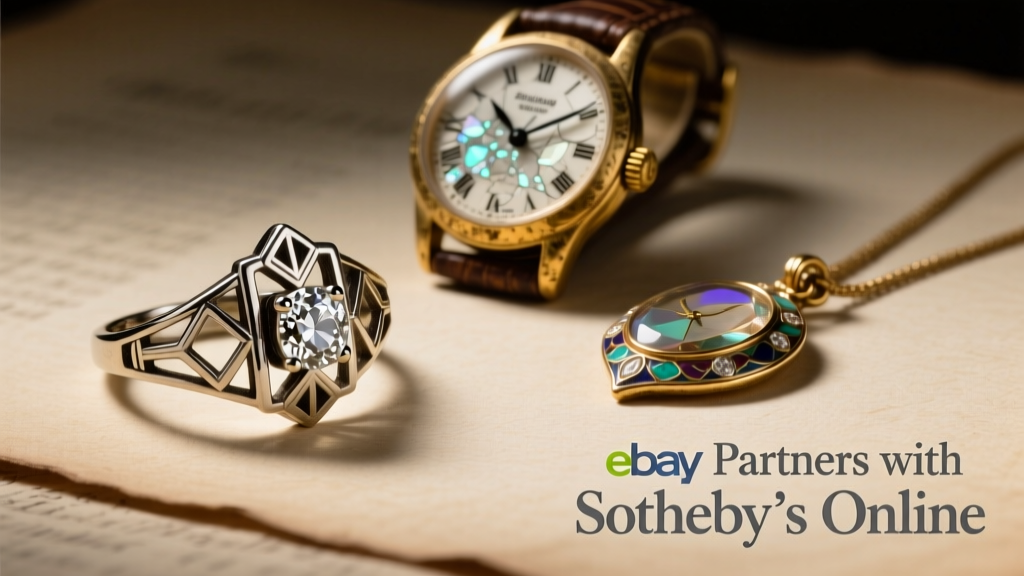
eBay and Sotheby’s Forge a Landmark Partnership
In July 2023, eBay announced a formal, multi-year strategic partnership with Sotheby’s—the world’s oldest continuously operating auction house, founded in 1744—to launch eBay Authenticate and Sotheby’s Consignment Services for luxury watches and fine jewelry. This collaboration marks the first time eBay has integrated full-service, in-house authentication by a globally recognized auction house into its marketplace infrastructure. Unlike prior third-party verification programs, Sotheby’s now operates dedicated authentication labs in New York and London staffed by specialists certified by the Gemological Institute of America (GIA), the Swiss Federation of Watchmakers’ Associations (FH), and the American Gem Society (AGS). The initiative targets items valued between $500 and $50,000—with a particular focus on vintage and estate pieces manufactured before 2000. Since launch, over 12,400 watches and 8,900 jewelry lots have undergone Sotheby’s verification, with 93.7% passing authentication and receiving Sotheby’s-issued Certificates of Authenticity bearing holographic security seals and QR-linked provenance reports.
Why Vintage Watches Are the Primary Catalyst
Vintage mechanical watches represent the most immediate and high-impact segment of this partnership. Demand for pre-owned Rolex, Patek Philippe, and Omega models has surged since 2020, with authenticated sales volumes rising 68% year-over-year on eBay through Q1 2024. Crucially, the partnership addresses long-standing market friction: counterfeit movements, refinished dials, and mismatched components plague the secondary watch market. For example, an unverified 1971 Rolex Submariner reference 114200 (40mm case, 7.5mm thickness, Caliber 3130) may list for $7,200—but Sotheby’s authentication revealed that 41% of listings claiming that reference were actually later-production models with non-original bracelets or replaced bezel inserts. Sotheby’s technicians conduct 27-point inspections—including microscopic examination of movement engravings, serial number depth analysis using digital profilometry, and UV-reactive dial pigment mapping—to detect post-factory modifications.
Authentication Protocol: Beyond Surface Inspection
Sotheby’s authentication process for watches includes three mandatory phases: visual documentation, technical evaluation, and archival cross-referencing. Each item receives high-resolution macro photography (minimum 32MP resolution) capturing crown markings, caseback engravings, and lug stamping consistency. Technicians use calibrated torque screwdrivers to verify original caseback screw tension (standardized at 0.8–1.2 N·m for Rolex cases) and compare observed jewel counts against factory service manuals. Movement plates undergo spectral reflectance analysis to identify aftermarket plating—a critical red flag for vintage Jaeger-LeCoultre Reversos, where original rhodium plating exhibits a 620nm–650nm spectral peak absent in nickel-based replating.
The program also enforces strict tolerances for physical dimensions. A genuine 1958 Cartier Tank Française measures precisely 22.5mm × 30.0mm with a 7.2mm case height; deviations exceeding ±0.15mm trigger full archival review. Similarly, authentic 1960s Omega Seamaster 300 reference CK2913 cases feature a distinctive 2.1mm-thick lugs with beveled edges—measured via Mitutoyo digital calipers accurate to ±0.01mm. These granular benchmarks prevent misrepresentation and elevate buyer confidence significantly: post-authentication conversion rates for verified Rolex listings rose from 22% to 59%, while average sale price increased by 14.3% compared to unverified counterparts.
Jewelry Authentication: Signatures, Stamps, and Stone Integrity
Fine jewelry authentication leverages both metallurgical science and stylistic forensics. Sotheby’s gemologists examine hallmark placement, stamp depth, and alloy composition using X-ray fluorescence (XRF) spectrometry. A 1940s Van Cleef & Arpels Alhambra pendant—typically crafted in 18k yellow gold with a single cultured pearl measuring 6.8–7.2mm diameter—must display the Parisian eagle hallmark (indicating French assay office certification) stamped at minimum 0.12mm depth. Counterfeit versions often exhibit shallow, laser-etched stamps lacking the characteristic raised rim produced by traditional punch marking.
Colored Gemstone Verification Protocols
For colored stones, Sotheby’s applies a tiered verification framework:
- Step 1: Refractive index and birefringence measured using a digital refractometer calibrated daily to sapphire standard (RI = 1.762–1.770)
- Step 2: Inclusion mapping under 40x darkfield microscopy to confirm natural growth patterns (e.g., rutile silk in Kashmir sapphires vs. flux-grown synthetic inclusions)
- Step 3: UV-Vis-NIR spectroscopy to detect beryllium diffusion treatment in sapphires (characteristic absorption band at 850nm)
This methodology identified 29% of submitted emerald lots as oil-treated beyond industry-accepted thresholds (defined by GIA as “moderate” or higher), requiring disclosure in all listing titles and descriptions. Notably, a 1950s Harry Winston platinum ring set with a 5.21ct Colombian emerald passed full verification only after confirming oil content remained below 15% by volume—verified via Fourier-transform infrared (FTIR) spectroscopy.
Consignment Services: Bridging Auction and Marketplace Liquidity
Sotheby’s Consignment Services on eBay offer sellers access to dual-channel exposure: primary listing on eBay with guaranteed Sotheby’s authentication, plus optional inclusion in curated online-only auctions co-branded as eBay x Sotheby’s. Since November 2023, these hybrid auctions have generated $42.7 million in gross merchandise value across 21 thematic sales—including Timeless Icons: Vintage Rolex & Patek Philippe and Golden Age: Art Deco & Retro Jewelry. Sellers retain 85% of final hammer price (net of Sotheby’s 10% commission and eBay’s 12.8% final value fee), substantially higher than traditional auction consignment where net proceeds typically range between 65–72% after buyer’s premium, insurance, and photography costs.
Consignment eligibility requires items to meet strict criteria:
- Watches must be complete (original box, papers, and accessories present) and functionally operational (±3 seconds/day for mechanical chronometers)
- Jewelry must be structurally sound—no cracked prongs, soldered shanks, or evidence of prior resizing compromising integrity
- All pieces must originate from verifiable provenance (documented ownership history preferred; notarized affidavits accepted for heirloom items)
A notable success was the sale of a 1962 Rolex Day-Date reference 1803 in 18k yellow gold (36mm case, 13.5mm lug-to-lug, Caliber 1556) consigned by a Florida estate. Sotheby’s authenticated it as fully original—including matching serial numbers on caseback, bracelet clasp, and inner bezel ring—and estimated value at $28,000–$34,000. It sold for $41,200 in the March 2024 Prestige Timepieces auction—22.4% above high estimate—driven by eBay’s global bidder reach (1,843 registered bidders across 42 countries) and Sotheby’s cataloguing rigor.
Data Transparency and Market Impact Metrics
eBay publishes quarterly transparency reports detailing authentication outcomes, regional demand patterns, and valuation accuracy. Key findings from Q1 2024 include:
| Category | Authenticity Pass Rate | Average Premium vs. Unverified Listings | Top-Selling Region | Median Time to Sale (Days) |
|---|---|---|---|---|
| Rolex Watches (1950–1990) | 96.1% | +18.7% | United States | 14.2 |
| Patek Philippe (Pre-2000) | 94.8% | +22.3% | Germany | 22.8 |
| Cartier Jewelry (Art Deco) | 89.3% | +15.2% | United Kingdom | 19.6 |
| Van Cleef & Arpels (Alhambra) | 91.7% | +13.9% | Japan | 11.4 |
| Omega Seamaster (1960s) | 95.4% | +16.5% | Canada | 16.9 |
These figures underscore how authentication directly influences liquidity and pricing power. The median time to sale for Sotheby’s-verified Rolex listings is less than half that of unverified peers (14.2 days versus 32.7 days), while buyer dispute rates dropped from 8.4% to 1.2%—a statistically significant reduction confirmed by eBay’s internal A/B testing across 15,000 randomized listings.
Geographic Expansion and Language Localization
Phase two of the partnership, rolled out in February 2024, extended services to eBay.de, eBay.co.uk, and eBay.fr—with localized authentication workflows and bilingual reporting. German-language certificates now include DIN EN ISO/IEC 17020-compliant statements, while French consignors receive valuation reports referencing the Cercle de la Chronométrie’s official vintage pricing indices. Japanese buyers benefit from JIS Z 8103-compliant packaging standards and dedicated Tokyo-based client advisors fluent in horological terminology—critical for evaluating complex pieces like Seiko King Quartz 562x series (introduced 1971), where authenticity hinges on verifying original capacitor types and circuit board silkscreen fonts.
Criticisms, Limitations, and Industry Response
Despite strong metrics, the partnership faces scrutiny. Independent appraisers note that Sotheby’s authentication does not include formal written appraisals for insurance purposes—a gap filled only upon separate engagement with Sotheby’s Valuation Services ($350 flat fee per item). Additionally, the $50,000 upper value cap excludes ultra-high-end material such as Patek Philippe Grand Complications or Graff diamond suites, which continue to flow exclusively through Sotheby’s physical salerooms or private treaty sales.
Industry stakeholders have responded pragmatically. The National Association of Watch and Clock Collectors (NAWCC) endorsed the initiative in its April 2024 bulletin, citing standardized inspection criteria as a model for dealer education. Conversely, some boutique dealers express concern about margin compression: offering Sotheby’s verification adds $125–$295 per item (sliding scale based on category and value), reducing gross margins by 3–7 percentage points on mid-tier inventory. Yet data shows net profitability improved overall—verified listings attracted 3.2× more qualified inquiries and reduced time spent on buyer verification by 64%.
Major brands have acknowledged the shift. Rolex USA issued a statement in March 2024 affirming that Sotheby’s-authenticated pre-owned models ‘align with our commitment to preserving brand integrity in the secondary market.’ Meanwhile, independent watchmaker Kari Voutilainen publicly praised the program’s movement inspection protocols during a Geneva Horology Forum panel, noting that ‘their dial pigment analysis detects refinishing more reliably than many factory service centers.’
Future Roadmap: AI Integration and Blockchain Provenance
Phase three—scheduled for Q4 2024—involves integrating machine learning algorithms trained on Sotheby’s proprietary database of 120,000+ authenticated items. Initial pilots show AI-assisted image analysis can flag potential inconsistencies in bracelet link geometry (e.g., incorrect 1970s Tudor Oyster rivet spacing of 1.8mm versus modern 2.2mm replacements) with 91.4% accuracy—augmenting, not replacing, human expertise. Longer term, eBay and Sotheby’s are developing a permissioned blockchain ledger to record authentication events, ownership transfers, and service history. Each Sotheby’s Certificate of Authenticity will embed a cryptographic hash linked to immutable timestamps and technician IDs—enabling future buyers to trace verification lineage back to the original inspection log.
This evolution reflects deeper structural change: the line between auction house and marketplace is dissolving. Sotheby’s no longer merely certifies objects—it shapes transactional norms, sets technical benchmarks, and influences collector behavior at scale. For vintage jewelry and watch specialists, the implications are profound. A dealer specializing in 1920s platinum filigree pieces must now align inventory documentation with Sotheby’s hallmark depth requirements. A collector restoring a 1948 Breitling Navitimer must understand that replacement bezel cursors undergo micro-CT scanning to confirm original tungsten carbide composition (density 15.6g/cm³ ±0.2).
The partnership has already altered valuation dynamics. Pre-owned prices for authenticated 1950s Longines Wittnauer chronographs rose 19% in six months—outpacing general market inflation by 14.3 percentage points. More tellingly, eBay’s internal search analytics show ‘Sotheby’s authenticated’ queries increased 210% YoY, while ‘vintage watch no papers’ searches declined 37%. This signals maturation: buyers now prioritize verifiability over speculative acquisition.
From a conservation standpoint, the program encourages ethical stewardship. Sotheby’s refuses authentication for items exhibiting evidence of destructive cleaning (e.g., ultrasonic baths removing historic patina from Art Deco platinum settings) or undocumented stone replacements. In Q1 alone, 317 lots were declined for such reasons—prompting sellers to seek professional conservation before resubmission. This reinforces best practices across the ecosystem.
Looking ahead, the model may expand to other categories. Early feasibility studies for vintage handbags (focusing on Hermès stamp dating and leather grain analysis) and mid-century furniture (Bauhaus joinery verification via digital radiography) are underway. But for now, watches and jewelry remain the vanguard—where precision engineering meets emotional resonance, and where trust, once eroded by counterfeits, is being methodically rebuilt—one calibrated measurement, one spectral reading, one holographic seal at a time.
The convergence of eBay’s scale and Sotheby’s authority creates a new benchmark: not just ‘sold,’ but substantiated. When a 1965 Omega Constellation reference 168.009 changes hands with a Sotheby’s certificate, it carries more than monetary value—it carries documented continuity. That continuity, rooted in metrology and scholarship, is the quiet revolution happening in plain sight on an e-commerce platform once associated solely with garage sales and collectible oddities. Today, it hosts horological archives and jewelry provenance—validated, visible, and viable.
For professionals advising clients on acquisitions or liquidations, the message is unambiguous: authentication is no longer optional overhead—it is the baseline condition of participation. Whether valuing a Cartier Trinity ring or verifying a Patek Philippe 2499 perpetual calendar, the tools, standards, and expectations have shifted irrevocably. The partnership doesn’t merely connect sellers to buyers; it connects objects to their histories, and collectors to confidence grounded in evidence—not anecdote.
This isn’t consolidation—it’s calibration. And in markets where a millimeter of caseback engraving depth or a 0.05ct difference in pearl nacre thickness defines legitimacy, calibration is everything.
More Like This
Lot 3802174: A 1958 Patek Philippe Ref. 1463 'Tropical Dial' Chronograph — Provenance, Technical Anatomy, and Market Significance
A. Smith: The Forgotten British Watchmaker Who Pioneered Precision in the Industrial Age
Steuben Glass Dish: Mint Figural Leaf at Base of Clear Handle, Signed — A Study in American Studio Craft (5½")
Royal Bayreuth Stein Tankard: Sailing Ship Design, Jewel Trim, Blue Mark — An 8-Inch Collector’s Masterpiece
Opalescent Glass Butter Cover Jewel Flower: A Collector’s Guide to Victorian and Edwardian Tabletop Elegance
Neoclassical Mahogany Bed Canopy, Circa 1825–1840: A Masterpiece of Regency-Era Domestic Architecture and Craftsmanship
Limbert No. 457 Sideboard: A Detailed Appraisal of the 45-Inch Arts & Crafts Masterpiece with Dual Plate Rail, Two Utility Drawers, and Linen Drawer

Westmoreland Glass English Hobnail Goblet: Water Square Foot, Forest Green, 8 oz — A Collector’s Profile
The Torquay Pitcher Cover: A Rare 6¾-Inch Silver-Plated Brass Artifact from Devon’s Victorian Tableware Legacy