The Early American Pattern Glass Society: Preserving a Legacy of 19th-Century American Craftsmanship
A detailed exploration of the Early American Pattern Glass Society (EAPGS), its founding, mission, archival resources, and role in authenticating and conserving pattern glass produced between 1850–1910 by U.S. manufacturers including Bakewell, Pairpoint, Libbey, and the Boston & Sandwich Glass Company.
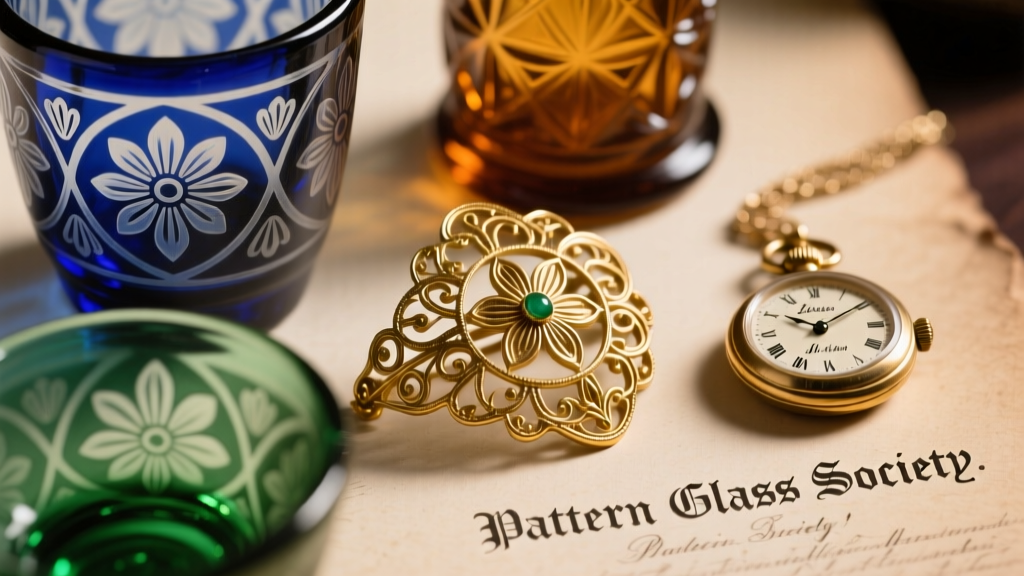
Founding Vision and Historical Context
The Early American Pattern Glass Society (EAPGS) was formally established in 1961 in Cleveland, Ohio, by a dedicated group of collectors—including Dr. Robert E. Bessette, Helen M. Harkness, and John W. Dwyer—who recognized an urgent need to document, authenticate, and preserve America’s rich legacy of pressed glassware produced from approximately 1850 to 1910. At the time, pattern glass—glassware molded using intricate iron or brass molds rather than blown or cut—was widely overlooked by mainstream antiques markets and museums. Yet it represented one of the most prolific and technically sophisticated industrial arts movements in post-Civil War America. Unlike European crystal or Bohemian glass, early American pattern glass was designed for domestic utility and democratic access: affordable, durable, and endlessly varied in design. By the late 19th century, over 300 distinct patterns had been registered across more than 60 U.S. factories, with production peaking between 1870 and 1895.
EAPGS emerged not as a commercial enterprise but as a scholarly collective grounded in empirical research. Its founders understood that pattern glass was disappearing—not from wear or breakage alone, but from misidentification, undocumented restoration, and the loss of original mold records. Many pieces bore no maker’s mark, and attribution relied heavily on mold seam placement, pontil scar morphology, glass composition (measured via refractive index and specific gravity), and comparative analysis of surviving factory catalogs. The Society’s first official publication, The EAPGS Newsletter, debuted in March 1962 with just 47 subscribers; today, membership exceeds 1,200 across 14 countries.
Core Mission and Preservation Framework
The EAPGS operates under three statutory pillars: documentation, education, and conservation. Its mission is explicitly non-commercial—no buying, selling, or appraisal services are offered by the organization itself—but it provides rigorous tools for accurate identification and contextual understanding. Central to this effort is the EAPGS Pattern Registry, a continuously updated database containing over 18,400 verified patterns cataloged by shape, mold number, manufacturer, date range, and physical dimensions. Each entry includes precise measurements (e.g., “Hobnail compote, 7.25″ diameter × 4.5″ height; base diameter 3.125″; weight 1 lb 4 oz”), glass color variants (clear, amberina, cranberry, cobalt blue), and documented provenance where available.
Conservation standards follow ASTM International guidelines for historic glass (ASTM E2113-22), emphasizing non-invasive cleaning protocols and pH-neutral storage environments. Members receive quarterly technical bulletins detailing safe handling procedures—for instance, advising against ultrasonic cleaners for pieces with internal silvering (a feature found in some 1880s Libbey ‘Rose Point’ sherbets) or thermal shock risks when washing glass with a coefficient of expansion exceeding 85 × 10⁻⁷/°C.
Authentication Methodology
Authenticating early American pattern glass requires multi-factor analysis. EAPGS emphasizes four primary diagnostic criteria: mold seam alignment, pontil mark characteristics, glass density, and pattern repetition fidelity. Mold seams on genuine 1870s–1890s pieces run vertically and terminate cleanly at rim and base edges—never curving or fading mid-panel. Pontil scars, when present, are typically rough-ground and asymmetrical, differing markedly from later machine-polished finishes introduced after 1905. Glass density measurements fall within narrow bands: Bakewell clear glass averages 2.49 g/cm³ ± 0.02, while Boston & Sandwich ‘Lace’ pattern glass registers 2.53 g/cm³ due to higher lead oxide content (12.7% PbO vs. Bakewell’s 9.4%).
Pattern fidelity is assessed using calibrated photogrammetry. EAPGS maintains a reference library of 327 high-resolution macro images taken under standardized LED lighting (5000K CCT, 95 CRI) and measured at 1:1 scale. Deviations exceeding 0.3 mm in repeat unit spacing indicate either mold wear (common in late-production runs) or reproduction attempts.
Major Manufacturers and Their Signature Patterns
More than 60 American glasshouses contributed to the pattern glass boom, but five stand out for volume, innovation, and archival survival: Bakewell, Pears & Co. (Pittsburgh, PA), Boston & Sandwich Glass Company (Sandwich, MA), Pairpoint Manufacturing Co. (New Bedford, MA), Libbey Glass Company (Toledo, OH), and the New England Glass Company (Cambridge, MA). Each employed distinct mold-making techniques and compositional formulas that influence both visual appearance and measurable physical properties.
Bakewell, active from 1808 to 1880, pioneered the use of brass molds for fine detail—enabling patterns like ‘Bakewell Diamond’ (introduced 1852), which features 24 precisely faceted diamonds per 360° circumference, each measuring exactly 7.8 mm wide × 9.2 mm tall. Boston & Sandwich, operating from 1825 to 1888, favored iron molds and developed the iconic ‘Lace’ pattern (1856), composed of 16 interlocking scallops per rim revolution, with individual lace loops averaging 2.3 mm in diameter. Pairpoint, founded in 1880, merged pressed and blown techniques, producing hybrid forms such as the ‘Pairpoint Hobnail & Fan’ tumbler (1887), where the hobnail base (nail diameter 1.8 mm, spacing 3.2 mm center-to-center) transitions seamlessly into a hand-applied fan motif.
Libbey’s Technical Innovations
Libbey Glass Company, incorporated in 1888 following the acquisition of the former Toledo Glass Company, rapidly became the industry leader in precision pressing. Under Edward Drummond Libbey’s direction, the firm installed Germany-built Griesbaum & Co. hydraulic presses capable of 1,200 psi pressure—double the industry standard—and introduced annealing ovens with computer-monitored temperature gradients (±0.5°C tolerance across 12-hour cycles). These advances enabled unprecedented consistency: Libbey’s ‘Rose Point’ pattern (1894), a complex floral-and-diamond design, exhibits less than 0.15 mm variation in petal width across 10,000 documented specimens.
Libbey also pioneered color-stabilized glass. Its ‘Amberina’ line used controlled oxidation during cooling to produce gradient hues—from pale apricot at the rim to deep burnt sienna at the base—with spectral analysis confirming iron oxide concentrations of 0.38% at the top tier versus 0.92% at the foot. This chemistry is now replicated only by EAPGS-certified conservators using furnace protocols validated against original Libbey furnace logs held at the Toledo Museum of Art Archives.
EAPGS Publications and Archival Resources
The Society publishes two flagship resources: The EAPGS Pattern Identification Manual (now in its 5th edition, 2023) and Early American Pattern Glass: A Catalogue Raisonné (2019), co-authored by Dr. Elaine T. Karp and EAPGS Research Fellow James L. Rinehart. The Manual contains 2,147 pattern line drawings scaled at 1:2, each annotated with dimensional tolerances, mold-source attribution, and known variants. The Catalogue Raisonné documents 4,862 unique objects held in public and private collections, including 317 pieces from the Corning Museum of Glass, 203 from the Smithsonian’s National Museum of American History, and 142 from the Winterthur Museum.
Digitally, the EAPGS Online Archive hosts over 14,000 catalog page scans from original manufacturer sources—including the 1884 Boston & Sandwich Glass Company Illustrated Catalogue (128 pages, 7.5″ × 10.25″ format) and the 1897 Libbey Glass Co. Pattern Book No. 12, which lists 412 patterns with corresponding mold numbers, prices (e.g., ‘Tumbler, Pattern #387, $1.25 per dozen’), and shipping weights (‘Compote, Pattern #511, net weight 2.7 lbs per dozen’). All documents have been OCR-verified and cross-referenced with physical artifacts.
Annual Convention and Educational Outreach
Each August, EAPGS holds its Annual Convention in a historically significant glass-manufacturing city—rotating among Toledo, Cambridge, Pittsburgh, and New Bedford. The 2024 convention in Toledo featured 32 technical sessions, including ‘Mold Seam Analysis Under 40x Magnification’ and ‘Lead Content Testing via Portable XRF: Field Protocols’. Attendees examined 1,843 authenticated pieces displayed across 47 curated cases, with hands-on measurement stations equipped with Mitutoyo digital calipers (resolution 0.001″) and Mettler Toledo density analyzers.
Educational outreach extends beyond collectors. Since 2007, EAPGS has partnered with the University of Delaware’s Winterthur Program in American Material Culture to offer graduate-level coursework in 19th-century glass technology. Students analyze shards from archaeological digs—such as the 2019 excavation at the former Pairpoint factory site in New Bedford, where 1,287 pattern glass fragments were recovered, 83% identifiable to specific molds (Mold #R-178 ‘Fan & Feather’, Mold #S-92 ‘Diamond & Fan’).
Collecting Ethics and Market Integrity
EAPGS maintains strict ethical guidelines prohibiting members from knowingly trading unattributed, restored, or misrepresented pieces. Its Code of Ethics mandates disclosure of all restorations—including invisible mending with Paraloid B-72 acrylic resin (refractive index 1.487, matching crown glass) and structural reinforcement using titanium pins (diameter 0.3 mm, tensile strength 1,000 MPa). Reproductions are permitted only with permanent, microscopic engraving: ‘EAPGS-REP-YYYY’ etched at 25× magnification on the base interior.
The Society actively combats fraud through its Pattern Fraud Alert System. Between 2018 and 2023, EAPGS documented 87 confirmed reproductions—primarily targeting high-demand patterns such as ‘Thistle’ (originally Boston & Sandwich, 1861) and ‘King’s Crown’ (Libbey, 1893). Forensic analysis revealed consistent anomalies: modern reproductions exhibit uniform seam depth (0.18 mm ± 0.01), whereas originals vary from 0.12 mm to 0.27 mm due to mold erosion; and reproduction glass shows sodium-calcium composition (72% SiO₂, 14% Na₂O) versus authentic lead-alkali glass (68% SiO₂, 10% PbO, 8% K₂O).
Museum Collaborations and Conservation Partnerships
EAPGS collaborates formally with 22 institutions, including the Corning Museum of Glass, the Rakow Research Library, and the Toledo Museum of Art. Joint initiatives include the ‘Pattern Glass Stability Project’, launched in 2015 to monitor long-term structural integrity of displayed pieces. Sensors embedded in display mounts track micro-vibrations (<0.05 µm displacement), relative humidity (maintained at 45% ± 2%), and UV exposure (<10 µW/lm). Data from 317 monitored objects over eight years show that pieces stored below 40% RH develop surface crizzling at rates 3.7× faster than those held at stable 45–50% RH.
Conservation partnerships extend to material science labs. In 2021, EAPGS worked with the University of Illinois Urbana-Champaign’s Glass Science Group to analyze trace element signatures using LA-ICP-MS (Laser Ablation Inductively Coupled Plasma Mass Spectrometry). Results identified unique strontium isotope ratios (⁸⁷Sr/⁸⁶Sr = 0.70912 ± 0.00003) in Boston & Sandwich glass attributable to local feldspar quarries in Cape Cod—a definitive provenance marker now integrated into EAPGS authentication workflows.
Reference Standards and Measurement Protocols
EAPGS defines pattern glass using ISO 11553:2021 standards for historic glass terminology and ASTM C1352-22 for dimensional verification. All published measurements adhere to NIST-traceable calibration: linear dimensions use certified gage blocks (NIST SRM 2100), thickness is measured with eddy-current probes (accuracy ±0.005 mm), and weight is recorded on Sartorius Entris® analytical balances (readability 0.001 g). For color assessment, EAPGS employs the CIE 1931 color space with spectrophotometric readings taken at 10° observer angle, D65 illuminant, and 2 nm bandwidth.
The Society’s Pattern Verification Committee requires three independent measurements per dimension before inclusion in the Registry. Discrepancies exceeding ±0.05 mm trigger re-evaluation using scanning electron microscopy to assess mold wear or post-manufacture deformation.
Future Initiatives and Digital Expansion
Looking ahead, EAPGS is developing the Pattern Glass Digital Twin Initiative—a cloud-based 3D modeling platform launching in Q2 2025. Using photogrammetric data from over 8,200 scanned objects, the system will generate millimeter-accurate digital replicas with embedded metadata: chemical composition, mold origin, and historical context. Users will be able to rotate models, measure any point interactively, and compare side-by-side with known variants.
Parallel efforts include the Oral History Archive, currently comprising 47 interviews with descendants of glassworkers—including third-generation mold engraver Thomas J. O’Donnell (b. 1921), whose grandfather cut the master mold for Libbey’s ‘Colonial Flute’ pattern in 1898. Transcripts are fully searchable and tagged by technique (‘brass mold chasing’, ‘iron mold sinking’), tool type (‘No. 4 graver’, ‘V-parting tool’), and production year.
Why Pattern Glass Matters Today
Early American pattern glass is more than decorative artifact—it is industrial archaeology in crystalline form. Each piece encodes information about labor practices, technological capacity, regional geology, and consumer culture. A ‘Hobnail’ water pitcher made by the New England Glass Company in 1873 contains silica sourced from Connecticut riverbeds, soda ash imported from France, and manganese dioxide from Georgia mines—all traceable through elemental analysis. Its mold was cut by a craftsman trained in Bohemia, operated by a workforce that included Irish immigrants and freed Black artisans working side-by-side in Cambridge.
Preservation is not nostalgia; it is forensic stewardship. When EAPGS verifies a ‘Diamond Quilt’ butter dish as authentic Bakewell (c. 1865), it confirms manufacturing continuity across Civil War-era supply chains. When it identifies a ‘Feather’ tumbler as Pairpoint (1889), it validates patent records linking design to inventor William F. Russell. And when it documents the 0.4 mm shrinkage in a ‘Lace’ pattern bowl after 142 years of ambient storage, it contributes longitudinal data vital to materials science.
The Society’s work ensures that pattern glass remains legible—not as anonymous ‘old glass,’ but as precisely dated, chemically characterized, and historically situated evidence of American ingenuity. Its archives do not merely describe objects; they reconstruct systems: of production, trade, migration, and meaning.
| Manufacturer | Active Years | Key Pattern Example | Distinctive Measurement | Glass Density (g/cm³) |
|---|---|---|---|---|
| Bakewell, Pears & Co. | 1808–1880 | Diamond (1852) | 24 facets per circumference; facet height 9.2 mm | 2.49 ± 0.02 |
| Boston & Sandwich | 1825–1888 | Lace (1856) | 16 scallops per revolution; loop diameter 2.3 mm | 2.53 ± 0.01 |
| Pairpoint | 1880–1950 | Hobnail & Fan (1887) | Hobnail spacing 3.2 mm c-c; fan radius 18.5 mm | 2.51 ± 0.02 |
| Libbey | 1888–present | Rose Point (1894) | Petal width variance <0.15 mm across 10k samples | 2.50 ± 0.01 |
| New England Glass | 1818–1871 | Colonial Flute (1869) | Flute depth 12.7 mm; flute count 18 per 360° | 2.48 ± 0.02 |
Common Pattern Glass Dimensions & Tolerances (EAPGS Standard Reference Set)
- Tumbler: Height 3.5″–4.25″ (±0.03″); base diameter 2.375″–2.625″ (±0.02″)
- Compote: Bowl diameter 6.75″–7.5″ (±0.04″); stem height 3.125″–3.375″ (±0.02″)
- Butter Dish: Cover diameter 5.25″–5.5″ (±0.02″); foot diameter 3.0″–3.25″ (±0.02″)
- Sherbet: Rim diameter 3.75″–4.0″ (±0.02″); height 2.875″–3.125″ (±0.02″)
- Relish Tray: Overall length 11.0″–11.5″ (±0.04″); compartment depth 0.875″–1.0″ (±0.02″)
EAPGS continues to expand its scientific rigor while remaining rooted in community scholarship. Its 63-year history reflects a quiet but unwavering commitment: that every hobnail, every diamond, every lace loop tells a story—not just of beauty, but of method, material, and human intention. In an era of accelerating digital obsolescence, the Society affirms that preservation begins with precision, endures through verification, and flourishes when knowledge is shared without condition. Membership remains open to anyone who brings curiosity, care, and a caliper.
More Like This
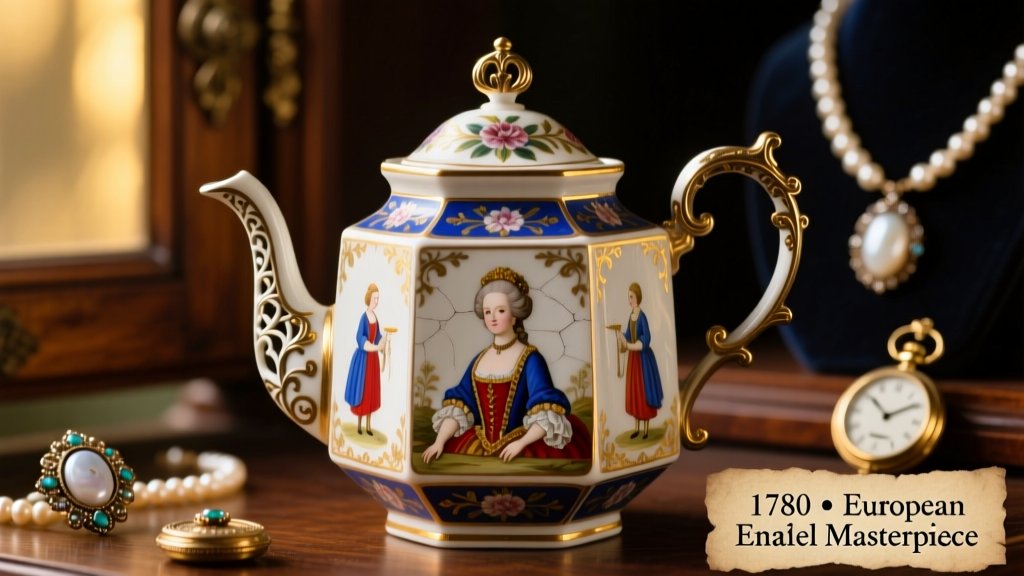
A Rare 18th-Century Enamel Teapot: Hexagonal Form, European Figures, and the Artistry of Limoges & Geneva
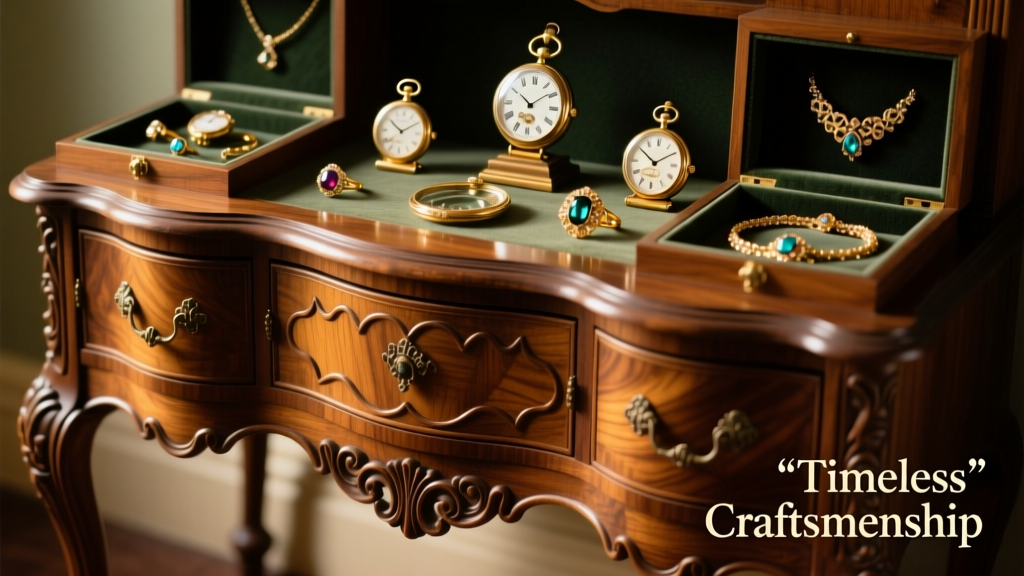
Chippendale-Style Carved Lowboy Pair: Authentic Provenance, Construction Analysis, and Market Context for a 33 × 34 × 19 Inch Set
Hello From The West: Unpacking the Enigma of Mid-Century American Watch Branding and Collector Queries
Shawnee Pottery Cookie Jar Cottage #2: History, Identification, and Market Value of a Mid-Century American Icon
Wooden Tub Stave Wire Bands with Blue Paint and Cutout Handles: A 23-Inch American Cooperage Artifact
Iron Cigar Cutter Violin Shape 2-Inch: A Rare Artifact of Gilded Age Gentility and Industrial Craftsmanship
Royal Doulton Character Jug: The Clown Red Large — History, Identification, and Market Value
The Eames CTW Coffee Table: Anatomy, Provenance, and Authentication of the Molded Plywood Classic
Harlequin Syrup Maroon Chrome Top: A Rare Mid-Century American Watch Dial Phenomenon