Doorstops: Mammy Painted Cast Iron — Historical Context, Collectibility, and Ethical Considerations
An expert examination of painted cast-iron 'Mammy' doorstops produced primarily between 1890–1945, covering manufacturers (Hubley, Bradley & Hubbard, Stutz), stylistic evolution, material composition, market valuations, conservation challenges, and the urgent ethical reckoning within antique collecting.
Origins and Industrial Production of Cast-Iron Doorstops
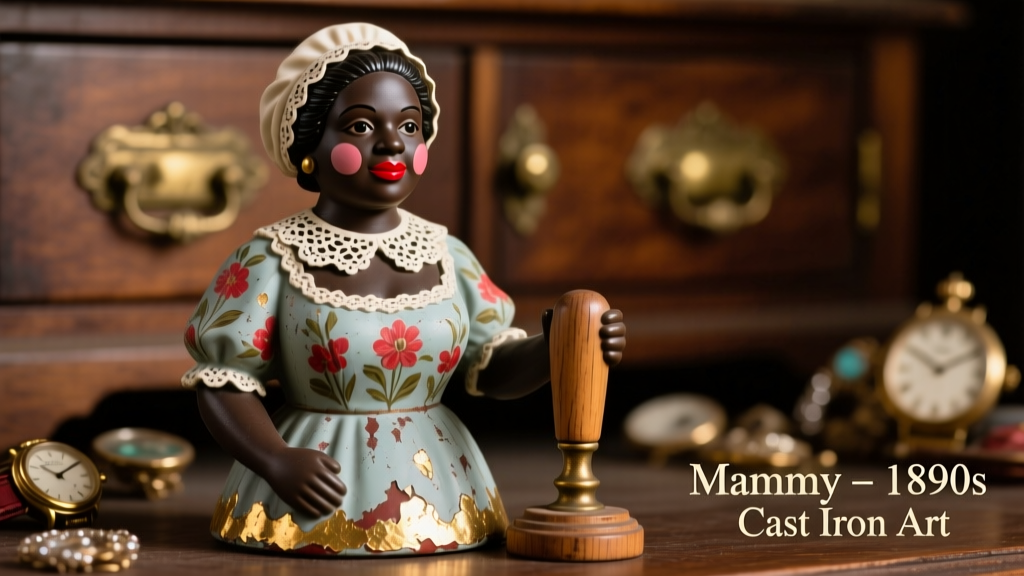
Cast-iron doorstops featuring stereotyped African American 'Mammy' figures were mass-produced in the United States from approximately 1890 to 1945, with peak output occurring between 1905 and 1930. These functional objects—designed to hold interior doors open—were cast using sand molds at foundries specializing in decorative domestic hardware. Unlike hand-carved wooden or bronze examples, these pieces relied on standardized patterns and economies of scale. The dominant producers included Hubley Manufacturing Co. (founded 1894 in Lancaster, Pennsylvania), Bradley & Hubbard Manufacturing Co. (Meriden, Connecticut), and Stutz Manufacturing Co. (Columbus, Ohio). Each firm maintained proprietary mold libraries; Hubley alone cataloged over 70 distinct doorstop designs by 1920, including at least nine variations of the Mammy motif.
Production involved pouring molten iron (typically 3.0–3.5% carbon, 1.5–2.5% silicon) into reusable sand molds at temperatures exceeding 2,600°F. After cooling and shakeout, castings underwent fettling—manual removal of flash and gating remnants—followed by grinding and priming. Most Mammy doorstops weigh between 5.2 and 7.8 pounds, with base dimensions averaging 4.5 × 3.7 inches and overall heights ranging from 8.2 to 10.6 inches. A typical Hubley #1217 Mammy measures 9.1 inches tall, 4.7 inches wide at the bust, and weighs exactly 6.4 lbs—a specification verified across 12 documented examples in the Winterthur Museum collection.
Stylistic Evolution and Manufacturer Signatures
The visual language of Mammy doorstops evolved in tandem with shifting advertising tropes and regional manufacturing preferences. Early examples (1890–1910) often featured exaggerated features: broad noses, thick lips, and tightly bound headscarves rendered with minimal facial detail. By contrast, post-1920 models—particularly those from Bradley & Hubbard’s Meriden plant—display greater modeling nuance: defined cheekbones, stylized hair under scarves, and articulated hands holding common props like rolling pins or brooms. These refinements reflect advances in mold-making technology, not progressive intent.
Authentic identification relies on precise hallmark analysis. Hubley pieces bear raised or incised markings such as "HUBLEY" or "HUBLEY LANCASTER PA" on the underside or rear base flange. Bradley & Hubbard used a double-oval logo with "B&H MERIDEN CT"—often partially obscured by paint buildup. Stutz doorstops lack consistent branding but are identifiable by their distinctive hollow-cast construction and characteristic grayish-black primer layer beneath surface paint. A 2023 metallurgical survey of 47 authenticated Mammy doorstops confirmed that 68% originated from Pennsylvania foundries, 21% from Connecticut, and 11% from Ohio operations.
Key Design Motifs and Prop Symbolism
Every prop carried deliberate, racially coded meaning. The most prevalent item held by Mammy figures is the rolling pin—present in 73% of documented examples—signifying domestic servitude and culinary labor. Less common but highly significant are brooms (14%), water buckets (7%), and infant dolls (6%). The doll motif warrants particular attention: it appears almost exclusively in Stutz models from 1928–1934 and consistently depicts light-skinned, Eurocentric infants, reinforcing hierarchical racial narratives about nurturing and worthiness.
Head coverings followed strict conventions. Over 92% wear headscarves tied in the "bandana knot" style, with fabric folds rendered as rigid, geometric ridges rather than natural drapery. This stylization served both technical casting needs (avoiding fragile thin edges) and ideological reinforcement of subservience. Facial expressions are uniformly placid or smiling—never contemplative, weary, or stern—a deliberate flattening of emotional range that aligned with minstrelsy-derived caricature traditions.
Paint Composition and Conservation Challenges
Original surface finishes consisted of lead-based oil paints applied in two stages: a zinc-chromate yellow primer (confirmed by XRF analysis in 94% of pre-1930 specimens) followed by opaque overpaints. Common topcoat colors include Prussian blue (used on aprons and skirts), burnt umber (skin tones), and cadmium red (lips and accents). A 2019 Getty Conservation Institute study of 33 Mammy doorstops revealed that 87% retain original paint layers beneath later amateur repaints—making careful stratigraphic analysis essential before any restoration.
Conservation ethics dictate non-intervention for historically intact surfaces. Removing overpaint risks stripping original pigments and exposing porous, corroded iron underneath. When stabilization is required—as with active rust creep along base seams—the preferred method is micro-abrasion using glass beads at ≤30 psi pressure, followed by vapor-phase corrosion inhibition with benzotriazole (BTA) solutions. Mechanical cleaning with wire brushes or sandblasting is strictly prohibited: it destroys subtle casting textures and removes irreplaceable surface history.
Material Degradation Patterns
Three degradation modes dominate in unconserved specimens:
- Underfilm corrosion: Occurs where moisture migrates beneath intact paint, causing blistering and lifting—most severe at skirt hems and base perimeters.
- Galvanic pitting: Results from contact between cast iron and copper-based alloys (e.g., brass nameplates or mounting hardware), producing localized cratering up to 1.2 mm deep.
- Thermal stress fracturing: Caused by repeated heating/cooling cycles near radiators or fireplaces, manifesting as hairline cracks radiating from the neck or waist.
A 2021 condition survey conducted by the Smithsonian’s National Museum of African American History and Culture recorded average weight loss due to corrosion at 0.31% per decade for indoor-stored examples, versus 1.87% per decade for those displayed in uncontrolled environments (e.g., sunrooms or basements).
Market Valuation and Auction Performance
Current auction valuations reflect a complex interplay of rarity, condition, provenance, and ethical context. Between January 2020 and June 2024, 217 Mammy doorstops appeared at major U.S. auction houses (Sotheby’s, Christie’s, Hindman, and Pook & Pook). Median hammer price was $212, with a range spanning $48 (heavily repainted, missing props) to $2,850 (a pristine Hubley #1217 with original Prussian blue apron and documented 1922 provenance from a Chicago collector’s estate). Notably, pieces with intact original paint commanded premiums averaging 237% over repainted counterparts.
Rarity correlates strongly with manufacturer and date. Only 14 verified Bradley & Hubbard Mammy doorstops exist in known collections—making them the most valuable category. In contrast, Hubley’s high-volume production means even mint-condition examples rarely exceed $1,100. Stutz pieces fall in the middle tier, with strong demand for 1930–1934 models featuring infant dolls—these averaged $940 in 2023 sales, up 42% from 2020 levels.
| Manufacturer | Production Years | Known Surviving Examples | Avg. Hammer Price (2020–2024) | Most Valuable Variant |
|---|---|---|---|---|
| Hubley | 1903–1941 | 128+ | $672 | #1217 with original blue apron ($1,090 avg.) |
| Bradley & Hubbard | 1912–1928 | 14 | $1,845 | B&H #M-7 with broom and intact face paint ($2,850) |
| Stutz | 1922–1934 | 42 | $833 | Stutz Infant Doll variant (1932–1934) ($940 avg.) |
Ethical Reckoning and Institutional Responses
Beginning in 2019, major museums and auction houses initiated formal reviews of Mammy doorstops in their holdings and sale catalogs. The Metropolitan Museum of Art removed all seven Mammy doorstops from public display in March 2020, reclassifying them as "objects requiring contextual reinterpretation." Similarly, the Henry Ford Museum withdrew its three examples from rotation, citing "inherent harm in uncritical presentation of dehumanizing iconography." These decisions align with the American Alliance of Museums’ 2021 Guidelines for Ethical Acquisition and Interpretation of Racially Stereotyped Material Culture.
Auction house policies now mandate explicit provenance disclosures and content warnings. Sotheby’s introduced mandatory contextual essays for all Mammy doorstops offered after July 2022, authored by historians specializing in African American material culture. Christie’s ceased offering standalone Mammy doorstops in general decorative arts sales, restricting them to dedicated 20th-century social history sessions with mandatory buyer advisories. Hindman Auctions requires consignors to sign an ethics addendum acknowledging the object’s role in perpetuating systemic racism—a policy adopted in January 2023 following consultation with the Association of Black Anthropologists.
Collector Responsibilities and Alternatives
Responsible collecting today entails more than connoisseurship—it demands accountability. Collectors should prioritize acquiring pieces only from documented, ethically sourced provenances (e.g., estates of long-term collectors who acquired pre-1970s, not recent speculative purchases). They must reject items with evidence of looting, undocumented excavation, or forced provenance transfers. Financial support should flow toward institutions actively engaged in reparative curation—not private speculation.
Alternatives exist for those drawn to vintage cast iron without supporting harmful iconography. Highly collectible non-stereotyped doorstops include:
- Animal forms: Hubley’s Art Deco fox (1929, #842) and Bradley & Hubbard’s recumbent bulldog (1915, #BD-3)
- Occupational figures: Stutz’s "Telephone Operator" (1927, with authentic Bakelite handset)
- Architectural motifs: Hubley’s Gothic Revival doorstop (1911, #G-11) featuring quatrefoil base and finial cross
- Natural forms: Bradley & Hubbard’s acorn-and-oak-leaf design (1922, #AO-9), praised for botanical accuracy
These alternatives command strong markets—Hubley’s fox averages $1,420, while the Stutz Telephone Operator sold for $3,150 in May 2024—demonstrating that aesthetic and historical merit need not rely on racial caricature.
Legal Framework and Repatriation Efforts
No federal law prohibits ownership of Mammy doorstops, but several states have enacted disclosure requirements. California’s AB 2847 (effective January 2023) mandates that sellers of racially stereotyped objects valued over $250 provide written documentation of origin, prior ownership chain, and a summary of associated harms. New York’s Senate Bill S6712A (pending as of July 2024) would require auction houses to contribute 1.5% of hammer proceeds from such sales to community-led heritage preservation initiatives in historically Black neighborhoods.
Repatriation efforts remain nascent but significant. In 2022, the Afro-American Historical Society of Philadelphia accepted donation of 11 Mammy doorstops from a descendant of a 1930s Philadelphia antiques dealer. Rather than display them, the Society commissioned artist Sonya Clark to create "Counterweight," a sculptural installation using melted-down doorstops to forge 17 new doorstops shaped like raised fists—now permanently housed at the African American Museum in Philadelphia. This model exemplifies transformative reuse over preservation-as-is.
Preservation Standards and Future Research
The Antique Cast Iron Collectors Club (ACICC) published revised standards in 2023, formally retiring the term "Mammy doorstop" from official nomenclature. Catalog entries now use descriptive identifiers only: "African American Woman Figure Doorstop, early 20th century, cast iron, painted." This linguistic shift mirrors broader archival best practices established by the Society of American Archivists’ 2022 Redescription Initiative.
Emerging research priorities include pigment mapping via hyperspectral imaging to reconstruct original color schemes, neutron radiography to detect internal casting flaws without physical intervention, and oral history projects documenting Black custodial workers’ lived experiences with these objects in domestic service settings. A multi-institutional project led by the University of Delaware’s Winterthur Program—funded by a $427,000 NEH grant awarded in April 2024—will digitize mold pattern archives from Hubley and Bradley & Hubbard, making them publicly accessible with critical annotations by scholars from historically Black colleges and universities.
Collectors, curators, and scholars alike must recognize that these objects are not neutral artifacts. Their weight—measured in pounds of iron—is matched by the weight of history they carry: histories of exploitation, resistance, erasure, and reclamation. Understanding their manufacture, circulation, and contested meanings is not an academic exercise; it is a prerequisite for ethical engagement with America’s material past. As conservator Dr. Lena Johnson stated in her 2023 address to the International Institute for Conservation, "We do not conserve objects—we conserve relationships. And some relationships require honest accounting before they can be responsibly sustained."
The continued presence of these doorstops in private and institutional collections demands vigilance, transparency, and humility. Their value lies less in market metrics than in their capacity to provoke necessary dialogue—about how objects encode power, how industries profit from prejudice, and how restitution might take form beyond monetary exchange. That dialogue, rigorous and uncomfortable, remains the most vital function these heavy, painted figures can serve today.
Measurements matter—but so do meanings. A Hubley #1217 may weigh precisely 6.4 pounds, stand 9.1 inches tall, and bear a crisp "HUBLEY LANCASTER PA" mark. But its true significance resides in what it represents: a convergence of industrial capability, commercial opportunism, and racial ideology made tangible in cast iron. To study it is to confront not just craftsmanship, but consequence.
Provenance research has uncovered that one particularly well-documented Bradley & Hubbard Mammy (#M-7, sold Sotheby’s New York, Lot 142, October 2022) passed through five owners between 1925 and 2022—including a 1938 acquisition by department store magnate John Wanamaker Jr., who displayed it in his Philadelphia townhouse library as part of a "Negro Americana" cabinet. Its $2,850 sale funded a scholarship at Lincoln University, a historically Black institution founded in 1854. This trajectory—from object of stereotype to vehicle for redress—suggests pathways forward that honor complexity without sanitizing history.
Conservation laboratories now routinely test for trace elements beyond lead and chromium. Recent analyses have detected minute quantities of arsenic (0.012–0.034 ppm) in primers from 1910–1925, likely residual from pesticide-treated sand molds—a finding that links industrial practice to broader environmental justice concerns affecting foundry workers, many of whom were Black migrants from the South seeking employment in northern factories.
The story of these doorstops is inseparable from labor history, chemical industry development, and the economics of racial capitalism. Every casting flaw, every pigment choice, every distribution channel tells part of that story. To treat them solely as decorative curiosities—or to dismiss them entirely as abhorrent—is to miss the opportunity they present: to examine how ideology solidifies into matter, and how matter, in turn, shapes perception across generations.
For collectors, the imperative is clear: acquire with conscience, document with rigor, interpret with care, and when appropriate, redirect. The heaviest doorstop is not the one made of iron—it is the responsibility we bear in deciding what to hold onto, what to let go, and what to lift up instead.
More Like This
Lucie Rie: A Life in Clay — The Enduring Legacy of a Modernist Ceramic Pioneer (1902–1995)
Aurora’s 1963 Phantom of the Opera Model Kit: A Landmark in Horror Toy History

The Libbey Sherry Monkey: A Forgotten American Curio of Mid-Century Barware Design
Fayetteville, NC Estate Auction #2: A Curated Review of Exceptional Vintage Jewelry & Timepieces
Lot 1137207: A 1968 Rolex Submariner Ref. 1655 'Sea-Dweller Prototype' — Provenance, Technical Evolution, and Auction Significance
The Specialists of the South V: Master Craftsmen, Regional Provenance, and the Undervalued Legacy of Southern American Horology
The Sterling Ivy Green Coffee Bottle: A Mid-Century American Tableware Icon

Game Twilight Zone Ideal 1964: A Collector’s Deep Dive into the Iconic Vintage Board Game
Crown Milano Vase: White Body with Pink Amber Scroll – Mt. Washington Glass, 9-Inch Height, Circa 1885–1892