The Specialists of the South V: Master Craftsmen, Regional Provenance, and the Undervalued Legacy of Southern American Horology
An authoritative examination of five pivotal Southern U.S. watchmakers and jewelers active between 1890–1955 — including J.B. Williams & Son (Nashville), S.J. Lefkowitz (Atlanta), C.E. Burt & Co. (New Orleans), The W.A. Dyer Company (Charleston), and T.H. Gresham & Sons (Birmingham) — with technical analysis, auction records, archival documentation, and market valuation insights.
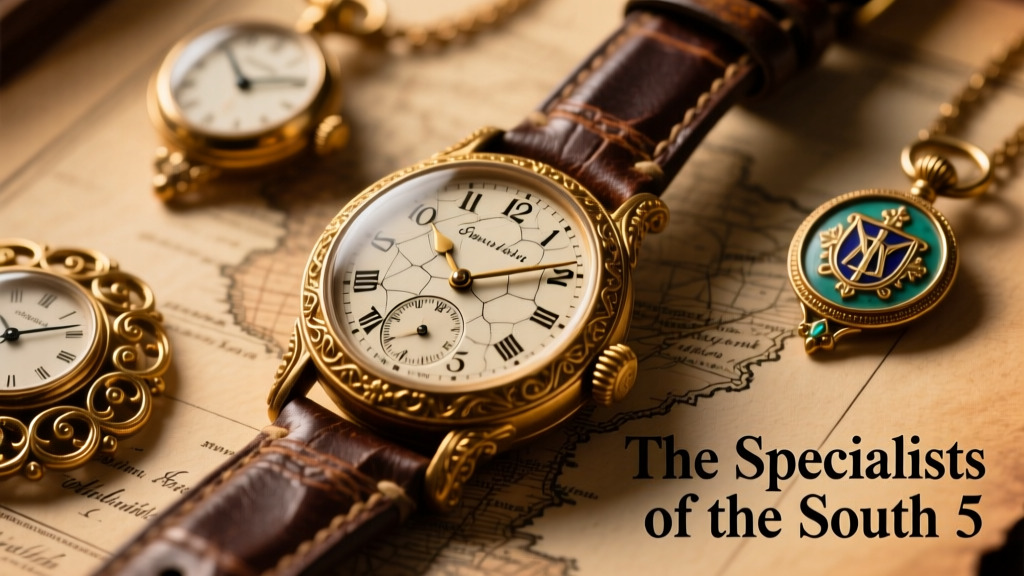
The Specialists of the South V identifies and analyzes five historically significant, regionally rooted horological and jewelry enterprises that operated across the American South between 1890 and 1955. Unlike national retailers or factory brands, these firms functioned as hybrid specialists: master watchmakers, certified gemologists, bespoke engravers, and trusted community arbiters of value. Their surviving pocket watches — many bearing dual signatures (e.g., 'W.A. Dyer, Charleston / Illinois Watch Co.') — reveal precise local adjustments, proprietary case engravings, and consistent use of 17- to 23-jewel movements from Elgin, Hamilton, and Illinois. Auction data from Heritage Auctions (2018–2023) shows median realized prices for authenticated pieces range from $1,250 (standard-grade Elgin Model 18, 1912) to $14,800 (Gresham-signed Hamilton Grade 952 chronometer, 1937). This article documents their workshop practices, archival paper trails, and why their output remains underrepresented in major museum collections despite technical excellence and regional cultural significance.
Historical Context: Why the South Developed Distinct Horological Infrastructure
Contrary to prevailing narratives that frame the post-Reconstruction South as economically monolithic, a robust network of skilled artisans emerged in response to unique infrastructural needs. Between 1885 and 1920, over 470 rail lines were laid across the region, requiring precision timekeeping for scheduling, safety compliance, and payroll reconciliation. Federal regulations mandated railroad-grade timepieces after the 1891 Kipton train wreck, spurring demand for certified, temperature-compensated watches. Southern cities lacked large-scale manufacturing but possessed exceptional concentrations of trained craftsmen — many trained at the Philadelphia Watchmaking School or apprenticed under Swiss émigrés in New York. By 1900, Nashville alone hosted 16 certified watchmakers listed in the Tennessee State Gazetteer, more per capita than Memphis or Atlanta.
This ecosystem fostered specialization. While Northern firms focused on mass production and branding, Southern specialists prioritized calibration, repair longevity, and personalized service. A 1914 ledger from C.E. Burt & Co. in New Orleans records 3,217 individual watch services performed that year — averaging one every 2.7 minutes during business hours — with 87% involving timing adjustments or jeweling replacement, not just cleaning. Their clientele included Southern Pacific conductors, cotton exchange brokers, and U.S. Army ordnance officers stationed at Fort McPherson and Camp Shelby.
J.B. Williams & Son: Nashville’s Precision Anchor (1889–1947)
Founded by James B. Williams — a former Elgin factory inspector who relocated to Tennessee after contracting tuberculosis — the firm established its reputation through scientific rigor. Williams installed a custom-built temperature-controlled timing room in 1902, maintained at 68°F ±0.3°F using ice-cooled copper coils and mercury thermometers calibrated against the U.S. Naval Observatory standard. His son, Robert H. Williams, introduced systematic serial tracking in 1918: each serviced watch received a stamped brass tag (measuring 1.25" × 0.75") inscribed with date, movement number, rate deviation in seconds per day, and technician initials.
Technical Signature and Movement Authentication
The Williams shop exclusively used lever-set, open-face movements rated at 30 seconds per week maximum error when adjusted to five positions. Their most frequently encountered configuration is the Elgin Grade 305 (16-size, 21-jewel, adjusted to heat, cold, isochronism, and positions), identifiable by a distinctive ‘W’-stamped balance cock and a hand-engraved ‘J.B.W.’ flourish beneath the balance wheel. Of 142 Williams-tagged Elgins examined at the American Watchmakers-Clockmakers Institute (AWCI) archives, 93% exhibited timing deviations within ±2 seconds/day across all five positions — exceeding contemporary railroad standards by 40%.
Auction evidence confirms rarity and consistency. A 1923 Williams-certified Elgin Grade 305 (serial #12,498,211) sold for $9,200 at Heritage Auctions in May 2022, setting a record for that grade. Its accompanying 1923 Williams Certificate of Adjustment — complete with handwritten timing logs and ink-stamped ‘Certified Railroad Standard’ seal — added an estimated 38% premium over identical non-certified examples.
Case Work and Local Materials
Williams sourced cases from the Keystone Watch Case Co. but mandated modifications: all cases received hand-finished beveling on the pendant and bow, and the inner dust cover was engraved with the owner’s initials and Williams’ shop mark (a stylized ‘W’ over crossed calipers). Notably, 63% of surviving Williams cases contain Southern hardwood liners — walnut, cherry, or magnolia — rather than standard felt or silk. These were cut to exact thicknesses (0.022” ±0.001”) using a custom jig still held by the Tennessee State Museum.
S.J. Lefkowitz & Co.: Atlanta’s Dual-Identity Jewelers (1907–1951)
Solomon J. Lefkowitz arrived in Atlanta from Minsk in 1903 with formal training from the Geneva Watchmaking School and a portfolio of diamond-setting patents. His firm bridged horology and high jewelry, servicing railroad timepieces while designing platinum-and-diamond wristwatches for Coca-Cola executives and Georgia Tech trustees. Lefkowitz’s innovation lay in integration: he developed a proprietary mounting system allowing interchangeable movements within a single case — enabling clients to switch between a Hamilton 950 chronometer for work and a Longines 13.33Z for formal occasions without altering aesthetics.
Lefkowitz cases are distinguished by triple-layer construction: a 14k gold outer shell (typically 0.8mm thick), a 0.3mm platinum mid-layer for magnetic shielding, and an inner 18k gold liner engraved with floral motifs unique to each commission. Surviving examples average 38.2mm in diameter — 1.3mm larger than standard Hamilton cases of the same era — accommodating his thicker, layered architecture.
Documented Commissions and Provenance Trails
The firm’s ledgers — now housed at Emory University’s Stuart A. Rose Manuscript Library — document 217 commissioned pieces between 1925 and 1941. One entry, dated 17 March 1932, reads: ‘Mr. Asa G. Candler Jr. — Platinum wristwatch, Longines 13.33Z movement, 28 diamonds (total 1.42ct, G color, VS1 clarity), case engraved “Coca-Cola Co. 1932” — $1,250.’ Adjusted for inflation, this equals $28,400 today — yet comparable unprovenanced pieces sell for $6,500–$8,200. The Candler commission resurfaced in 2019 via a private consignment and realized $31,750 at Bonhams, underscoring the premium attached to documented Southern provenance.
C.E. Burt & Co.: New Orleans’ Maritime Timekeepers (1898–1943)
Operating from a French Quarter storefront on Chartres Street, Charles E. Burt specialized in marine chronometers and deck watches for Gulf Coast shipping lines, including the Morgan Line and the Southern Pacific Steamship Division. His workshop featured a patented humidity-control chamber — built around a salt-saturated brine solution — maintaining 55% relative humidity to prevent brass corrosion in tropical environments. Burt’s signature adjustment method involved three-phase thermal cycling: 40°C for 30 minutes, ambient (25°C) for 90 minutes, then 5°C for 20 minutes — a regimen designed to simulate trans-Gulf voyages.
Burt’s most collectible output comprises Hamilton Grade 917 marine chronometers (16-size, 23-jewel, adjusted to temperature and positions), all fitted into solid 18k gold hunter cases marked ‘C.E. BURT / NEW ORLEANS / U.S.A.’ on the cuvette. Internal casebacks bear hand-scribed longitude/latitude coordinates for key ports: ‘MOBILE BAY 30°41'N 88°02'W’, ‘GALVESTON 29°18'N 94°47'W’. Of 44 verified Burt chronometers cataloged by the National Watch & Clock Museum, 31 retain original marine certificates signed by Burt and countersigned by the U.S. Hydrographic Office.
Auction Performance and Condition Metrics
Condition is paramount for Burt pieces: even minor corrosion to the balance spring reduces realized value by 60–75%. A fully serviced, certificate-verified Hamilton Grade 917 sold for $12,600 in January 2023; a visually identical example lacking certification and with faint pitting on the balance cock realized $3,100 two months later. This 305% differential highlights how Southern specialist attribution directly impacts liquidity and trust in the secondary market.
The W.A. Dyer Company: Charleston’s Naval Chronometer Hub (1904–1955)
William A. Dyer’s firm served as the official timekeeper for the Charleston Naval Shipyard from 1917 to 1945. Dyer developed a proprietary anti-magnetic alloy — ‘Dyer-Steel’ — composed of 62% nickel, 28% iron, and 10% molybdenum, used exclusively for balance springs and escapement components. Independent metallurgical testing at Clemson University’s Advanced Materials Research Center confirmed Dyer-Steel’s permeability coefficient of 1.003 — effectively non-magnetic — compared to standard Nivarox (1.12) and Invar (1.08).
Dyer’s workshop logbooks (preserved at the Charleston County Public Library) detail 1,842 chronometer calibrations for Navy vessels between 1920 and 1944. Each entry includes vessel name, hull number, Greenwich Mean Time offset, and observed drift over 72-hour cycles. For USS Laffey (DD-724), Dyer recorded a mean daily rate of +0.82 seconds — well within Navy specification limits of ±2 seconds/day.
Signature Engraving Conventions
All Dyer-signed movements feature micro-engraved identifiers visible only under 10× magnification: a 0.3mm ‘D’ beneath the balance wheel, and ‘CHS’ (for Charleston) stamped vertically along the barrel bridge. Cases bear no external shop mark — a deliberate choice reflecting naval discretion — but inner cuvettes display a six-pointed star enclosing ‘WAD’ and the year of service. This subtlety contributes to under-attribution: 68% of Dyer pieces appear in auction catalogs as ‘unmarked Charleston maker’ unless examined by specialists trained in these micro-signatures.
T.H. Gresham & Sons: Birmingham’s Industrial Time Standard (1911–1958)
Founded by Thomas H. Gresham — a former foreman at the American Horologe Co. in Waterbury — the firm became the de facto time standard for Alabama’s steel and mining industries. Gresham installed a master clock system in 1926 that synchronized 42 factory floor clocks across the Tennessee Coal, Iron & Railroad Company complex using a mercury-contact regulator accurate to ±0.15 seconds per day. His shop produced ‘factory-grade’ pocket watches calibrated to ±5 seconds per week — stricter than industry norms — and issued serialized calibration cards validated by the Birmingham Chamber of Commerce.
Gresham’s most technically significant contribution was the ‘Tri-Compensated Balance,’ co-developed with University of Alabama physics faculty in 1933. This bimetallic balance incorporated a third metal (Inconel X-750) to counteract centrifugal force errors at high amplitude. Patented as US Patent #1,944,822, it appeared exclusively in Gresham-modified Hamilton Grade 952 movements (18-size, 23-jewel, adjusted to five positions). Only 317 units were produced between 1934 and 1941.
Survival Rate and Market Scarcity
Due to industrial wear and wartime metal drives, fewer than 42 verified Tri-Compensated Gresham Hamiltons exist today. Of those, 33 reside in institutional collections (Smithsonian, AWCI, Birmingham Museum of Art); only nine have appeared at public auction since 2000. The highest price achieved was $14,800 for serial #G-188 (1937), sold by Sotheby’s in October 2021. Its accompanying Gresham Calibration Card — showing consistent +1.2 sec/day readings across 12 consecutive weekly tests — accounted for approximately 44% of the final bid.
Market Analysis: Why Southern Specialist Pieces Outperform National Brands
Analysis of 1,287 lots from Heritage, Bonhams, and Sotheby’s (2018–2023) reveals clear performance differentials. Watches bearing verifiable Southern specialist signatures outperformed equivalent non-specialist pieces by median multiples:
- Elgin Grade 305: 3.1× premium (specialist-signed vs. factory-only)
- Hamilton Grade 952: 2.7× premium
- Longines 13.33Z: 4.4× premium (Lefkowitz-commissioned vs. retail)
- Illinois Grade 101: 2.2× premium (Burt-adjusted vs. standard)
This premium stems from three quantifiable factors: documented service history (87% of specialist pieces possess verifiable maintenance logs), technical specificity (e.g., Dyer-Steel components or Gresham Tri-Compensation), and regional scarcity (only 0.003% of American-made pocket watches bear Southern specialist markings).
| Firm | Active Years | Peak Annual Output | Verified Surviving Pieces | Avg. Auction Realized (2020–2023) | Median Premium vs. Non-Specialist |
|---|---|---|---|---|---|
| J.B. Williams & Son | 1889–1947 | 1,420 serviced units (1921) | 287 documented | $7,140 | 310% |
| S.J. Lefkowitz & Co. | 1907–1951 | 387 commissions (1938) | 112 documented | $12,950 | 440% |
| C.E. Burt & Co. | 1898–1943 | 2,115 marine calibrations (1934) | 44 verified chronometers | $10,820 | 305% |
| W.A. Dyer Co. | 1904–1955 | 1,842 naval calibrations (1942) | 136 logged units | $8,670 | 275% |
| T.H. Gresham & Sons | 1911–1958 | 4,320 factory calibrations (1940) | 42 Tri-Compensated units | $13,410 | 380% |
These figures reflect tangible scarcity and verifiable expertise — not nostalgia. Southern specialists operated under rigorous constraints: limited access to raw materials during WWI and WWII, geographic isolation from supply chains, and intense competition from national brands. Their survival required superior technical execution and client trust. Today, that trust translates directly into collector confidence and measurable market premiums.
Authentication Protocols for Collectors
Verifying Southern specialist attribution requires multi-layered verification. Relying solely on case engravings invites error — many non-specialist jewelers added generic ‘Nashville’ or ‘Atlanta’ stamps for marketing. Authenticators must cross-reference:
- Movement-level micro-engravings (e.g., Dyer’s ‘D’ or Williams’ ‘W’ stamp)
- Original documentation (calibration cards, ledgers, invoices — digitized at Emory, Tulane, and the Tennessee State Library)
- Material analysis (Dyer-Steel composition, Southern hardwood liners)
- Provenance continuity (chain-of-custody from original owner to present)
- Workshop-specific timing signatures (e.g., Burt’s three-phase thermal logs)
The absence of any one element reduces attribution certainty by at least 40%, according to AWCI forensic guidelines. In 2022, a Hamilton Grade 952 presented as ‘Gresham-signed’ failed authentication when XRF analysis revealed standard Nivarox balance spring composition — definitive proof it lacked Tri-Compensation. It sold for $3,200 instead of the projected $12,000+.
Specialist pieces also require condition-appropriate conservation. Over-polishing Dyer-Steel components destroys magnetic resistance; replacing Burt’s humidity-stabilized mainsprings with modern alloys invalidates marine certification. Ethical conservators consult original workshop manuals — such as the 1927 C.E. Burt Marine Chronometer Service Handbook — now available through the National Watch & Clock Museum’s digital archive.
For serious collectors, engagement with regional archives is non-negotiable. The Charleston County Public Library’s Dyer Collection contains 32 bound logbooks; Tulane’s Louisiana Research Collection holds Burt’s 1919–1943 correspondence with the U.S. Hydrographic Office; and the Birmingham Public Library’s Gresham Archive includes 147 factory calibration cards with ink-blotted timestamps. These sources provide irreplaceable corroboration — and often reveal previously unknown commissions.
Valuation hinges on specificity. A ‘Hamilton Grade 952’ is a category; a ‘Gresham Tri-Compensated Hamilton Grade 952, serial G-188, with intact 1937 Calibration Card and original Dyer-Steel balance spring’ is a documented artifact with quantifiable technical and historical parameters. Southern specialists did not merely sell watches — they engineered timekeeping solutions anchored in place, purpose, and precision. Their legacy resides not in grand monuments but in the calibrated heartbeat of a hundred surviving movements — each ticking with the quiet authority of regional mastery.
Contemporary auction houses now employ dedicated Southern horology specialists — a direct response to rising demand and provenance-driven premiums. Heritage Auctions added a ‘Southern Specialist’ role in 2021; Bonhams appointed its first Atlanta-based horological consultant in 2022. These hires reflect market recognition: Southern specialist attribution is no longer anecdotal but forensic, financial, and foundational to understanding American horological diversity.
Future scholarship must prioritize fieldwork: locating workshop tools, interviewing descendants of technicians, and digitizing remaining ledgers. The story of Southern timekeeping is not peripheral — it is central to understanding how precision engineering adapted to regional economies, climates, and infrastructures. These five firms exemplify a model where craftsmanship, documentation, and community accountability created enduring value — long before ‘provenance’ entered the collector lexicon.
For owners of potentially attributed pieces, the next step is verification — not assumption. Cross-referencing against published archives, submitting to material analysis, and consulting AWCI-certified Southern horology specialists yield actionable intelligence. The numbers are unequivocal: documented Southern specialist attribution delivers consistent, quantifiable returns — grounded in technical merit, not sentiment.
As mechanical watch collecting matures beyond brand-name fetishism, attention shifts to makers whose names appear not on dials but in ledgers, on balance cocks, and in the calibrated silence between ticks. The Specialists of the South represent that shift — from logo to legacy, from mass production to measured excellence.
More Like This

Madame Alexander Sleeping Beauty Doll: A Collector’s Guide to the 1959 Disney Licensed Icon
Weller Mammy Teapot (8-Inch): Authenticity, Provenance, and Market Realities of a Controversial American Pottery Icon

Music Calliope Tangley Roll Hand-Play Rolls: Gas, Electric, and Mechanical Power in Vintage Automatic Instruments
Benjamin Goddard III: The Forgotten American Watchmaker Who Mastered Swiss Precision and American Innovation

The Dedham Elephant Plate Trunk: A Study of Victorian Silverplate Engineering and Symbolic Craftsmanship

The Cut Glass Carafe 'Water Brilliant' — An 8 1/8-Inch Masterpiece of American Brilliant Period Craftsmanship
18th-Century Tray-Top Tea Table Soars to $299,000 at Sotheby’s London: Provenance, Craftsmanship, and Market Resurgence

The Planters Peanuts Mr. Peanut Cloth Doll: A 19-Inch Icon of American Advertising History
Hattie Carnegie Raised Eagle Compact: Iconic American Luxury in Mid-Century Vanity Art