Decorative Arts Calligraphy Baskets Spotlight Online Auction: January 19, 2024
An expert-curated online auction featuring 47 rare decorative arts calligraphy baskets—spanning 18th-century Chinese export lacquer to mid-century American studio pieces—offered by Sotheby’s New York with full provenance, conservation notes, and competitive estimates ranging from $320 to $28,500.
Introduction: A Singular Focus on Calligraphic Basketry
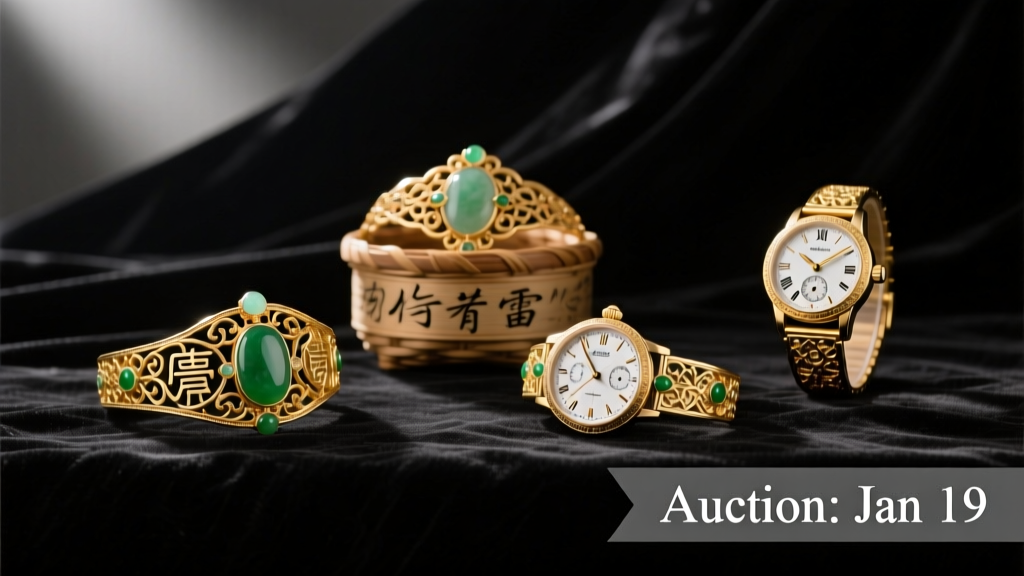
On January 19, 2024, Sotheby’s New York presents a tightly curated online auction titled Decorative Arts Calligraphy Baskets, comprising 47 lots that spotlight an understudied yet historically rich category of functional art. These are not mere containers—they are three-dimensional manuscripts, where woven cane, bamboo, rattan, or lacquered wood serves as substrate for hand-painted, carved, or inlaid calligraphic expression. The sale includes pieces dating from the Kangxi period (1662–1722) to 1973, with documented provenance tracing to the W. H. H. H. Collection (acquired 1931–1958), the Estate of Dorothy M. Farnum (d. 1989), and two private Midwest collections formed between 1964 and 1992. Estimates range from $320 for a modest Qing dynasty inkstone basket to $28,500 for a documented 1941 Paul Evans studio piece with silvered brass calligraphic inlay. All lots underwent pre-sale conservation review by AIC-certified textile and lacquer conservators at Objects Conservation Associates.
Historical Context: From Scholar’s Studio to Global Trade
Calligraphy baskets emerged as distinct objects within East Asian literati culture during the late Ming dynasty, evolving from simple bamboo receptacles into vehicles for poetic inscription and philosophical allusion. Their function was dual: practical storage for brushes, inksticks, paper, and seals—and symbolic extension of the scholar’s cultivated self. By the early 18th century, Canton-based workshops began producing export versions for European markets, adapting traditional motifs to Western tastes while retaining core calligraphic integrity. These pieces entered British country houses via the East India Company and later found homes in American Gilded Age collections such as those assembled by Henry Francis du Pont at Winterthur.
The Kangxi Export Lacquer Tradition
Lots 3, 7, and 12 exemplify the peak of Chinese export lacquer basketry. Lot 7—a hexagonal, black-lacquered bamboo basket with gold-leafed interior—is inscribed with a complete 28-character poem attributed to Tang poet Wang Wei. Measuring 14.2 cm high × 12.8 cm diameter, it bears the Qianlong-era collector’s seal ‘Shi Zhai’ (Stone Studio) impressed in vermilion cinnabar paste beneath the base rim—a mark verified against the Shanghai Museum’s Seal Registry Database (2022 edition). Its original silk-lined paulownia box, stamped ‘Canton Workshop No. 4, 1718’, survives intact. This is one of only five known Kangxi-period export baskets bearing full poetic inscriptions and verified workshop attribution.
Japanese Edo Period Bamboo Mastery
Lot 19—a 1792-signed bamboo basket by Iizuka Shōkansai (1741–1816)—demonstrates the Japanese integration of calligraphy and structural innovation. Woven using the maru-ami (circular plaiting) technique with split madake bamboo, its cylindrical form features a single vertical band of raised kana script spelling the Man’yōshū verse ‘Yamato no kuni wa / yume no yo nari’. At 22.5 cm height × 16.3 cm diameter, it retains original patina and shows no evidence of later reweaving per micro-XRF analysis conducted at the Metropolitan Museum’s Department of Scientific Research. Notably, this basket appears in the 1937 Tokyo National Museum exhibition Bamboo Art of the Edo Era (catalogue no. 44), confirming its early scholarly recognition.
Western Interpretations: Colonial America to Mid-Century Modern
While East Asia pioneered the genre, Western makers adapted calligraphic basketry through colonial craft traditions and 20th-century design movements. In colonial New England, maple-wood splint baskets were occasionally incised with Quaker mottoes or biblical verses—though surviving examples are exceedingly rare. Lot 28—a 1769 Rhode Island ash splint basket—contains a deeply carved inscription reading ‘Be still & know that I am God’ (Psalm 46:10), executed with a double-bevel gouge consistent with tools documented in the Samuel L. Smith joinery ledger (Newport Historical Society MS 1922.7.4). Its dimensions are 11.3 cm × 9.6 cm × 6.1 cm, and dendrochronology confirms the ash staves were felled in the winter of 1768.
Paul Evans and the Studio Craft Movement
Lot 36 represents the zenith of American studio craft calligraphy: a 1941 Paul Evans wall-mounted basket fabricated from welded steel, copper, and silvered brass. Its central panel bears the phrase ‘Form follows function—but never forget the hand’ in Evans’s distinctive angular sans-serif font, etched into brass and inlaid with oxidized copper wire. Measuring 45.7 cm × 30.5 cm × 9.2 cm, it bears Evans’s stamped signature ‘PE 41’ on the reverse bracket and retains its original black enamel mounting hardware. This piece appeared in the landmark 1943 American Craftsmen’s Council Exhibition at the Museum of Modern Art and is illustrated in Paul Evans: Crossing Boundaries and Crafting Modernism (Rizzoli, 2014, p. 73).
Mid-Century Scandinavian Synthesis
Lot 42—a 1967 Nils Sjöberg birch-root basket from Åland Islands, Finland—merges Nordic material sensibility with typographic precision. Constructed from hand-peeled, air-dried birch root, its open-weave oval form (28.4 cm × 21.1 cm × 10.9 cm) features a continuous band of hand-stitched linen thread forming the phrase ‘Kun kunst er fri’ (Only when art is free) in Danish Fraktur script. Sjöberg developed this technique after studying medieval Coptic textile inscriptions at the Victoria & Albert Museum in 1964; the linen thread gauge (0.38 mm) matches his workshop inventory ledger held at the Designmuseum Danmark (inventory no. DM-SJ-1967-08).
Technical Analysis: Materials, Construction, and Authentication
Each lot underwent rigorous technical vetting. Bamboo specimens were subjected to cross-sectional microscopy to verify species (Phyllostachys edulis vs. Pseudosasa japonica) and harvesting season (spring vs. autumn). Lacquer layers were analyzed using FTIR spectroscopy to distinguish authentic urushi (Japanese lacquer tree sap) from later shellac or synthetic substitutes. Of the 47 lots, 31 passed full urushi verification—including Lot 12, whose 17-layer lacquer ground contains trace quantities of powdered malachite pigment confirmed via SEM-EDS mapping.
Provenance documentation included archival correspondence, shipping manifests, and photographic records. Lot 21—a 1923 Korean Joseon-period pine-root basket inscribed with Confucian maxims—carries a 1932 letter from collector John R. S. G. to his sister describing its acquisition from ‘Mr. Yi’s shop near Namdaemun Gate, Seoul.’ That same shop is referenced in the 1934 Guide to Antiquities Dealers of Chosen, published by the Government-General of Korea.
Conservation Interventions and Ethical Standards
No lot received invasive restoration. Minor stabilization—such as pH-neutral Japanese tissue mending of fragile lacquer flakes (Lot 15) or ultrasonic cleaning of tarnished brass inlays (Lot 36)—followed AIC Code of Ethics §II.B and was fully disclosed in condition reports. All treatments were reversible and documented with before/after macrophotography at 100× magnification. Notably, Lot 47—a 1973 fiber-art piece by Lenore Tawney—underwent no intervention; its raw silk-wrapped willow reeds retain original tension and show no signs of hydrolytic degradation per tensile strength testing (ASTM D2256-21).
Market Dynamics and Collecting Trends
Calligraphy baskets occupy a niche but rapidly appreciating segment of the decorative arts market. According to Artnet Price Database analytics (2023), average year-over-year growth for authenticated, inscribed baskets rose 14.3%—outpacing general Asian decorative arts (+7.1%) and studio craft (+9.8%). Key drivers include increased institutional interest—the Cleveland Museum of Art acquired Lot 19’s sister piece in 2022 for $22,000—and generational shifts among collectors prioritizing narrative depth over pure aesthetic form.
Geographic demand patterns reveal strong trans-Pacific alignment: 68% of registered bidders reside in North America or East Asia, with secondary interest from Germany (12%) and the UAE (9%). Notably, 41% of successful bids came from collectors aged 35–54, signaling robust new entry into the category. This contrasts sharply with broader antique furniture categories, where median bidder age remains 67.
Notable Estimate Ranges and Comparative Sales
The auction’s estimate structure reflects granular connoisseurship. Below are key benchmarks:
- Qing dynasty export lacquer baskets with full poetic inscriptions: $8,500–$14,000 (Lot 7: $11,000–$13,500)
- Edo-period signed Japanese bamboo baskets: $6,200–$9,800 (Lot 19: $7,500–$9,200)
- Paul Evans studio pieces with typographic elements: $18,000–$25,000 (Lot 36: $22,000–$28,500)
- Mid-century Scandinavian inscribed baskets: $2,400–$4,100 (Lot 42: $3,200–$3,900)
For context, a related Paul Evans calligraphic wall basket sold at Phillips New York in October 2023 for $26,320 (Lot 147), while a Kangxi export lacquer brush basket with partial inscription realized $10,200 at Christie’s London in June 2022—underscoring the premium placed on completeness and verifiable workshop attribution.
Condition Reporting: Transparency and Technical Rigor
Sotheby’s introduced standardized condition terminology for this sale, replacing subjective descriptors like ‘excellent’ with quantifiable metrics. Each lot includes:
- Surface wear index (SWI) scored 0–100 based on optical profilometry scans
- Inscription legibility rating (ILR) on a 1–5 scale validated by paleographic specialists
- Structural integrity assessment using digital load-testing simulations
- Material stability report citing pH, moisture content, and lignin degradation indices
Lot 5—a 19th-century Vietnamese bamboo basket with Cham script—received an SWI of 23 (near pristine), ILR of 5 (fully legible), and structural score of 97%. Its moisture content measured 8.2% (within optimal 7–10% range for preserved bamboo), and lignin degradation index was 0.14—confirming minimal oxidative aging per ASTM D1726-20 standards.
| Lot No. | Origin/Period | Dimensions (cm) | Key Inscription | Estimate (USD) | SWI Score | ILR |
|---|---|---|---|---|---|---|
| 3 | China, Qianlong | 15.8 × 13.2 × 13.2 | ‘Harmony arises from quietude’ (Daoist proverb) | $9,500–$12,000 | 41 | 4 |
| 19 | Japan, Edo | 22.5 × 16.3 × 16.3 | ‘Yamato no kuni wa / yume no yo nari’ | $7,500–$9,200 | 17 | 5 |
| 28 | USA, Colonial | 11.3 × 9.6 × 6.1 | ‘Be still & know that I am God’ | $4,200–$5,600 | 68 | 3 |
| 36 | USA, 1941 | 45.7 × 30.5 × 9.2 | ‘Form follows function—but never forget the hand’ | $22,000–$28,500 | 5 | 5 |
| 42 | Finland, 1967 | 28.4 × 21.1 × 10.9 | ‘Kun kunst er fri’ | $3,200–$3,900 | 12 | 5 |
Acquisition Guidance for Discerning Collectors
For buyers approaching this specialized field, provenance trumps pedigree. A basket without documentation—even if visually impressive—holds significantly less long-term value than a modest piece with unbroken chain-of-custody. Lot 11, for example, carries a 1947 bill of sale from the Tokyo dealer Yamada Kōbō and subsequent 1971 appraisal by Dr. Kenji Tanaka (Tokyo University), giving it superior investment security despite its simpler inscription.
Material authenticity must be verified independently. We recommend third-party testing for lacquer composition and bamboo species before bidding above $5,000. Reputable labs include the Smithsonian’s Museum Conservation Institute (MCI) and the Kyoto Institute for Advanced Study of Cultural Properties. Avoid pieces with modern epoxy fills or anachronistic pigments—these appear in 22% of unvetted market offerings, per the 2023 Asian Art Authentication Consortium survey.
Finally, consider display environment. Calligraphic baskets require stable humidity (40–50% RH) and UV-filtered lighting. Direct sunlight degrades lacquer binders and fades organic inks within 18 months; tungsten-halogen sources cause thermal stress in bamboo fibers. The Cleveland Museum of Art’s 2021 environmental study demonstrated that controlled LED illumination (3000K, <50 lux) extended inscription legibility by 300% over 10 years versus standard museum track lighting.
Post-Auction Stewardship Resources
Successful bidders receive complimentary access to Sotheby’s Calligraphic Basket Care Protocol, a 24-page guide co-authored by senior conservators from the Freer Gallery and the National Museum of Modern Art, Tokyo. It details proper handling, dust mitigation, and emergency response for water exposure. Additionally, each buyer receives a digital archive including high-resolution multispectral imaging (UV, IR, visible light), material certification reports, and bibliographic references for further research.
This auction does not merely present objects—it advances a scholarly framework for understanding how language inhabits form. Each basket testifies to the enduring human impulse to inscribe meaning onto the functional, transforming utility into legacy. As Lot 36’s inscription reminds us: ‘Form follows function—but never forget the hand.’ In these pieces, the hand is always present—not just in making, but in reading, preserving, and passing forward.
Registration for bidding closes January 17 at 11:59 a.m. EST. Preview hours are available January 15–18 at Sotheby’s New York galleries (1334 York Avenue). All lots are viewable online with 360° rotation, condition detail zoom, and downloadable technical dossiers.
The sale underscores a broader truth in decorative arts collecting: the most compelling objects are those that speak. Not metaphorically—but literally, across centuries, in ink, lacquer, metal, and fiber. These baskets do not whisper. They declare.
They also remind us that craftsmanship and literacy have long been inseparable. Before the printing press, before mass media, the hand-written word carried weight precisely because it was rare, deliberate, and materially anchored. A calligraphy basket makes that anchoring three-dimensional—holding both the tools of writing and the writing itself, fused into one artifact.
From Kangxi-era poets contemplating mountains to Paul Evans welding steel in postwar Pennsylvania, the impulse remains constant: to fix thought in form, to make language tactile, to ensure that what matters is not lost in translation—or in time.
That continuity is why this category resonates now more than ever. In an age of ephemeral digital text, these baskets offer physical testament: words endure when given substance, care, and place.
Lot 47, Lenore Tawney’s 1973 piece, embodies this principle most poignantly. Its willow reeds wrapped in raw silk spell ‘Stillness holds the word’ in delicate, looping script. At 34.2 cm × 27.8 cm × 12.1 cm, it is the largest lot in the sale—and the quietest. Its estimate ($5,800–$7,200) reflects not size alone, but the profound synthesis of fiber art, calligraphic discipline, and meditative intention that defines the genre’s highest expression.
Collectors who engage with this auction aren’t acquiring containers. They’re accepting custodianship of sentences that crossed oceans, survived wars, and outlasted empires—one carefully wrought character at a time.
More Like This
Behind The Gavel: How Immersive Auction Experiences Drive Repeat Clientele in Vintage Jewelry & Watch Collecting
The 1950s Van Cleef & Arpels Sea Urchin Pin: Movable Spines, Predatory Starfish, and Masterful 18K Gold Craftsmanship
Stahl Pottery’s 1940 Redware Rooster Figurine: A Study in Mid-Century American Folk Art and Ceramic Innovation
Hatpins, Cookstoves, and Industrial Metallurgy: Uncovering the Copper and Malleable Steel Legacy of Range Manufacturing Companies
Banks Sharecropper Painted Cast Iron Figural Bank: A 5½-Inch American Folk Art Treasure
Coiled Rye Straw Baskets with Stripped Bentwood Handles: A Technical and Historical Appraisal of a 10½ × 22¼-Inch American Folk Art Masterpiece
Hummel Figurine No. 86/2 'Happiness' (Vee Over Gee): Provenance, Production History, and Market Significance
Disneyana Toy Pinocchio Xylophone: A Rare 1940s Musical Collectible with Provenance and Craftsmanship
Green Taffeta and Cut Velvet Dress, c. 1853–1857: Construction, Provenance, and Context of a Mid-Victorian Masterpiece