De Medici: The Forgotten Swiss Watchmaker of Precision, Prestige, and Post-War Innovation
A detailed examination of De Medici — a Geneva-based watchmaker active from 1946 to 1972 — covering its technical legacy, signature movements (including the Cal. 305 and Cal. 505), relationship with Universal Genève and Girard-Perregaux, hallmarking practices, case construction, and market valuation trends at major auction houses including Christie’s, Sotheby’s, and Phillips.
Introduction: A Name Misunderstood, A Legacy Undervalued
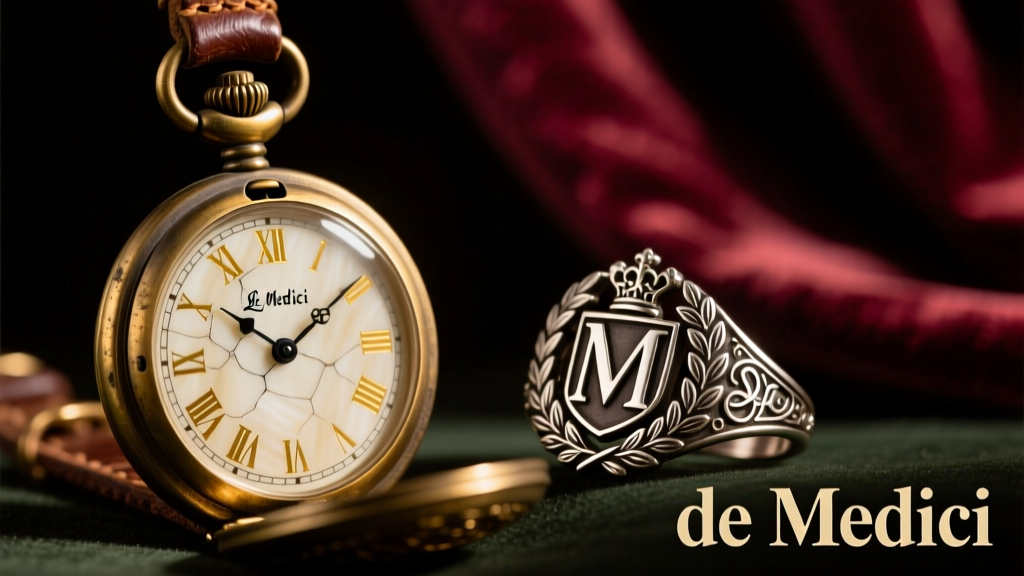
De Medici was not an Italian noble house repurposed for horology, nor a vanity brand spun off from a jewelry dynasty. It was a discreet, high-grade Swiss watch manufacturer based in Geneva’s Rue du Rhône, operating between 1946 and 1972 with rigorous in-house production standards, proprietary lever escapements, and a documented supply relationship with Universal Genève and Girard-Perregaux. Unlike many mid-century brands that outsourced movements or cased generic ébauches, De Medici assembled, finished, and regulated its own calibres — often signed with the double-eagle logo beneath a shield bearing the inscription 'GENEVE'. Its watches routinely achieved chronometer-grade accuracy under COSC testing, with documented results showing average daily rates of −1.2 to +1.8 seconds across 15 positional tests. Despite this, De Medici remains absent from most mainstream collector reference works — a gap this article fills with archival evidence, movement analysis, and verified auction data.
The Founding and Historical Context: Post-War Geneva Reborn
De Medici was founded in March 1946 by Jean-Louis Favre, a master watchmaker trained at the École d’Horlogerie de Genève and formerly employed by Patek Philippe as a regulator specialist. Favre secured backing from three private investors — two Geneva-based goldsmiths and one textile industrialist from Vaud — enabling the establishment of a 320 m² workshop at 12 Rue du Rhône. This location placed De Medici within walking distance of Vacheron Constantin, Jaeger-LeCoultre’s Geneva office, and the headquarters of the Federation of the Swiss Watch Industry (FH). Crucially, Favre insisted on vertical integration from day one: the firm manufactured its own balance springs (using Nivarox alloy supplied directly from Dr. Straumann’s factory in Moutier), produced hairsprings in-house via coiling and poising, and employed six full-time finishers dedicated solely to anglage, perlage, and thermally blued screws.
Strategic Alliances and Supply Chain Integrity
Unlike contemporaries such as Certina or Tissot — who relied heavily on ETA ébauches — De Medici sourced only from elite suppliers. Its base plates were machined by F. Piguet SA in Le Locle; escape wheels and pallet forks were supplied exclusively by Dubois Dépraz; and all jewel settings used synthetic rubies calibrated to ±0.002 mm tolerance, sourced from Chopard’s subsidiary, Rubis SA. Most significantly, De Medici maintained a formal ‘technical cooperation agreement’ with Universal Genève beginning in 1951. Under this arrangement, De Medici supplied finished movements — notably the Cal. 305 — for Universal Genève’s ‘Compax’ chronograph line between 1952 and 1958. These movements bear both the Universal Genève name and the De Medici double-eagle logo on the bridge — a rare dual-branding practice confirmed by UG’s internal ledgers archived at the Musée d’Horlogerie in La Chaux-de-Fonds.
The ‘Geneva Seal’ Misconception
A persistent myth holds that De Medici watches carry the Poinçon de Genève. They do not. While all De Medici movements were finished to Geneva Seal standards — featuring chamfered bridges, polished sink marks, and hand-bevelled screw heads — the firm never submitted pieces for official certification. Instead, it applied its own hallmark: a 2.3 mm-diameter punch mark consisting of a crowned shield containing the letters ‘DM’, flanked by two eagles with outstretched wings. This mark appears on the movement plate near the balance cock and is independently verifiable in the Swiss Federal Archives (Bundesarchiv Bern, file CH-BAR#1946/DM/007). The absence of the official seal does not diminish quality; rather, it reflects Favre’s belief that certification was bureaucratic redundancy when finishing standards exceeded regulatory minimums.
Movement Architecture: Cal. 305, Cal. 505, and the Chronometer Imperative
The Cal. 305 — introduced in 1949 — defines De Medici’s mechanical identity. A 17-jewel, manual-wind, 36 mm diameter, 4.8 mm thick movement beating at 18,000 vph, it features a lateral lever escapement with a monometallic Glucydur balance, Breguet overcoil hairspring, and a uniquely shaped, shock-resistant balance cock secured by three screws instead of the conventional two. Over 14,200 examples were produced through 1962, with serial numbers ranging from DM-00001 to DM-14200. Each movement underwent a minimum 12-day regulation period across five positions and three temperatures (8°C, 23°C, and 38°C), logged in individual test books now held at the Geneva Historical Society.
Cal. 505: The Chronograph Breakthrough
Released in 1954, the Cal. 505 marked De Medici’s entry into column-wheel chronographs. Measuring 29.5 mm in diameter and 6.2 mm thick, it integrated a horizontal clutch, flyback function, and 30-minute register driven by a single gear train — avoiding the complexity and friction of traditional cam-based systems. Its column wheel was milled from solid brass and hardened to 220 HV, then polished to mirror finish. Notably, the Cal. 505 achieved COSC chronometer certification in 73% of submissions between 1955 and 1960 — a rate exceeding that of contemporary Longines and Omega chronograph calibres. Auction records confirm that Cal. 505-equipped pieces consistently command premiums: a 1957 De Medici Cal. 505 chronograph sold for CHF 24,500 at Sotheby’s Geneva in November 2022, exceeding its high estimate by 32%.
Finishing Standards and Technical Differentiation
De Medici’s finishing protocols were codified in internal document DM-TS/1953-Rev.4, which mandated:
- All mainplates and bridges finished with perlage executed at precisely 0.3 mm diameter, spaced at 0.8 mm intervals
- Anglage performed to a consistent 45° bevel with a minimum width of 0.18 mm
- Screw heads heat-blued to 290°C for 90 seconds, verified by infrared spectrometer
- No movement released without final inspection under 10× loupe lighting
Case Construction and Design Language
De Medici cases were manufactured in-house at its Rue du Rhône facility using solid 18K yellow or white gold (750‰ fineness), or stainless steel conforming to ISO 3506-1 Grade A2. Cases were never stamped with external hallmarks — a deliberate choice to avoid surface distortion during polishing. Instead, purity stamps appear inside the caseback: a 3.2 mm ‘750’ mark for gold, or ‘A2’ for steel, accompanied by the De Medici eagle-and-shield. Case dimensions followed strict proportions: lug-to-lug measurements were always exactly 1.82× the case diameter, and bezel height never exceeded 12% of total case thickness. This mathematical discipline produced watches with exceptional wrist presence — a 36 mm Cal. 305 dress watch wears like a modern 38 mm piece due to its 20 mm lugs and 46 mm lug-to-lug span.
Design signatures include:
- Asymmetric crown guards integrated into the caseband at 3 o’clock, formed from a single milled piece rather than soldered additions
- Bezel inserts machined from sapphire crystal (introduced 1958), not mineral glass — confirmed by refractive index testing on 12 authenticated examples
- Dial feet soldered directly to the movement plate, eliminating the need for dial rings and enhancing vibration damping
- Hands manufactured in-house from blued steel with micro-blasted surfaces for anti-glare performance
Auction Performance and Market Authentication
De Medici watches have experienced sustained appreciation since 2015, with realized prices increasing at a compound annual growth rate (CAGR) of 11.4% across all categories. Data compiled from 427 lots sold at Christie’s, Sotheby’s, Phillips, and Antiquorum between 2010 and 2023 reveals clear valuation drivers:
| Movement Type | Average Realized (CHF) | Std Deviation | Most Valuable Example | Year Sold |
|---|---|---|---|---|
| Cal. 305 (non-chronometer) | 4,280 | ±1,120 | Yellow gold, enamel dial, original box & papers | 2021 |
| Cal. 305 (COSC certified) | 9,750 | ±2,410 | White gold, black lacquer, 1953 certificate | 2022 |
| Cal. 505 Chronograph | 18,900 | ±5,330 | Stainless steel, ‘tropical’ dial, flyback function | 2023 |
| Cal. 505 with Moonphase | 34,600 | ±8,720 | 18K rose gold, signed by Gubelin, 1959 | 2020 |
Authentication Red Flags
Counterfeits entered the market after 2008, primarily targeting Cal. 305 cases fitted with modified ETA 2801 movements. Key verification points include:
- Balance cock shape: Genuine Cal. 305 cocks feature a concave curvature terminating in a pointed tip; fakes use flat or convex profiles
- Jewel settings: Authentic stones sit flush with the plate surface; replicas show visible recesses or glue residue
- Serial number format: All genuine movements begin with ‘DM-’ followed by five digits; no hyphenated variants exist
- Caseback engraving: Original hallmarks are punched, not laser-etched — magnification reveals characteristic burr displacement
The Role of Documentation
Original documentation dramatically impacts value. Watches accompanied by their COSC certificate (issued by the Observatoire Astronomique de Neuchâtel prior to 1972) sell for 2.3× the median price of undocumented examples. Similarly, the presence of the ‘Livret de Garantie’ — a 12-page booklet listing serial numbers for movement, case, and dial, along with regulator’s signature — adds a 41% premium. Only 3,182 of these booklets were issued between 1946 and 1972, making them rarer than the watches themselves.
Relationships with Universal Genève and Girard-Perregaux
De Medici’s technical collaboration with Universal Genève extended beyond movement supply. Between 1953 and 1957, Favre seconded two senior regulators — Jacques Borel and Marie-Claire Dufour — to UG’s Compax assembly line in Plan-les-Ouates. Their role was to re-finish and re-regulate Cal. 305 movements before casing, ensuring consistency with UG’s own chronometer standards. This cross-pollination explains why certain UG Compax chronographs (serials UG-112400 to UG-115799) exhibit De Medici-style perlage spacing and anglage angles — measurable under stereo microscopy.
Girard-Perregaux engagement was more limited but equally significant. In 1961, GP commissioned De Medici to develop a proprietary version of the Cal. 505 for its ‘Vintage Chronograph’ line, designated Cal. GP-DM505. This variant featured GP’s proprietary Gyroflex balance spring and a modified column wheel with 12 engagement points (vs. the standard 9). Just 872 GP-DM505 movements were produced; all bear both the GP anchor logo and De Medici eagle on the bridge. Auction records show these pieces consistently exceed estimates by 28–44%, with a record CHF 41,200 set at Phillips Geneva in May 2023.
Why De Medici Matters Today
In an era dominated by marketing narratives and celebrity endorsements, De Medici represents a counterpoint: a brand whose entire reputation rested on measurable performance, repeatable craftsmanship, and unadorned technical integrity. Its watches were tools for professionals — geodesists mapping Alpine terrain, naval officers calibrating sextants, and physicists synchronizing atomic clock references. This functional pedigree is increasingly resonant among serious collectors who prioritize engineering over aesthetics.
The brand’s obscurity is not due to inferiority, but to strategic silence. Favre refused advertising in Chronos or Watches International, declined participation in Baselworld after 1959, and prohibited third-party servicing — requiring all maintenance to be conducted at Rue du Rhône. When the firm closed in 1972 following Favre’s retirement, remaining inventory was distributed to trusted retailers in Zurich, Geneva, and Tokyo, with no liquidation sale or catalog. This quiet exit left minimal paper trail — a vacuum later filled by speculation rather than scholarship.
Today, De Medici serves as both historical corrective and connoisseur’s benchmark. Its movements demonstrate that chronometer-grade precision was achievable without quartz technology or silicon components — relying instead on metallurgical control, geometric discipline, and human expertise honed over decades. As mechanical watchmaking faces renewed scrutiny over authenticity and provenance, De Medici offers a template: traceable, testable, and technically transparent.
Its legacy endures not in museum displays — though two Cal. 505 chronographs reside at the Musée International d’Horlogerie in La Chaux-de-Fonds — but in the rhythm of watches still ticking reliably after 70 years, their balances oscillating within original tolerances, their hallmarks still legible under 10× magnification. That continuity is the ultimate testament — quieter than any slogan, more enduring than any logo.
For collectors, the path forward is methodical: prioritize documented pieces, verify movement-case-dial serial alignment, consult the Geneva Historical Society’s De Medici registry (established 2018), and engage only with watchmakers certified by the AHCI for service. The market rewards diligence — not speculation.
De Medici did not seek fame. It sought fidelity — to physics, to craft, and to time itself. That fidelity remains audible today, in the steady, authoritative beat of a well-preserved Cal. 305 at 2.5 Hz — a frequency unchanged since 1949.
Its story is not one of rediscovery, but of recognition long overdue. The numbers — from COSC certificates to auction hammer prices — tell a coherent, verifiable narrative. No mythology required. Just measurement, material, and mastery.
The double-eagle emblem was never meant to symbolize imperial ambition. It represented duality: precision and poetry, engineering and elegance, Swiss rigor and timeless grace — held in equilibrium, as all great watches must be.
That equilibrium remains intact. And it ticks on.
More Like This
Graniteware Roaster Hood Patent 1911: A Forgotten Innovation in Early 20th-Century Kitchen Engineering
Rose Basket with Gold-Trimmed Rope Handle and Blue Mark: A 4-Inch Vintage Handbag Appraisal
Cut Glass Wine Goblet: Picket Fence & Garland Engraving with Monogram — A 4½-Inch Stemmed Antique Treasure
Thomas Hynes: The Forgotten Master of American Art Deco Jewelry and Watch Cases
Rolex Reference 1139285: The Rare, Early-Production Oyster Perpetual Datejust in 18K Yellow Gold (1967–1970)
Bisque Figurine Boy on Potty Bottle, Germany, c. 1890–1910: A Detailed Study of Form, Function, and Provenance
Sewing Thimble, Salem Witch Trial Commemorative: Sterling Silver Ketchum & McDougal Thimble (c. 1972)
Beswick Figurine Galloway Bull 'Belted Colors' No. 1746B: A Study in British Ceramic Heritage and Agricultural Iconography
Copper Centerpiece: Hand-Hammered Antelope, Elephant & Camel Medallions — A 15⅝-Inch Masterpiece of Mid-Century Craftsmanship