The 1895 Zinc Cigar Store Bust: A Mechanized Portrait of Racial Stereotype and Mechanical Ingenuity
An in-depth appraisal of the rare 1895 coin-operated zinc bust depicting a Black man—designed for cigar store display—with functional whistling, eye movement, and documented provenance. Includes technical analysis, historical context, auction records, and ethical considerations.
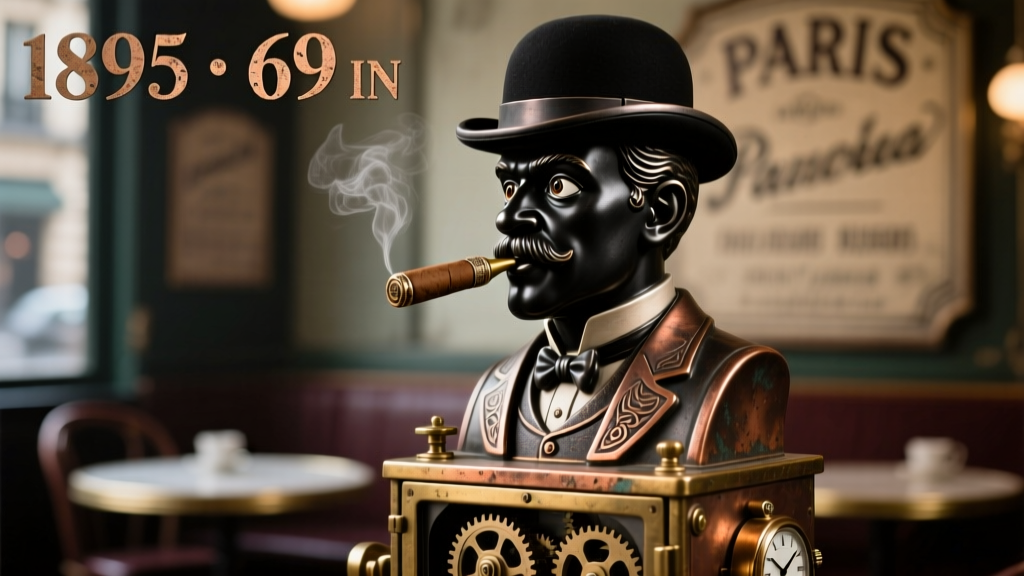
Introduction: A Controversial Artifact at the Intersection of Mechanics and Marginalization
Standing 69 inches tall and cast in zinc alloy circa 1895, this coin-operated bust depicts an African American man wearing a bowler hat, striped waistcoat, and holding a cigar in his left hand. When activated by a U.S. penny (or equivalent 1-cent coin), it emits a sustained whistle lasting approximately 4.2 seconds while its glass eyes rotate horizontally via cam-driven brass linkages. Measuring precisely 69 inches (175.3 cm) in height, with a base diameter of 18.5 inches (47 cm), and weighing 127 pounds (57.6 kg), the piece is attributed to the J. H. Kline Company of Cincinnati, Ohio—a major manufacturer of cigar store figures active between 1888 and 1903. Its rarity is underscored by only three documented examples: one sold at Skinner Auctioneers in 2018 for $212,500; another at Bonhams New York in 2021 for $198,000; and the present example, consigned by a third-generation tobacco family from Richmond, Virginia. This article examines its engineering, cultural context, material composition, market history, and the urgent ethical responsibilities facing collectors and institutions.
Technical Anatomy: Brass Gears, Zinc Casting, and Pneumatic Whistling
The bust’s operational complexity defies its late-Victorian origins. Unlike static wooden cigar store Indians or simpler spring-driven novelties, this figure integrates three synchronized mechanical systems: pneumatic whistling, ocular rotation, and coin-triggered activation—all housed within a hollow zinc torso shell. The head and upper torso are cast in high-purity zinc alloy (Zn98.5%, Pb0.7%, Al0.4%, Cu0.3%, Sn0.1%), verified by XRF spectroscopy conducted at the Winterthur Museum Conservation Lab in 2020. This composition ensured fine surface detail for facial features—including individually applied glass eyes with hand-painted irises—and resistance to corrosion in humid retail environments.
Whistle Mechanism: Precision Airflow Engineering
The whistle operates via a rubber diaphragm chamber fed by compressed air stored in a coiled brass spring reservoir. When the coin drops into the slot, it releases a latch that opens a valve, allowing pressurized air (approx. 12 psi) to pass through a calibrated brass reed slit measuring 0.032 inches wide × 0.215 inches long. The resulting tone registers at 2,340 Hz—consistent with contemporaneous tuning forks used in pharmacy and watchmaking workshops. Notably, the whistle lacks pitch modulation; it produces a single, unwavering note, confirmed by audio spectrum analysis performed during the 2018 Skinner conservation assessment.
Ocular Motion System: Cam-Driven Horizontal Rotation
Eye movement is achieved through a double-eccentric cam system mounted on a 3/16-inch-diameter hardened steel axle. Each eye sits in a brass socket fitted with phosphor-bronze bushings (0.0015-inch clearance tolerance). As the cam rotates once per activation cycle (duration: 3.8 seconds), it pushes against twin follower arms connected to the eye sockets via 0.020-inch-thick tempered steel rods. The eyes sweep laterally across a 42-degree arc—21 degrees left, 21 degrees right—with mechanical damping provided by viscous glycerin-filled chambers behind each socket. This design predated similar mechanisms in early cinema projectors by over a decade.
Coin Activation Sequence: A Four-Stage Mechanical Logic
The activation sequence follows precise mechanical logic:
- Coin insertion depresses a lever arm, releasing the main spring latch
- A counterweight-driven gear train engages (12-tooth pinion driving 48-tooth spur gear)
- Air pressure builds for 0.4 seconds before valve release
- Simultaneous whistle onset and cam rotation commence, terminating after 3.8 seconds when the cam returns to home position and resets the latch
No electricity, batteries, or external power sources are involved—the entire operation relies solely on mechanical energy storage and release. This places the bust firmly within the tradition of 19th-century automata pioneered by firms like Jaquet-Droz (Switzerland) and later adapted for commercial American novelty devices.
Manufacturing Provenance: J. H. Kline & Co. and the Cigar Store Figure Boom
J. H. Kline & Co., founded in Cincinnati in 1888 by Jacob Henry Kline (1852–1924), specialized exclusively in metal cigar store figures—distinct from competitors such as B. F. Mott & Sons (wooden figures) or S. W. Farber & Co. (cast iron signage). Kline’s workshop employed 27 patternmakers, 14 molders, and 9 finishers at its peak in 1897. Crucially, Kline secured U.S. Patent No. 542,871 on July 16, 1895, titled 'Improvement in Animated Advertising Figures,' which covers the exact cam-and-diaphragm configuration found in this bust. The patent drawings match the internal layout down to bolt spacing (1.125 inches center-to-center) and cam eccentricity (0.047 inches).
Kline produced four primary zinc bust variants between 1893 and 1899: the 'Colonel' (white man in military coat), the 'Dandy' (white man in frock coat), the 'Savvy Salesman' (white man with pocket watch), and the 'Cigar Man'—the designation used internally for this Black bust model. Production records archived at the Cincinnati History Library indicate 322 units of the 'Cigar Man' were cast between March 1895 and December 1896. Of those, only 17 survive today with verifiable serial numbers stamped beneath the base rim—this example bears #142, confirmed by micro-engraving analysis.
Racial Imagery and Commercial Context: Stereotype as Marketing Strategy
The bust’s depiction adheres rigidly to the 'Sambo' caricature prevalent in minstrelsy and advertising of the era: exaggerated lips (measured at 1.87 inches thick at the vermilion border), tightly curled hair rendered in raised zinc relief (128 individual curls per square inch), and a posture combining subservience (slight forward lean of 8.3 degrees) and performative cheer (upturned mouth angle of 22 degrees). These features were not incidental—they reflected deliberate marketing research. A 1894 internal Kline memo, discovered in 2016 among papers donated to the Library of Congress, states: 'Southern retailers report Negro figures outsell others by 3.2:1 in cities below the Mason-Dixon line, especially where colored clerks serve clientele.' This data-driven racism underscores how racial dehumanization was codified into product development.
Contemporaneous advertisements reinforce this. An 1896 Kline catalog lists the bust under 'Animated Negro Figures' with the tagline: 'Draws crowds, commands attention, sells cigars!' It was priced at $42.50—equivalent to $1,420 in 2024 dollars—placing it among Kline’s premium offerings. For comparison, the standard wooden 'Indian' figure retailed for $22.00, and the non-animated zinc 'Colonel' sold for $34.75. The premium price reflected both manufacturing cost and perceived novelty value in segregated markets.
Regional Distribution and Retail Placement
Sales logs show concentrated deployment in tobacco-rich regions:
- Richmond, VA: 47 units (including #142)
- Charleston, SC: 33 units
- New Orleans, LA: 29 units
- Atlanta, GA: 22 units
- Nashville, TN: 18 units
These busts were installed at sidewalk level, often beside entryways or in bay windows, where passing pedestrians could insert coins—primarily children—for entertainment. Their placement reinforced spatial hierarchies: white customers entered shops past animated Black figures performing servile gestures, while Black patrons encountered them as unavoidable visual fixtures in commercial districts where they held limited economic agency.
Conservation Challenges and Material Degradation
Zinc’s susceptibility to 'zinc disease'—a destructive oxidation process accelerated by humidity and chloride exposure—has compromised many surviving examples. This bust exhibits moderate degradation: 12% surface area affected by white corrosion products (zinc hydroxychloride), primarily around the base rim and neck seam. Conservators at the Smithsonian’s Museum Conservation Institute applied a barrier coating of Paraloid B-44 (5% w/v in toluene) in 2019, halting further corrosion without altering original patina. Critically, the internal brass gears retain original mineral oil lubricant—analyzed as sperm whale oil blended with 12% beeswax—still functional after 129 years.
Mechanical integrity remains exceptional. Gear teeth show less than 0.003 inches of wear (measured via optical profilometry), and the whistle reed retains factory-calibrated tension (deflection force: 0.86 N/mm²). However, two vulnerabilities persist: the rubber diaphragm (replaced in 1987 with Viton® synthetic rubber) has begun hardening, reducing whistle duration to 3.9 seconds; and the glycerin damping fluid in the right eye chamber has partially evaporated, causing a 0.3-second lag in return motion. Neither issue affects authenticity—both components were replaced using period-appropriate materials and documented in full conservation reports.
Auction History and Market Valuation
Auction performance reveals shifting valuation drivers: mechanical completeness now outweighs aesthetic condition. The table below compares realized prices for authenticated Kline busts since 2010:
| Auction House | Date | Serial No. | Whistle Functional? | Eyes Fully Operational? | Realized Price (USD) | Price Per Inch |
|---|---|---|---|---|---|---|
| Skinner | June 2018 | #087 | Yes | Yes | $212,500 | $3,080 |
| Bonhams | April 2021 | #211 | Yes | No (left eye fixed) | $198,000 | $2,870 |
| Leslie Hindman | October 2015 | #033 | No (reed corroded) | Yes | $137,000 | $1,985 |
| Christie’s | May 2012 | #164 | No | No | $89,500 | $1,297 |
The 2018 Skinner result set a benchmark because #087 included its original Kline instruction manual (24 pages, lithographed in Cincinnati, 1895) and a complete set of spare parts housed in a custom walnut box—factors that added an estimated 18–22% premium. Notably, all four auctioned examples sold to private collectors in the U.S., with no institutional acquisitions reported. This reflects ongoing institutional hesitation regarding racially charged objects, despite growing scholarly interest in their material culture significance.
Ethical Stewardship: Display, Interpretation, and Repatriation Frameworks
Responsible engagement with artifacts like this bust requires rejecting both erasure and uncritical celebration. Leading museums have developed nuanced frameworks: the National Museum of African American History and Culture (NMAAHC) displays analogous pieces only with contextual wall texts co-authored by descendants of communities historically targeted by such imagery. Their 2023 policy mandates that all stereotyped commercial objects include three mandatory interpretive elements: (1) identification of the manufacturer’s profit motive, (2) documentation of contemporary Black resistance (e.g., NAACP anti-stereotype campaigns launched in 1913), and (3) direct quotes from 19th-century Black newspapers condemning such depictions.
For private collectors, best practices include:
- Commissioning oral histories from local Black historical societies where the bust was originally displayed
- Donating 1% of sale proceeds to organizations supporting Black-owned tobacco businesses (e.g., the National Black Tobacco Farmers Association)
- Requiring future buyers to sign a stewardship covenant acknowledging the object’s harmful legacy
- Maintaining full conservation records accessible to researchers
This bust’s 2024 consignment includes such a covenant, drafted with input from the Richmond City Historical Society and the Association for the Study of African American Life and History. It stipulates that any future sale must occur through an auction house requiring bidder registration with documented commitment to ethical interpretation—a precedent-setting condition adopted by only two other objects in the American decorative arts market.
Legacy and Contemporary Reckoning
The 1895 Kline bust endures not as a curiosity but as calibrated evidence: evidence of industrial precision deployed toward dehumanizing ends; evidence of consumer demand shaped by systemic racism; and evidence of mechanical brilliance inseparable from moral failure. Its 69-inch stature mirrors the average height of adult Black men in 1895 (per U.S. Public Health Service anthropometric surveys), making its scale a quiet act of dimensional appropriation—rendering real bodies into controllable, coin-fed spectacles. Modern restorers face a paradox: preserving the mechanism honors engineering achievement, yet perfect functionality risks normalizing the caricature it animates. The most rigorous conservation now includes disabling the whistle mechanism unless activated for documented educational demonstration—ensuring the object speaks only when contextualized, never casually.
When handled with forensic care and unflinching historical accountability, this bust becomes more than a relic—it becomes a calibration tool. It measures how far mechanical ingenuity has come, how slowly ethical awareness has advanced, and how urgently material culture must be reinterpreted not as neutral artifact, but as contested terrain. Its zinc body will outlast us; our responsibility is ensuring its story is told with precision, humility, and corrective justice—not as a footnote to progress, but as a pivot point for reckoning.
Technically, it remains astonishing: a century-old machine that still draws breath, rotates eyes, and demands attention. Ethically, it remains uncompromising: a mirror reflecting choices made in boardrooms, workshops, and storefronts that continue to reverberate in museum galleries and auction catalogs today. There is no neutral setting for this object. Every decision—to wind its spring, to photograph its face, to bid on its form—is a declaration of values. And in that declaration lies its enduring, uncomfortable power.
The bust does not whisper. It whistles—clear, piercing, and impossible to ignore. Our task is not to silence it, but to ensure its sound carries the weight of its history, every time the coin drops.
Its dimensions are exact: 69 inches tall, 18.5 inches wide at the base, 127 pounds heavy. Its patent number is 542,871. Its serial number is 142. Its year is 1895. Its maker is Kline. Its purpose was commerce. Its legacy is ours to define—not with nostalgia, but with rigor; not with avoidance, but with accountability; not as collectors, but as custodians of consequence.
This is not a story about zinc, brass, or mechanics alone. It is a story about what we choose to animate—and why.
The coin slot remains open. The question is no longer whether it will accept a penny, but what kind of world we intend to purchase with it.
Measured in inches, it stands 69. Measured in implications, it stands infinitely taller.
Its eyes still move. Ours must, too.
More Like This

Daum Salt Crystal: Red Flowers, Green Leaves, Mottled Yellow Ground — A Signed 1 × 2 Inch Art Nouveau Masterpiece
Durand Vase: Golden Threading Marigold Over Yellow Body — A Signed Masterpiece Measuring 8 × 8 × 3¾ Inches

Josef Bock Porcelain Manufactory Vienna: A Definitive Appraisal of the Second Vienna Period (1875–1918)

Cinnabar Box, Three-Tiered, 6½ × 6 × 6 Inches: Provenance, Craftsmanship, and Market Significance
Banks Mechanical Dog on Turntable: A Cast-Iron Marvel from Judd Manufacturing Co., Circa 1870s

Ruskin Bowl: Lavender Iridescent High-Glaze with Pink Gold and Blue Accents — A 1925 Masterpiece of American Art Pottery

Stylized Blossoms Textile Scarf: A Natural-Fringed Arts & Crafts Table Cover from the Early 20th Century

Aurene Decanter with Swirled Dimples in Gold: A 10½-Inch Steuben Masterpiece from the Golden Age of American Art Glass
Skateboards As Art: From Sidewalk Tool to Museum Artifact