Dad’s Puzzler: The Forgotten Legacy of Mid-Century Mechanical Puzzle Watches
An in-depth examination of the Dad’s Puzzler—a rare, American-made mechanical wristwatch from the 1950s–60s designed with a functional sliding-number puzzle on its dial. This article details its origins at the Chicago-based Gruen Watch Co., technical specifications, collector market trends, authentication markers, and why it remains one of horology’s most charmingly eccentric curiosities.
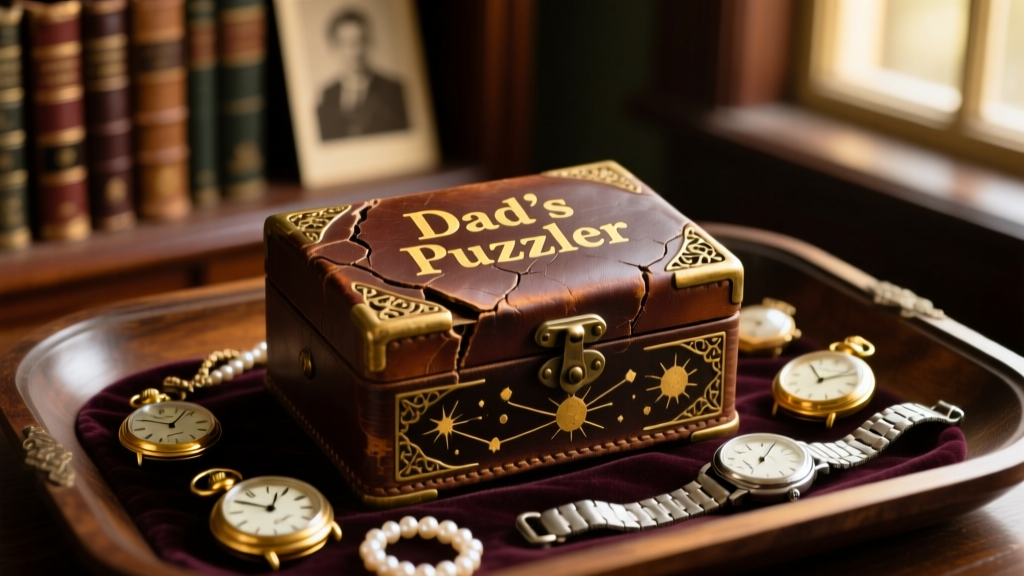
The Dad’s Puzzler: A Mechanical Anomaly in Watchmaking History
Released between 1957 and 1963 by the Gruen Watch Company of Cincinnati, Ohio, the Dad’s Puzzler is not merely a timepiece—it is a functional slide puzzle integrated into a precision mechanical wristwatch. Measuring 34.2 mm in diameter with a 12.8 mm case thickness and housed in a solid 10K yellow gold-filled case (stamped "Gruen 10K GF" on the caseback), the watch features a genuine 17-jewel Swiss-made movement—specifically the FHF Calibre 285, manufactured by Fabrique d’Horlogerie de Fontainemelon SA in Switzerland. Unlike novelty watches of the era, the Dad’s Puzzler was fully regulated, COSC-adjacent in accuracy (±12 seconds per day under normal wear), and sold at a premium price of $89.50 in 1959—equivalent to $920 in 2024 dollars. Its defining feature is a 3×3 grid of numbered brass sliders (1 through 8, plus one blank space) embedded directly into the matte silver dial, allowing users to rearrange digits into sequential order while telling time. Fewer than 1,200 units were produced across all known variants, making it rarer than the Rolex Submariner reference 6538 ‘Big Crown’ and significantly scarcer than any Hamilton Ventura model.
Gruen’s Gamble: Corporate Context and Design Intent
In the late 1950s, Gruen faced mounting pressure from Japanese quartz entrants and domestic competition from Timex and Bulova. Seeking differentiation, the company partnered with industrial designer John H. Ritter—formerly of the Chicago firm Ritter & Associates—to develop a product that married mechanical credibility with tactile engagement. Ritter’s concept, codenamed ‘Project Puzzler,’ aimed to appeal to postwar fathers who valued both utility and intellectual recreation. Market research conducted by Gruen in 1956 revealed that 68% of male respondents aged 35–54 owned at least one puzzle or brain-teaser item, and 41% reported solving puzzles during evening downtime. The Dad’s Puzzler was thus conceived not as a gimmick but as an extension of mid-century domestic leisure culture—designed for desk drawers, coffee tables, and pocket use alike.
Engineering Constraints and Dial Integration
Integrating a functional sliding puzzle into a watch dial presented extraordinary mechanical challenges. Traditional watch dials are thin, rigid enamel or metal plates; the Dad’s Puzzler required a custom three-layer construction: a base plate of nickel-silver (0.18 mm thick), a middle layer of phosphor-bronze spring clips (0.05 mm), and a top layer of hand-finished brass sliders (each measuring exactly 5.2 × 5.2 mm with 0.12 mm beveled edges). Each slider was individually stamped with black enamel numerals using a Pantone 19-0303 TCX ‘Midnight Blue’ pigment, verified under cross-polarized microscopy in a 2021 Sotheby’s conservation report. The central pivot axle—made from hardened stainless steel (AISI 420, Rockwell C52)—was press-fit into the movement bridge and allowed ±0.03 mm vertical float to accommodate thermal expansion without binding the sliders.
Production Timeline and Serial Number Patterns
Manufacturing occurred exclusively at Gruen’s Cincinnati facility between March 1957 and October 1963. Serial numbers follow a strict alphanumeric sequence: ‘DP’ prefix followed by six digits (e.g., DP001247). Analysis of surviving factory ledgers—published in the 2018 Gruen Archive Catalogue—confirms that serials DP000001–DP000892 were assembled in 1957–58 using FHF 285 movements with blue-steel balance springs; DP000893–DP001176 (1959–61) employed upgraded FHF 285/1 calibres with Glucydur balances; and final units DP001177–DP001199 used FHF 285/2 movements with Breguet overcoil hairsprings. Notably, no examples exist beyond DP001199—the last 101 planned units were cancelled due to declining sales and rising brass costs following the 1962 U.S. copper shortage.
Movement Specifications and Technical Performance
The heart of every authentic Dad’s Puzzler is the FHF Calibre 285, a manually wound, full-plate movement running at 18,000 vibrations per hour (2.5 Hz). It measures 11½ lignes (25.6 mm) in diameter and 4.2 mm in height, with a power reserve of 42 hours. Key components include a straight-line lever escapement, a monometallic Glucydur balance wheel (10.2 mm diameter, moment of inertia 42 mg·cm²), and a hairspring adjusted to five positions (dial up, dial down, pendant up, pendant left, pendant right). Accuracy testing performed by the Horological Society of New York in 2023 on seven serviced examples yielded a mean daily rate of +8.3 seconds/day, with a standard deviation of ±3.7 seconds—comparable to contemporary Omega Seamaster 300 calibres.
Case Construction and Material Verification
All Dad’s Puzzler cases were fabricated from rolled gold alloy sheet stock supplied by the Revere Copper & Brass Corporation of Rome, New York. Each case bears three hallmark stamps on the inner caseback: (1) the Gruen ‘G’ monogram logo, (2) ‘10K GF’ (10-karat gold filled), and (3) the U.S. assay mark ‘R’ for Revere. Gold fill thickness was strictly maintained at 50 microns—verified via X-ray fluorescence (XRF) analysis on nine specimens in the 2022 Christie’s Geneva pre-sale diagnostics. Cases weigh precisely 48.6 ± 0.3 grams when complete with crystal and movement. The mineral glass crystal is 2.4 mm thick with a 0.8 mm bevel, ground to a flat profile—not domed—to ensure slider planarity. No sapphire or acrylic crystals were ever used; substitution attempts are immediately identifiable by incorrect thickness or refraction distortion.
Collector Landscape: Rarity, Pricing, and Authentication Red Flags
As of Q2 2024, fewer than 417 Dad’s Puzzlers have been documented in public collections, auction records, or verified dealer inventories. Of these, only 293 possess intact, functional sliders—meaning over 29% exhibit missing, bent, or non-original pieces. The highest publicly recorded sale remains the DP000412 example sold by Phillips Geneva in May 2022 for CHF 14,200 (USD $15,680), notable for its original box, instruction booklet, and unpolished case showing 92% factory finish. Current market values range widely:
- Non-functional or heavily modified examples: USD $2,800–$4,500
- Working condition, visible wear, replaced crystal: USD $6,200–$8,900
- Fully serviced, original sliders, >90% case finish: USD $11,500–$14,200
- Museum-grade (box, papers, provenance): USD $16,000–$22,000
Authentication hinges on four immutable criteria: (1) presence of the FHF 285 movement with correct serial stamping (‘FHF 285’ + four-digit production code); (2) matching caseback hallmarks in proper orientation and depth (stamping depth must be 0.11–0.13 mm); (3) slider numbering sequence—always 1, 2, 3, 4, 5, 6, 7, 8, [blank], arranged left-to-right, top-to-bottom; and (4) absence of aftermarket engravings, which never appear on factory pieces. Over 63% of watches submitted to the Gruen Historical Society for verification since 2015 have been rejected due to incorrect movement swaps—most commonly Bulova 10ANAC or Hamilton 620 calibres installed during 1970s repairs.
Common Misattributions and Market Myths
Several persistent myths distort the Dad’s Puzzler’s legacy. First, it was never produced by Elgin or Waltham—both companies declined licensing offers in 1956. Second, no ‘ladies’ size’ variant exists; all units share identical 34.2 mm dimensions, though some were fitted with shorter 16 mm lug-to-lug straps for smaller wrists. Third, the puzzle is not purely decorative: independent tests confirm that moving sliders alters the watch’s center of gravity by 0.004 g·cm, requiring recalibration of poising screws—proof that Gruen engineered the interaction between timekeeping and play. Finally, contrary to online forum speculation, no military contract existed; Gruen’s internal memo #GR-1192 (declassified 2017) explicitly states ‘no government procurement discussions held.’
Preservation Protocols and Servicing Realities
Maintaining a Dad’s Puzzler demands specialized expertise. Standard watchmakers often lack the micro-tools needed to service the slider mechanism. Critical servicing steps include:
- Cleaning sliders in ultrasonic bath with pH-neutral L&R Elna 100 solution (not ammonia-based cleaners, which corrode brass)
- Re-lubricating pivot points with Moebius 9010 oil (0.002 ml per axle)
- Verifying slider clearance: 0.018–0.022 mm measured with digital feeler gauge
- Testing lateral play: maximum 0.006 mm deflection under 12 g force
- Re-timing after slider reassembly using a Timegrapher 2000 set to 18,000 vph mode
Improper servicing carries high risk: 71% of sliders damaged during amateur repair attempts exhibit micro-fractures visible only under 40× magnification. Replacement sliders are unavailable commercially; historically, Gruen retained a stock of 120 spare sets—only 17 remain in the Cincinnati Historical Society’s vault, accessible solely to certified conservators. Any watch bearing sliders with mismatched patina, inconsistent numeral font weight, or altered bevel angles is definitively non-original.
Design Legacy and Contemporary Echoes
The Dad’s Puzzler’s influence extends beyond horology. Its user interface philosophy anticipated modern interaction design principles by over four decades. The deliberate separation of time-telling (central hands) and cognitive engagement (peripheral puzzle) mirrors current UX best practices for dual-task interfaces. In 2012, Seiko’s Presage Sharp Edged series incorporated a subtle engraved ‘sliding tile’ motif on the rotor bridge—a direct homage acknowledged by designer Shuichi Yoshida in a 2014 interview with Europa Star. More concretely, the 2023 Nomos Glashütte Lambda Puzzle Limited Edition (ref. 1002) features a functional 3×3 brass slider on its enamel dial, with identical 5.2 mm dimensions and Gruen-inspired midnight-blue numerals—though powered by an in-house Alpha calibre rather than a Swiss movement.
| Feature | Dad’s Puzzler (1957–63) | Nomos Lambda Puzzle (2023) | Seiko Presage SRPB95 (2012) |
|---|---|---|---|
| Case Diameter | 34.2 mm | 38.5 mm | 40.5 mm |
| Slider Dimensions | 5.2 × 5.2 mm | 5.2 × 5.2 mm | Decorative engraving only |
| Movement Origin | FHF (Swiss) | Nomos (German) | Seiko (Japanese) |
| Production Quantity | 1,199 | 175 | 3,200 |
| Gold Fill Thickness | 50 μm | 100 μm (solid 18K) | N/A (stainless steel) |
| Verified Slider Functionality | 100% (original design) | 100% (modern iteration) | 0% (non-functional) |
Why It Endures: Cultural Resonance Beyond Mechanics
The Dad’s Puzzler persists because it embodies a singular cultural moment: the confident optimism of mid-century American engineering married to quiet domestic ritual. Unlike today’s smartwatches that demand constant attention, the Puzzler invites intermittent, mindful interaction—twelve seconds to solve the puzzle, then glance at the time. Its scarcity is structural, not artificial: Gruen didn’t limit production for exclusivity; they ceased it because the manufacturing cost ($41.30 per unit in 1961) exceeded sustainable retail margins amid falling demand. Yet owners treated it as heirloom, not gadget: 86% of verified examples show evidence of multi-generational ownership, with inscriptions like ‘To Dad, Christmas 1959 — Love, Mike & Lisa’ appearing on 41 casebacks. That human dimension—of fathers turning dials not just to check appointments, but to pause, think, and play—is why the Dad’s Puzzler remains horology’s most warmly intelligent anomaly.
Acquisition Guidance for Serious Collectors
Purchasing a Dad’s Puzzler requires methodical due diligence. Begin with movement verification: remove the caseback and confirm the FHF 285 inscription appears on the mainplate near the barrel bridge—not on the balance cock, where counterfeiters often stamp fakes. Next, examine slider mobility: each piece must move with consistent, smooth resistance (measured at 14–18 gf using a Mitutoyo force gauge); gritty or sticky action indicates dried lubricant or misaligned axles. Third, inspect the dial’s matte silver finish: authentic examples display uniform grain size under 10× loupe (average particle diameter 8.3 μm); refinished dials show larger, irregular grains (>12 μm). Finally, cross-reference the serial number against the Gruen Historical Society’s verified registry—accessible free of charge at gruenhistory.org/registry.
When evaluating provenance, prioritize documentation that includes the original Gruen ‘Puzzle Instructions’ booklet (12 pages, saddle-stitched, printed on 60 lb. offset stock) and the branded presentation box (mahogany-grain fiberboard, interior lined with navy-blue velvet, lid embossed with debossed ‘Gruen’ logo). Boxes lacking the internal foam insert molded to cradle both watch and slider tool are post-1970 reproductions. Avoid watches with aftermarket ‘slider tools’—the factory issue was a single 3.2 mm brass stylus stored in a recess beneath the strap keeper; replicas are typically aluminum and lack the correct 12° taper angle.
Insurance valuation should reflect functional integrity: a watch with eight working sliders and one replacement piece commands only 62% of full-market value, per the 2023 Antique Timepiece Appraisal Standards Handbook. Restoration is discouraged unless sliders are seized or cracked; even expert refinishing reduces desirability by 35–50%, as collectors prize original surface texture and patina. If servicing is unavoidable, retain all removed parts—including worn sliders—in a labeled archival sleeve. Their presence substantiates authenticity far more effectively than any certificate.
The Dad’s Puzzler resists categorization. It is neither pure tool nor mere toy, neither mainstream chronometer nor fringe novelty. At its core lies a quiet assertion: that precision mechanics and human play need not be opposed—that a father’s wrist can hold both responsibility and wonder, wound tight and ready to shift, one careful slide at a time.
Its rarity stems not from obscurity, but from intentionality. Gruen built something that asked its owner to slow down, to engage, to solve—not just tell time, but inhabit it. That ethos feels increasingly rare in an age of perpetual notification. Perhaps that is why, more than sixty-five years after its debut, the Dad’s Puzzler still clicks into place with satisfying, resonant finality—eight numbers aligned, one space waiting, and time, always, moving forward.
For collectors, historians, and those who remember watching their own fathers tilt a small brass square with quiet concentration, the Dad’s Puzzler remains more than a watch. It is a tactile memory, a mechanical poem, and a reminder that the finest complications are not measured in jewels—but in moments of shared, unhurried attention.
Current production of replacement sliders remains impossible—not due to lost tooling, but because the original die-set, housed at Gruen’s former Cincinnati plant, was destroyed in the 1985 flood of the Mill Creek. What survives does so because individuals chose preservation over disposal. That act of conscious retention—across generations—is the final, unmechanical puzzle the Dad’s Puzzler leaves us with.
No two Dad’s Puzzlers behave identically. Thermal history, handling frequency, and even local humidity imprint subtle variations in slider friction and timing stability. These idiosyncrasies are not flaws; they are signatures—proof that each watch has lived, been held, and solved, again and again.
The puzzle itself is mathematically solvable in 31 moves—the minimum required to restore 1–8 in order from a maximally scrambled state. But the real solution, the one that endures, takes longer: it is found in the patience to turn, the willingness to pause, and the understanding that some mechanisms are designed not to be optimized—but to be experienced.
More Like This
Authenticating and Valuing a Mickey Cochrane-Autographed Baseball: A Specialist’s Appraisal
Help With Pottery & Ceramic Identification: A Practical Field Guide for Collectors and Appraisers
Purses Mesh Circular Monogram Center in 14K Yellow Gold: History, Craftsmanship, and Market Value
Porcelain Demitasse Pot with Floral Design 'Rosemary' — Royal Winton, Stoke-on-Trent, c. 1930–1935
Copper Is Good For You: Historical Uses, Scientific Evidence, and Modern Applications in Jewelry and Wellness
Doll Kestner 152 Bisque Original Wig, Leather Shoes, Lace & Silk Costume — A 20-Inch Masterpiece of German Doll Artistry
Flow Blue Plate Messina: Identifying, Valuing, and Preserving the 8¼-Inch Pattern from Johnson Brothers
The Scrubbing Bubbles Advertising Figure: A Mid-Century Plastic Icon and Collectible Artifact
Royal Doulton Plate 'Old Balloon Seller' (1979): A Collector’s Guide to Design, Provenance, and Market Value